Have any questions? Contact us!
Join our team!
Request a free quote or consultation

CMU stands for Concrete Masonry Unit—a standardized, precast rectangular block made from Portland cement, aggregates, and water. These versatile building units are used extensively in both load-bearing and non-load-bearing construction applications, valued for their strength, fire resistance, and cost-effectiveness.
Walk onto any construction site, and you’ll likely spot stacks of gray rectangular blocks waiting to become walls. These aren’t just simple cinder blocks—they’re concrete masonry units, and they’ve been shaping the built environment for decades.
But what exactly makes CMUs so prevalent in modern construction? Let’s break down everything from their composition to their real-world applications.
Understanding Concrete Masonry Units
CMU stands for Concrete Masonry Unit. It’s a standardized, precast rectangular block manufactured from a mixture of Portland cement, aggregates like sand or gravel, and water.
Most people recognize these as concrete blocks. They’re modular building components that come in uniform sizes, making them predictable and easy to work with on job sites.
According to ASTM C90, the standard specification for loadbearing concrete masonry units, these blocks must meet specific requirements for compressive strength, absorption, and dimensional tolerances. This standardization ensures consistency across manufacturers and projects.
How CMUs Are Made
The manufacturing process involves several critical steps. Raw materials get mixed to form a stiff concrete mixture. This mixture is then placed into molds and compacted using vibration and pressure.
Here’s where it gets interesting. Blocks are heated in a low-pressure steam kiln, where steam and heat are gradually introduced. Once the top temperature is reached, the kiln shuts down, and blocks remain in the warm, moist environment for 12-18 hours.
Then the humid air is drawn out, and blocks cure fully. This process creates the strength and durability that make CMUs reliable for structural applications.
Add BIM Support Without Expanding Your Team

Powerkh works with companies that need extra engineering capacity for ongoing projects. Its services include BIM modeling, coordination, detailing, automation, and point cloud processing, helping teams handle technical work without adding internal hires.
Need Extra BIM Capacity?
Talk with Powerkh to:
- extend your team with BIM specialists
- handle modeling and documentation tasks
- support project delivery from design to build
👉 Contact Powerkh for a project review and consultation.
Types of Concrete Masonry Units
Not all CMUs are created equal. Different construction needs call for different block types.
Standard Hollow Blocks
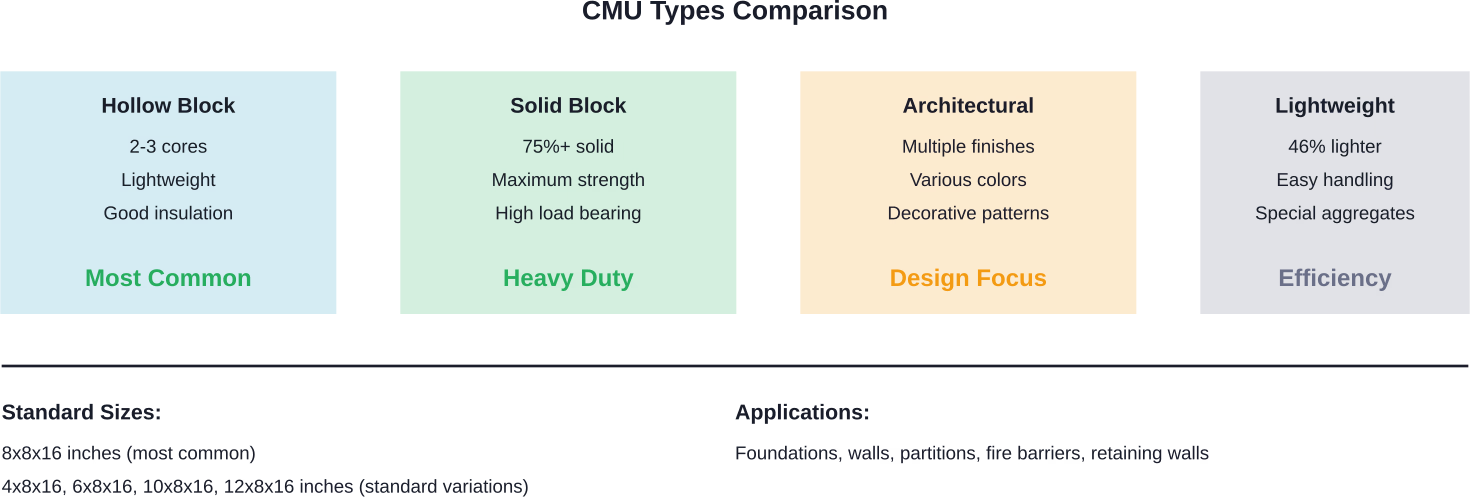
These are the workhorses of CMU construction. They feature two or three hollow cores that reduce weight and allow for reinforcement placement. The hollow design also improves thermal insulation properties.
Solid Blocks
When a unit has 75 percent or more solid material, it’s classified as solid according to ASTM standards. These provide maximum strength and are used where high compressive loads occur.
Architectural CMUs
Architectural concrete masonry units are made to be seen and celebrated. They come in various colors, textures, and finishes—from split-face to polished surfaces.
These units deliver versatility that supports both performance requirements and design intent. Bond patterns, colors, and finishes provide aesthetic possibilities that go way beyond basic gray blocks.
Lightweight CMUs
Manufactured with expanded shale, clay, or slate aggregates, lightweight CMUs can be up to 46 percent lighter than standard units. They’re easier to handle on site while maintaining structural integrity.
Common CMU Sizes and Dimensions
Standardization is one of CMU’s greatest strengths. The most common size is 8x8x16 inches—though this refers to nominal dimensions.
Actual dimensions are typically 3/8 inch smaller to account for mortar joints. So an 8x8x16 block actually measures 7-5/8 x 7-5/8 x 15-5/8 inches.
Other standard sizes include 4x8x16, 6x8x16, 10x8x16, and 12x8x16 inches. This modular sizing simplifies design calculations and reduces material waste on projects.
Key Benefits of CMU in Construction
Why do builders keep reaching for concrete masonry units? Several compelling advantages explain their popularity.
Structural Strength
CMUs offer excellent compressive strength. When properly reinforced with rebar and grout, they create robust load-bearing walls that meet stringent building codes.
Fire Resistance
Concrete doesn’t burn. CMU walls provide superior fire protection, often achieving fire ratings of two to four hours depending on thickness and design.
Durability and Longevity
These blocks resist moisture, pests, and decay. Buildings constructed with CMUs can last for generations with minimal maintenance.
Cost-Effectiveness
Material costs remain competitive. Installation is straightforward, and the modular nature reduces construction time compared to some alternatives.
Thermal Mass
Concrete masonry provides thermal mass that helps regulate interior temperatures. It absorbs heat during the day and releases it slowly at night.
Sound Insulation
The density of concrete blocks provides excellent sound attenuation—a major advantage for multi-unit residential buildings, schools, and commercial structures.
| Benefit | Description | Best Application |
|---|---|---|
| Fire Resistance | 2-4 hour fire ratings | Fire walls, barriers |
| Compressive Strength | High load capacity | Load-bearing walls, foundations |
| Durability | Resists moisture and pests | Exterior walls, basements |
| Sound Insulation | Excellent acoustic properties | Multi-family, schools, commercial |
| Thermal Mass | Regulates temperature | Energy-efficient buildings |
Real-World Applications of CMU
Concrete masonry units show up across nearly every construction sector.
Residential Construction
Foundation walls are a classic CMU application. They provide structural support and resist soil pressure. Basement walls, load-bearing interior walls, and even decorative garden walls utilize these blocks.
Commercial Buildings
Schools, offices, warehouses, and retail spaces frequently incorporate CMU walls. They’re particularly common in single-story commercial structures where their strength and fire resistance shine.
Institutional Projects
Hospitals, universities, and government buildings rely on CMUs for their durability and code compliance. The material meets strict safety standards while keeping projects on budget.
Industrial Facilities
Factories and distribution centers use CMUs for exterior and interior walls. The blocks withstand heavy use and provide security.
CMU Installation Considerations
According to OSHA regulations (1926.706), a limited access zone must be established whenever a masonry wall is being constructed. Safety protocols protect workers from potential wall collapse during installation.
Proper installation requires skilled masons who understand mortar application, block placement, and reinforcement techniques. Corners must be properly bonded, and vertical alignment maintained throughout.
Reinforcement typically involves placing steel rebar in the hollow cores and filling them with grout. This creates a composite structure that dramatically increases strength.
Environmental and Sustainability Aspects
Studies show that CMUs sequester almost 50 percent of the CO2 from the product’s production through carbonation over their lifespan. This natural ability to absorb carbon dioxide occurs as the concrete reacts with atmospheric CO2.
Concrete masonry is also recyclable. Demolished CMU walls can be crushed and used as aggregate in new concrete or as base material for roads and parking areas.
Challenges and Limitations
No building material is perfect. CMUs come with some drawbacks worth considering.
Weight
Standard concrete blocks are heavy. This makes handling labor-intensive and requires proper equipment for transport and staging on site.
Insulation Requirements
While thermal mass provides benefits, CMUs alone don’t meet modern energy codes in many climates. Additional insulation is typically required—either in the cores, on the exterior, or as a separate interior layer.
Moisture Management
CMUs are porous and can absorb water. Proper waterproofing and drainage are essential, especially for below-grade applications.
Labor Intensity
Masonry work requires skilled tradespeople. In areas where qualified masons are scarce, this can increase costs and extend timelines.
Making the Right Choice for Your Project
Concrete masonry units have earned their place as a construction staple. Their combination of strength, fire resistance, durability, and cost-effectiveness makes them suitable for countless applications.
That said, they’re not always the perfect solution. Weight, insulation requirements, and labor considerations matter depending on project specifics.
When evaluating materials for a construction project, consider the full picture. Load requirements, climate, energy goals, budget, and timeline all play roles in material selection. CMUs excel in many scenarios—but understanding both their capabilities and limitations ensures the best decision for each unique situation.
For projects requiring load-bearing walls, fire-rated assemblies, or long-term durability, concrete masonry units remain a proven, reliable choice backed by decades of successful performance across the construction industry.
Frequently Asked Questions
What does CMU stand for in construction?
CMU stands for Concrete Masonry Unit. It refers to standardized concrete blocks used to build walls, foundations, and other structural elements.
What’s the difference between a CMU and a cinder block?
Cinder blocks historically used coal cinders as aggregate, while modern CMUs use sand, gravel, or similar materials. CMUs are stronger and meet current industry standards.
How much does a standard CMU block weigh?
A typical 8x8x16-inch hollow CMU weighs around 38 to 43 pounds. Lightweight versions may weigh less, while solid units are heavier.
Can CMU walls be used below grade?
Yes, CMU walls are commonly used for foundations and basements. Proper waterproofing and drainage systems are essential to prevent moisture issues.
Do CMU walls need insulation?
In most climates, CMU walls require added insulation to meet energy standards. This can be done with core fills, exterior rigid insulation, or interior systems.
How long do CMU structures last?
CMU structures can last 100 years or more when properly built and maintained. They resist rot, pests, and weather damage effectively.
Are CMUs environmentally friendly?
CMUs offer environmental benefits such as durability, recyclability, and thermal mass that helps regulate indoor temperatures. They can also absorb some carbon dioxide over time.

Our Case Studies
We have handled 200+ BIM & VDC projects for commercial, industrial, and residential sectors.
Our work includes:
Formwork design automation
Our client from
California, USA
Suspended ceiling design automation
Our client from
New York, USA
Wall framing design automation
Our client from
California, USA