Herhangi bir sorunuz var mı? Bize ulaşın!
Ekibimize katılın!
Ücretsiz fiyat teklifi veya danışmanlık talep edin

Labor burden in construction refers to all indirect costs employers pay beyond an employee’s base wage, including payroll taxes, workers’ compensation, insurance, benefits, and paid time off. According to industry data, labor burden typically adds 24-70% on top of direct wages, meaning a worker earning $30/hour might actually cost the employer $45-51/hour. Understanding and accurately calculating labor burden is essential for competitive bidding, accurate project pricing, and maintaining profitability in construction projects.32цч
Construction companies spend countless hours pricing jobs and preparing bids. But here’s the thing—many contractors still lose money on projects they thought would be profitable.
The culprit? Underestimating labor burden.
When estimating project costs, the hourly wage paid to workers represents just the starting point. The true cost of employing construction labor runs significantly higher once all indirect expenses are factored in. For instance, while a carpenter may earn $30 per hour in base pay, the actual cost to the employer can easily exceed $45 per hour when labor burden is properly calculated.
Understanding what labor burden entails and how to calculate it accurately can make the difference between profitable projects and financial shortfalls.
What Is Labor Burden in Construction?
Labor burden represents all the additional costs employers pay beyond an employee’s direct wages or salary. These are the indirect expenses associated with keeping someone on the payroll.
Direct wages are straightforward—the hourly rate or salary amount paid to workers for their time. If an electrician earns $35 per hour, that’s the direct labor cost.
But the total employment cost extends well beyond that base wage.
Labor burden encompasses mandatory payroll taxes, insurance premiums, employee benefits, paid time off, training costs, and other employment-related expenses. According to the Bureau of Labor Statistics, employer costs for employee compensation in the construction industry include both wages and a substantial benefits component. As of December 2025, private industry employer costs for benefits averaged $13.79 per hour worked across all private industries in the United States, representing a significant portion of total compensation costs.
For construction specifically, labor burden typically ranges from 24% to 70% of base wages, depending on the company’s benefit structure, location, and worker classification.
Why Labor Burden Matters for Contractors
Accurate labor burden calculations directly impact several critical business functions:
- Bid accuracy: Underestimating true labor costs leads to unprofitable projects and lost revenue
- Project budgeting: Knowing the fully burdened rate allows for realistic budget projections
- Cost control: Identifying which burden components drive costs highest enables strategic cost management
- Competitive positioning: Understanding labor burden helps contractors price competitively while maintaining margins
Omitting burden costs from project budgets inevitably leads to financial shortfalls and inaccurate bidding.
Components of Labor Burden
Labor burden consists of multiple cost categories. Each adds to the total employment expense beyond the base hourly wage.
Mandatory Payroll Taxes
Federal and state governments require employers to pay specific taxes on employee wages:
- Federal Insurance Contributions Act (FICA): 7.65% for Social Security and Medicare
- Federal Unemployment Tax Act (FUTA): 0.6% on the first $7,000 of wages
- State unemployment insurance (SUI/SUTA): Rates vary by state and employer experience rating, typically 1-8%
These taxes apply automatically to every employee’s wages and represent non-negotiable costs.
Workers’ Compensation Insurance
Construction carries higher injury risk than many industries. Workers’ compensation insurance protects both employees and employers when workplace injuries occur.
According to OSHA, employers pay almost $1 billion per week for direct workers’ compensation costs alone. Premium rates vary significantly based on job classification, with riskier trades like roofing or steel erection carrying higher rates than lower-risk positions.
Workers’ comp costs can range from 5% to 30% or more of payroll, depending on the specific trades involved and the company’s safety record.
General Liability and Other Insurance
Beyond workers’ compensation, construction companies carry additional insurance coverage:
- General liability insurance
- Professional liability coverage
- Commercial auto insurance (when workers use company vehicles)
- Builder’s risk insurance for specific projects
While some insurance costs are project-specific, others relate directly to maintaining a workforce and should be factored into labor burden calculations.
Employee Benefits
Many construction companies offer benefits to attract and retain skilled workers:
- Health insurance
- Retirement plan contributions (401k matching)
- Dental and vision coverage
- Life insurance
- Disability insurance
Benefit costs vary dramatically based on plan selection and employer contribution levels. Some companies may spend 15-25% of wages on benefits alone.
Paid Time Off
Vacation days, sick leave, holidays, and personal days represent time workers are paid but not producing billable work. For example, if a company provides 6 paid holidays, 5 PTO days, and 2 training days, that’s 104 hours of paid non-productive time annually.
This reduces the actual productive hours available from each employee, effectively increasing the hourly cost for billable work.
Training and Safety Costs
Construction companies invest in ongoing training for certifications, safety programs, and skill development. OSHA training requirements, equipment certifications, and trade-specific education all represent costs that burden labor.
Equipment and Tools
Personal protective equipment (PPE), hand tools, power tools, and specialized equipment provided to workers add to employment costs. While larger equipment might be tracked separately, smaller tools and safety gear often factor into labor burden.
How to Calculate Labor Burden in Construction
Calculating labor burden requires identifying all indirect costs and determining how they relate to base wages. Here’s a step-by-step approach that construction companies use.
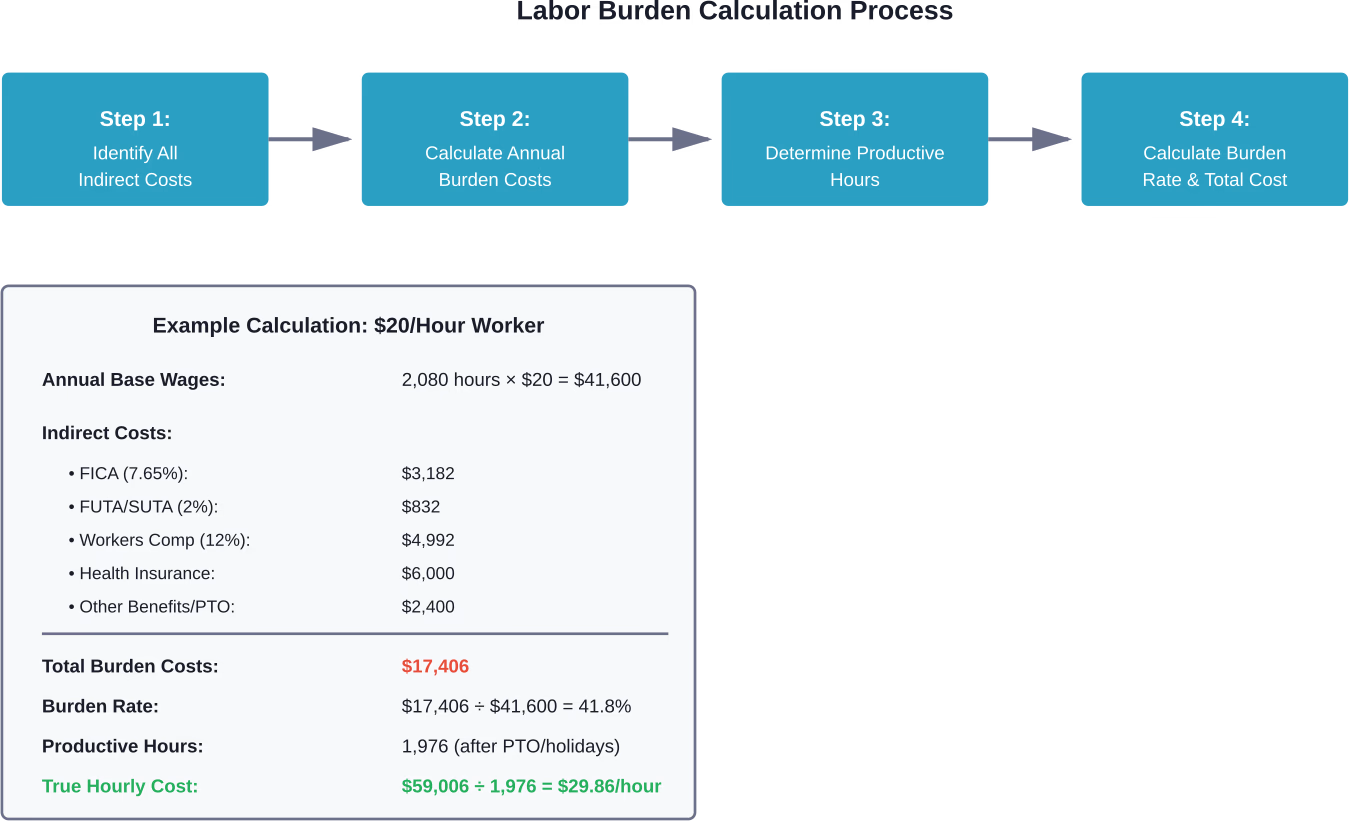
Step 1: Identify All Indirect Costs
Create a comprehensive list of every cost associated with employing workers beyond their base pay. Review financial statements, insurance policies, and benefit plan documents to capture all expenses.
Step 2: Calculate Total Annual Burden Costs
Sum all indirect costs for a typical employee or employee category. Some costs are percentage-based (like payroll taxes), while others are fixed amounts (like health insurance premiums).
Real talk: this gets easier after the first time. Once the framework is established, updating the calculation quarterly or annually becomes routine.
Step 3: Determine Actual Productive Hours
Here’s where many contractors make a critical mistake—they use 2,080 hours (40 hours × 52 weeks) as the denominator.
But workers aren’t productive for all 2,080 hours.
Subtract non-productive paid time: holidays, vacation days, sick leave, training time, and administrative hours. A more realistic productive hour count might be 1,800-1,950 hours annually.
Using actual productive hours rather than total paid hours gives a more accurate fully burdened hourly rate.
Step 4: Calculate the Labor Burden Rate and Fully Burdened Cost
The labor burden rate is calculated as:
Labor Burden Rate = Total Annual Burden Costs ÷ Annual Base Wages
The fully burdened hourly cost is:
Fully Burdened Rate = (Annual Base Wages + Total Burden Costs) ÷ Productive Hours
Using a practical example: an employee earning $20 per hour with $17,406 in annual burden costs and 1,976 productive hours would have a labor burden rate of 41.8% and a fully burdened hourly cost of approximately $29.86.
Lower Your Real Labor Cost Now

Labor burden isn’t just payroll add-ons – it’s everything that makes hours more expensive than they should be. Overtime from delays, extra supervision, repeated tasks, and work that takes longer than planned all push that number up. Powerkh cuts into those drivers by checking how the job is actually being executed, not how it was estimated. They look at where crews are losing efficiency, where sequencing doesn’t hold, and where design decisions are forcing extra labor. That gives you a clear view of why labor is costing more than expected and what needs to change.
Stop Paying For Unproductive Hours
Where Powerkh helps reduce labor burden in practice:
- Identifies where crews are overworking tasks due to poor sequencing
- Shows where coordination issues are increasing labor effort
- Highlights areas where installation takes longer than planned
- Tracks where extra supervision or intervention is required
- Points out inefficiencies that inflate labor cost without adding output
Contact Powerkh and cut the labor cost you’re currently paying for but not getting value from.
Common Labor Burden Percentages in Construction
Labor burden varies significantly across construction companies based on several factors.
| Factor | Lower Burden (24-35%) | Higher Burden (50-70%) |
|---|---|---|
| Benefits Package | Minimal or no benefits | Comprehensive health, retirement, paid leave |
| Worker Classification | Lower-risk trades | High-risk trades (roofing, steel work) |
| Konum | States with lower unemployment taxes | States with higher tax rates and requirements |
| Safety Record | Excellent safety history | Poor safety record increasing insurance costs |
| Union vs. Non-Union | Typically non-union | Union with benefit requirements |
According to industry analysis, contractors can expect labor burden to add approximately 40% on average to base wages, though some contractors experience burden rates as high as 70% depending on their specific circumstances.
Impact of Labor Burden on Construction Estimating
Labor burden directly affects how contractors price projects and prepare competitive bids.
Using Fully Burdened Rates in Estimates
When estimating labor costs for a project, using the fully burdened rate rather than base wages ensures all employment costs are captured. This prevents the common mistake of winning a bid based on incomplete cost calculations, only to lose money during project execution.
For accurate estimates, contractors should calculate fully burdened rates for different worker classifications separately, since a laborer’s burden costs differ from a project manager’s.
The Danger of Underestimating Labor Burden
Omitting burden costs or using outdated burden rates creates significant financial exposure. A project that appears profitable at first glance can quickly become a loss when actual employment costs exceed estimates.
Consider a $500,000 project with $200,000 in estimated labor costs. If the estimate used base wages of $30/hour but the true fully burdened cost is $45/hour, the project is immediately $100,000 over budget on labor alone.
That’s not a margin problem. That’s a business survival problem.
Adjusting Markup for Burden
When calculating markup, ensure burden costs are accounted for in the base estimate, not added later as overhead. Double-counting burden in both direct costs and overhead inflates bids unnecessarily and reduces competitiveness.
Managing and Reducing Labor Burden Costs
While the labor burden can’t be eliminated, strategic management can control costs.
Improve Safety Performance
According to OSHA research, inspected firms across industries saved an estimated $355,000 in injury claims and compensation costs on average in the four years following inspection. The study showed a 9.4% drop in injury claims and a 26% average savings on workers’ compensation costs.
Investing in safety programs, training, and culture reduces workers’ compensation premiums and indirect injury costs.
Review Benefit Plans Regularly
Employee benefits represent a significant burden component. Reviewing plan options, negotiating with providers, and considering cost-sharing arrangements can reduce expenses while maintaining competitive benefits.
Optimize Staffing Mix
Using the right mix of full-time employees, part-time workers, and subcontractors for different project phases can optimize labor burden. While subcontractors may have higher hourly rates, they eliminate burden costs entirely.
Track Burden Costs Accurately
Regular monitoring of actual burden costs versus estimates allows for adjustments before significant variances accumulate. Quarterly reviews ensure burden rates used in estimating remain current.
Labor Burden vs. Overhead vs. Markup
Understanding how labor burden relates to other cost categories prevents confusion and double-counting.
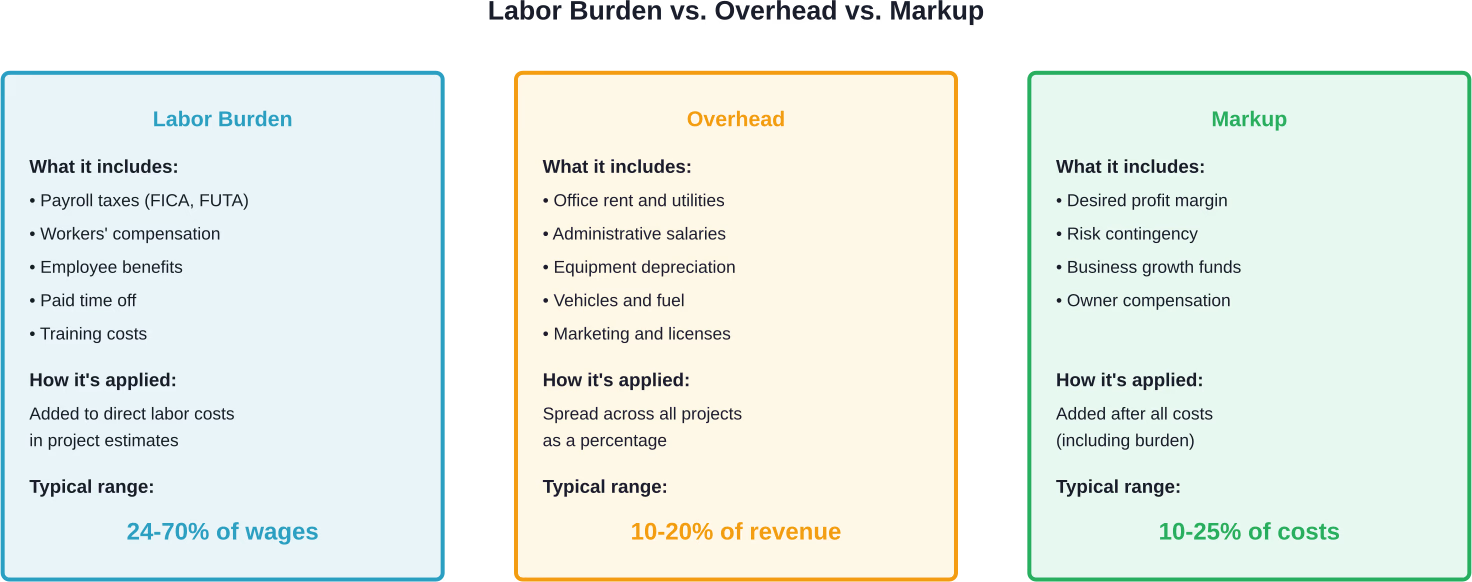
Labor burden includes only the indirect costs directly tied to employing workers. It’s calculated per employee and added to direct labor costs.
Overhead represents the general operating expenses of running the business—office costs, administrative staff, equipment, vehicles, and other expenses not directly tied to specific projects. Overhead is typically spread across all projects as a percentage.
Markup is the amount added to total project costs (including labor, materials, equipment, burden, and overhead) to generate profit.
These are distinct cost categories that work together in complete project pricing. Labor burden gets added to direct labor first, then overhead and markup are applied to the total project cost.
Tools and Software for Managing Labor Burden
Modern construction management software helps automate labor burden calculations and tracking.
Many estimating platforms allow contractors to set burden rates for different employee classifications, automatically applying the fully burdened rate when estimating labor hours. This eliminates manual calculation errors and ensures consistency across estimates.
Payroll services designed for construction can track and report burden costs in real-time, making it easier to update burden rates regularly and identify cost trends.
While specific software pricing varies—check vendor websites for current pricing and feature availability—investing in tools that automate burden calculations typically pays for itself through improved bid accuracy and cost control.
Understanding Labor Burden Drives Profitability
Labor burden represents one of the most significant—and most commonly underestimated—costs in construction. The difference between a carpenter’s $30/hour wage and the $45-51/hour true employment cost directly impacts project profitability.
Contractors who accurately calculate and apply labor burden rates to their estimates gain competitive advantage through realistic pricing. Those who ignore or underestimate burden costs inevitably face financial shortfalls, even on projects that appeared profitable during bidding.
The calculation itself isn’t complicated. Identify all indirect costs, sum them, divide by productive hours, and use the resulting fully burdened rate in estimates. But the discipline to maintain accurate burden calculations and consistently apply them separates profitable contractors from struggling ones.
According to Bureau of Labor Statistics data, employer costs for employee compensation continue rising, making accurate labor burden calculations increasingly critical. As of December 2025, private industry benefits averaged $13.79 per hour, representing a substantial portion of total employment costs.
Start by calculating labor burden for key employee classifications. Update these calculations quarterly. Apply fully burdened rates consistently in all estimates. The improved bid accuracy and cost control will directly impact the bottom line.
Construction companies that master labor burden calculations build sustainable, profitable businesses. Those that don’t eventually discover the hard way that winning bids based on incomplete cost data is a pyrrhic victory.
Sıkça Sorulan Sorular
What is the average labor burden rate for construction companies?
Labor burden in construction typically ranges from 24% to 70% of base wages, with most contractors experiencing burden rates around 40%. The specific rate depends on benefit offerings, insurance costs, worker classifications, and location. High-risk trades and companies offering comprehensive benefits tend toward the higher end of this range.
Is workers’ compensation included in the labor burden?
Yes, workers’ compensation insurance is a major component of labor burden in construction. Since workers’ comp premiums are calculated as a percentage of payroll and vary by worker classification, they represent a significant indirect labor cost that must be factored into the fully burdened labor rate.
Should labor burden be included in overhead?
No, labor burden should not be included in overhead. Labor burden is a direct cost tied specifically to employing workers and should be calculated as part of the total labor cost. Overhead represents general business operating expenses not directly tied to specific employees or projects. Including labor burden in both categories would double-count these costs.
How often should contractors recalculate labor burden rates?
Contractors should review and update labor burden calculations at least quarterly, and ideally whenever significant changes occur in insurance rates, benefit costs, or tax rates. Annual recalculation at minimum is necessary to maintain accurate estimating, but more frequent updates ensure burden rates reflect current costs.
What’s the difference between labor burden and fully burdened labor rate?
Labor burden refers to the total dollar amount or percentage of indirect costs added to base wages. The fully burdened labor rate is the complete hourly cost of employing a worker, calculated by dividing total compensation (wages plus burden) by productive hours. For example, a 40% labor burden on a $25/hour worker results in a fully burdened rate of $35/hour.
Can using subcontractors reduce labor burden costs?
Using subcontractors eliminates labor burden entirely since subcontractors are not employees. While subcontractor rates are typically higher than employee base wages, they include no payroll taxes, insurance, benefits, or other burden costs for the hiring contractor. This trade-off can be advantageous for specialized work or variable workload situations.
Do salaried employees have a different labor burden than hourly workers?
Salaried employees have the same types of burden costs (payroll taxes, insurance, benefits), but the calculation approach differs. For salaried workers, calculate annual burden costs, add them to annual salary, then divide by productive hours to get the fully burdened hourly rate. The burden percentage may differ if salaried employees receive different benefits than hourly workers.

Vaka Çalışmalarımız
Ticari, endüstriyel ve konut sektörleri için 200'den fazla BIM ve VDC projesi gerçekleştirdik.
Çalışmalarımız şunları içermektedir:
Kalıp tasarım otomasyonu
Our client from
California, USA
Asma tavan tasarım otomasyonu
Our client from
New York, USA
Duvar çerçeveleme tasarım otomasyonu
Our client from
California, USA