Herhangi bir sorunuz var mı? Bize ulaşın!
Ekibimize katılın!
Ücretsiz fiyat teklifi veya danışmanlık talep edin

A COI (Certificate of Insurance) in construction is a document that proves a contractor, subcontractor, or vendor has active insurance coverage. It’s not an insurance policy itself but rather evidence that required coverage exists. Construction projects typically require COIs from all parties to verify compliance with contractual insurance requirements and protect against liability risks.
Every construction project brings a stack of paperwork. Plans, permits, contracts, change orders—and somewhere in that pile sits one of the most important documents that gets overlooked until someone asks for it.
The Certificate of Insurance.
If you’re working in construction, you’ll encounter COIs constantly. General contractors need them from subs. Property owners demand them from GCs. And when someone doesn’t have proper documentation, projects grind to a halt before the first shovel hits dirt.
But what exactly is a COI in construction terms? More importantly, how do you make sure you’re checking the right things on these certificates to avoid gaps that could expose your business to serious financial risk?
What Does COI Stand For in Construction?
COI stands for Certificate of Insurance. In construction, it’s a one-page document issued by an insurance company or broker that verifies a contractor, vendor, or subcontractor carries active insurance coverage.
Here’s what it’s not: an insurance policy. The policy is the actual legal contract between the insured party and the insurance carrier. The COI is simply proof that the policy exists and shows key coverage details like policy numbers, effective dates, coverage limits, and who’s listed as additional insured.
Think of it this way—your driver’s license proves you’re authorized to drive, but it’s not your car registration or insurance policy. A COI works the same way for construction insurance.
Why Construction Projects Require Certificates of Insurance
Construction sites are inherently risky. Workers operate heavy machinery. Materials get lifted overhead. Third parties visit job sites. Property damage happens. Injuries occur.
When something goes wrong, someone bears financial responsibility. COIs exist to verify that the responsible parties carry adequate insurance to cover potential claims.
It’s a Contractual Obligation
Most construction contracts include specific insurance language requiring coverage minimums. Common requirements include:
- General Liability coverage, typically $1 million per occurrence and $2 million aggregate
- Commercial Auto insurance for vehicles used on the project
- Workers’ Compensation with statutory limits
- Umbrella or Excess Liability coverage for larger projects
- Additional Insured status for the property owner and general contractor
- Waiver of Subrogation protecting upstream parties from insurer recovery actions
Before work starts, the hiring party requests a COI to confirm these requirements are met. No valid COI? No work.
Risk Management and Liability Protection
Every subcontractor, vendor, or supplier who steps onto a construction site represents potential liability exposure. If an uninsured plumber floods a building, or an underinsured electrician causes a fire, the property owner and general contractor could face lawsuits.
Collecting and verifying COIs creates a documented chain of insurance coverage across all project parties. This protects against scenarios where one party’s insurance denies a claim and the injured party sues everyone else involved.
State and Licensing Requirements
Contractor licensing boards frequently require proof of insurance to issue or renew licenses. Most states require coverage from the first employee. Texas makes workers’ compensation optional for private employers, though many contractors carry it because major projects require proof. Washington requires coverage through the state Labor & Industries system.
Many states set specific liability minimums through licensing authorities. Oregon, for instance, requires general liability coverage as part of contractor licensure, and licensing boards may accept a COI as verification.
What Information Appears on a Construction COI
A standard COI follows the ACORD 25 form, an industry-standard template recognized across the insurance and construction industries. While the layout is consistent, the details matter tremendously.
Here’s what appears on a typical construction certificate of insurance:
| Section | Information Included | Neden Önemli?
|
|---|---|---|
| Producer Info | Insurance agent or broker contact details | Who to contact for questions or changes |
| Insured Party | Name and address of the contractor/vendor | Confirms the right entity is covered |
| Insurance Carrier | Name of the insurance company providing coverage | Verifies carrier legitimacy and financial strength |
| Policy Numbers | Specific policy identification numbers | Allows verification directly with the insurer |
| Coverage Types | General Liability, Auto, Workers’ Comp, Umbrella | Shows what risks are covered |
| Coverage Limits | Per-occurrence and aggregate dollar amounts | Ensures adequate financial protection |
| Effective Dates | Start and end dates for each policy | Confirms coverage is active during the project |
| Additional Insured | Names of parties added to the policy | Extends liability protection to the certificate holder |
| Certificate Holder | Entity receiving the COI (often the GC or owner) | Identifies who’s being provided proof |
| Description Box | Special notes, waivers, or endorsements | Documents additional requirements like waiver of subrogation |
Policy Effective Dates vs. Certificate Issue Date
One common mistake: confusing when the certificate was issued with when the coverage is active.
A COI reflects the coverage status at the exact time of issuance; brokers generally cannot issue a standard ACORD 25 for a policy that has already lapsed or expired unless it is a historical confirmation clearly marked as such. Always check the policy effective dates, not just the certificate date. Since insurance claims can be made retroactively, coverage needs to span the entire project duration.
Common Coverage Types Required in Construction COIs
Different construction projects demand different insurance types. A residential remodel has different risk profiles than a high-rise commercial build. But certain coverage types appear across nearly all construction COIs.
General Liability Insurance
This covers bodily injury and property damage caused by the contractor’s operations. If a subcontractor damages existing building structure or a worker injures a passerby, general liability responds.
Standard minimums are $1 million per occurrence and $2 million aggregate, though larger projects often require higher limits.
Workers’ Compensation
Required in most states for businesses with employees, workers’ comp covers medical expenses and lost wages when workers are injured on the job. According to OSHA requirements, all employers must report work-related fatalities within 8 hours and work-related inpatient hospitalizations, amputations, or eye losses within 24 hours.
Most states require coverage from the first employee. Texas makes workers’ compensation optional for private employers, though many contractors carry it because major projects require proof. Washington requires coverage through the state Labor & Industries system.
Commercial Auto Insurance
Covers vehicles used for construction business—trucks hauling materials, vans transporting workers, or equipment trailers. This protects against accidents involving company vehicles on and off the job site.
Umbrella or Excess Liability
Provides additional coverage above the limits of general liability and auto policies. For large projects with significant risk exposure, umbrella policies of $5 million or more aren’t uncommon.
Builder’s Risk Insurance
Protects the building under construction from damage due to fire, theft, vandalism, or weather. Generally, the property owner or general contractor carries this coverage, but subcontractors should verify it exists.
How to Read and Verify a Construction COI
Collecting COIs isn’t enough. You need to verify they actually provide the protection your contract requires.
Here’s the thing though—many businesses just file COIs without checking the details. That’s where compliance gaps create massive liability exposure.
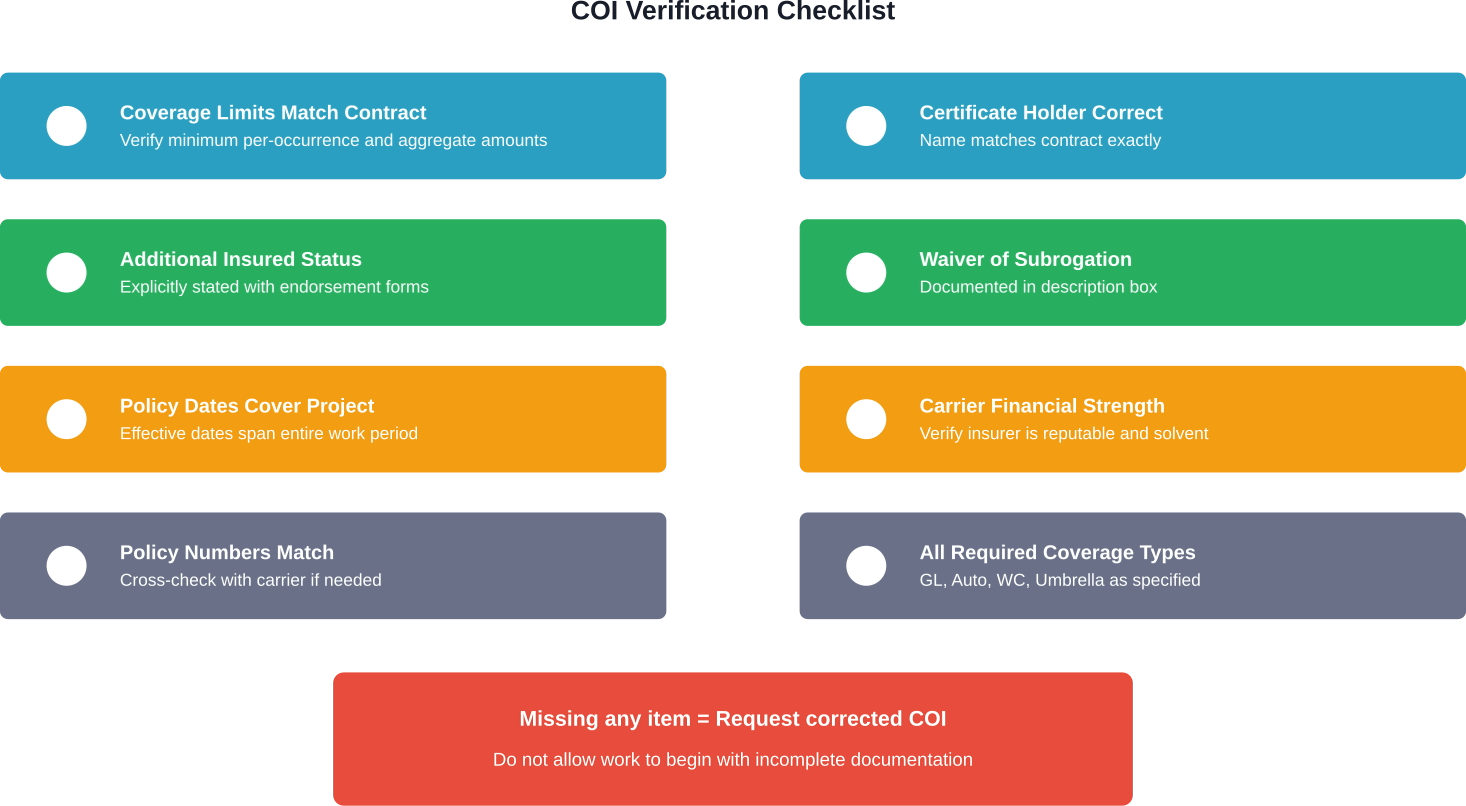
Check Coverage Limits Against Contract Requirements
Your contract specifies minimum coverage amounts. The COI should meet or exceed those minimums. Common construction minimums are $1 million per occurrence and $2 million aggregate for general liability.
If the COI shows $500,000 per occurrence when your contract requires $1 million, that’s a compliance failure. The contractor needs to increase coverage or provide proof of umbrella coverage that brings the total to required limits.
Verify the Certificate Holder Is Correctly Named
The certificate holder section should show your business name exactly as it appears in the contract. Misspellings, incomplete names, or old business names can create problems if a claim occurs.
Confirm Additional Insured Status
Being named as a certificate holder doesn’t automatically make you an additional insured. The COI should explicitly state in the description box that you’re added as additional insured, often referencing specific endorsement forms like CG 20 10 and CG 20 37.
Why does this matter? Additional insured status extends the contractor’s liability coverage to you. If someone sues both you and the contractor for an incident caused by the contractor, their insurance covers both parties.
Look for Waiver of Subrogation
Subrogation lets an insurance company recover money it paid on a claim by going after the party who caused the loss. A waiver of subrogation prevents the contractor’s insurer from suing you to recover claim costs.
Most construction contracts require waivers of subrogation. The COI description box should state this waiver is in place.
Validate Policy Dates Cover the Entire Project
Construction projects often span months or years. The policy effective dates on the COI need to cover your project timeline. If the policy expires mid-project, you need a commitment that updated COIs will be provided when coverage renews.
Get Your COIs Approved Without Delays

A COI gets rejected or flagged when what’s documented doesn’t match what’s happening on site. Wrong scope, missing parties, or unclear coverage creates risk and slows approvals. Powerkh gives you a clear view of actual site activity and responsibilities so your COIs reflect the real job, not assumptions. Instead of fixing issues after submission, you go in with the right information from the start. That keeps compliance checks moving and avoids last-minute corrections that hold up access or work.
Submit COIs That Pass First Time
Powerkh helps you align COIs with real project conditions:
- Confirms who is actually working on site and in what roles
- Shows how responsibilities are split across contractors and trades
- Flags mismatches between scope and documented coverage
- Highlights gaps that can block approval or site access
- Supports clean, accurate submissions without rework
Contact Powerkh now and get your COIs approved without delays or back-and-forth.
Common COI Mistakes That Create Liability Gaps
Even experienced construction professionals make COI errors that expose their businesses to risk. Here are the mistakes that show up most frequently.
Accepting Expired Certificates
A COI shows coverage dates. When those dates pass, the certificate becomes invalid. Yet contractors often continue working with expired COIs on file.
Set up a tracking system that alerts you 30 days before COI expiration. Request renewed certificates before coverage lapses.
Incomplete Additional Insured Endorsements
The COI might say you’re an additional insured, but the actual policy endorsement doesn’t include you. Or it includes you only for ongoing operations but not completed operations.
For full protection, you need both. Request copies of the actual endorsement forms—not just the COI statement.
Coverage Limits That Don’t Stack Properly
A contractor shows $500,000 general liability and $1 million umbrella. Does that create $1.5 million total coverage?
Not always. Umbrella policies typically sit on top of—not in addition to—underlying coverage. That means the total is $1 million, not $1.5 million. If your contract requires $2 million, there’s a gap.
Wrong Certificate Holder Information
The certificate holder seems like a minor detail. It’s not. If your business is the certificate holder and a claim occurs, but the COI lists someone else as certificate holder, you’re not receiving the intended protection.
This happens frequently when contractors use old COI templates without updating certificate holder details for each project.
How to Obtain a COI as a Contractor
If you’re the contractor being asked to provide a certificate of insurance, the process is straightforward—assuming you already have the required coverage.
Contact your insurance agent or broker and request a COI. You’ll need to provide:
- Certificate holder name and address
- Project description and location
- Any specific endorsements required (additional insured status, waiver of subrogation)
- Special language the contract requires in the description box
Some insurance providers issue COIs instantly through online portals. Other insurers may charge $7 to $15 per certificate, or higher if multiple additional insureds need to be added.
Don’t Wait Until the Last Minute
Request COIs as soon as you’re awarded a contract. Processing can take several days, especially if endorsements need to be added to your policy. Missing COI deadlines can delay project start dates and damage client relationships.
Managing Multiple COIs Across Construction Projects
Large contractors and general contractors often manage dozens or hundreds of COIs simultaneously. Subcontractors on ten different jobs. Multiple vendors per project. Coverage expiring at different times.
Tracking all this manually through email and spreadsheets becomes unmanageable fast.
COI Tracking and Management Systems
Specialized COI management platforms automate tracking, verification, and compliance monitoring. These systems typically offer:
- Centralized digital storage for all certificates
- Automated expiration alerts and renewal reminders
- Compliance checking against contract requirements
- Direct verification with insurance carriers
- Integration with project management and accounting software
For businesses managing substantial contractor networks, these systems reduce administrative burden and minimize risk of coverage gaps.
Document Retention for Construction COIs
How long should you keep COIs after a project completes? Since insurance claims can be made retroactively—sometimes years after work finishes—best practice is to retain COIs for as long as your business operates.
Completed operations claims can arise long after project completion. A building defect discovered five years later could trigger litigation. Having historical COIs proves insurance coverage existed when the work was performed.
State-Specific COI Requirements in Construction
While the ACORD 25 form is standard nationwide, specific insurance requirements vary by state. Workers’ compensation requirements provide a clear example.
Most states require coverage from the first employee. Texas makes workers’ compensation optional for private employers, though many contractors carry it because major projects require proof. Washington requires coverage through the state Labor & Industries system.
General liability minimums also vary. Some states like Texas, Colorado, and Maine have no state-mandated minimums—requirements come from licensing boards or contract terms. Oregon sets specific liability minimums through its licensing authority.
Contractor licensing boards in many states require proof of insurance to issue or renew licenses. A COI serves as acceptable proof in most jurisdictions.
When working across state lines, verify requirements for each state where you’re performing work. Don’t assume your home state’s coverage meets requirements in other jurisdictions.
What Happens When a COI Is Missing or Invalid
Real talk: projects stop.
General contractors typically won’t allow subcontractors on site without valid COIs. Property owners won’t issue notices to proceed without GC certificates. The financial and liability risks are too significant.
Beyond project delays, working without proper insurance documentation creates severe consequences:
- Contract breach exposing the uninsured party to damages
- Personal liability for claims that would otherwise be covered
- Potential licensing violations and fines
- Disqualification from future projects with the same client
- Legal liability for upstream parties who allowed uninsured work
If you’re the party requesting COIs, enforcing compliance before work starts protects your business. If you’re providing COIs, maintaining current coverage and documentation keeps you working.
Moving Forward With Proper COI Management
Construction projects succeed when risks are properly managed. Insurance documentation sits at the foundation of that risk management.
A certificate of insurance proves coverage exists. But that proof only protects you when certificates are properly verified, tracked, and updated throughout the project lifecycle.
Don’t treat COIs as paperwork to file and forget. Look at them as evidence of financial protection. Check every detail against contract requirements. Verify coverage dates span your project. Confirm additional insured status and waivers are in place.
For contractors providing COIs, maintain adequate coverage and respond quickly to certificate requests. Your insurance documentation directly impacts your ability to bid and win projects.
Whether you’re a property owner, general contractor, or subcontractor, understanding what a COI means in construction terms—and how to properly handle these documents—protects your business from gaps that could cost millions. The time invested in proper COI management pays returns every time a claim doesn’t bankrupt your company.
Frequently Asked Questions About COIs in Construction
What’s the difference between a COI and an insurance policy?
An insurance policy is the actual contract between the insured and the insurance company defining coverage terms, exclusions, and limits. A COI is a summary document proving the policy exists. The policy is dozens of pages; the COI is one page. You can’t file a claim with just a COI – you need the underlying policy.
How long does a certificate of insurance stay valid?
A COI remains valid as long as the underlying insurance policies listed on it remain active. Most policies run for one year, so COIs typically expire annually when coverage renews. Always check the policy effective dates on the certificate, not just when the certificate was issued.
Can I start work before receiving a COI from a subcontractor?
No. Allowing unverified parties to begin work creates massive liability exposure. If they lack proper coverage and cause damage or injury, you could be held financially responsible. Standard practice is no valid COI, no site access.
Who pays for certificates of insurance in construction?
The insured party – the contractor or vendor being asked to provide proof of coverage – pays for their own insurance and any COI issuance fees. Some insurers provide unlimited free COIs; others charge $7 to $15 per certificate. The party requesting proof doesn’t pay for the other party’s insurance documentation.
What does it mean to be named as additional insured on a COI?
Being named as additional insured extends the contractor’s liability coverage to you. If someone sues both you and the contractor for an incident caused by the contractor’s work, the contractor’s insurance defends and covers both parties. This protects you from claims arising from their operations.
Do I need to verify COI information with the insurance carrier?
For high-risk projects or unfamiliar contractors, direct verification adds an extra layer of protection. Contact the insurance carrier using information from their website – not contact details on the COI itself – and verify the policy is active, limits are accurate, and endorsements are in place. This catches fraudulent certificates.
What should I do if a contractor’s COI expires mid-project?
Contact the contractor immediately and request an updated certificate showing renewed coverage. If they don’t provide it within a reasonable timeframe, stop their work until coverage is verified. Continuing work with expired insurance violates most contracts and exposes you to liability.

Vaka Çalışmalarımız
Ticari, endüstriyel ve konut sektörleri için 200'den fazla BIM ve VDC projesi gerçekleştirdik.
Çalışmalarımız şunları içermektedir:
Kalıp tasarım otomasyonu
Our client from
California, USA
Asma tavan tasarım otomasyonu
Our client from
New York, USA
Duvar çerçeveleme tasarım otomasyonu
Our client from
California, USA