Herhangi bir sorunuz var mı? Bize ulaşın!
Ekibimize katılın!
Ücretsiz fiyat teklifi veya danışmanlık talep edin

A construction bond is a type of surety bond that protects project owners and ensures contractors fulfill their contractual obligations on construction projects. These bonds guarantee that contractors will complete work according to specifications, pay subcontractors and suppliers, and meet other project requirements. Construction bonds are typically required on public projects and larger private developments to minimize financial risk.
Picture this scenario: A school board opens bids for a new elementary school, and the lowest bidder is an unfamiliar general contractor. How can they trust this contractor won’t abandon the project halfway through? Or fail to pay subcontractors, leaving the property vulnerable to liens?
That’s where construction bonds enter the picture.
These financial instruments have become the backbone of risk management in the construction industry. They protect project owners against contractor default and ensure that contractual obligations get met, no matter what challenges arise during a build.
But construction bonds can seem complex—especially when dealing with different bond types, varying requirements, and the three-party relationship between principal, obligee, and surety. This guide breaks down everything contractors and project owners need to understand about how construction bonds work.
What Are Construction Bonds?
Construction bonds, also known as contract bonds, are surety bonds designed specifically for construction projects. They create a three-party agreement involving the principal (contractor), the obligee (project owner), and the surety (bonding company).
Unlike insurance policies that protect the policyholder, construction bonds protect the project owner from financial loss if the contractor fails to meet their contractual obligations. The surety company essentially vouches for the contractor’s ability to complete the work as specified.
Here’s the thing though—construction bonds aren’t just formalities. They represent a comprehensive risk management tool that evaluates a contractor’s financial stability, work history, and capacity to handle specific projects before work even begins.
According to the Associated General Contractors, these bonds have become standard practice across the industry, with organizations like the Surety and Fidelity Association of America (SFAA) and the National Association of Surety Bond Producers (NASBP) establishing best practices for their use.
How Construction Bonds Differ from Insurance
Many people confuse construction bonds with insurance, but they’re fundamentally different financial products.
Insurance protects the policyholder from unexpected losses. Construction bonds protect the project owner from contractor default. If a claim gets paid on a bond, the contractor remains liable to reimburse the surety company for the full amount.
This distinction matters. Insurance spreads risk across many policyholders. Bonds place ultimate financial responsibility on the contractor who obtained them.
How Do Construction Bonds Work?
The construction bond process involves a careful evaluation system that begins long before any project starts.
When contractors apply for bonds, surety companies scrutinize their financial statements, work history, current projects, and management team. This underwriting process resembles applying for a significant loan—because in essence, that’s what a bond represents.
The surety evaluates what’s known as the “three C’s”: Capital (financial resources), Capacity (ability to perform the work), and Character (reputation and track record). Strong performance in all three areas leads to bond approval.
What Happens When Claims Occur
When a contractor fails to meet their obligations, the project owner files a claim against the bond. The surety investigates the claim to determine its validity.
For performance bond claims, the surety may hire a new general contractor to complete the contract, or pay the obligee for any damages they incurred. Payment bond claims may result in the surety issuing direct payments to subcontractors who weren’t paid according to their contract.
But wait. After the surety pays a claim, the contractor isn’t off the hook. The contractor must reimburse the surety for the full claim amount plus investigation costs. This is why bond claims can have serious long-term consequences for contractors’ ability to secure future work.
Prove You Can Deliver The Contract

A construction bond is built on one thing – confidence that the project will be completed as agreed. That confidence breaks when the design doesn’t hold, when coordination falls apart, or when work on site starts drifting from what was planned. Powerkh steps in before and during construction to show whether the project can actually be delivered without failure. Instead of relying on guarantees and coverage, you get a clear, grounded view of what stands and what doesn’t. That means fewer unknowns, fewer weak points, and a stronger position before issues turn into claims.
Show Your Project Will Hold
Powerkh looks at the job the way it will actually run and highlights where it can fail:
- Which parts of the design won’t survive real site conditions
- Where coordination will break under pressure
- Where execution is already drifting from what was agreed
- Which areas can trigger delays, disputes, or non-performance
- What needs to be fixed to keep delivery on track
If your project is backed by a bond, talk to Powerkh and make sure it delivers without falling apart.
Types of Construction Bonds
Different stages of construction projects require different types of bonds. Understanding these variations helps contractors and owners ensure appropriate protection throughout the project lifecycle.
Bid Bonds
Bid bonds protect project owners during the bidding process. According to the National Institute of Governmental Purchasing (NIGP), a bid bond is a written agreement by which a third party guarantees that a bidder will accept the contract if awarded.
These bonds typically equal 5-10% of the bid amount. They ensure contractors don’t submit frivolous bids or back out after being selected as the low bidder.
If a contractor withdraws their bid or refuses to sign the contract after winning, the surety compensates the owner for the difference between that bid and the next lowest qualified bid.
Performance Bonds
Performance bonds guarantee that contractors will complete the project according to the contract terms and specifications. They’re the most comprehensive type of construction bond.
These bonds protect owners against contractor default, ensuring the project gets finished even if the original contractor can’t complete the work. The surety may step in to hire a replacement contractor or compensate the owner for completion costs.
Performance bonds remain in effect until the project reaches final completion and acceptance by the owner.
Payment Bonds
Payment bonds guarantee that the contractor will pay all suppliers and subcontractors who assist in the performance of the work.
These bonds are particularly important because they protect property owners from mechanics’ liens. When subcontractors or suppliers don’t receive payment, they can typically file liens against the property. Payment bonds transfer that risk to the surety company.
Real talk: Payment bonds protect the entire supply chain, not just the prime contractor and owner.
Maintenance Bonds
Maintenance bonds, also called warranty bonds, extend coverage beyond project completion. They guarantee that the completed work will remain free from defects for a specified warranty period, typically one to two years.
If defects appear during the warranty period, the surety ensures they get corrected at no additional cost to the owner.
Subdivision Bonds
Subdivision bonds guarantee that developers will install required infrastructure—roads, sidewalks, sewers, utilities—in new residential developments. Local governments require these bonds to ensure communities receive promised public improvements.
| Bond Type | Amaç | Typical Coverage | Duration
|
|---|---|---|---|
| Bid Bond | Guarantees bid acceptance | 5-10% of bid amount | Until contract signing |
| Performance Bond | Ensures project completion | 100% of contract value | Through project completion |
| Payment Bond | Guarantees payment to subs/suppliers | 100% of contract value | Through final payment period |
| Maintenance Bond | Covers defects after completion | Varies (often 50% of contract) | 1-2 years post-completion |
| Subdivision Bond | Ensures infrastructure completion | Cost of improvements | Until improvements accepted |
When Are Construction Bonds Required?
Construction bonds aren’t universally required, but specific situations mandate them by law or practical necessity.
Federal Projects
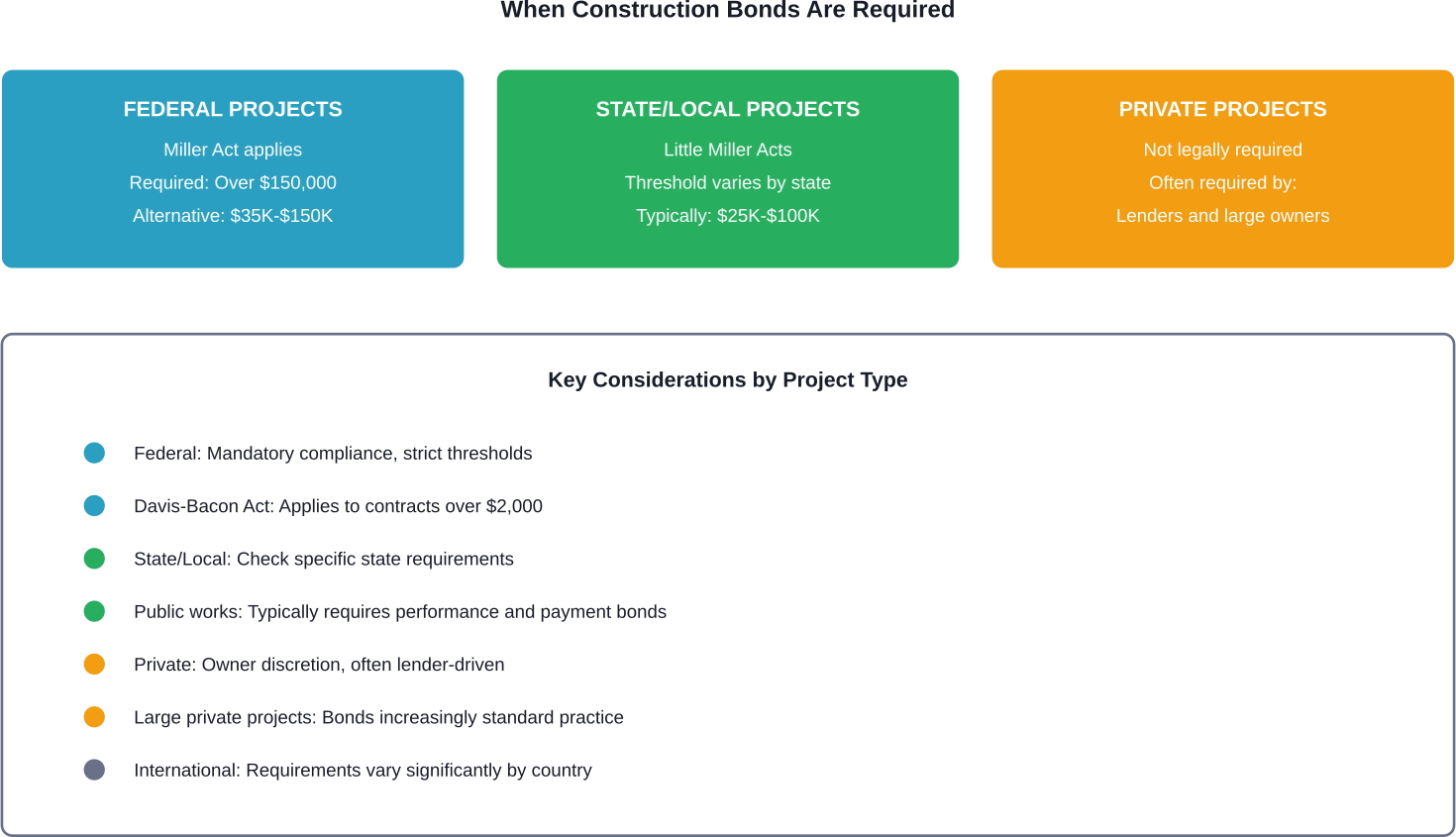
The Miller Act requires performance and payment bonds on federal construction contracts exceeding $150,000. For contracts between $35,000 and $150,000, alternative payment protections may be required.
According to the U.S. Department of Labor, these requirements ensure taxpayer-funded projects get completed as specified while protecting subcontractors and suppliers from non-payment.
State and Local Government Projects
All 50 states have enacted “Little Miller Acts” that mirror federal bonding requirements for state and local public works projects. The Davis-Bacon Act applies to federal government or District of Columbia contracts in excess of $2,000 for the construction, alteration, or repair of public buildings or public works.
Threshold amounts vary by state, but most require bonds on public projects exceeding $25,000 to $100,000. Some states set even lower thresholds.
Private Projects
Private project owners aren’t legally required to demand construction bonds, but many choose to require them anyway—especially for large or complex projects.
Banks financing construction often require bonds to protect their investment. Large corporations and institutions routinely mandate bonds to minimize risk exposure.
Federal Bonding Requirements
According to Cornell Law School’s Legal Information Institute, the Code of Federal Regulations (2 CFR § 200.326) establishes bonding requirements for federally funded projects. The federal agency or pass-through entity may accept the recipient’s bonding policy for construction contracts exceeding the simplified acquisition threshold, provided the federal interest is adequately protected.
How Much Do Construction Bonds Cost?
Construction bond costs aren’t standardized—they’re based on risk assessment and vary significantly between contractors.
The short answer? Construction bond premiums are typically a small percentage of the bond’s total amount, often around 1% to 10% of the required bond value. Bond premium costs vary significantly based on factors including credit score, financial strength, work history, project size, and project type.
Factors Affecting Bond Costs
Several elements influence what contractors pay for bonds:
- Credit score: Personal and business credit directly impact premium rates
- Financial strength: Strong balance sheets and cash reserves reduce costs
- Work history: Established track records with successful completions earn better rates
- Proje büyüklüğü: Larger projects typically receive lower percentage rates
- Proje türü: Complex or unfamiliar work types increase premiums
- Backlog: Too many concurrent projects raises risk assessment
Bid bonds typically cost less than performance and payment bonds.
How to Obtain a Construction Bond
Securing construction bonds requires preparation and documentation. The process resembles applying for business credit—because that’s essentially what it is.
Step 1: Find a Surety Provider
Start by contacting surety bond agencies or insurance brokers who specialize in construction bonds. Many insurance agencies maintain surety departments, while some brokers focus exclusively on bonds.
Working with experienced bond agents matters. They understand what different surety companies look for and can match contractors with sureties likely to approve their applications.
Step 2: Complete the Application
Bond applications request detailed financial and operational information:
- Three years of business financial statements
- Personal financial statements from business owners
- Work-in-progress schedules showing current projects
- Resume of experience and completed projects
- Bank references and credit authorization
- Business organization documents
Step 3: Underwriting Review
The surety analyzes submitted information to assess risk. Underwriters evaluate whether the contractor has sufficient capital, capacity, and character to complete the bonded project successfully.
This process can take anywhere from a few days to several weeks for first-time bond applicants. Established contractors with ongoing surety relationships often receive approval within 24-48 hours.
Step 4: Receive Bond Approval
Once approved, the surety issues a bond commitment letter specifying the maximum bond amount they’ll provide. This bonding capacity determines the size of projects contractors can bid on.
The actual bond documents get issued when needed for specific projects, drawing against the approved bonding capacity.
Securing construction bonds requires preparation and documentation. The process resembles applying for business credit—because that’s essentially what it is.
Step 1: Find a Surety Provider
Start by contacting surety bond agencies or insurance brokers who specialize in construction bonds. Many insurance agencies maintain surety departments, while some brokers focus exclusively on bonds.
Working with experienced bond agents matters. They understand what different surety companies look for and can match contractors with sureties likely to approve their applications.
Step 2: Complete the Application
Bond applications request detailed financial and operational information:
- Three years of business financial statements
- Personal financial statements from business owners
- Work-in-progress schedules showing current projects
- Resume of experience and completed projects
- Bank references and credit authorization
- Business organization documents
Step 3: Underwriting Review
The surety analyzes submitted information to assess risk. Underwriters evaluate whether the contractor has sufficient capital, capacity, and character to complete the bonded project successfully.
This process can take anywhere from a few days to several weeks for first-time bond applicants. Established contractors with ongoing surety relationships often receive approval within 24-48 hours.
Step 4: Receive Bond Approval
Once approved, the surety issues a bond commitment letter specifying the maximum bond amount they’ll provide. This bonding capacity determines the size of projects contractors can bid on.
The actual bond documents get issued when needed for specific projects, drawing against the approved bonding capacity.
Benefits of Construction Bonds
Construction bonds create value for all parties involved in construction projects—though the benefits differ depending on perspective.
For Project Owners
Owners gain substantial protection through construction bonds:
- Financial security: Guarantees project completion even if contractors default
- Lien protection: Payment bonds prevent mechanics’ liens from attaching to property
- Contractor prequalification: Only contractors who pass surety underwriting can bond
- Kalite güvencesi: Sureties monitor bonded projects to prevent problems
- Recourse mechanism: Clear path to compensation if contractors fail
For Contractors
Contractors benefit from bonding capability despite the costs:
- Access to larger projects: Public work and major private projects require bonds
- Competitive advantage: Bonding capacity demonstrates financial strength
- Business credibility: Surety approval validates operational capability
- Relationship building: Long-term surety partnerships support business growth
- Financial discipline: Bond requirements encourage strong financial management
For Subcontractors and Suppliers
The construction supply chain gains payment protection:
- Payment guarantee: Payment bonds ensure compensation regardless of prime contractor issues
- Reduced risk: Working on bonded projects minimizes payment disputes
- Clear remedies: Bond claims provide defined recovery processes
Common Challenges with Construction Bonds
Despite their benefits, construction bonds present certain challenges that contractors need to navigate.
Qualifying for Initial Bonds
New contractors often struggle to secure their first bonds. Sureties prefer established track records, creating a catch-22: contractors need bonds to get work, but need work history to get bonds.
Solutions include starting with smaller unbonded projects to build financial strength, seeking sureties that specialize in emerging contractors, or partnering with experienced contractors on bonded work.
Bonding Capacity Limitations
Sureties limit the total amount of bonded work contractors can have in progress simultaneously. Bonding capacity is typically based on contractors’ financial strength and work history.
Contractors sometimes must complete current projects before taking on new bonded work, potentially limiting growth.
Financial Scrutiny
Maintaining bonding requires ongoing financial transparency. Sureties require regular financial updates and may reduce or revoke bonding capacity if financial conditions deteriorate.
This level of scrutiny can feel invasive, but it serves a purpose—ensuring contractors don’t overextend themselves.
Bond Claims Impact
Bond claims can devastate contractors’ futures in the industry. Even a single claim makes obtaining future bonds extremely difficult and expensive. Multiple claims may render a contractor unbondable.
That said, claims remain relatively rare. Most bonded projects complete successfully without claims.
Construction Bonds vs. Letters of Credit
Some project owners accept letters of credit as alternatives to construction bonds. Understanding the differences helps determine which option works better for specific situations.
| Özellik | Construction Bonds | Letters of Credit
|
|---|---|---|
| Maliyet | 1-10% premium | Ties up credit line |
| Financial Impact | No balance sheet impact | Reduces borrowing capacity |
| Approval Process | Surety underwriting | Bank approval |
| Claims | Surety investigates before paying | Bank pays on demand |
| Contractor Liability | Must reimburse surety | Must repay bank |
| Industry Acceptance | Standard for public projects | Sometimes accepted on private work |
Construction bonds generally offer better financial flexibility since they don’t tie up credit lines or appear as liabilities on balance sheets.
Best Practices for Managing Construction Bonds
Contractors who successfully navigate bonding requirements follow certain best practices that minimize risk and maximize bonding capacity.
Maintain Strong Financial Records
Keep clean, accurate financial statements prepared according to generally accepted accounting principles. Work with CPAs who understand construction accounting and bonding requirements.
Update financials quarterly and provide them promptly to sureties when requested. Transparency builds trust.
Build Surety Relationships Early
Don’t wait until needing a bond to contact sureties. Establish relationships before they’re required, allowing time to address any financial or operational concerns sureties might identify.
Work with the same surety consistently when possible. Long-term relationships earn better terms and more flexibility during challenging times.
Understand Bond Obligations
Read bond documents carefully and understand all obligations they create. Know the notification requirements, claim procedures, and warranty periods.
Communicate with sureties about project challenges before they become crises. Sureties can often help solve problems if informed early.
Protect Against Claims
The best claim strategy is prevention:
- Maintain detailed project documentation
- Communicate regularly with owners and sureties
- Address payment issues promptly
- Never divert project funds to other uses
- Obtain proper lien waivers from subcontractors
- Document all change orders and approvals
Plan for Bonding Capacity Needs
Understand current bonding capacity and how it relates to business growth plans. If planning to pursue larger projects, work with sureties on strategies to increase capacity over time.
This might involve improving financial ratios, completing projects successfully to build track records, or bringing in additional equity.
The Future of Construction Bonds
The construction bonding industry continues evolving in response to changing market conditions and technological advancement.
Digital platforms are streamlining bond applications and issuance. Some sureties now offer instant bond quotes and 24-hour issuance for qualified contractors.
Data analytics are enhancing risk assessment. Sureties increasingly use sophisticated modeling to evaluate contractor risk more accurately, potentially expanding bonding availability to well-managed contractors who might not meet traditional criteria.
Environmental, social, and governance (ESG) factors are entering bonding considerations. Some sureties now evaluate contractors’ safety records, environmental practices, and diversity initiatives as part of underwriting.
The Bipartisan Infrastructure Law and other government spending initiatives are driving increased demand for bonded contractors. According to the U.S. Department of Labor, enhanced protections for workers in construction under this legislation emphasize the importance of proper bonding on federally funded projects.
Sonuç
Construction bonds serve as the foundation of risk management in the construction industry. They protect project owners against contractor default, ensure subcontractors and suppliers receive payment, and validate that contractors possess the financial strength and operational capability to complete their work.
While obtaining and maintaining bonds requires financial discipline and transparency, the benefits far outweigh the challenges. Bonds open doors to public projects and larger private work that would otherwise remain inaccessible.
For project owners, requiring construction bonds transforms contractor selection from a leap of faith into a calculated decision backed by third-party financial validation. The peace of mind that comes from knowing a surety company stands behind the contractor’s obligations is invaluable.
Understanding how construction bonds work, what they cost, and how to manage them effectively positions contractors for sustainable growth while protecting all project stakeholders against the inherent risks of construction work.
Ready to explore bonding for your next construction project? Connect with a qualified surety bond specialist to discuss specific needs and begin the qualification process. Whether seeking to expand into bonded work or evaluating risk management options, understanding construction bonds is the first step toward successful project outcomes.
Sıkça Sorulan Sorular
What’s the difference between a construction bond and insurance?
Construction bonds protect project owners from contractor default, while insurance protects contractors from unexpected losses. If a bond claim gets paid, contractors must reimburse the surety company. Insurance claims don’t require repayment. Bonds guarantee performance; insurance manages risk.
How long does it take to get a construction bond?
For established contractors with existing surety relationships, bonds can be issued within 24-48 hours. First-time applicants should expect two to four weeks for the initial approval process, as sureties need time to review financial statements, verify references, and complete underwriting. Emergency situations can sometimes be expedited.
Can small contractors get construction bonds?
Yes, though it can be challenging for very new or small contractors. Sureties that specialize in small to mid-size contractors exist and may approve bonds for contractors with limited history if they demonstrate strong financial management, relevant experience, and adequate capitalization. Starting with smaller bonded projects helps build the track record needed for larger bonds.
What happens if a contractor can’t get bonded?
Contractors who can’t secure bonds are limited to private projects that don’t require bonding. This excludes them from virtually all public work and many larger private projects. Options include improving financial strength over time, partnering with bondable contractors, focusing on unbonded market segments, or considering alternative arrangements like letters of credit on private work.
Do construction bonds expire?
Bond duration depends on the type. Bid bonds expire when contracts are awarded. Performance and payment bonds remain in effect until project completion and final acceptance, plus any required warranty period. Maintenance bonds cover specific warranty periods after completion. Unlike insurance policies, construction bonds don’t require annual renewal – they’re project-specific.
How much bonding capacity do contractors typically need?
Bonding capacity should exceed the largest project a contractor wants to pursue, plus coverage for any other ongoing bonded work. Bonding capacity varies based on individual contractor circumstances and surety underwriting criteria.
Are construction bonds refundable?
No. Bond premiums are earned when the bond is issued and aren’t refundable, even if the project gets canceled or completed early. This differs from insurance, which may offer pro-rated refunds for canceled policies. However, since bond premiums are typically charged as a percentage of contract value, contractors only pay for the bonds they actually need.

Vaka Çalışmalarımız
Ticari, endüstriyel ve konut sektörleri için 200'den fazla BIM ve VDC projesi gerçekleştirdik.
Çalışmalarımız şunları içermektedir:
Kalıp tasarım otomasyonu
Our client from
California, USA
Asma tavan tasarım otomasyonu
Our client from
New York, USA
Duvar çerçeveleme tasarım otomasyonu
Our client from
California, USA