¿Tiene alguna pregunta? Póngase en contacto con nosotros
¡Únete a nuestro equipo!
Solicitar presupuesto o consulta gratuita

Quick Summary: IFC stands for two different things in construction: “Issued for Construction” (drawings/documents approved for building) and “Industry Foundation Classes” (an open data standard for BIM). IFC drawings are final, approved design documents released to contractors to begin construction work. Industry Foundation Classes enable different software platforms to share building data seamlessly, supporting digital collaboration across the construction lifecycle.
Walk onto any construction site, and you’ll hear “IFC” thrown around constantly. But here’s where it gets confusing—IFC means two completely different things in the construction industry.
One refers to drawings. The other refers to digital data standards. Both are critical, and mixing them up causes real problems.
This guide breaks down both meanings, when each applies, and why understanding the difference matters for your projects.
IFC as Issued for Construction: The Drawing Definition
In construction documentation, IFC stands for “Issued for Construction.”
These are the final set of design drawings and specifications that have been reviewed, approved, and officially released by the design team—architects, engineers, and consultants—for actual construction work to begin.
Think of IFC drawings as the green light. They represent the complete, coordinated design that contractors can rely on to build from. No more “subject to review” or “preliminary” stamps.
What Makes a Drawing IFC?
Several criteria must be met before drawings earn the IFC designation:
- Complete design coordination across all disciplines
- Client or owner approval obtained
- All consultant reviews completed and incorporated
- Construction-ready level of detail provided
- Specifications finalized and aligned with drawings
- Legal and regulatory requirements satisfied
Once stamped IFC, these documents become the contractual basis for construction. Changes after this point typically require formal change orders and can trigger additional costs.
Who Issues IFC Drawings?
The design team—led by the architect or lead consultant—issues IFC drawings to the client. After client approval, they’re distributed to the contractor and all relevant subcontractors.
This isn’t a casual handoff. The issuance process usually involves formal transmittals, revision tracking, and documentation that specific versions have been released for construction purposes.
IFC vs Other Drawing Designations
Construction projects go through multiple drawing stages. Understanding where IFC fits helps clarify its importance.
| Drawing Type | Propósito | Nivel de detalle | Who Uses It |
|---|---|---|---|
| IFT (Issued for Tender) | Bidding and cost estimation | Near-complete design | Contractors bidding on work |
| IFC (Issued for Construction) | Actual building work | Complete, approved design | Contractors and subcontractors |
| Planos de taller | Fabrication details for specific components | Highly detailed, product-specific | Manufacturers and fabricators |
| Planos As-Built | Record of what was actually built | Complete with field changes | Owner and facility managers |
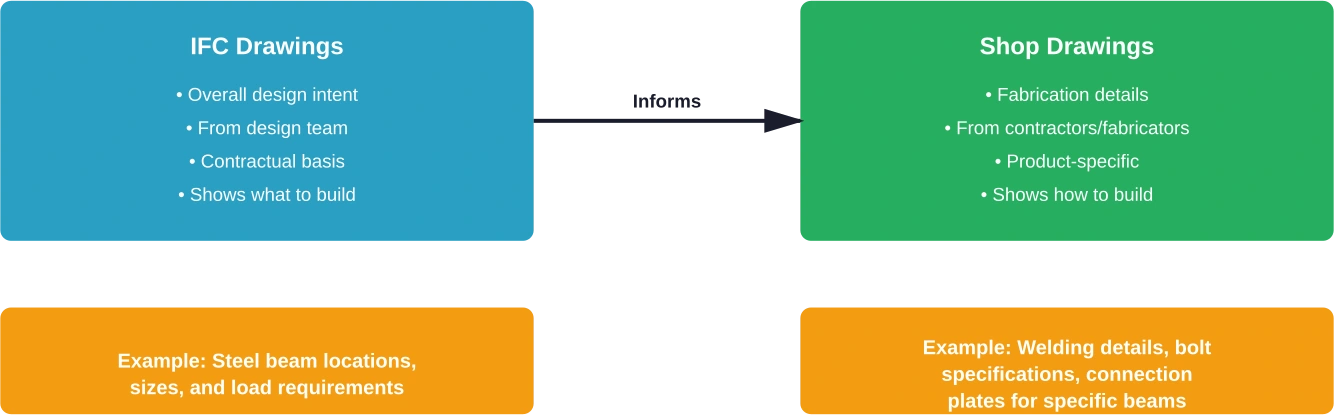
The key distinction? IFC drawings show what should be built. Shop drawings show how specific components will be fabricated. As-built drawings show what actually got built.
Add Outside BIM Capacity to Your Team

Powerkh provides BIM and VDC services for companies that need extra production support during design and construction work. Its services cover modeling, coordination, Scan to BIM, automation, prefabrication, and structural detailing. That makes it useful for teams that need help with technical delivery rather than just software access.
Looking for a BIM Delivery Partner?
Talk with Powerkh to:
- develop models and drawings for ongoing projects
- handle scan-based BIM work and documentation
- support detailing, coordination, and fabrication-related tasks
👉 Contact Powerkh for a project review and consultation.
Industry Foundation Classes: The BIM Data Standard
Now for the completely different meaning of IFC.
According to buildingSMART International, Industry Foundation Classes (IFC) are “a set of standardized, digital descriptions of the built asset industry.” It’s an open, global standard published under a Creative Commons license and as ISO 16739.
This IFC has nothing to do with drawing stamps. It’s about data.
Why Industry Foundation Classes Exist
Building Information Modeling (BIM) involves multiple software platforms—Revit, ArchiCAD, Tekla, Bentley, and dozens of others. Each stores building data differently.
Without a common language, sharing models between platforms becomes a nightmare. Data gets lost, misinterpreted, or requires tedious manual rework.
Industry Foundation Classes solve this. IFC provides a vendor-neutral format that enables machine interpretability of building information, allowing automation of workflows across different software platforms.
How IFC Works as a Data Format
Think of IFC as a translator. When an architect working in Revit needs to share a model with an engineer using Tekla, they export to IFC format.
The IFC file contains standardized descriptions of building elements—walls, beams, doors, HVAC systems—structured in a way any IFC-compliant software can read and interpret.
The latest official version as of 2026 is IFC 4.3.2.0, according to buildingSMART Technical documentation. This version expands support for infrastructure projects beyond just buildings.
Key Benefits of Industry Foundation Classes
Using IFC as a data exchange format delivers several advantages:
- Vendor neutrality: Not tied to any single software company
- Workflow automation: Machine-readable data enables automated clash detection, quantity takeoffs, and energy analysis
- Long-term data preservation: Open standard ensures files remain accessible even if specific software becomes obsolete
- Interoperability: Seamless collaboration across diverse project teams using different tools
Research on IFC-based BIM workflows, such as IFC-Based BIM-to-BEM Model Transformation studies, shows the standard facilitates data exchange for energy analysis and other specialized applications that require accurate building geometry and properties.
Common IFC Use Cases in Digital Construction
Industry Foundation Classes support multiple workflows throughout a project lifecycle.
Coordinación del diseño y detección de conflictos
Structural engineers export their model to IFC. MEP engineers import it to check for conflicts between ductwork and beams. Clash detection software like Solibri reads IFC files to identify spatial conflicts before construction begins.
Cálculo de cantidades y costes
Estimators can import IFC models into cost estimation software to automatically extract material quantities, dimensions, and component counts without manual measurement from drawings.
Energy Analysis and Building Performance
Building energy modeling tools can import IFC files to run thermal simulations and energy consumption predictions. The standardized format ensures geometry and material properties transfer accurately.
Facility Management and Operations
After construction, IFC models provide facility managers with digital representations of the building for maintenance planning, space management, and future renovations.
IFC Validation and Compliance
Not all IFC exports are created equal. Software implementations vary in quality.
buildingSMART offers certification programs to validate that software correctly implements IFC standards. Look for certified applications when IFC interoperability is critical.
IFC validation tools check exported files for errors, missing data, or non-compliant implementations. These checks help ensure data integrity before sharing models with other project stakeholders.
The Two IFCs: When Each Applies
So how do you know which IFC someone’s talking about?
Context makes it clear:
| Situation | Which IFC | Key Clue |
|---|---|---|
| “We received the IFC drawings yesterday” | Issued for Construction | Refers to drawings/documents |
| “Export the model to IFC format” | Industry Foundation Classes | Refers to file format/data |
| “Construction can’t start until IFC is issued” | Issued for Construction | About approval and authorization |
| “Does your software support IFC 4.3?” | Industry Foundation Classes | Mentions version numbers |
| “We need IFC-compliant BIM deliverables” | Industry Foundation Classes | About BIM and digital data |
Document-focused conversations typically mean Issued for Construction. Software and data conversations typically mean Industry Foundation Classes.
IFC Drawings vs Shop Drawings
One more common confusion: the difference between IFC drawings and shop drawings.
IFC drawings show the overall design intent—what needs to be built and how it should fit together. They come from the design team.
Shop drawings are detailed fabrication and installation drawings for specific components—steel connections, curtain wall panels, millwork details. They come from subcontractors and manufacturers.
The contractor uses IFC drawings to create shop drawings. The design team then reviews shop drawings to confirm they match the design intent shown in the IFC drawings.
Preguntas frecuentes
What does IFC stand for in construction?
IFC can refer to two concepts: “Issued for Construction,” meaning approved drawings ready for execution, and “Industry Foundation Classes,” an open BIM standard used for exchanging building data between different software platforms.
Who prepares IFC drawings?
IFC (Issued for Construction) drawings are prepared by the design team, including architects, engineers, and consultants. Once approved by the client, these documents are issued to contractors for construction.
Can construction start without IFC drawings?
No. Construction should not begin without IFC drawings, as they represent the finalized and approved design. They serve as the contractual basis for construction and ensure proper coordination across all disciplines.
What’s the difference between IFC and IFT drawings?
IFT (Issued for Tender) drawings are used during the bidding phase for cost estimation. IFC drawings are final, fully coordinated documents used for actual construction work and are typically more detailed.
Do I need special software to open IFC files?
Most BIM software supports IFC files, and there are also free IFC viewers available. Using software with buildingSMART certification ensures better compatibility and accurate data exchange.
What version of IFC should projects use?
The latest version is IFC 4.3.2.0, though IFC 4 and IFC 2×3 are still widely used. The choice depends on project requirements, client specifications, and software compatibility.
Are IFC files the same as native BIM files?
No. IFC files are neutral formats designed for interoperability between platforms, while native BIM files (such as Revit or Archicad formats) contain software-specific data that may not fully transfer to IFC.
Conclusión
Understanding both meanings of IFC prevents costly confusion on construction projects.
Issued for Construction drawings mark the critical transition from design to building—the point where approved plans become contractual documents guiding actual construction work.
Industry Foundation Classes enable the digital collaboration that modern construction demands, providing a vendor-neutral language for building data exchange across the project lifecycle.
Whether dealing with drawing approvals or BIM data workflows, knowing which IFC applies—and how each functions—keeps projects moving smoothly. Clear communication about these terms saves time, reduces errors, and prevents misunderstandings that can derail coordination.
For projects involving BIM deliverables, verify that IFC requirements are clearly specified in contracts, including which version and what level of detail is expected. For drawing management, establish clear protocols for when designs transition to IFC status and how changes are managed afterward.

Nuestros casos prácticos
Hemos gestionado más de 200 proyectos BIM y VDC para los sectores comercial, industrial y residencial.
Nuestro trabajo incluye:
Automatización del diseño de encofrados
Our client from
California, USA
Automatización del diseño de falsos techos
Our client from
New York, USA
Automatización del diseño del entramado de muros
Our client from
California, USA