Have any questions? Contact us!
Join our team!
Request a free quote or consultation

Site preparation in construction involves clearing, grading, excavating, and stabilizing land before building begins. This critical phase ensures stable foundations, proper drainage, safe working conditions, and regulatory compliance. The process typically includes surveying, utility location, soil testing, erosion control, and establishing temporary facilities.
Site preparation is the foundation of every successful construction project. Before a single wall goes up or concrete gets poured, the land itself needs careful attention.
Think about it—building on unprepared ground is like constructing a house on quicksand. The site preparation phase transforms raw land into a stable, safe, and code-compliant construction zone ready for development.
But what exactly does site preparation involve? And why does it matter so much to the long-term success of a building project?
Understanding Site Preparation in Construction
Site preparation refers to all the work required to make a plot of land ready for construction. This involves clearing vegetation and debris, leveling the ground, testing soil conditions, and installing necessary infrastructure.
The process begins once a project receives necessary permits and continues until the site meets engineering specifications. Site preparation activities fall under according to OSHA’s Safety and Health Regulations for Construction (29 CFR 1926), which apply to construction site preparation generally.
Here’s the thing though—site prep isn’t just about pushing dirt around. It’s a systematic process that directly impacts structural integrity, worker safety, and project costs.
The Scope of Site Preparation Work
Site preparation encompasses several interconnected activities. Each step builds on the previous one, creating a stable platform for construction.
The work typically includes land surveying, demolition of existing structures, clearing vegetation and surface debris, excavation and earthmoving, grading and leveling, soil stabilization and compaction, drainage system installation, utility location and protection, and temporary facility setup.
According to OSHA excavation requirements, all surface encumbrances located so as to create hazards to workers shall be removed or supported as necessary to safeguard employees (29 CFR 1926.651).
Why Site Preparation Matters for Project Success
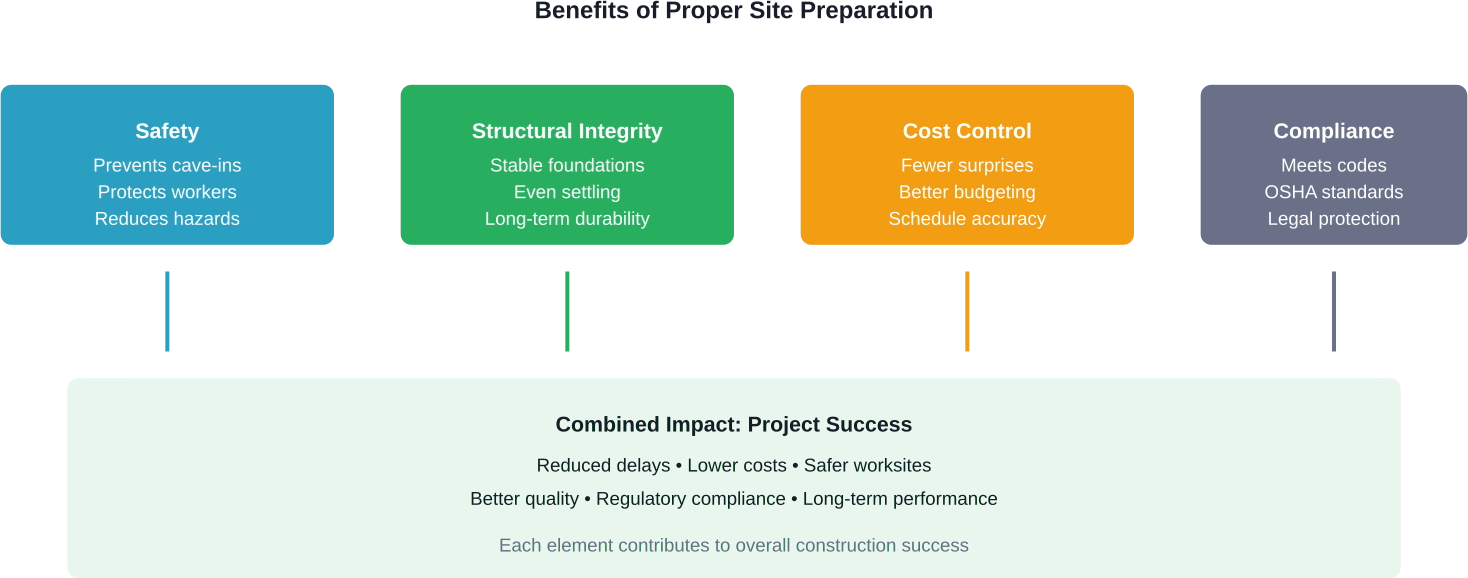
Proper site preparation prevents costly problems down the road. Skipping steps or rushing through this phase creates risks that compound over time.
A well-prepared site ensures structural stability for foundations and buildings. Without proper ground preparation, structures can settle unevenly, crack, or even fail.
Safety Considerations
According to OSHA, the primary hazard of trenching and excavation work is employee injury from cave-ins. Before workers enter trenches, soil analysis should generally be conducted to determine appropriate protection methods such as sloping, benching, shoring, or shielding.
Employers must also consider struck-by hazards associated with heavy equipment, falling loads, and vehicular traffic near excavation areas.
Safe site preparation protects workers throughout the construction lifecycle. It establishes clear access routes, identifies underground utilities, and creates stable working platforms.
Cost Control and Timeline Management
Investment in thorough site preparation reduces expensive surprises during construction. Discovering unsuitable soil conditions or unmarked utilities mid-project can halt work and blow budgets.
Proper preparation allows accurate project scheduling. Contractors can establish realistic timelines when they understand site conditions fully.
Get BIM Support From Powerkh

If your team needs accurate models before work starts, Powerkh can step in with technical BIM support. The company works with construction teams on BIM modeling, BIM coordination, scan to BIM, structural detailing, prefabrication support, and BIM automation. That helps turn drawings, scans, and design files into clearer project documentation.
Need Better Models, Drawings, and Coordination?
Talk with Powerkh to:
- build BIM models from design files or point cloud data
- catch clashes and coordination issues earlier
- prepare shop drawings and fabrication-ready documentation
👉 Contact Powerkh to review your project and BIM needs.
Essential Steps in the Site Preparation Process
Site preparation follows a logical sequence. Each step creates conditions necessary for the next phase.
1. Site Surveying and Assessment
Professional surveyors establish exact property boundaries, topography, and elevation points. This creates the baseline for all subsequent work.
ASTM D420 provides standard guidelines for site characterization for engineering design and construction purposes. This guide helps teams systematically evaluate site conditions.
The survey identifies existing features, access points, and potential obstacles. It also establishes reference points for grade and elevation requirements.
2. Utility Location and Protection
According to OSHA excavation regulations, the estimated location of utility installations—such as sewer, telephone, fuel, electric, water lines, or other underground installations that reasonably may be expected to be encountered during excavation work—shall be determined prior to opening an excavation (29 CFR 1926.651).
This step prevents damage to existing infrastructure and protects workers from electrocution, gas line ruptures, and other utility-related hazards.
3. Clearing and Demolition
Clearing removes vegetation, trees, stumps, rocks, and existing structures. All surface debris gets hauled away to create a clean slate.
For sites with existing buildings, demolition work must proceed carefully. Salvageable materials are often separated for recycling or reuse.
4. Excavation and Earthmoving
Excavation removes soil to required depths for foundations, basements, or underground utilities. Heavy equipment like excavators, bulldozers, and backhoes handle this work.
The amount of excavation depends on project requirements. Some sites need minimal digging while others require significant earth removal.
5. Grading and Leveling
Grading shapes the land to specified elevations and slopes. This ensures proper drainage and creates level building platforms.
According to Carnegie Mellon University’s construction management resources, combined with electro-hydraulic control systems mounted on mobile equipment such as bulldozers, graders, and scrapers, blade height can be precisely and automatically controlled. This automation has reduced costs in some cases significantly.
6. Soil Testing and Compaction
Geotechnical engineers test soil composition, bearing capacity, and drainage characteristics. ASTM D698 provides standard test methods for laboratory compaction characteristics of soil using standard effort (12,400 ft-lbf/ft³).
Soil compaction increases density and stability. Compacted soil provides better support for foundations and reduces settlement risks.
| Soil Condition | Erosion Impact | Recommendation
|
|---|---|---|
| Compacted and smooth | Increases erosion by 30% | Add roughness, vegetation |
| Tracks across slopes | Increases erosion by 20% | Minimize cross-slope traffic |
| Tracks up and down slopes | Decreases erosion by 10% | Route equipment vertically |
| Rough and irregular | Minimal erosion | Maintain texture until stabilized |
7. Drainage System Installation
Proper drainage prevents water accumulation that can undermine foundations or flood work areas. Systems may include French drains, swales, retention ponds, or underground piping.
Site grading works in conjunction with drainage systems to direct water away from structures.
8. Erosion and Sediment Control
Construction sites disturb soil and vegetation, increasing erosion risks. Control measures include silt fences, erosion blankets, temporary seeding, and sediment traps.
These measures protect both the construction site and surrounding properties from sediment runoff.
9. Temporary Facilities Setup
Before construction begins, sites need temporary infrastructure. This includes construction fencing and security barriers, access roads and parking areas, temporary offices and storage sheds, sanitation facilities, and utility connections for construction power and water.
Creating a functional work environment ensures efficiency throughout the project lifecycle.
Critical Factors Affecting Site Preparation
Several variables influence how site preparation proceeds. Understanding these factors helps teams plan effectively.
Soil Composition and Conditions
ASTM standards address problem soils that complicate construction. Soils containing more than 30% oversize fraction (material retained on the 3/4-inch sieve) present problems, with correction factors potentially applicable for soils containing up to about 50 to 70% oversize.
Expansive soils are another concern. ASTM D4829 provides standard test methods for expansion index of soils, helping engineers predict swelling potential that can damage foundations.
Clay-heavy soils, rocky terrain, high water tables, and contaminated land all require specialized approaches.
Site Topography and Accessibility
Steep slopes require more extensive grading work and erosion control measures. Flat sites are generally easier to prepare but may need more attention to drainage.
Access challenges affect equipment mobilization and material delivery. Remote sites with poor road access increase costs and timelines.
Environmental and Regulatory Requirements
Wetlands, protected species habitats, and historical sites impose restrictions on site work. Projects must comply with federal, state, and local environmental regulations.
Permits for grading, excavation, and stormwater management are typically required. Oregon State University Extension provides guidance on protecting trees during construction and development, noting that while best management practices are widely accepted, they don’t guarantee 100% successful tree survival.
Weather and Seasonal Considerations
Wet conditions make earthwork difficult and can damage soil structure. Frozen ground prevents excavation and compaction.
Many projects schedule site preparation during dry seasons to optimize working conditions and soil handling.
Common Risks in Site Preparation
Even with careful planning, site preparation carries inherent risks that require active management.
Worker Safety Hazards
Cave-ins during excavation work represent the primary safety concern according to OSHA. Trenches deeper than five feet generally require protective systems.
Other hazards include equipment strikes, falling loads, utility contact, hazardous atmospheres in excavations, and unstable soil or rock.
OSHA requires testing and controls for hazardous atmospheres in trenches and excavations, particularly when working near landfills, hazardous waste sites, or in oxygen-deficient environments (29 CFR 1926.651).
Unforeseen Site Conditions
Unmarked utilities, buried debris, contaminated soil, unexpected rock formations, and underground voids or sinkholes can halt work and require remediation.
Thorough investigation reduces these surprises but can’t eliminate them entirely.
Environmental Damage
Poor erosion control leads to sediment runoff that pollutes waterways and damages neighboring properties. Disturbing protected habitats or archaeological sites creates legal and financial consequences.
Best Practices for Effective Site Preparation
Following proven practices improves outcomes and reduces risks.
Conduct comprehensive site investigations early. The more information available upfront, the fewer surprises during execution.
Engage qualified professionals. Site preparation requires expertise in surveying, geotechnical engineering, and heavy equipment operation.
Prioritize safety compliance. Follow OSHA regulations, provide proper training, and implement protective systems for excavation work.
Plan for weather contingencies. Build schedule flexibility for weather delays and have erosion control measures ready before storms.
Maintain clear communication among stakeholders. Architects, engineers, contractors, and inspectors need coordinated information.
Document everything. Photo documentation, test results, and as-built surveys create valuable records for the construction phase and future reference.
Technology in Modern Site Preparation
Digital tools are transforming how teams plan and execute site work.
According to research published in the Journal of Computing in Civil Engineering, digitizing construction site layout planning optimizes efficiency and safety. Software helps managers identify optimal placement for temporary facilities and equipment.
GPS and machine control systems enable precise grading. Operators can achieve specified elevations within fractions of an inch, reducing material waste and rework.
Drones survey sites quickly and create detailed topographic maps. This technology captures current conditions and monitors progress throughout preparation.
Building Information Modeling integrates site conditions into design models, helping teams identify conflicts before breaking ground.
How Long Does Site Preparation Take?
Duration varies dramatically based on project scope and site conditions.
Small residential lots might require just a few days for basic clearing and grading. Large commercial or industrial sites can need weeks or months of preparation work.
Factors affecting timeline include site size and complexity, extent of clearing and excavation required, soil conditions and necessary stabilization, weather and seasonal constraints, permit approval processes, and availability of equipment and crews.
Complex sites with difficult soil conditions, extensive utilities, or environmental sensitivities take significantly longer than straightforward projects.
Final Thoughts on Site Preparation
Site preparation forms the literal foundation of construction success. This critical phase transforms raw land into a stable, safe, code-compliant platform ready for building.
The work involves systematic steps—surveying, clearing, excavating, grading, testing, and stabilizing. Each step builds on the previous one, creating conditions necessary for durable structures.
Shortcuts during site preparation create problems that multiply throughout construction and building lifespan. Investment in thorough preparation pays dividends through reduced delays, lower costs, safer worksites, and better long-term performance.
Whether planning a residential home, commercial development, or industrial facility, prioritize site preparation. Engage qualified professionals, follow regulatory requirements, and commit adequate time and resources to this foundational phase.
The quality of site preparation directly determines the success of everything that follows. Build your project on solid ground—literally.
Frequently Asked Questions
What’s included in site preparation costs?
Site preparation costs typically include surveying and engineering services, clearing and demolition, excavation and earthmoving, grading and compaction, drainage installation, erosion control measures, utility location and protection, and temporary facility setup. Costs vary widely based on site conditions and project requirements.
Can construction start before site preparation is complete?
No. Construction should not begin until site preparation is fully complete and inspected. Building on unprepared ground compromises structural integrity, creates safety hazards, and often violates building codes. Proper sequencing is essential for project success.
Who is responsible for site preparation?
Responsibility depends on project delivery method. In traditional design-bid-build, the general contractor typically handles or subcontracts site preparation. Design-build firms manage it as part of their integrated scope. Owners sometimes separately contract site work before engaging building contractors.
What happens if site preparation is done incorrectly?
Poor site preparation leads to foundation settlement, structural cracks, drainage problems, slope failures, code violations requiring correction, project delays and cost overruns, and potential safety incidents. Correcting site preparation mistakes after construction begins is expensive and disruptive.
Do all construction projects require site preparation?
Yes, though the extent varies. Even minor projects need some level of site evaluation and preparation. Large developments require extensive work while small additions might need only minimal clearing and leveling. The principle remains constant—understand and prepare the site before building.
What permits are needed for site preparation?
Common permits include grading and excavation permits, stormwater management permits, erosion control permits, tree removal permits (if applicable), and environmental clearances for sensitive areas. Requirements vary by jurisdiction, so check with local building departments early in planning.
How does site preparation affect project sustainability?
Thoughtful site preparation minimizes environmental impact by preserving existing vegetation where possible, managing stormwater runoff effectively, preventing erosion and sedimentation, protecting natural habitats, and optimizing cut-and-fill to reduce material transport. Sustainable practices align with green building certification requirements.

Our Case Studies
We have handled 200+ BIM & VDC projects for commercial, industrial, and residential sectors.
Our work includes:
Formwork design automation
Our client from
California, USA
Suspended ceiling design automation
Our client from
New York, USA
Wall framing design automation
Our client from
California, USA