Have any questions? Contact us!
Join our team!
Request a free quote or consultation

If you’re in the architecture, engineering, or construction world, you know Revit services are a cornerstone of modern Building Information Modeling (BIM). But let’s talk dollars and cents – how much does it actually cost to use Revit for your projects? Having worked on everything from cozy home redesigns to sprawling commercial complexes, I’ve seen budgets make or break a job. The price of Revit services hinges on two big pieces: the software itself and the expert work to bring those models to life. In this guide, we’ll unpack Autodesk’s subscription options, dive into the value of bundled tools, explore outsourcing costs, and share tips to keep your wallet happy. By the end, you’ll have a clear roadmap to plan your 2026 BIM budget without the guesswork. Let’s dive in and make sense of those numbers!
The Cost of Revit Software: Your Starting Point

Before you even think about hiring a BIM pro, you need the software. Autodesk Revit’s pricing is built for flexibility, catering to freelancers, small firms, and big enterprises alike. As of 2026, costs have crept up slightly with new features like AI-driven design and carbon analysis, but they’re still reasonable for the value.
Subscription Options for Revit
Autodesk offers several ways to access Revit, each with its own price tag. Here’s the breakdown based on current averages:
- Monthly Subscription: Around $380 per user. Perfect for short-term projects or testing the waters, this gives you full access to the latest version, cloud collaboration, and support.
- Annual Subscription: Roughly $3,005 per user, which works out to about $250 a month – a 22% savings over monthly billing. Ideal for teams committed for a year.
- Three-Year Subscription: Approximately $9,020 per user. This locks in your rate, shielding you from price hikes, and includes all updates and tools.
These subscriptions come with perks like access to previous versions, administrative tools for team management, and the ability to work anywhere with cloud syncing. I’ve seen firms save by going annual, especially when they know Revit’s their go-to for multiple projects.
Free Access for Students and Educators
If you’re learning the ropes, Autodesk’s Education plan is a gem. It offers free access to Revit and the entire Autodesk portfolio for students and educators, strictly for non-commercial use. This is a fantastic way to build skills without spending a dime, though you’ll need a paid license for professional work.
Powerkh Cost-Effective BIM Solutions

We are a UK-based company with additional offices in Ukraine and the USA, specializing in Revit-based architectural, engineering, and construction services. Powerkh provides 3D modeling solutions for a variety of industries, supporting clients throughout the design, planning, and construction phases. Using Revit software, we create accurate digital models of buildings and infrastructure, which are used for visualizations and technical documentation.
In addition to Revit modeling, we offer BIM (Building Information Modeling) coordination, clash detection, and design optimization services. These services help improve project efficiency, reduce errors, and enhance collaboration between architects, engineers, and contractors. We ensure that all project details align with client requirements and industry standards.
Our team, experienced in both traditional and digital modeling, focuses on delivering accurate and cost-effective solutions. By leveraging Revit, we provide precise results, ensuring smooth project execution for clients worldwide.
Key Highlights:
- UK-based company with offices in Ukraine and the USA
- Specializes in Revit-based architectural, engineering, and construction services
- Offers 3D modeling, BIM coordination, clash detection, and design optimization
- Focus on delivering accurate, cost-effective, and efficient solutions
- Experienced team skilled in both traditional and digital modeling techniques
- Serves clients across various industries, ensuring alignment with client needs and industry standards
The AEC Collection: Bundling for Bigger Savings
Revit’s powerful, but many projects need more than one tool. The Architecture, Engineering & Construction (AEC) Collection bundles Revit with essentials like AutoCAD, Navisworks, Civil 3D, and Forma, creating a seamless workflow from design to construction. For teams juggling multiple disciplines, this is often the smarter buy.
Pricing the AEC Collection
Here’s how the costs stack up in 2026:
- Monthly: Around $460 per user, giving you the full suite for short-term needs.
- Annual: Roughly $3,675 per user, or $306 a month, offering significant savings over buying Revit and AutoCAD separately (which could top $4,000 yearly).
- Three-Year: Approximately $11,030 total, breaking down to under $306 a month. This long-term option maximizes savings and locks in pricing.
The collection shines for projects needing coordination across architecture, structural, and MEP systems. Tools like Navisworks for clash detection or Forma for conceptual design can cut hours off your workflow. In my experience, firms using the collection save 20-30% compared to standalone licenses, especially when scaling up for larger teams.
Added Value of the Collection
Beyond cost savings, the AEC Collection offers:
- Cloud-based collaboration via Autodesk Docs, making remote teamwork a breeze.
- Integration with tools like Insight for energy analysis, crucial for green building compliance.
- Access to 3ds Max for high-end visualizations, perfect for client presentations.
If your projects involve site planning or complex coordination, this bundle is a no-brainer. Just watch for add-ons like BIM Collaborate Pro, which can add $500-700 annually for advanced sharing features.
Flex Option: Pay Only When You Need It
Not every project demands full-time Revit access, especially for freelancers or one-off tasks. Autodesk’s Flex option lets you pay as you go, using tokens for 24-hour access periods. A pack of 100 tokens costs about $300, and Revit uses 10 tokens per day.
Flex Cost Breakdown
- Daily Cost: Roughly $30 (10 tokens/day at $3/token).
- Weekly Estimate: $150-200 for five days of use, depending on token purchases.
- Monthly Comparison: For heavy use (20 days/month), you’re at $600, making annual subs cheaper for regular users.
Flex is great for consultants doing quick models or client reviews. I’ve used it for last-minute revisions, saving the hassle of a full subscription. But if you’re logging more than 10 days a month, crunch the numbers – an annual plan might save you cash.
Outsourcing Revit Services: The Human Element
Software’s just the start – Revit services often mean hiring experts for modeling, coordination, or analysis. Outsourcing is a go-to for teams lacking in-house BIM skills or facing tight deadlines. Costs vary based on task complexity, location, and expertise, but here’s what I’ve seen in 2026.
Hourly Rates for Revit Professionals
Hourly billing is common for flexible or smaller tasks. Here’s a snapshot of average rates:
- Basic Drafting: $25-50/hour for 2D-to-3D conversions or simple modeling by junior drafters.
- BIM Modeling: $50-100/hour for experienced modelers handling LOD 100-400 models.
- Specialized Roles (MEP/Structural): $100-200/hour for certified pros tackling complex systems like HVAC or steel detailing.
- National Average: Around $39/hour for general BIM consultants, though quality work in the US often hits $60-100/hour.
Offshore providers, especially in Eastern Europe or Asia, can drop to $20-40/hour, offering savings if you manage communication well. Always check portfolios – low rates can lead to sloppy models that cost more to fix.
Fixed-Price Models for Predictable Budgets
For larger projects, fixed pricing offers clarity. Here’s what to expect:
- Small Projects (e.g., residential): $1,500-2,500 for basic drafting or modeling.
- Mid-Size Commercial (10,000 sq ft): $3,000-9,000 for LOD 300-400 models, averaging $0.30-0.90/sq ft.
- Large Projects (50,000+ sq ft): $5,000-100,000, depending on complexity and detail level.
- Scan to BIM: $0.10-0.20/sq ft for modeling, plus $200-500/hour for scanning equipment, totaling $5,000-50,000 for renovations.
Fixed contracts often include 1-2 revision rounds. I’ve found hybrid models (hourly with a cap) work well to balance flexibility and cost control.
Factors That Drive Revit Service Costs
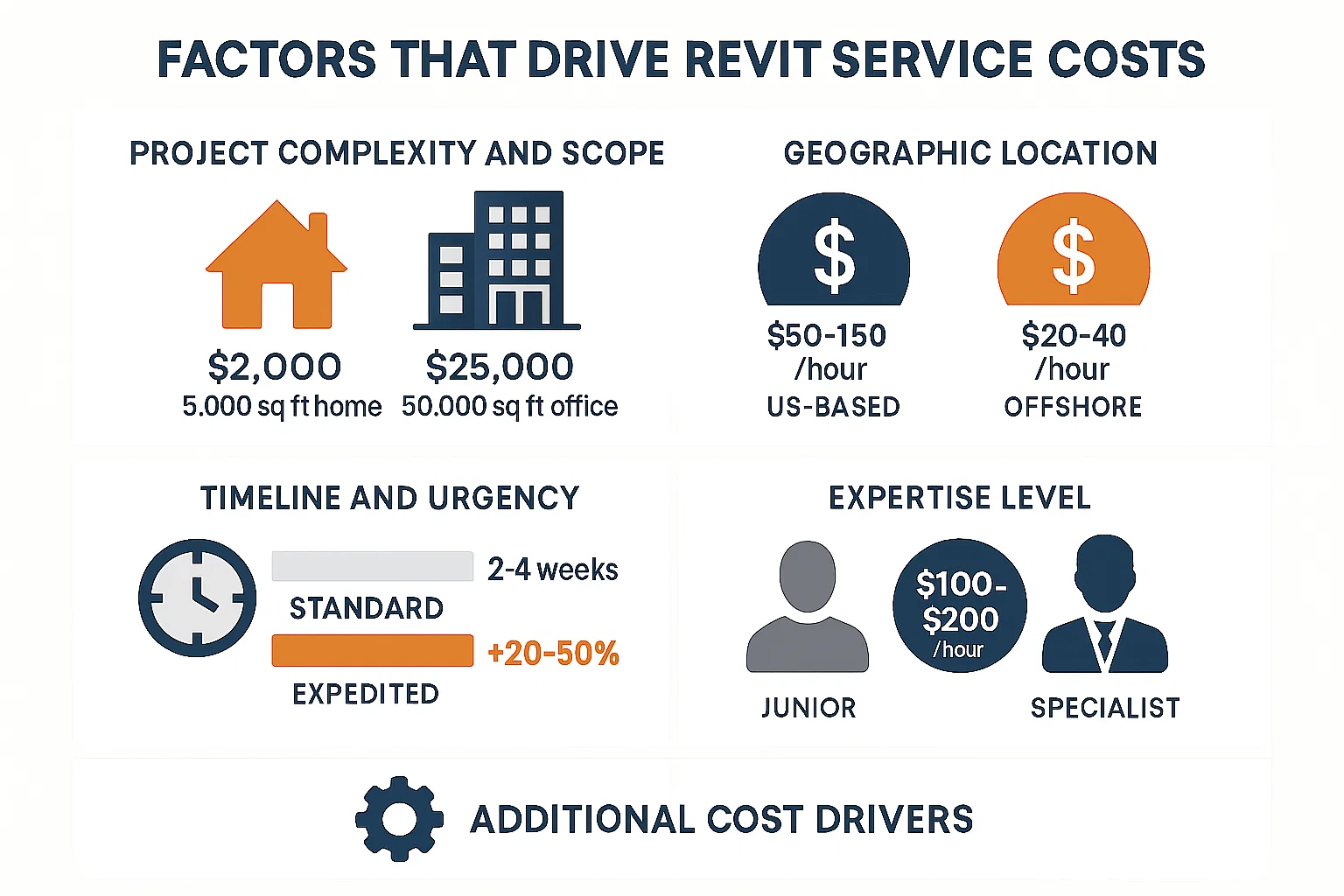
Pricing isn’t pulled out of thin air – it’s shaped by several variables. Understanding these helps you budget smarter.
Project Complexity and Scope
Simple residential models cost less than intricate hospitals with MEP systems. Higher LODs (like 500 for as-builts) push prices up due to added detail. A 5,000 sq ft home might run $2,000, while a 50,000 sq ft office could hit $25,000.
Geographic Location
US-based pros charge $50-150/hour, reflecting higher labor costs and code expertise. Offshore rates ($20-40/hour) save money but may need extra oversight for quality and compliance.
Timeline and Urgency
Rush jobs add 20-50% premiums. A standard model might take 2-4 weeks; expedited could cost $75-200/hour to meet tight deadlines.
Expertise Level
Junior drafters are cheaper but risk errors. Certified BIM managers or MEP specialists charge more ($100-200/hour) for precision and experience, saving rework costs.
Additional Cost Drivers
- Software Add-Ons: Custom plugins or integrations add $500-2,000.
- Revisions: Unlimited changes inflate bills; cap at 2-3 rounds.
- Certifications: LEED or BIM-accredited pros charge 10-20% more.
- Project Volume: Long-term contracts may offer 10-15% discounts.
A tip from experience: Always overestimate scope by 10-20% to cover surprises like last-minute client tweaks.
Costs for Specialized Revit Services
Not all Revit tasks cost the same. Here’s a closer look at niche services and their price ranges.
Family Creation
Building custom components like unique fixtures runs $50-100/hour or $500-2,000 per set. Complex families with parametric controls lean toward the higher end.
BIM Coordination and Clash Detection
Resolving conflicts across disciplines averages $75-125/hour. Full project coordination, including Navisworks reviews, costs $2,000-10,000, depending on scale.
Prefabrication and Detailing
Design-to-fabrication workflows for CNC manufacturing or shop drawings run $100-150/hour. A mid-size project’s detailing might total $5,000-20,000.
Energy and Sustainability Analysis
Using Insight for energy simulations costs $1,000-5,000 per project, driven by model complexity and reporting needs.
Scan to BIM
Converting laser scans to models averages $0.10-0.20/sq ft, with scanning equipment at $200-500/hour. A 20,000 sq ft retrofit could run $7,000-15,000 total.
Bundling services (e.g., modeling plus coordination) often nets 5-10% discounts, so ask providers about package deals.
Strategies to Optimize Revit Service Costs
Saving money without sacrificing quality is the goal. Here are practical ways to stretch your budget:
- Compare Multiple Quotes: Get bids from 3-5 providers to gauge value, not just the lowest price.
- Leverage Offshore Talent: Rates in Asia or Eastern Europe can be 50% lower, but ensure clear communication and quality checks.
- Train In-House Staff: Use free Education access to upskill employees, cutting outsourcing needs by 30-50%.
- Use Flex for Short Tasks: Avoid full subscriptions for one-off jobs; $30/day via Flex can suffice.
- Negotiate Retainers: Long-term partnerships often yield 10-15% discounts.
- Define Clear Scopes: Detailed briefs prevent scope creep, keeping costs predictable.
One lesson I’ve learned: Cheap providers can lead to expensive fixes. Invest in quality upfront to avoid headaches later.
Real-World Cost Scenarios
Let’s put it in context with some examples:
- Small Residential Project: Annual Revit sub ($3,000) plus freelance modeling ($1,500 fixed) = ~$4,045 total.
- Mid-Size Office (50,000 sq ft): AEC Collection ($3,675/year) plus LOD 400 modeling ($0.50/sq ft = $25,000) and coordination ($5,000) = ~$32,825.
- Historic Renovation: Flex tokens ($300 for 10 days) plus scan to BIM ($10,000 for 20,000 sq ft) = ~$10,300.
- MEP Coordination for Hospital: Annual sub ($3,000) plus specialist at $150/hour for 100 hours = ~$17,545.
These ballparks show how costs scale with project needs. Always get custom quotes for accuracy.
Wrapping Up: Budgeting for Revit Success in 2026
Revit services are an investment in smoother, smarter projects, but costs can vary widely. Software subscriptions range from $365/month to $9,000 for three years, with the AEC Collection offering value at $3,675/year. Outsourcing averages $50-150/hour or $0.30-0.90/sq ft, depending on complexity and expertise. By understanding your project’s scope, comparing options, and leveraging tools like Flex or training, you can keep costs in check while reaping BIM’s benefits. As someone who’s seen Revit save projects from costly errors, I’d say it’s worth every penny when done right. Ready to budget your next job? Start with a clear scope and shop around – your bottom line will thank you.
Frequently Asked Questions
What’s included in a Revit subscription?
A Revit subscription provides access to the latest and previous versions, cloud collaboration, administrative tools, and automatic updates. You can use the software anywhere, with support for remote and on-site work.
Is the AEC Collection worth it over standalone Revit?
For teams needing multiple tools (e.g., AutoCAD, Navisworks), the AEC Collection at $3,675/year saves 20-30% compared to separate licenses. It’s ideal for multidisciplinary projects requiring coordination and analysis.
How much does outsourcing Revit modeling typically cost?
Basic modeling averages $50-100/hour or $0.30-0.90/sq ft for LOD 300-400. Specialized tasks like MEP or scan to BIM can hit $100-200/hour or $5,000-50,000 per project, depending on scope.
Can I save money on Revit services without losing quality?
Yes, compare quotes, use offshore providers ($20-40/hour), leverage Flex for short tasks ($30/day), or train staff with free Education access. Clear scopes and capped revisions also prevent cost overruns.
Our Case Studies
We have handled 200+ BIM & VDC projects for commercial, industrial, and residential sectors.
Our work includes:
Formwork design automation
Our client from
California, USA
Suspended ceiling design automation
Our client from
New York, USA
Wall framing design automation
Our client from
California, USA


