Have any questions? Contact us!
Join our team!
Request a free quote or consultation

Virtual Construction Explained: Meaning, Benefits, and How It Works
Virtual construction is the practice of building your project digitally before a single crew shows up on site. Teams use coordinated models, schedules, and cost data to test ideas, spot clashes, and plan the work with fewer surprises. It is often called VDC, short for virtual design and construction. Think of it as a rehearsal. BIM provides the detailed model. VDC turns that model into a working plan that links people, tasks, materials, and money. The result is better coordination, clearer decisions, and a build that stays closer to the budget and timeline you set.
What is Virtual Construction?
At its core, virtual construction is the practice of creating a digital version of a project before physical work begins. Using 3D models, data, and project management tools, teams can rehearse every step virtually. That includes design coordination, scheduling, cost estimation, safety planning, and even ongoing operations once the building is complete.
It is often called VDC. While BIM (Building Information Modeling) provides the digital blueprint of a building, VDC is the broader framework that uses that model to manage the entire project. Think of BIM as the detailed drawing and VDC as the playbook that makes sure the drawing becomes a real building with fewer surprises.
Virtual Construction vs. BIM
It is easy to confuse BIM and VDC, but they are not the same thing. BIM is a technology that creates a data-rich model of the building. That model shows geometry, materials, and systems like HVAC, plumbing, and electrical. It helps designers and engineers see how everything fits together.
VDC takes that model further. It uses BIM data to plan schedules, track costs, and manage collaboration between teams. For example:
- BIM answers “What does the building look like and how is it designed?”
- VDC answers “How do we build it, when, at what cost, and with which team?”
BIM is the foundation. Virtual construction is the bigger picture that turns information into real-world execution.
Why Virtual Construction is Becoming Essential
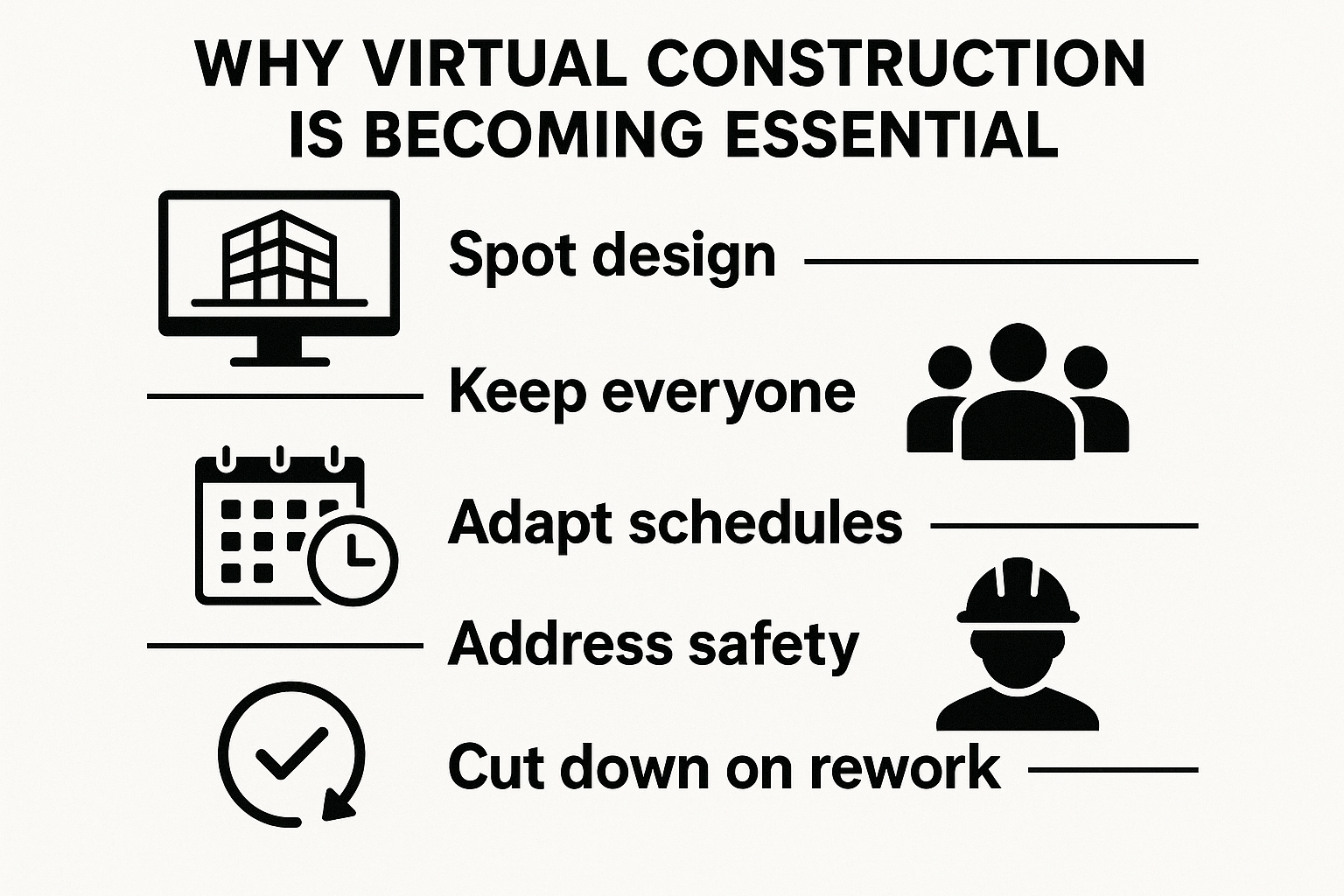
If construction projects always followed a script with the same design, the same people, and the same conditions, virtual construction would be unnecessary. But that is not how the industry works. Every project brings its own mix of variables. A design tweak in the middle of planning, a new subcontractor joining late, or unexpected soil conditions can shift timelines and budgets instantly. These realities create a moving target that traditional methods struggle to manage.
Virtual construction provides a flexible framework to deal with this complexity. By building a project digitally first, teams can identify risks in a controlled environment before they show up in the field. This approach lets project leaders:
- Spot design clashes early: Digital models highlight conflicts between structural, mechanical, and electrical systems before they turn into expensive rework.
- Keep everyone on the same page: A shared, up-to-date model eliminates the confusion caused by outdated drawings or siloed communication.
- Adapt schedules and budgets quickly: When plans shift, teams can test scenarios virtually to see the impact on costs and timelines before committing resources.
- Address safety before work begins: Potential hazards, such as poor site access or unsafe equipment placement, can be identified and resolved in the model stage.
- Cut down on rework: Problems solved virtually do not become expensive fixes on site, which reduces both material waste and lost time.
At its core, virtual construction is about shifting uncertainty out of the physical environment and into a digital one. It is faster, cheaper, and safer to test solutions on a screen than it is to correct mistakes with crews, cranes, and materials already in motion. That shift is why VDC is quickly moving from a nice-to-have to a standard practice in modern construction.
How to Bring Virtual Construction to Life With Powerkh

At Powerkh, we focus on making construction easier to manage and more predictable. Our team has delivered more than 200 BIM and VDC projects across the US, UK, and Europe, and we know that every client comes with unique challenges. That’s why we don’t just provide models or drawings – we help you rethink the way your projects are planned, coordinated, and executed.
What sets us apart is the combination of technical expertise and practical workflow support. We work with architects, engineers, contractors, and on-site teams to build accurate BIM models, coordinate between disciplines, and automate time-consuming processes. Our goal is to cut down on rework and help your teams stay aligned from design through fabrication.
Why Clients Choose Us
- Proven experience: Over 200 successful BIM and VDC projects delivered across different sectors
- Speed and efficiency: Automation solutions that make routine processes up to three times faster
- Detailed outputs: Models up to LOD 500, shop drawings, and fabrication-ready detailing
- Adaptability: We stay responsive to design changes, shifting schedules, and evolving requirements
- Ongoing support: We remain engaged after delivery to help teams implement and refine workflows
With us, you get more than a service provider – you get a partner who makes sure your project runs smoother, safer, and with fewer surprises. Whether it’s BIM modeling, scan-to-BIM, prefabrication, or automation, our team is here to make the digital side of construction work for you.
The Lifecycle of a Project with Virtual Construction
Virtual construction extends across the entire project lifecycle, from the earliest design concepts to the day-to-day operation of a finished building. Each phase benefits differently, but together they form a continuous chain that reduces uncertainty and improves outcomes.
1. Pre-Construction
The planning stage is where virtual construction shows its strongest impact. Teams create detailed digital models that combine architectural, structural, and MEP systems into a single coordinated view. Instead of waiting for conflicts to emerge on site, potential issues like plumbing intersecting with ductwork can be identified and resolved before a shovel ever hits the ground.
Beyond clash detection, the pre-construction phase also uses virtual tools to refine cost estimates, link tasks to schedules through 4D modeling, and map out the use of labor, equipment, and materials. Safety can also be addressed early by simulating construction sequences and testing different scenarios. The outcome is not just a model, but a roadmap that outlines the project’s entire path forward with greater accuracy and confidence.
2. Construction Phase
Once crews begin work on site, the virtual model becomes a living reference point that keeps everyone aligned. Instead of relying on stacks of drawings that quickly become outdated, project teams access current information directly through platforms such as Procore or BIM 360.
This allows managers and subcontractors to track progress in real time, compare actual site conditions with the digital plan, and adjust workflows when unexpected challenges appear. Virtual construction acts as a buffer against delays by making coordination easier and ensuring that decisions are made based on accurate, up-to-date data. Rather than reacting to problems after they occur, teams can anticipate issues and adjust proactively.
3. Post-Construction and Operations
The value of virtual construction does not end when the building opens. The digital models created during design and construction evolve into long-term resources for owners and operators. These models provide detailed records of system layouts, materials, and equipment that support maintenance, repairs, and upgrades.
At this stage, digital twins become especially powerful. A digital twin is a continuously updated virtual version of the building, fed by data from sensors and operational systems. By linking VDC practices with digital twin technology, facility managers can monitor performance in real time, optimize energy use, and plan future modifications more efficiently. What starts as a planning tool ultimately becomes a management system for the building’s entire lifecycle.
Key Benefits of Virtual Construction
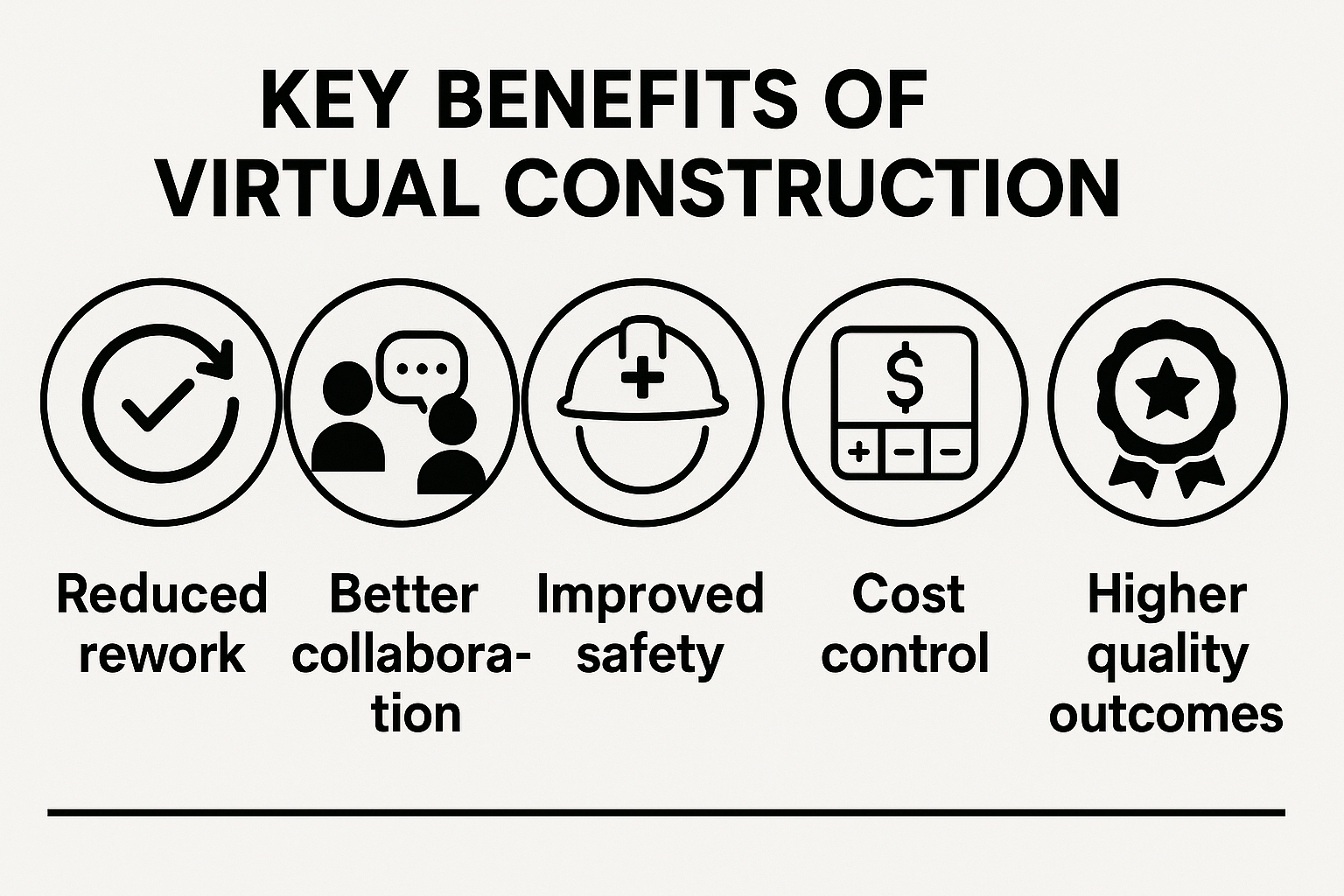
The value of virtual construction shows up in several areas. These benefits extend across planning, construction, and operations, making projects more predictable and efficient.
- Reduced rework: Detecting clashes and design conflicts early avoids costly fixes later. By resolving issues in the model instead of on site, teams save time, prevent material waste, and keep projects on schedule.
- Better collaboration: Shared digital models keep architects, engineers, contractors, and owners on the same page. Everyone works with the latest data, which reduces miscommunication and makes decision-making faster and clearer.
- Improved safety: Hazards can be identified and addressed virtually before work begins. Simulating site conditions and construction sequences allows teams to spot risks in advance and create safer environments for crews.
- Cost control: Linking models to budgets and schedules makes it easier to track spending and reduce waste. Teams can forecast costs more accurately, adjust resources as needed, and maintain financial oversight throughout the project.
- Higher quality outcomes: Projects are built closer to the design intent with fewer defects at handover. Systems are better coordinated, errors are reduced, and owners receive buildings that perform as expected.
Challenges and Limitations
While the benefits are clear, virtual construction is not without hurdles. Successful adoption often depends on how well organizations prepare for the transition and support their teams. Some of the most common challenges include:
- Adoption resistance: Some teams are slow to embrace new technology or lack the training to use it effectively. Shifting from traditional drawings and workflows to digital models requires a cultural change as much as a technical one.
- Upfront investment: The cost of software, hardware, and skilled staff can feel like a barrier, especially for smaller firms. Although the long-term savings are significant, the initial financial commitment may discourage some companies.
- Data management: Virtual construction involves coordinating huge amounts of information from different stakeholders and systems. Without strong processes in place, teams risk version conflicts, duplicated work, or gaps in communication.
- Project variation: No two projects are identical. Workflows that succeed on one build may need to be rethought on the next. Adapting models and processes to fit unique project requirements takes effort, flexibility, and strong collaboration.
These issues are not deal-breakers, but they highlight the importance of planning VDC adoption carefully. With clear strategies, consistent training, and stakeholder alignment, most of these challenges can be managed and gradually reduced as teams gain experience.
What’s Next for Virtual Construction
The future of virtual construction is closely tied to digital twins, artificial intelligence, and real-time connectivity. As more sensors and IoT devices feed data back into models, buildings can be managed almost entirely in a digital environment. This shift turns the model into more than just a reference – it becomes a living system that mirrors the building’s actual performance.
We are also seeing rapid growth in automation. Scheduling, resource allocation, and safety analysis are beginning to move beyond simple visualization. Systems are learning to recommend optimizations based on data patterns, and in some cases, even execute adjustments automatically. This evolution reduces manual oversight and allows teams to focus on decision-making rather than routine tasks.
Another area gaining traction is predictive analytics. By combining project data with AI, teams will be able to anticipate delays, forecast maintenance needs, and even optimize energy performance before problems surface.
For owners and contractors, this all translates into greater visibility and control not only during construction but throughout the full lifecycle of a building. In the near future, virtual construction will not just support projects, it will guide them, making buildings smarter, safer, and more cost-effective to operate long after handover.
Conclusion
Virtual construction is no longer just a niche tool for complex projects. It is quickly becoming a standard practice for teams that want to avoid surprises, cut costs, and deliver higher-quality buildings. By combining BIM models with scheduling, budgeting, and collaboration tools, VDC brings clarity to every stage of a project.
From design through operations, virtual construction helps teams rehearse before they perform. The result is fewer errors, smoother workflows, and buildings that live up to their intent. For an industry known for tight margins and unpredictable schedules, that is a welcome shift.
Frequently Asked Questions
What is virtual construction in simple terms?
Virtual construction is the process of building a project digitally before physical work starts. It uses 3D models, scheduling tools, and data to test designs, plan workflows, and spot problems early.
How is virtual construction different from BIM?
BIM creates a detailed digital model of a building, showing geometry and systems. Virtual construction (also called VDC) uses that model to manage the full project: from schedules and costs to collaboration and safety planning.
What are the main benefits of virtual construction?
The biggest benefits include fewer design clashes, better collaboration between teams, improved safety, stronger cost control, and higher quality outcomes at handover. It helps projects stay on time and within budget.
Who uses virtual construction?
Virtual construction is used by architects, engineers, contractors, and owners. It is especially valuable for complex projects with multiple stakeholders who need to coordinate in real time.
What software is commonly used in virtual construction?
Popular tools include Autodesk Revit, Navisworks, Synchro, Procore, and BIM 360. Matterport and other reality capture tools are also used to create digital twins and connect on-site data to the virtual model.
Is virtual construction expensive to implement?
There is an upfront cost for software and skilled staff, which can be a challenge for smaller firms. However, the long-term savings from reduced rework, fewer delays, and better resource management often outweigh the initial investment.
Does virtual construction end after the project is built?
No. The digital models created can be used for operations and maintenance. With digital twins, building owners can monitor performance, plan repairs, and optimize systems throughout the building’s lifecycle.
Our Case Studies
We have handled 200+ BIM & VDC projects for commercial, industrial, and residential sectors.
Our work includes:
Formwork design automation
Our client from
California, USA
Suspended ceiling design automation
Our client from
New York, USA
Wall framing design automation
Our client from
California, USA