Have any questions? Contact us!
Join our team!
Request a free quote or consultation

If you’ve ever been on a construction site, you know the chaos that can erupt – a missed measurement, a last-minute design change, or a miscommunication that sends costs skyrocketing. I’ve been there, juggling plans and trying to keep everyone aligned. That’s where Virtual Design and Construction (VDC) services come in, and let me tell you, they’re a game-changer. VDC lets you build a project digitally first, spotting issues before they become expensive mistakes. It’s not just tech for tech’s sake – it’s about making construction smoother, cheaper, and safer. In this article, I’ll dive deep into what VDC services are, how they work, who they help, and why they’re becoming a must-have in 2025. Expect practical insights, a bit of my own experience, and tips to make your next project a success.
Understanding VDC: The Foundation of Modern Construction
At its heart, Virtual Design and Construction is about creating a digital twin of your entire project before any physical work begins. Think of it like a video game where you can test every move, tweak designs, and predict outcomes without risking real-world resources. It’s a blend of technology and strategy that brings architects, engineers, contractors, and clients together in a virtual space to plan every detail – down to the last pipe and beam.
Why VDC Matters in 2025
In today’s fast-paced construction world, where budgets are tight and timelines are tighter, VDC is a lifeline. It uses 3D models packed with data to simulate building processes, catch errors, and optimize workflows. I’ve seen projects where VDC turned a potential disaster – like a structural clash that would’ve delayed work for weeks – into a quick fix done in a virtual meeting. It’s not just for mega-projects either; even small renovations benefit from this level of foresight.
The Evolution of VDC
VDC has roots in older tech like CAD, but it’s evolved into a powerhouse with advancements in cloud computing and real-time collaboration. Unlike traditional methods relying on 2D drawings and crossed fingers, VDC integrates data across disciplines, making it easier to spot issues early. In 2025, with sustainability and efficiency driving the industry, VDC’s ability to adapt to complex demands – like green building codes – makes it indispensable.
VDC vs. BIM: Untangling the Two
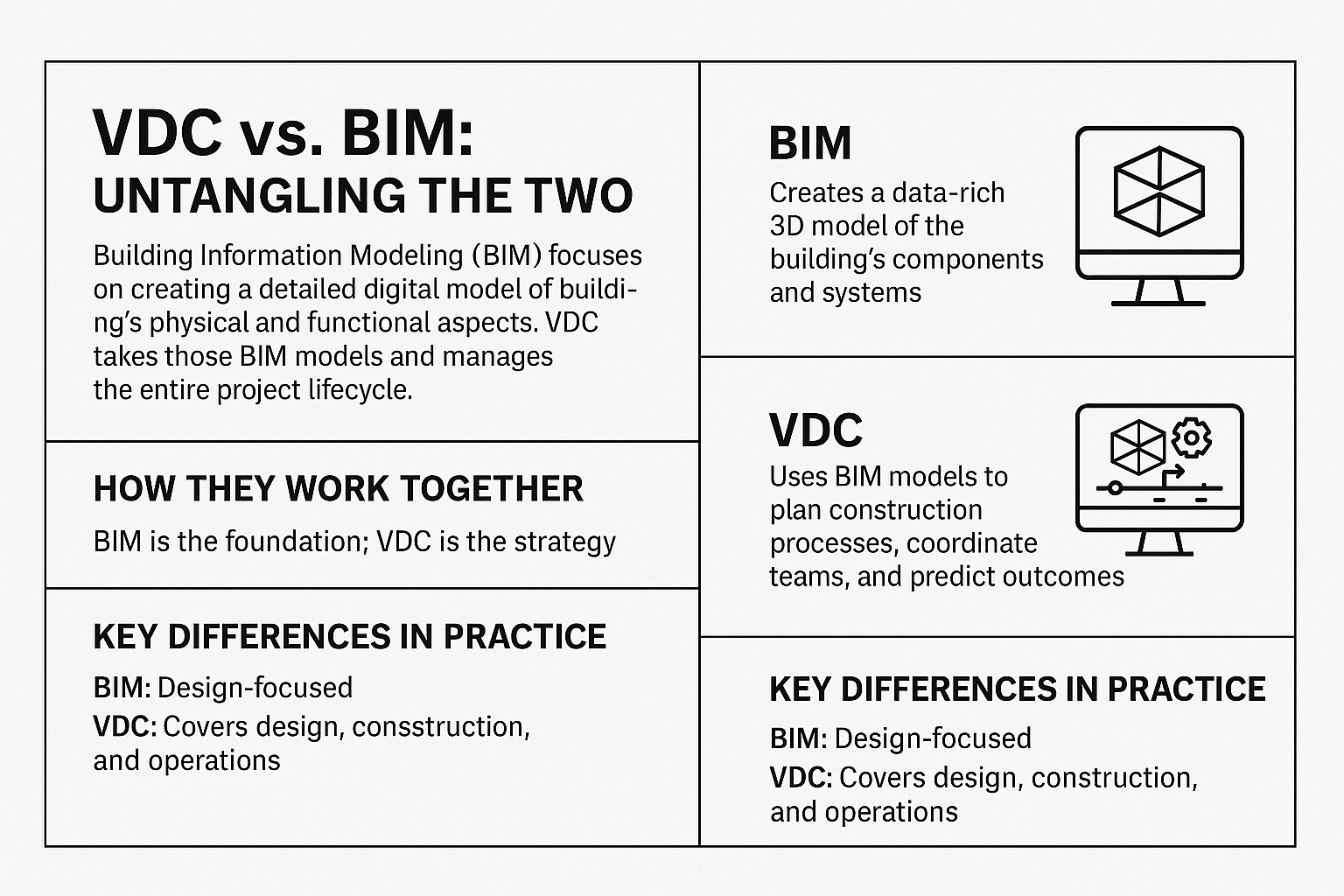
A common question I hear is, “Isn’t VDC just BIM?” Not quite, though they’re close cousins. Building Information Modeling (BIM) focuses on creating a detailed digital model of a building’s physical and functional aspects – think walls, HVAC systems, and material specs. VDC takes those BIM models and runs with them, using them to manage the entire project lifecycle, from cost estimates to scheduling and risk analysis.
How They Work Together
BIM is the foundation; VDC is the strategy. For example, BIM might show you where a duct runs, but VDC simulates how to install it without hitting a steel beam. I worked on a project where BIM gave us a stunning model, but only VDC caught a timeline snag that saved us from missing a deadline. If you’re starting out, think of BIM as the detailed map and VDC as the GPS guiding you through the journey.
Key Differences in Practice
Here’s a quick comparison to clarify:
- BIM: Creates a data-rich 3D model of the building’s components and systems.
- VDC: Uses BIM models to plan construction processes, coordinate teams, and predict outcomes.
- Scope: BIM is design-focused; VDC covers design, construction, and even post-build operations.
Understanding this distinction helps teams choose the right approach. If you’re only modeling, BIM might suffice, but for end-to-end project management, VDC is the way to go.
Powerkh's VDC Services: Streamlining Construction with Cutting-Edge Solutions

At Powerkh, we are a UK-based company specializing in Virtual Design and Construction (VDC) services, with offices in the United States and Ukraine. We assist clients in adopting VDC technologies to streamline workflows and ensure efficient collaboration between architectural, structural, and MEP systems.
Our services include BIM modeling, BIM coordination, Scan to BIM, prefabrication, and structural engineering. We use advanced tools to deliver practical solutions for clash detection, generative design, and workflow automation. These services are designed to address project-specific needs while improving efficiency for architects, engineers, contractors, and on-site teams.
In our company, we use VDC principles to manage complex construction projects. By integrating advanced digital tools, we help clients make informed decisions, improve coordination, and deliver accurate project outcomes. Our work includes detailed shop drawings, prefabrication workflows, and automation processes tailored to meet project goals.
Key Highlights:
- UK-based company with additional offices in the United States and Ukraine.
- Specializes in Virtual Design and Construction (VDC) services to improve project workflows and collaboration.
- Utilizes advanced digital tools for clash detection, generative design, and workflow automation.
- Focuses on integrating architectural, structural, and MEP systems for seamless coordination.
- Provides tailored solutions for architects, engineers, contractors, and on-site teams.
The Building Blocks of VDC Services
VDC services rely on a few core components that make them tick. Each piece is like a gear in a well-oiled machine, ensuring projects run smoothly from concept to completion.
Digital Modeling
This is the backbone – creating 3D models that represent every part of the project, from structural elements to MEP (mechanical, electrical, plumbing) systems. These aren’t just visuals; they’re loaded with data on costs, materials, and timelines, making them a single source of truth.
Integrated Workflows
VDC brings everyone – designers, builders, clients – into a shared virtual environment. Instead of passing paper plans around, teams access the same model in real-time, cutting down on miscommunication. I’ve seen teams save hours just by avoiding version-control mix-ups.
Data-Driven Collaboration
The models generate insights that guide decisions. For instance, you can analyze material costs or predict maintenance needs, helping teams stay proactive. This data-sharing aspect is what makes VDC so powerful – it’s like having a crystal ball for your project.
Simulation and Visualization
VDC lets you simulate construction sequences and visualize outcomes. Want to see how a crane will maneuver on-site? Run it virtually. Need client buy-in? Show them a 3D walkthrough. This step catches issues early and builds confidence.
How VDC Works: A Step-by-Step Journey
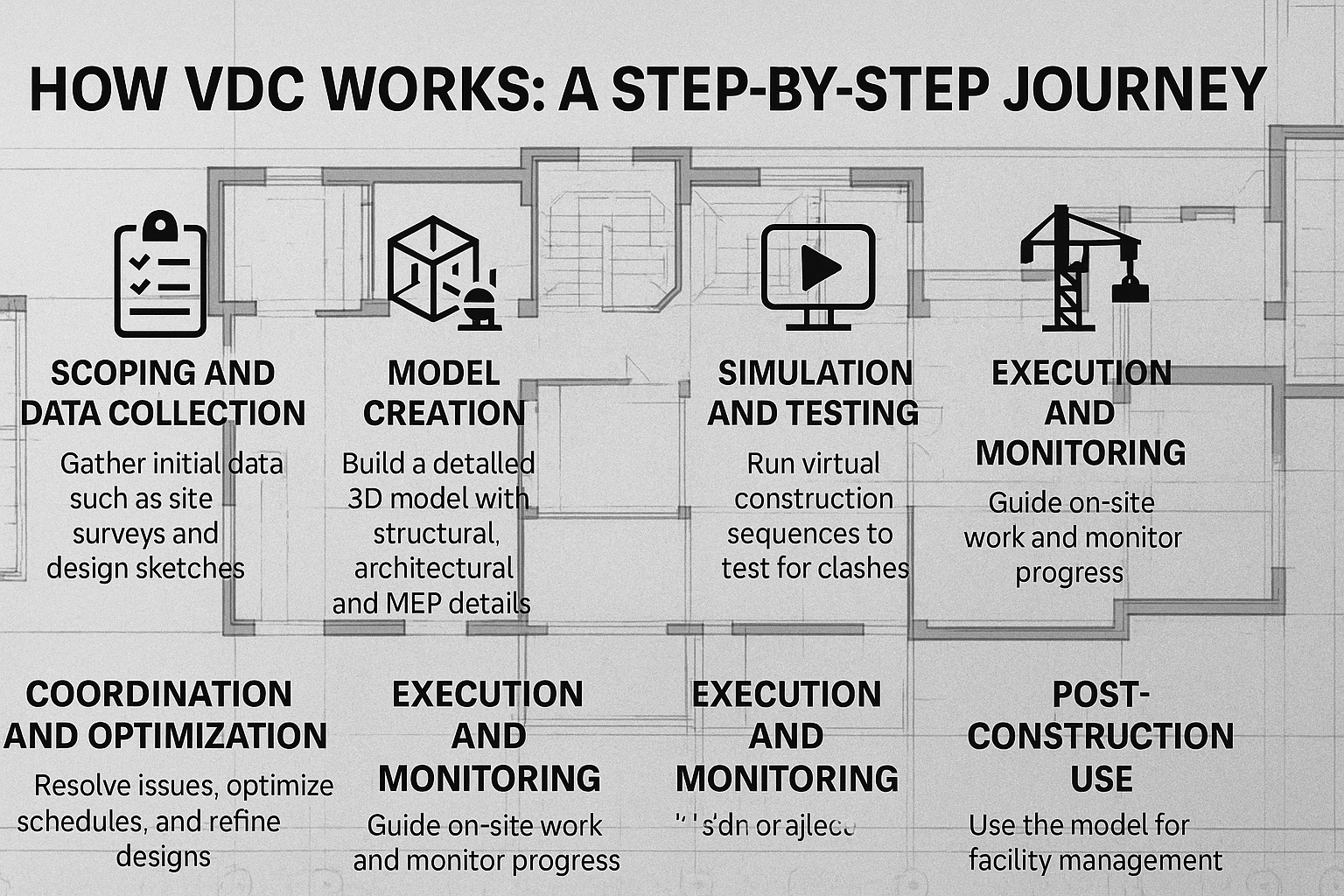
Let’s walk through how VDC services play out in a real project. It’s not a rigid process; it’s iterative, adapting as needs evolve. Here’s the breakdown:
- Scoping and Data Collection: Teams gather initial data – site surveys, design sketches, and client goals. This sets the stage for accurate modeling.
- Model Creation: Using advanced software, a 3D model is built, incorporating structural, architectural, and MEP details. It’s detailed down to the nuts and bolts.
- Simulation and Testing: Run virtual construction sequences to test for clashes or inefficiencies. For example, check if plumbing conflicts with electrical conduits.
- Coordination and Optimization: Teams collaborate to resolve issues, optimize schedules, and refine designs. Clash detection tools are key here, flagging problems automatically.
- Execution and Monitoring: As construction begins, the model guides on-site work. Updates feed back into the system, keeping everything aligned.
- Post-Construction Use: The model supports facility management, tracking maintenance and upgrades long after the build.
I recall a hospital project where this process caught a major HVAC conflict early. Fixing it digitally took a day; fixing it on-site would’ve cost weeks and thousands. That’s VDC’s real-world impact.
Tools That Power VDC: The Tech Behind the Magic
VDC services lean on a robust tech stack to deliver results. The right tools make all the difference, and they’re more accessible than ever in 2025.
Modeling Software
These create the 3D models, handling everything from basic geometry to complex MEP systems. They’re data-rich, supporting calculations for cost and performance.
Collaboration Platforms
Cloud-based tools let teams access models anywhere, anytime. Real-time updates mean no one’s working off outdated info, which is a lifesaver for global projects.
Simulation and Analysis Tools
These run clash detection, scheduling, and risk assessments. Some even integrate time (4D) or cost (5D) data, giving a fuller picture of project needs.
Emerging Tech
Automation tools like scripting speed up repetitive tasks, while drones feed site data into models. AR and VR are gaining ground for immersive reviews, letting teams “walk” the site virtually.
Choosing tools depends on your project’s complexity. Start with ones that integrate well and have strong support communities. I’ve seen teams struggle with mismatched software, so prioritize compatibility.
Who Benefits from VDC? A Wide Net of Winners
VDC services aren’t just for big firms with deep pockets; they help everyone in the construction chain:
- Architects: Refine designs with real-time feedback, ensuring creativity meets buildability.
- Engineers: Simulate structural and system performance for precision and safety.
- Contractors: Reduce on-site surprises with pre-planned sequences and clear models.
- Surveyors: Integrate site data for accurate modeling and as-built documentation.
- Consultants: Provide data-driven insights for cost, risk, and sustainability.
- Clients and Owners: Get transparent updates and models for long-term facility management.
Smaller teams benefit just as much, especially when outsourcing VDC expertise. It’s like hiring a seasoned guide for a tricky climb – you get to the top faster and safer.
The Big Wins: Why VDC Is Worth It
The benefits of VDC services are hard to ignore, especially when you see them in action. Here’s why they matter:
- Cost Savings: Catching errors early avoids costly rework. Some projects see 10-20% savings by optimizing materials and processes.
- Time Efficiency: Streamlined planning and simulations cut weeks off schedules, especially for complex builds.
- Better Collaboration: Shared models reduce disputes and align teams, even across continents.
- Higher Quality: Virtual testing ensures designs are robust, leading to fewer defects.
- Improved Safety: Pre-planning hazards like unsafe scaffolding setups boosts site safety.
- Sustainability: Models optimize for energy-efficient designs, meeting green standards and reducing environmental impact.
In my experience, these wins compound. A retail project I followed used VDC to shave 15% off costs and finish a month early – clients were thrilled, and the team looked like heroes.
Outsourcing VDC: A Smart Strategy for Any Team
Not every company has the resources to run VDC in-house, and that’s where outsourcing shines. Partnering with specialists gives you access to top-tier talent without the overhead of hiring full-time staff.
Why Outsource?
- Expertise: Get pros with years of experience in 3D modeling and coordination.
- Cost-Effective: Pay for services as needed, avoiding big software or training costs.
- Scalability: Ramp up for large projects, scale down for smaller ones.
- Fresh Perspectives: Outsiders spot efficiencies your team might miss.
Tips for Outsourcing
Choose partners with strong communication and a track record in your industry. Define clear deliverables upfront to avoid scope creep. I’ve seen outsourced VDC turn small firms into contenders, delivering results that rival bigger players.
VDC Trends to Watch in 2025 and Beyond
As we move deeper into 2025, VDC is evolving with the times. Here are trends shaping its future:
- AI and Machine Learning: Predictive analytics spot risks and automate designs, speeding up iterations.
- Digital Twins: Real-time models that update during and after construction, aiding facility management.
- Sustainability Focus: VDC optimizes for low-carbon materials and energy-efficient systems, aligning with green regulations.
- Modular Construction: Simulating prefab components for faster, more precise builds.
- AR/VR Integration: Immersive reviews make design approvals more engaging and accurate.
- Robotics: On-site robots guided by VDC models reduce labor risks and boost efficiency.
These advancements are making VDC more accessible, even for smaller budgets. Public projects are starting to mandate it, signaling its growing importance.
Bringing It Home: Making VDC Work for You
So, what’s the takeaway? VDC services are transforming construction by making it smarter, safer, and more efficient. From digital twins to collaborative workflows, they offer a clear path to better projects. If you’re new to VDC, start small – try a pilot project to test the waters. If you’re a seasoned pro, explore emerging tools like AI or digital twins to stay ahead.
I’ve seen VDC turn chaotic builds into well-orchestrated successes, and I’m betting it can do the same for you. It’s not about replacing the human touch; it’s about giving teams the tools to shine. Got a project coming up? Consider VDC – it might just be the edge you need to build better, faster, and smarter.
Conclusion: Embrace VDC for Smarter, Stronger Projects
So, there you have it – Virtual Design and Construction services laid bare. From creating digital twins that catch errors early to fostering seamless collaboration across teams, VDC is transforming how we approach construction in 2025. It’s not about replacing the grit and grind of the job site; it’s about giving you the tools to make every decision count, saving time, money, and headaches along the way. I’ve seen firsthand how VDC can turn a chaotic build into a well-orchestrated success, like when a virtual model saved a project from weeks of costly delays. Whether you’re tackling a small renovation or a sprawling industrial complex, VDC offers a clear path to better outcomes. If you’re ready to level up, start exploring VDC services today – maybe with a pilot project to test the waters. Trust me, once you see the difference, you’ll wonder how you ever built without it. Let’s make your next project not just a build, but a masterpiece.
Frequently Asked Questions About VDC Services
How does VDC improve project efficiency compared to traditional methods?
VDC boosts efficiency by creating a digital model that simulates the entire construction process before work begins. Unlike traditional 2D drawings, which can lead to miscommunication and errors, VDC uses 3D models to spot clashes, optimize schedules, and streamline resource use. For example, it can catch a pipe conflicting with a beam early, saving rework costs. By integrating data like timelines and budgets, VDC ensures teams work from a single source of truth, reducing delays and boosting productivity by up to 20% in some cases.
Can small construction firms benefit from VDC services, or is it only for large projects?
Absolutely, small firms can benefit just as much! VDC scales to any project size, from residential remodels to large commercial builds. Smaller teams often lack in-house expertise, so outsourcing VDC services provides access to advanced 3D modeling and coordination without heavy investment. This levels the playing field, letting small firms deliver high-quality results with fewer risks. I’ve seen small contractors use VDC to impress clients with precise plans, winning bigger jobs as a result.
What kind of training is needed to implement VDC effectively?
Implementing VDC requires some training, but it’s manageable. Teams need familiarity with 3D modeling software, clash detection tools, and collaboration platforms. Basic training might take a few weeks, focusing on software navigation and data integration. For complex tasks like automation or 4D scheduling, advanced courses or outsourcing to specialists can help. Many firms start with a hybrid approach, training key staff while partnering with experts to handle heavier lifting, ensuring a smooth transition without overwhelming the team.
How does VDC contribute to sustainability in construction projects?
VDC promotes sustainability by optimizing designs for energy efficiency and material use. Through digital simulations, teams can test eco-friendly materials, reduce waste, and model energy performance to meet green standards. For instance, VDC can predict how insulation choices impact long-term energy costs, helping meet regulations like LEED. It also supports modular construction, minimizing on-site waste. In 2025, with sustainability a top priority, VDC’s ability to align projects with environmental goals is a major win.
Our Case Studies
We have handled 200+ BIM & VDC projects for commercial, industrial, and residential sectors.
Our work includes:
Formwork design automation
Our client from
California, USA
Suspended ceiling design automation
Our client from
New York, USA
Wall framing design automation
Our client from
California, USA