Have any questions? Contact us!
Join our team!
Request a free quote or consultation

Structural precast modeling might sound like a niche technical term, but in modern construction it is quickly becoming a cornerstone of how buildings get planned and built. Instead of treating concrete walls, slabs, and beams as simple drawings on paper, precast modeling turns them into data-rich digital elements inside a BIM environment.
That shift makes a big difference. Engineers and fabricators can see exactly how each component fits, reinforce it according to set rules, and generate shop drawings and CNC files directly from the model. It cuts down on guesswork, reduces errors on site, and keeps projects moving on tighter schedules. In short, structural precast modeling is the bridge between design intent and fabrication reality.
What Is Structural Precast Modeling?
At its core, structural precast modeling is about creating digital representations of concrete elements that will be fabricated off-site and later installed on-site. These elements often include walls, insulated panels, hollow-core slabs, columns, beams, stairs, landings, and even more complex components like double tee slabs and spandrels.
Each of these elements is built within a BIM environment such as Autodesk Revit or Tekla Structures. Unlike traditional 2D drawings, the models are parametric and data-driven. That means every change made in the model automatically updates across drawings, schedules, and fabrication files.
For example, if a wall panel needs a window opening shifted by 300 mm, that adjustment is not just a visual edit. The change instantly applies to the 3D geometry, the reinforcement layout, the shop drawing, and even the bill of materials. This level of integration makes precast modeling far more accurate and efficient than manual drafting.
Why Precast Modeling Matters in Construction

The shift toward structural precast modeling is not just about having a 3D picture of a building. It directly addresses some of the biggest challenges in construction:
- Time pressures: Precast elements manufactured off-site reduce the amount of formwork, curing, and on-site labor needed. Modeling ensures these pieces fit the first time, cutting project schedules.
- Coordination: Precast models are not developed in isolation. They connect with MEP, structural steel, and architectural models to avoid clashes and costly rework.
- Quality control: Since the fabrication data comes directly from the model, the risk of translation errors between drawings and production is minimized.
- Cost savings: Better accuracy means fewer changes during construction, which directly impacts budget performance.
In industries like residential, commercial, and industrial construction, precast modeling has become an essential tool to balance speed with precision.
How Powerkh Delivers Structural Precast Modeling That Works

Powerkh is a BIM and VDC services partner with hands-on engineering experience and a track record of 200+ projects across the US, UK, and Europe. Our role on precast jobs is simple to describe and hard to replicate: turn design intent into fabrication-ready models that install cleanly on site. We handle the heavy lifting in Revit and Tekla, keep coordination tight, and move information from model to shop floor without the usual friction.
We start by defining scope with clear deliverables, time, and budget, then build an established workflow around it. Our team develops data-rich precast elements at the right LOD, applies rule-based segmentation and reinforcement, and generates shop drawings and CNC outputs from a single source of truth. Throughout, we stay in close contact, respond to changes fast, and keep stakeholders aligned.
What We Bring to Precast and Prefabrication Work:
- BIM modeling from LOD 100 to LOD 400 or 500
- Revit-based clash detection and resolution that shortens coordination cycles
- Scan to BIM for accurate as-built context and point cloud integration
- Design-to-fabrication workflows, including shop drawings and CNC file prep
- BIM automation and scripting that speed up repetitive tasks and reduce errors
- Structural detailing for steel, rebar, precast, and façade systems
- Creation and management of Revit families and parametric content for consistency at scale
What Clients Notice
- Faster turnaround enabled by automation and a proven communication cadence
- Fewer site surprises thanks to multidisciplinary coordination with MEP and architecture
- Smoother handoffs, because drawings, schedules, and bills of materials flow from the same model
If you need an accurate 3D precast model, coordinated connections, or a full design-to-fabrication pipeline, Powerkh builds the path and keeps it moving.
The Workflow of Structural Precast Modeling
Although every project has its own requirements, most follow a structured workflow when it comes to precast modeling. This sequence helps teams move from concept to fabrication with fewer interruptions and greater accuracy.
1. Setting Up the Model Environment
The process starts with preparation. Engineers configure project standards, including units, templates, and Revit or Tekla families. They also define the rules for how walls, slabs, and other components will be segmented. Taking the time to set up the environment correctly is critical, as it sets the tone for accuracy and consistency throughout the project.
2. Creating the Precast Elements
Once the groundwork is in place, walls, slabs, beams, and columns are modeled in the BIM platform. Here, predefined rules for segmentation and reinforcement come into play. Instead of manually slicing large elements, the software can automatically split them into transportable and fabrication-ready parts. This step turns broad design intent into buildable digital components.
3. Adding Reinforcement
After the basic geometry is defined, reinforcement is layered in. The software generates reinforcement layouts based on code-compliant criteria. Bars, meshes, and inserts are automatically positioned where needed, reducing the risk of missed details and keeping design aligned with safety standards.
4. Producing Shop Drawings
With reinforcement in place, the model becomes the source for shop drawings. These drawings are generated directly from the model and include dimensions, bar schedules, and connection details. Since they are linked to the digital elements, any design change updates the drawings automatically, saving time and cutting down on manual rework.
5. Generating CAM and CNC Files
One of the standout advantages of precast modeling is its direct tie to manufacturing. From the same model, computer numerical control (CNC) files can be created. These files guide cutting, bending, and other fabrication machines, making the transition from design to production almost seamless.
6. Coordination and Review
Before the model is finalized, it undergoes thorough coordination. Clash detection tools are used to check the interaction between structural precast elements and other systems like MEP and architecture. This step ensures that ducts, reinforcement, and fixtures do not conflict with concrete panels or beams. Addressing these issues in the digital model prevents costly fixes on-site.
Tools Commonly Used in Precast Modeling
Structural precast modeling relies on BIM platforms designed for accuracy and automation.
| Tool | Main Use | Key Strengths | Typical Role in Workflow |
| Autodesk Revit with Structural Precast Extension | BIM modeling and precast automation | Automatic segmentation of walls and slabs, reinforcement layouts, shop drawing creation, CAM file export | Central hub for architectural and structural workflows, connects well with other Autodesk tools |
| Tekla Structures | Detailed concrete and steel modeling | Precise control over reinforcement, embedded parts, fabrication-level outputs | Often chosen for complex projects requiring high-detail shop drawings and CNC integration |
| Navisworks | Model coordination and clash detection | Combines models from different disciplines, enables 4D sequencing and visualization | Used alongside Revit or Tekla to check integration of precast with MEP and architecture |
| Partner Tools and Add-Ons | Specialized productivity enhancements | Automation scripts, generative design, faster formwork detailing | Complements main platforms with targeted features that speed up repetitive or complex tasks |
Standards and Quality in Precast Detailing
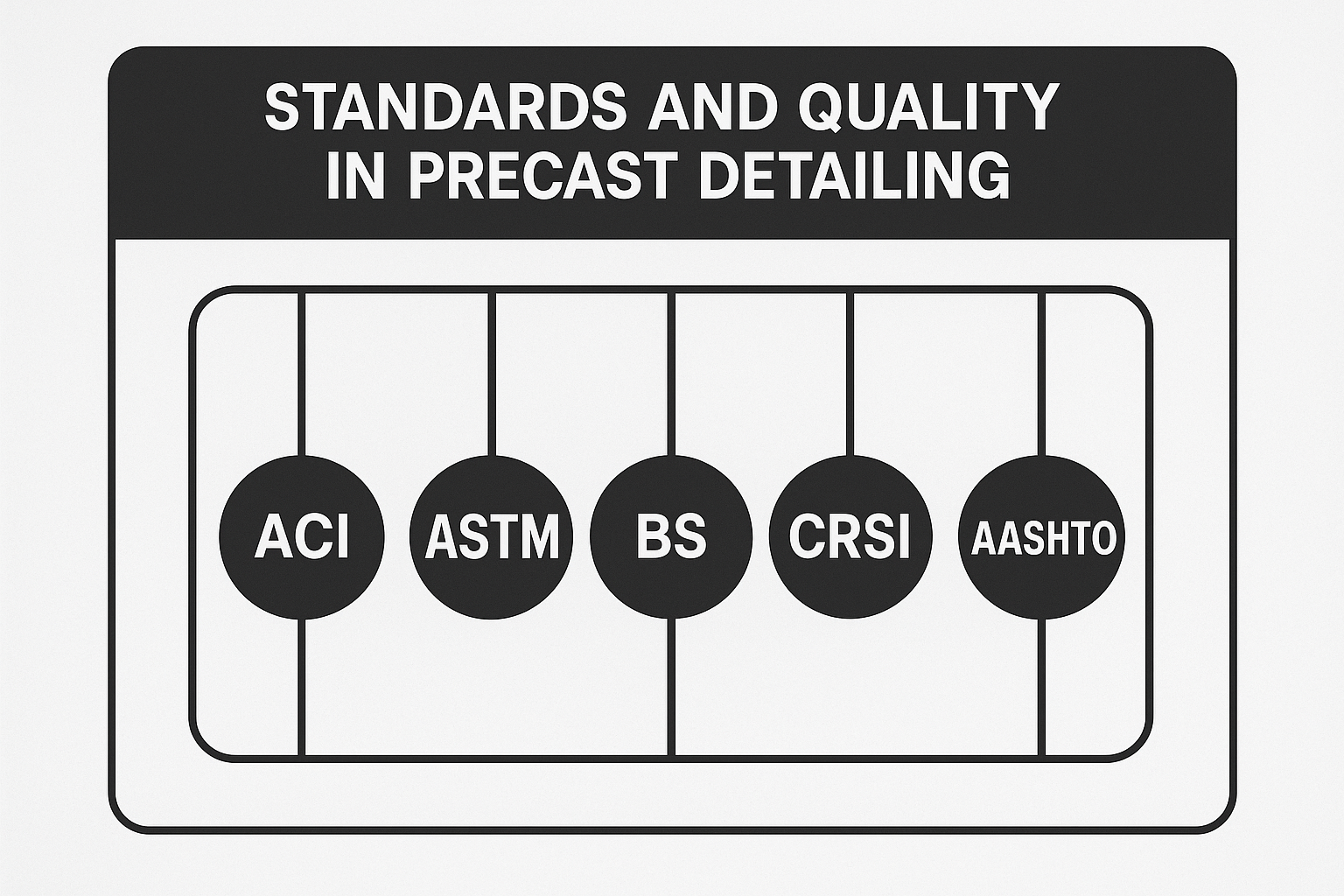
Precast modeling is not just about speed. Accuracy and compliance with standards are equally important. Many firms follow international guidelines, such as:
- ACI – American Concrete Institute: Sets out requirements for concrete design, construction practices, and quality control, ensuring that modeled elements meet structural integrity standards.
- ASTM – American Society for Testing and Materials: Provides specifications for materials, testing methods, and performance, making sure that digital models align with real-world material properties.
- BS – British Standards: Offers detailed codes for design, detailing, and fabrication that are widely adopted in the UK and internationally.
- CRSI – Concrete Reinforcing Steel Institute: Focuses on reinforcement practices, bar detailing, and placement standards to improve structural safety and reliability.
- AASHTO – American Association of State Highway and Transportation Officials: Commonly applied in infrastructure projects, ensuring precast elements used in bridges and highways meet transportation-specific codes.
These standards ensure that the digital models are not only geometrically correct but also structurally sound and compliant with codes in different regions.
Benefits and Challenges of Structural Precast Modeling
Like most innovations in construction, structural precast modeling brings both clear advantages and a few hurdles that teams need to plan for. Understanding both sides is the key to making the most of the technology.
Benefits
The benefits of adopting precast modeling are practical and measurable. Automation of reinforcement and shop drawings can save countless hours compared to manual drafting. Integrated models also cut down on errors by keeping design and fabrication data aligned. Because everyone works from the same source of truth, collaboration between architects, engineers, and contractors becomes smoother and less fragmented.
Safety improves as well, since a larger portion of the work is shifted from unpredictable site conditions to controlled factory environments. Finally, models are adaptable. Changes applied once ripple automatically across drawings, bills of materials, and fabrication files, reducing repetitive rework and keeping projects on schedule.
Challenges
At the same time, precast modeling is not without its challenges. The software platforms used for this work are powerful but come with a steep learning curve, requiring teams to invest in training. Upfront costs for tools, licenses, and skilled personnel can also be significant, especially for firms just beginning to adopt BIM-based workflows.
Coordination remains a constant demand. Precast elements must align with architectural and MEP systems, and that requires close communication across disciplines. On top of that, every project is unique. Complex geometries or unusual design requirements sometimes call for custom modeling or even scripting solutions, which add another layer of effort.
A Balanced Perspective
These challenges are not deal breakers, but they highlight the importance of approaching precast modeling as a managed process rather than just a software upgrade. When firms invest in skills, plan workflows carefully, and commit to collaboration, the benefits almost always outweigh the hurdles. The result is faster schedules, more accurate models, and a safer, more efficient construction process.
Looking Ahead: The Future of Precast Modeling
As BIM continues to evolve, precast modeling is moving beyond its current role of detailing and coordination toward deeper automation and integration. What once was mainly a design support tool is becoming a driving force in how projects are planned, built, and even maintained throughout their lifecycle.
- 4D Modeling: Linking precast models directly to project schedules allows teams to visualize construction sequences step by step. This makes it easier to spot potential delays, optimize crane usage, and coordinate installation logistics before crews arrive on site.
- 5D Modeling: By tying cost data to each precast component, teams gain real-time insight into budgets as designs evolve. Instead of waiting for manual estimates, project managers can track how design changes affect costs instantly.
- Generative Design: Algorithms are increasingly being used to explore alternative panel layouts, reinforcement strategies, or connection details automatically. This not only saves time but can also uncover design solutions that humans might overlook.
- Digital Twins: Precast models are also finding a home beyond construction. When detailed data is carried into facility management systems, building operators gain a “digital twin” that helps them monitor performance, plan maintenance, and extend the life of structures.
Taken together, these developments point to a future where structural precast modeling is not just a step in the design process but a central platform that connects design, fabrication, installation, and operation. The role of the model will shift from being a drawing generator to being a living source of data that supports decision-making across the entire lifecycle of a building.
Conclusion
Structural precast modeling has grown from a specialized niche into a mainstream part of construction workflows. By connecting design, fabrication, and installation inside a single BIM environment, it delivers faster schedules, improved accuracy, and safer projects.
From hollow-core slabs in residential towers to double tees in parking structures, the ability to model, coordinate, and fabricate precast elements digitally is transforming how projects are built. The challenges of training, coordination, and investment are real, but the benefits consistently outweigh them.
In simple terms, structural precast modeling is the bridge between what engineers design and what fabricators deliver. For teams looking to save time, reduce errors, and push efficiency higher, it is no longer an option but an essential practice in modern construction.
FAQ
What is structural precast modeling?
Structural precast modeling is the process of creating digital, data-rich representations of precast concrete elements such as walls, slabs, beams, and columns. These models are built in BIM platforms and include reinforcement details, shop drawings, and fabrication data.
Which software is used for precast modeling?
The most common tools are Autodesk Revit with the Structural Precast Extension and Tekla Structures. Navisworks is often used for coordination, while specialized add-ons handle automation, formwork design, and generative layouts.
What challenges should teams expect?
The main challenges include the learning curve of BIM software, upfront investment in tools and skilled staff, and the need for continuous coordination across architects, engineers, and contractors. Every project also has unique geometry that may require custom modeling.
How does precast modeling support fabrication?
Models can generate shop drawings and even CNC files directly, allowing fabricators to cut, bend, and assemble components with minimal manual translation. This reduces production errors and speeds up the workflow.
How does precast modeling connect with 4D and 5D BIM?
4D modeling links precast components with project schedules for construction sequencing, while 5D modeling ties them to cost data for real-time budgeting and estimation.
Our Case Studies
We have handled 200+ BIM & VDC projects for commercial, industrial, and residential sectors.
Our work includes:
Formwork design automation
Our client from
California, USA
Suspended ceiling design automation
Our client from
New York, USA
Wall framing design automation
Our client from
California, USA