Have any questions? Contact us!
Join our team!
Request a free quote or consultation

Structural BIM consultancy sits at the intersection of structural engineering and digital delivery. It is not just about building clean 3D models or following BIM standards on paper. It is about helping structural teams design, coordinate, and deliver buildings in a way that actually works on site, under real constraints, deadlines, and budgets.
In practice, a structural BIM consultant helps turn structural intent into reliable, data-driven models that align with architects, MEP teams, and contractors. They focus on accuracy, constructability, and coordination, making sure the structural model is not just visually correct, but usable throughout design, construction, and sometimes even operation.
In this guide, we’ll break down what structural BIM consultancy actually involves, how it fits into different phases of a project, where it overlaps (and doesn’t) with engineering, and when it makes the biggest impact.
What Structural BIM Consultancy Really Involves
At its core, structural BIM consultancy is about building the bridge between structural design intent and usable digital models. It’s not about making the model look good – it’s about making sure it works.
A structural BIM consultant typically handles:
- Translating structural drawings or sketches into data-rich 3D models.
- Coordinating the structural model with architectural and MEP models to avoid clashes.
- Setting up workflows to maintain model integrity from early design through to fabrication.
- Providing automation or scripting tools to speed up repetitive structural detailing tasks.
- Reviewing models for compliance with BIM standards, project requirements, and agreed modeling rules.
In practice, some BIM consultants specialize in structural workflows, combining BIM process expertise with an understanding of structural coordination. They understand how the building is actually going to be built, not just how it should look.
Why Not Just Use a Structural Engineer or BIM Modeler?
This is a fair question, and one that comes up a lot. Can’t a structural engineer handle the model? Or a BIM modeler just follows the drawings?
In theory, yes. In practice, not always.
Structural engineers are typically focused on calculations, design loads, and compliance. They produce intent drawings and might not have the time or skillset to manage high-detail BIM models. On the flip side, BIM modelers often come from architectural backgrounds or only follow visual references. They might miss subtle but critical structural logic if they’re not guided correctly.
A structural BIM consultant fills that gap. They speak both languages – structural and digital. They don’t guess. They identify coordination risks early and flag potential conflicts for review by the structural engineer or detailing team. Their job is to make sure the model doesn’t just pass a visual check, but can stand up to reality.
Key Areas Where Structural BIM Consultants Add Value
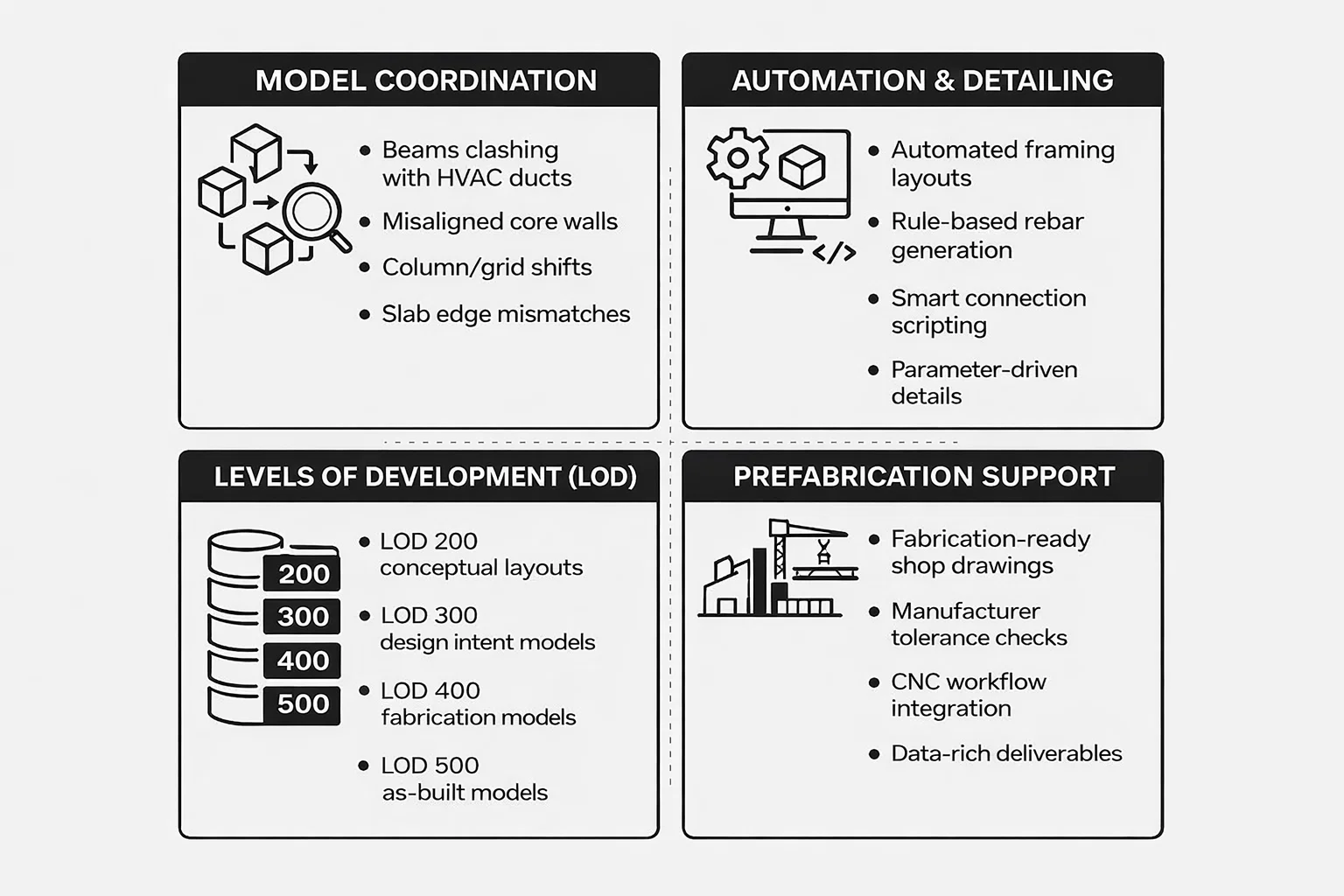
Let’s move past definitions and look at where these consultants make the most impact.
1. Model Coordination Across Disciplines
One of the biggest headaches in BIM is coordination, especially when structural elements start clashing with ductwork, piping, or architectural features. A good structural BIM consultant stays ahead of this.
They manage the structure’s role in the wider BIM environment, helping detect and resolve:
- Beams colliding with HVAC routes.
- Core walls misaligned with architectural openings.
- Column shifts impacting grid layouts.
- Slab edge mismatches with curtain wall systems.
This proactive approach to clash prevention saves thousands in rework and keeps site teams happy.
2. Automation and Detailing at Scale
Not every beam needs to be hand-modeled. Not every connection should be built from scratch. Structural BIM consultants often bring automation tools or scripting knowledge to the table.
They help teams:
- Automate repetitive framing layouts.
- Generate rebar from rule-based templates.
- Create smart connections with embedded logic.
- Apply parameters that control visibility and schedule data.
It’s not about making things fancy. It’s about speed, consistency, and reducing human error.
3. Managing Levels of Development (LOD)
A structural BIM consultant knows that LOD is not just a checkbox. Getting the LOD right for your stage of work is crucial, and doing too much or too little can cause issues.
They help define and manage:
- LOD 200 conceptual layouts used for early coordination and spatial alignment.
- LOD 300 design intent models suitable for design coordination and approval processes.
- LOD 400 models developed to support fabrication detailing and construction sequencing.
- LOD 500 as‑built models reflecting verified construction outcomes, when required by the project.
This helps clients and contractors understand what’s expected, what’s deliverable, and what’s usable.
4. Prefabrication and Fabrication Support
If the project involves precast, steel fabrication, or modular assembly, the BIM model needs to be far more precise than typical design models.
Structural BIM consultants can:
- Prepare fabrication-ready shop drawings.
- Adjust models to meet manufacturer tolerances.
- Align with CNC workflows.
- Provide data-rich outputs for scheduling or tracking.
It’s not just 3D anymore. It’s data, logistics, and constructability.
How Structural BIM Consultancy Differs from General BIM Support
To make it clearer, here’s how structural BIM consultancy stacks up against general BIM consulting:
| General BIM Consultant | Structural BIM Consultant |
| Manages BIM across all trades | Focuses deeply on structure-specific needs |
| Often coordinates architecture first | Prioritizes constructability and load-bearing elements |
| May not understand structural logic | Trained in structural engineering workflows |
| Provides general clash detection | Applies domain-specific quality checks |
| Works with visual tools mostly | Adds scripting, automation, and calculation logic |
Both are valuable. But if your structure is complex, your schedule tight, or your deliverables include fabrication models, you probably want someone who’s seen it all from the structural side.
How We Deliver Structural BIM Consultancy at Powerkh

At Powerkh, structural BIM consultancy isn’t just a service line – it’s part of how we ensure design continuity across every stage of a project. We’re an engineering-led digital construction consultancy with experience across 400+ BIM and VDC projects in the UK, US, and Europe. Our structural BIM work spans from early-stage Revit modeling to high-detail fabrication support, but what ties it all together is our focus on protecting and verifying the design intent.
We don’t treat structure as a standalone output. Instead, we work closely with project teams to develop coordination-ready structural models and prepare designs that hold up under construction pressures. Our consultants actively monitor deviation between what was designed and what’s actually being built, giving clients early visibility into real risks. Whether it’s LOD 300 framing or concrete detailing aligned to site workflows, we stay involved until the structure is fully delivered and verified.
What sets our approach apart is the way we embed structural support within a broader continuity framework. From RIBA Stage 3 design development to Stage 5 progress verification and Stage 6 as-built checks, we carry structural data through every phase, flagging misalignments before they reach the site. That means fewer surprises, stronger outcomes, and confidence that what’s been designed is actually what’s being built.
When to Bring in a Structural BIM Consultant
Waiting until things start to go wrong is usually too late. Ideally, structural BIM consultants should be involved:
- During concept development (for setting up modeling logic).
- At the start of detailed design (for workflow planning).
- Before any major model handover or coordination meetings.
- Before starting prefabrication or structural detailing.
Early involvement allows them to catch issues before they spread and set up the project on solid digital footing.
Typical Deliverables from Structural BIM Consultancy
Here’s what clients and project teams usually get when they engage structural BIM consultants:
- Coordinated structural BIM models (LOD 200-400+).
- Clash reports and resolution logs.
- Revit templates and automation scripts.
- Parametric Revit families (e.g., columns, beams, connections).
- Prefabrication-ready drawings and cut lists.
- Quantity takeoffs for procurement.
- BIM Execution Plan inputs and structural-specific guidelines.
Every consultant offers different services, but the goal is the same: make structural data usable across the lifecycle.
Common Use Cases: Where Structural BIM Consultants Make the Biggest Difference
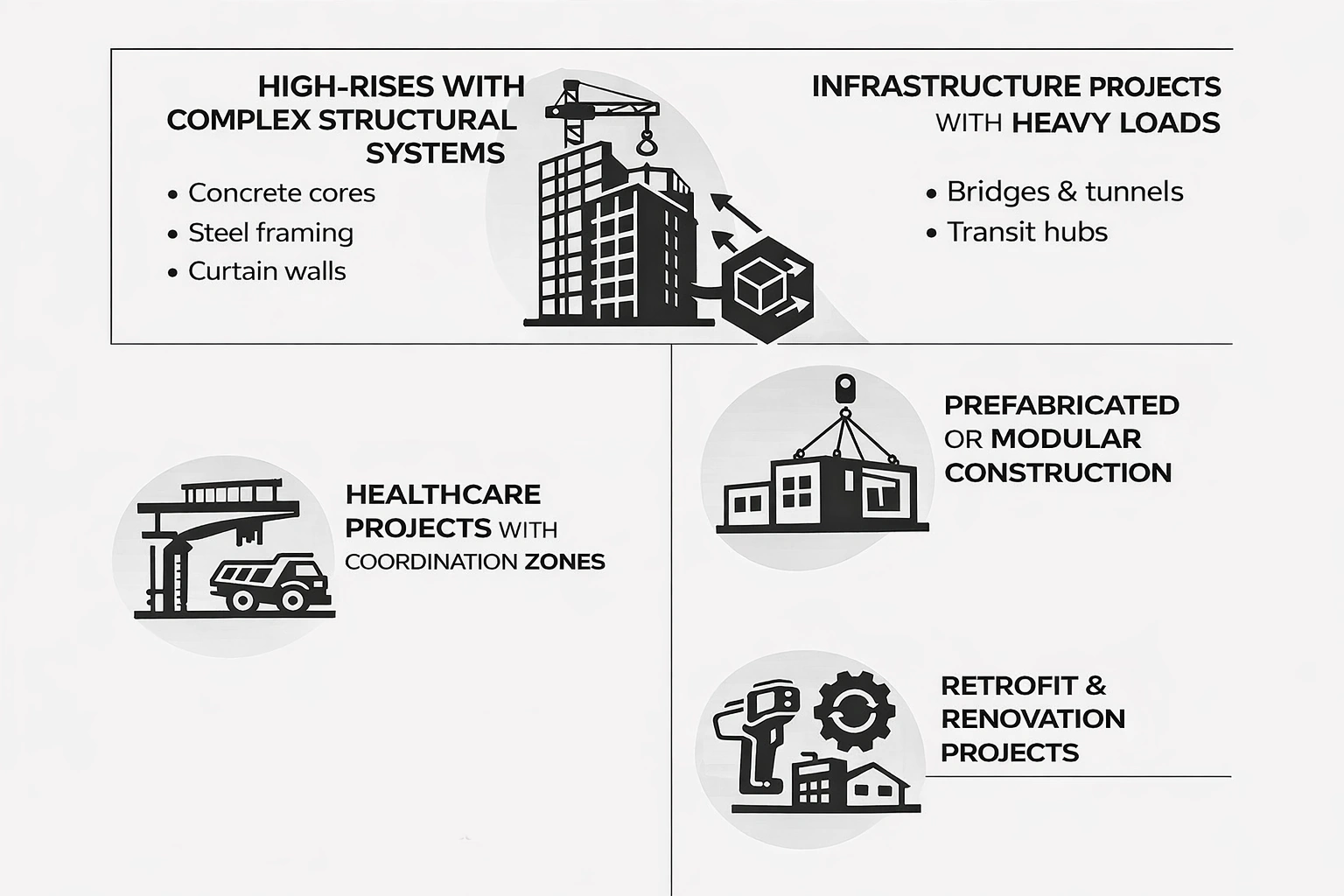
Not every project needs a structural BIM consultant on day one. But in certain environments, skipping that support can lead to real problems down the line. Below are a few situations where structural BIM consultancy isn’t just helpful – it’s often essential.
High-Rises with Complex Structural Systems
When you’re dealing with tall buildings that blend concrete cores, steel framing, and curtain walls, coordination becomes a high-stakes puzzle. Structural consultants help align structural geometry with façade systems and internal loads, all while managing sequencing and constructability challenges. One small misalignment can snowball quickly in this context, having structure modeled right from the start avoids a lot of pain later.
Infrastructure Projects with Heavy Loads
Bridges, tunnels, transit hubs – these aren’t just big, they’re structurally unforgiving. BIM consultants help ensure load paths are respected, reinforcement detailing is accurate, and everything fits around civil or geotechnical constraints. In these types of jobs, the structure isn’t just a framework – it is the building.
Healthcare Projects with Tight Coordination Zones
Hospitals are notorious for packed ceiling voids, stacked risers, and last-minute equipment changes. Structural BIM consultants play a critical role in coordinating slab penetrations, beam clearances, and service routes before anything gets poured. Without them, MEP clashes often show up far too late to fix cleanly.
Prefabricated or Modular Construction
In modular projects, precision isn’t a bonus – it’s the entire premise. Structural models must be fabrication-ready early, with clear tolerances and exact connections. A BIM consultant ensures every element in the digital model lines up with shop drawings and site installation workflows.
Retrofit and Renovation Projects
Working with existing buildings means starting with what’s already there, and it’s rarely clean or well-documented. Structural BIM consultants help process scan data, validate models against reality, and build around historical quirks. This avoids surprises during demolition or construction and brings some much-needed clarity to complex upgrades.
Final Thoughts
At the end of the day, structural BIM consultancy is less about pretty models and more about real-world results. It’s the kind of work that often goes unnoticed when it’s done right, and causes massive delays when it’s ignored.
The best structural BIM consultants combine engineering logic with digital fluency. They don’t just build models – they solve problems. They don’t just coordinate – they anticipate. And in a world where every hour counts and every error costs, that kind of support isn’t a nice-to-have. It’s essential.
If you’re planning a project that involves concrete, steel, loads, codes, and coordination headaches, don’t leave the structure to chance. Bring in someone who understands how it’s built, how it’s modeled, and how those two things are supposed to meet.
FAQ
1. What’s the actual difference between a structural engineer and a structural BIM consultant?
A structural engineer focuses on calculations, loads, and making sure a building will stand up safely. A structural BIM consultant makes sure that same intent is modeled accurately and used properly across the rest of the project team. They take the engineer’s logic and translate it into a 3D model that’s buildable, clash-free, and coordinated with everything else. One sets the rules, the other makes sure those rules survive coordination.
2. Do I need a structural BIM consultant if I already have a BIM manager?
It depends on the scope and complexity of your project. A general BIM manager looks after the big picture – all disciplines, all models. A structural BIM consultant digs deep into the structural side. If your project involves heavy detailing, fabrication, or tricky coordination zones, having someone who understands how structure actually works (and builds) is a huge advantage.
3. When should we bring in a structural BIM consultant?
Honestly, the earlier the better. If you wait until coordination meetings are already exposing issues, you’re probably burning time and budget. Ideally, they should come in during detailed design, when model logic is still flexible, but coordination is starting to take shape. That’s the sweet spot for getting things right before they snowball.
4. What kind of deliverables can I expect from structural BIM consultancy?
Think of it as a mix of models, data, and quality control. You’ll typically get a fully coordinated structural model (LOD 300 or higher), smart Revit families for common elements, clash reports, and maybe even scripts or automation tools if your project has repetitive geometry. Some consultants also support prefab workflows and generate fabrication-ready drawings. It’s not just outputs – it’s how well they integrate with the rest of your team.
5. What makes Powerkh different when it comes to structural BIM?
We don’t just model, we stay close to the design intent from concept to handover. Our team doesn’t walk away once the drawings are signed off. We track what’s happening, compare it against the design, and flag misalignments before they become problems. We’re engineers who think digitally, and digital specialists who understand construction. That middle ground is where we do our best work.

Have a BIM Project? Talk To Us.
Contact UsOur Case Studies
We have handled 200+ BIM & VDC projects for commercial, industrial, and residential sectors.
Our work includes:
Formwork design automation
Our client from
California, USA
Suspended ceiling design automation
Our client from
New York, USA
Wall framing design automation
Our client from
California, USA