Have any questions? Contact us!
Join our team!
Request a free quote or consultation

Quick Summary: Construction scheduling is the process of planning, organizing, and coordinating all activities, resources, and timelines needed to complete a construction project on time and within budget. It involves creating detailed timelines that map out task sequences, dependencies, resource allocation, and milestones. This systematic approach helps project teams anticipate delays, optimize workflows, and maintain clear communication throughout the project lifecycle.
Every construction project, from small renovations to massive commercial developments, shares one universal challenge: keeping everything on track. Materials need to arrive exactly when crews are ready to use them. Different trades need to coordinate without stepping on each other’s toes. And the client expects completion by a specific date.
That’s where construction scheduling comes in.
Without proper scheduling, even well-funded projects spiral into costly delays, resource conflicts, and budget overruns. But with effective scheduling? Project managers gain control over complexity, teams know exactly what to do when, and stakeholders can track progress with confidence.
This guide breaks down everything about construction scheduling—what it is, why it matters, and how to create schedules that actually work in the field.
What Is Construction Scheduling?
Construction scheduling is the systematic process of organizing and sequencing all tasks, activities, and resources required to complete a construction project from start to finish. It creates a roadmap that shows when each activity should begin and end, which tasks depend on others, and how resources should be allocated throughout the project.
At its core, construction scheduling answers three critical questions: What needs to be done? When should it happen? Who’s responsible for making it happen?
The schedule serves as the central coordination tool for everyone involved in the project. General contractors use it to coordinate subcontractors. Project managers use it to track progress and identify problems early. Owners use it to understand when their building will be ready. Suppliers use it to plan material deliveries.
Construction scheduling differs significantly from simply creating a list of tasks. A proper schedule accounts for task dependencies—the fact that some activities can’t start until others finish. Concrete foundations must cure before framing begins. Electrical rough-in happens before drywall installation. These logical sequences form the backbone of any construction schedule.
The Core Components of Construction Schedules
Every construction schedule, regardless of methodology, contains several fundamental elements:
- Activities and tasks represent the individual work units that need completion. These range from major phases like “excavation” to specific tasks like “install HVAC units on the third floor.”
- Durations indicate how long each activity takes to complete. Accurate duration estimates come from historical data, crew productivity rates, and material specifications.
- Dependencies show the relationships between activities. A finish-to-start dependency means one task must complete before another begins. Start-to-start dependencies allow tasks to begin simultaneously.
- Resources include the labor, equipment, and materials required for each activity. Proper resource allocation prevents bottlenecks and ensures crews have what they need when they need it.
- Milestones mark significant project achievements like permit approval, substantial completion, or final inspection. These create clear checkpoints for measuring progress.
- Float or slack represents the amount of time an activity can be delayed without affecting the project completion date. Activities with zero float sit on the critical path.
Why Construction Scheduling Matters
Time is money in construction—literally. Project delays cost money through extended overhead, equipment rental fees, and potential contract penalties. But the benefits of proper scheduling extend far beyond avoiding delays.
Effective scheduling creates predictability. When everyone knows what’s happening next week or next month, they can prepare accordingly. Subcontractors can schedule their crews. Suppliers can coordinate deliveries. Inspectors can plan site visits.
Resource optimization represents another major benefit. Construction projects involve expensive equipment and skilled labor. Poor scheduling leads to workers standing idle because materials haven’t arrived, or equipment sitting unused because the site isn’t ready. Good scheduling maximizes resource utilization and minimizes waste.
Communication improves dramatically with clear schedules. Rather than constant phone calls asking “when can we start?” or “are they finished yet?”, everyone can reference the schedule. This transparency reduces confusion and disputes.
According to data from the U.S. Bureau of Labor Statistics, the construction management field shows strong growth with a 9% increase projected between 2024 and 2034—nearly three times the 3% average growth rate across all occupations. This growth reflects the increasing complexity of construction projects and the rising demand for skilled scheduling and project management.
Risk management becomes more systematic with proper scheduling. When project managers can visualize the entire project timeline, they can identify potential conflicts, weather-sensitive activities, and resource constraints before they become problems.
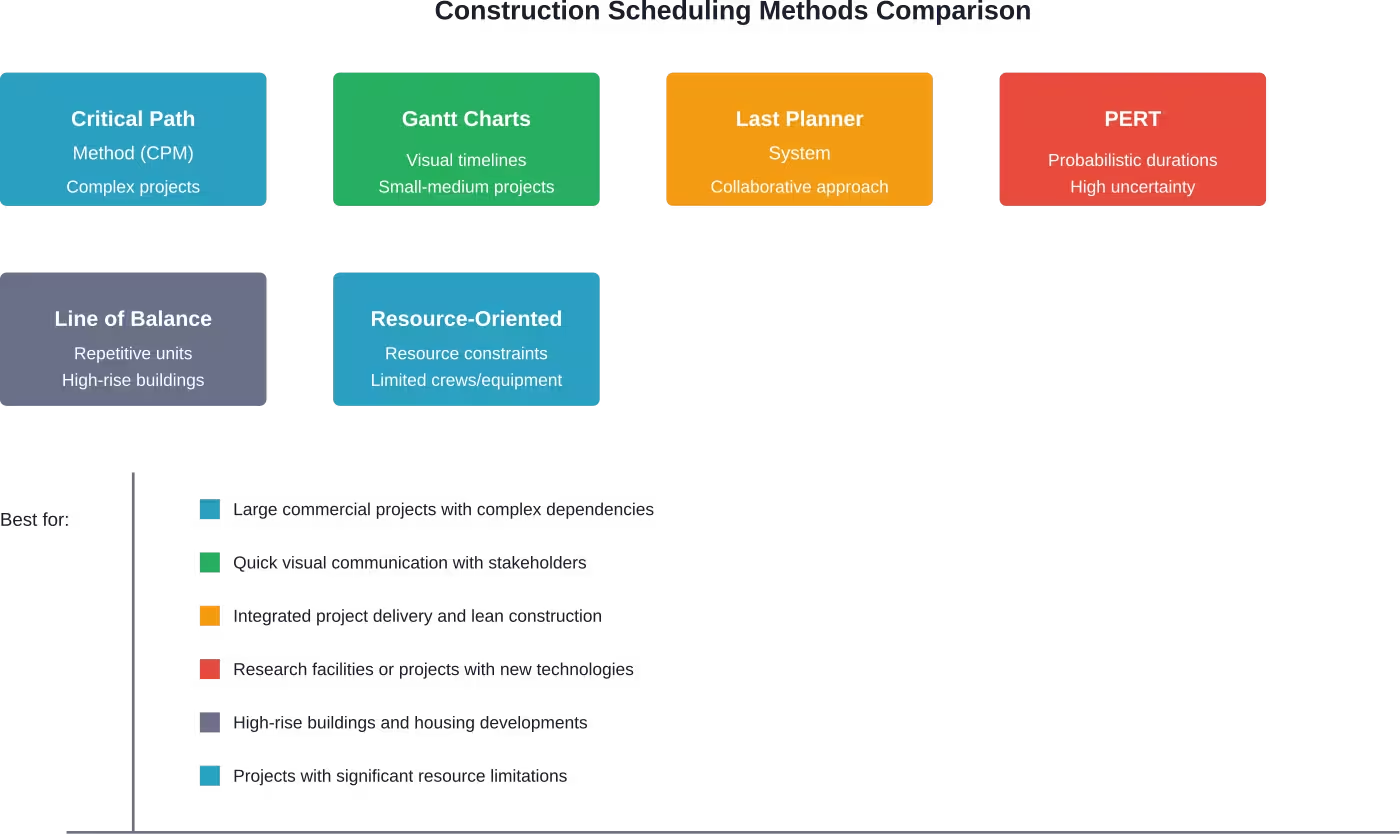
Construction Scheduling Methods Explained
Different projects require different scheduling approaches. A small residential renovation doesn’t need the same scheduling complexity as a 50-story office tower. Here are the main scheduling methods used in modern construction.
Critical Path Method (CPM)
The Critical Path Method stands as the most widely used scheduling technique for complex construction projects. According to the American Society of Civil Engineers (ASCE), construction engineers need to understand critical path method fundamentals and network analysis to avoid poorly informed decisions that affect project outcomes.
CPM identifies the longest sequence of dependent activities from project start to finish—the critical path. Any delay in critical path activities delays the entire project. Activities not on the critical path have float, meaning they can be delayed without impacting the completion date.
Creating a CPM schedule involves defining all activities, establishing their durations, identifying dependencies, and calculating early and late start/finish dates for each activity. The math reveals which activities are critical and which have scheduling flexibility.
CPM construction scheduling works exceptionally well for projects with predictable activity durations and clear dependencies. Large commercial buildings, infrastructure projects, and industrial facilities typically use CPM scheduling.
The Harvard Business Review, in a foundational 1963 article, described the Critical Path Method as “a powerful but basically simple technique for analyzing, planning, and scheduling large, complex projects.” More than six decades later, that assessment still holds true.
Gantt Charts
Gantt charts provide visual timeline representations of project schedules. Each activity appears as a horizontal bar, with the bar’s length representing the activity’s duration. Activities are arranged vertically, often grouped by phase or trade.
The visual nature makes Gantt charts excellent communication tools. Stakeholders can quickly grasp the project timeline, see which activities are happening simultaneously, and understand overall progress. Color coding can indicate different trades, phases, or responsibility areas.
Modern Gantt charts incorporate dependency lines showing how activities relate to each other. This adds some CPM functionality to the visualization, though the underlying calculations aren’t as sophisticated as dedicated CPM software.
Gantt charts work well for small to medium projects with relatively straightforward sequences. They’re also valuable as summary-level views for large projects, showing major phases rather than detailed activities.
Last Planner System
The Last Planner System represents a more collaborative, pull-based approach to construction scheduling. Instead of top-down schedules created by project managers, the people actually doing the work (the “last planners”) participate in creating reliable commitments.
This methodology uses multiple planning horizons. The master schedule covers the entire project. Phase schedules (lookahead planning) cover 6-8 weeks. Weekly work plans detail the coming week’s activities. Each level involves the people responsible for execution.
The system emphasizes constraint analysis—identifying and removing obstacles before they impact work. If materials won’t arrive on time or a prerequisite task won’t finish as planned, the team adjusts proactively rather than reacting to delays.
Last Planner System works particularly well for projects emphasizing lean construction principles and collaborative delivery methods like Integrated Project Delivery (IPD).
Program Evaluation and Review Technique (PERT)
PERT addresses uncertainty in activity durations by using probabilistic time estimates. Instead of single duration estimates, PERT uses three: optimistic (best case), pessimistic (worst case), and most likely. These combine to calculate expected durations and project completion probabilities.
This method suits projects with significant uncertainty, such as research facilities, prototype construction, or projects using new technologies. The probabilistic approach provides more realistic completion date ranges rather than false precision.
PERT shares structural similarities with CPM—both use network diagrams and identify critical paths. The key difference lies in how durations are estimated and calculated.
Line of Balance
Line of Balance (also called Vertical Production Method) works best for repetitive construction projects—high-rise buildings, housing developments, highway construction, or any project with repeated identical or similar units.
Rather than scheduling each unit independently, Line of Balance optimizes crew flow through repetitive work. Activities are plotted on a graph with time on one axis and units (floors, houses, segments) on the other. The lines represent different activities flowing through the project.
This method balances production rates to minimize crew idle time and maintains consistent workflow. It answers questions like: How many floors per week should the concrete crew complete? When should the MEP trades start to maintain optimal spacing behind the concrete crew?
Resource-Oriented Scheduling
Resource-oriented scheduling prioritizes resource availability and utilization over pure logic-driven sequencing. This approach recognizes that real-world constraints often come from limited resources rather than technical dependencies.
If a project has only one concrete crew, activities requiring that crew must be scheduled sequentially even if they could theoretically happen simultaneously. Resource-oriented scheduling explicitly accounts for these limitations.
This method often involves resource leveling (smoothing resource demand over time to avoid peaks and valleys) and resource allocation (assigning specific resources to activities based on availability and capability).
Core Principles of Effective Construction Scheduling
Regardless of which scheduling methodology is chosen, certain principles separate effective schedules from ineffective ones. These fundamentals apply universally across project types and sizes.
Realistic Duration Estimates
Schedules built on wishful thinking fail. Duration estimates must reflect realistic productivity rates, not best-case scenarios. Historical data from similar projects provides the best foundation for estimates.
Experienced estimators account for factors that affect productivity: crew size and skill level, site conditions, weather exposure, work complexity, and coordination requirements. A task that takes four hours in a controlled shop environment might take eight hours in the field.
Building contingencies into the schedule provides a buffer for inevitable variations. But here’s the thing—those buffers should be explicit and managed, not hidden within inflated individual activity durations.
Clear Activity Definitions
Activities need clear, unambiguous definitions. “Install electrical” means different things to different people. “Install electrical rough-in for the second floor south wing” leaves no room for confusion.
The right level of detail balances control with manageability. Too much detail creates schedules with thousands of activities that become impossible to maintain. Too little detail provides insufficient control and visibility.
Generally speaking, activities should represent work packages that can be completed by a single crew in a reasonable timeframe—typically one to ten working days for detailed schedules.
Accurate Dependency Mapping
Proper dependency relationships form the logical skeleton of any schedule. These relationships must reflect real-world constraints, not arbitrary sequences.
Four types of dependencies exist in construction scheduling: Finish-to-Start (activity B can’t start until activity A finishes), Start-to-Start (activity B can’t start until activity A starts), Finish-to-Finish (activity B can’t finish until activity A finishes), and Start-to-Finish (rarely used in construction).
Lag time can be added to dependencies when gaps are required. Concrete must cure for seven days before formwork removal—that’s a Finish-to-Start dependency with a seven-day lag.
Resource Reality
Schedules must account for actual resource availability. Scheduling three activities simultaneously that all require the same specialized crane creates an impossible situation.
Resource calendars define when resources are available. Some crews work five days per week, others seven. Equipment might be available only during specific rental periods. Material deliveries have lead times that must be respected.
Resource leveling smooths demand to match availability. If the schedule shows a need for 20 carpenters one week and 5 the next, leveling adjusts activity timing to maintain more consistent crew sizes.
Regular Updates and Communication
As one expert notes, schedules must be updated regularly or they lose value. A schedule showing last month’s plan doesn’t help anyone make decisions today.
Weekly or biweekly updates represent common practice for active construction projects. Updates include completed work, in-progress activities, changes to future work, and revised duration estimates based on actual productivity.
But updating the schedule without communicating changes wastes effort. Effective scheduling includes regular schedule reviews with key stakeholders, clear communication of upcoming activities, and proactive identification of potential delays.
How to Create a Construction Schedule: Step-by-Step Process
Creating an effective construction schedule involves systematic progression through several phases. Here’s how the process typically unfolds.
Step 1: Define Project Scope and Objectives
Before scheduling anything, the project scope must be clearly defined. What exactly is being built? What are the performance specifications? What are the quality standards?
Project objectives establish priorities. Is early completion the top priority? Is minimizing disruption to adjacent operations critical? Are there specific sustainability goals that affect sequencing?
Contractual requirements often dictate scheduling obligations. Some contracts specify completion dates, milestone dates, or required scheduling methodologies. Understanding these requirements upfront prevents problems later.
Step 2: Break Down the Work Structure
The Work Breakdown Structure (WBS) decomposes the project into manageable components. This hierarchical breakdown starts with the overall project, divides into major phases, then further subdivides into work packages and individual activities.
According to project management best practices, WBS levels typically include: the overall project at the top level, major phases (site preparation, foundation, structure, envelope, interior finishes, systems), work packages within each phase (for example, breaking “foundation” into excavation, formwork, reinforcing, concrete placement, curing), and individual activities that represent specific tasks.
The WBS provides the framework for all subsequent planning, including scheduling, budgeting, and resource allocation. It ensures nothing gets overlooked.
Step 3: Identify and Sequence Activities
With the WBS complete, identify every activity required to complete each work package. This detailed activity list forms the schedule’s building blocks.
Sequencing determines the logical order of activities. Some sequences are mandatory—you can’t install windows before framing. Others are preferential—north wing versus south wing first.
Documenting the logic behind sequences helps future schedule analysis. Why must activity A precede activity B? Understanding the reasoning helps identify opportunities for acceleration if needed.
Step 4: Estimate Activity Durations
Duration estimating requires input from people who will actually do the work. Subcontractors, crew foremen, and suppliers provide realistic productivity rates and timeframes.
Multiple factors influence durations: crew size and composition, equipment availability and capability, material quantities and complexity, site accessibility and working conditions, weather considerations, and permit or inspection requirements.
Documenting assumptions behind duration estimates creates transparency. “Framing estimate assumes crew of 6 carpenters working 10-hour days with material delivered in advance” explains the basis and reveals what could change.
Step 5: Determine Resource Requirements
Each activity requires specific resources—labor, equipment, and materials. Identifying these requirements enables resource planning and conflict identification.
Labor requirements specify crew types, sizes, and skill levels. Equipment requirements detail specific machinery and tools needed. Material requirements list quantities, specifications, and required delivery timing.
Resource availability constraints often dictate scheduling decisions more than pure logic. A project might have access to only one tower crane, forcing sequential scheduling of activities that could theoretically overlap.
Step 6: Develop the Initial Schedule
With activities defined, sequenced, and duration-estimated, the initial schedule can be developed. Scheduling software calculates dates based on the logic network, durations, and project start date.
The critical path emerges from this calculation—the longest path through the network that determines project duration. Activities on the critical path have zero float and require careful attention.
The initial schedule typically shows an unacceptable completion date or reveals resource conflicts. That’s normal. The first pass rarely produces an implementable schedule.
Step 7: Optimize and Balance
Schedule optimization adjusts activity timing, durations, logic, and resources to meet project objectives. This might involve crashing critical path activities by adding resources, fast-tracking by overlapping activities normally done in sequence, or adjusting non-critical activities to level resource demand.
Resource balancing ensures the schedule doesn’t require more resources than are available. If the schedule shows a need for 30 electricians but only 20 are available, activities must be rescheduled.
Cost-schedule trade-offs often arise during optimization. Accelerating the schedule typically increases costs. Finding the optimal balance requires input from project leadership.
Step 8: Validate with Stakeholders
Before finalizing, the schedule needs validation from everyone who must execute it. Subcontractors should confirm their activities and durations. Suppliers should verify delivery timing. The owner should approve major milestones.
This validation process often reveals missed activities, unrealistic durations, or coordination issues. Catching these problems during planning prevents disruptions during execution.
Buy-in from executors is crucial. People are more committed to schedules they helped create than schedules imposed from above.
Step 9: Establish the Baseline
Once approved, the schedule becomes the baseline—the reference point for measuring progress and analyzing changes. The baseline schedule is saved separately and remains unchanged.
As-built schedules track actual performance against the baseline. Comparing actual versus planned reveals trends in productivity, identifies activities consistently running long, and documents the impact of changes.
Contract administration often requires maintaining baseline schedules. Claims and disputes frequently involve comparing what was planned against what actually happened.
Step 10: Communicate the Schedule
An excellent schedule that nobody understands serves no purpose. Effective communication involves multiple formats tailored to different audiences.
Field crews need detailed near-term schedules showing next week or next month. Senior management needs high-level milestones and overall project status. Owners want to understand major phases and occupancy dates.
Visual formats like Gantt charts communicate better than tables of data. Color coding, filtering, and grouping help audiences quickly find relevant information.
Step 11: Monitor and Update Regularly
Schedules require continuous maintenance throughout the project. Regular updates capture completed work, in-progress activities, changes to future work, and revised estimates.
Update frequency depends on project pace and complexity. Fast-moving projects might update weekly. Slower projects might update biweekly or monthly. The key is consistency—establishing a rhythm that becomes routine.
Update meetings review schedule status with key stakeholders. These meetings identify upcoming critical activities, resolve coordination issues, and maintain shared understanding of project status.
Step 12: Analyze and Adjust
Schedule analysis goes beyond simple updates. It involves examining trends, identifying problems early, evaluating impacts of changes, and developing recovery plans when needed.
Critical path analysis remains important throughout the project. The critical path often shifts as activities complete ahead or behind schedule. Activities that weren’t critical might become critical.
Variance analysis compares actual versus planned performance. Consistently long durations for certain activity types might indicate productivity problems, resource shortages, or estimating errors that need correction.
Build A Schedule That Matches Reality

A schedule only works if the design behind it is actually ready to be built. If coordination is incomplete or key interfaces aren’t resolved, timelines slip no matter how well the plan looks. Powerkh works at the point where schedules usually break – checking design readiness, coordination status, and whether the sequence of work matches real site conditions.
They don’t build schedules, but they make sure the inputs behind them are solid. That means fewer false starts, fewer resequencing issues, and a schedule that reflects how work will actually progress on site.
Start Work Without Delays
What Powerkh brings into your project:
- Confirms which areas are actually ready for planned activities
- Highlights interfaces that will block crews and slow progress
- Flags design gaps that force resequencing on site
- Tracks what’s installed to validate real vs planned progress
- Shows where the schedule doesn’t match build reality
Get in touch with Powerkh before your schedule starts slipping and keep your project moving as planned.
Common Construction Scheduling Challenges
Even well-planned schedules encounter problems. Understanding common challenges helps project teams anticipate and mitigate them.
Weather Delays
Weather represents one of the most common and unpredictable schedule disruptors. Rain delays concrete pours. Extreme temperatures affect material properties and worker safety. High winds shut down crane operations.
Mitigation strategies include building weather contingencies into schedules based on historical climate data, scheduling weather-sensitive activities during favorable seasons when possible, and maintaining flexible sequencing that allows productive work when primary activities are weather-delayed.
Material and Supply Chain Issues
Material delays ripple through project schedules. If structural steel arrives late, multiple downstream activities get delayed. Long lead-time items like elevators or custom equipment require early procurement and careful tracking.
Supply chain management requires early identification of long lead-time items, advance ordering with confirmed delivery dates, maintaining relationships with multiple suppliers for critical materials, and updating schedules immediately when delivery delays become known.
Labor Shortages and Productivity Variations
Skilled labor shortages affect many construction markets. Finding qualified electricians, plumbers, or specialty trade workers can delay activities even when the schedule shows they should start.
Labor planning involves early subcontractor commitments secured through contracts, realistic crew size assumptions based on actual market availability, and schedule flexibility that accommodates contractor availability constraints.
Productivity variations create schedule uncertainty. Crews work faster or slower than estimated based on site conditions, complexity, crew experience, and countless other factors.
Design Changes and Scope Creep
Changes to design or scope after scheduling disrupt even well-planned timelines. Owner-requested modifications, design errors discovered during construction, and unforeseen site conditions all drive changes.
Change management processes should include formal evaluation of schedule impacts before approving changes, immediate schedule updates reflecting approved changes, and clear documentation of delay responsibilities for contractual purposes.
Coordination Failures
Construction projects involve multiple parties—general contractors, subcontractors, suppliers, inspectors, utilities, and more. Coordination failures create delays, rework, and conflicts.
Improved coordination comes from regular coordination meetings reviewing upcoming activities, clear communication protocols for scheduling information, and collaborative planning tools that provide shared visibility into schedules.
Unrealistic Baseline Schedules
Sometimes the biggest problem is the schedule itself. Overly optimistic durations, insufficient float, or failure to account for realistic constraints create schedules that were never achievable.
Schedule quality reviews should validate duration estimates against historical data, verify adequate float for schedule uncertainty, confirm resource availability assumptions, and ensure logical relationships reflect actual constraints.
Best Practices for Construction Scheduling Success
Successful scheduling extends beyond technical methodology. These best practices separate effective schedulers from ineffective ones.
Involve the People Doing the Work
Schedulers sitting in offices disconnected from field operations create theoretical schedules that don’t reflect reality. The people actually performing the work provide the most accurate duration estimates and identify practical constraints.
Collaborative scheduling sessions bring subcontractors, foremen, and other executors into the planning process. Their input improves accuracy and increases buy-in.
Keep Schedules Current
Outdated schedules mislead rather than guide. Regular updates keep schedules relevant and useful for decision-making.
Update discipline requires commitment from project leadership. Assigning specific responsibility for updates, establishing regular update cycles, and dedicating time for thorough updates prevents schedules from becoming stale.
Focus on the Critical Path
Not all activities deserve equal attention. Critical path activities directly impact project completion and require intensive management.
Smart schedulers monitor critical path activities closely, maintain contingency plans for critical activities, and protect critical path float from erosion. Activities with significant float require less intensive monitoring.
Communicate Effectively
Technical schedule accuracy means nothing if stakeholders don’t understand or use the schedule. Communication adapts to audiences.
Field crews need simple, visual formats showing their specific work. Management needs summary-level information highlighting status and risks. Owners want milestone tracking and overall completion projections.
Build in Contingencies Appropriately
Schedules need contingency for inevitable variations and unknowns. But contingency should be explicit and managed, not hidden within padded activity durations.
Many experts suggest reserving contingency at the project level rather than padding individual activities. This prevents contingency from being consumed by early activities that don’t need it, preserving buffer for activities that encounter actual problems.
Use the Right Tools
Scheduling software enables calculations and visualizations impossible with manual methods. But the tool must match the project’s needs and the team’s capabilities.
Complex projects require robust tools like Primavera P6 or Microsoft Project. Simpler projects might use lighter tools. The key is selecting software the team will actually use rather than the most feature-rich option that creates barriers.
Document Assumptions and Logic
Schedules involve countless assumptions and decisions. Documenting these provides transparency and enables future analysis.
Why does activity X take five days? What crew size does that assume? Why must activity Y follow activity Z? These explanations help when conditions change and the schedule requires adjustment.
The Role of Construction Schedulers
Construction schedulers specialize in creating and maintaining project schedules. Understanding this role clarifies what effective scheduling requires.
Key Responsibilities
Construction schedulers track project progress, identify potential delays, and work with stakeholders to ensure projects remain within scope. The ultimate goal is ensuring projects complete on time, within budget, and meeting quality and safety standards.
Daily responsibilities include updating schedules with actual progress, analyzing schedule performance and trends, identifying schedule risks and developing mitigation plans, coordinating with subcontractors and suppliers, and preparing schedule reports for project stakeholders.
Essential Skills
Effective schedulers combine technical expertise with interpersonal skills. Technical capabilities include proficiency with scheduling software (Primavera P6 appears on 5.5% of scheduler resumes according to job market analysis), understanding of construction methods and sequencing, knowledge of critical path methodology, and ability to analyze schedule data and identify trends.
Soft skills prove equally important: communication to explain schedules to diverse audiences, negotiation to resolve conflicts and coordinate activities, problem-solving to develop schedule recovery plans, and attention to detail to maintain schedule accuracy.
Career Outlook
The construction management field shows strong growth prospects. Bureau of Labor Statistics data compiled in research demonstrates 9% growth for construction management positions between 2024 and 2034, compared to just 3% growth across all occupations during the same period.
This growth reflects increasing project complexity, growing recognition of scheduling’s importance, and industry adoption of sophisticated project management methodologies.
Construction Scheduling Tools and Software
Modern construction scheduling relies heavily on software tools that enable complex calculations, provide visualization capabilities, and facilitate collaboration.
Common Software Platforms
Primavera P6 represents the industry standard for large, complex projects. This enterprise-level tool handles thousands of activities, sophisticated resource management, and detailed analysis capabilities.
Microsoft Project offers more accessible scheduling capabilities suitable for small to medium projects. Lower cost and simpler interface make it popular for less complex work.
Specialized construction scheduling platforms have emerged in recent years, offering features tailored specifically to construction workflows, often with cloud-based collaboration and mobile access.
Key Software Capabilities
Effective scheduling software should provide activity definition and dependency management, duration estimation and calendar management, resource allocation and leveling, critical path calculation and analysis, progress tracking and updating, and visualization through Gantt charts and other formats.
Collaboration features grow increasingly important. Cloud-based access, mobile compatibility, and real-time updates enable distributed teams to work from current information.
Choosing the Right Tool
Tool selection should consider project size and complexity, team familiarity and training requirements, budget constraints, integration with other project systems, and client or contractual requirements.
Starting with simpler tools and advancing to more sophisticated platforms as needs grow often works better than immediately adopting complex systems that overwhelm teams.
Integration with Other Project Management Functions
Construction scheduling doesn’t exist in isolation. It integrates closely with other project management functions.
Cost Management
Schedule and cost are intrinsically linked. Longer schedules mean higher overhead costs. Accelerated schedules often require premium labor rates or expedited material delivery.
Cost-loaded schedules assign costs to activities, enabling earned value analysis. This combines schedule and cost performance into integrated metrics that show whether the project is ahead or behind in terms of value delivered.
Resource Management
Schedules drive resource needs. The schedule determines when and where crews, equipment, and materials are required.
Effective resource management uses schedules to forecast demand, identify conflicts, and optimize utilization. Resource-constrained schedules explicitly account for limited availability.
Risk Management
Schedule risk analysis evaluates uncertainty and its potential impacts. Monte Carlo simulation runs thousands of schedule iterations with varying durations to produce probabilistic completion forecasts.
Risk registers identify specific threats to the schedule. Mitigation plans reduce likelihood or impact of schedule risks.
Quality and Safety Management
Schedules must accommodate quality control activities—inspections, testing, and reviews. Rushed schedules that eliminate these steps compromise quality.
Safety planning integrates with scheduling. Certain activities require specific safety measures, equipment, or training. The schedule must allow time for proper safety implementation.
| Schedule Type | Best Use Case | Typical Detail Level | Update Frequency |
|---|---|---|---|
| Master Schedule | Overall project timeline and major milestones | High-level phases | Monthly |
| Milestone Schedule | Contract deliverables and key completion dates | Critical events only | As milestones change |
| Phase Schedule | Detailed planning for specific project phases | Activity-level detail | Weekly or biweekly |
| Lookahead Schedule | Near-term work planning (4-8 weeks) | Very detailed tasks | Weekly |
| Weekly Work Plan | Immediate work coordination | Day-by-day tasks | Daily |
| Recovery Schedule | Getting delayed projects back on track | Focused on critical items | Weekly until recovered |
Future Trends in Construction Scheduling
Construction scheduling continues evolving with technology advances and changing industry practices.
Artificial Intelligence and Machine Learning
AI applications are emerging in schedule optimization, duration prediction based on historical data analysis, risk identification through pattern recognition, and automated schedule generation from design models.
Machine learning algorithms can analyze thousands of past projects to identify factors affecting productivity and predict realistic durations for new work.
Building Information Modeling (BIM) Integration
BIM models contain geometric and functional information about buildings. Linking BIM to schedules creates 4D models—three-dimensional space plus time.
4D BIM visualizes construction sequences, identifies spatial conflicts, and helps stakeholders understand phasing. Construction teams can “build” the project virtually before breaking ground.
Cloud-Based Collaboration
Cloud scheduling platforms enable real-time collaboration among distributed teams. Everyone works from the same current schedule rather than passing files back and forth.
Mobile access lets field personnel update progress and access schedule information from job sites. This immediacy improves schedule currency and decision-making.
Lean Construction Principles
Lean construction emphasizes pull planning, constraint analysis, and collaborative scheduling. The Last Planner System represents the most developed lean scheduling methodology.
These approaches focus on reliable commitments, removing barriers to work flow, and continuous improvement—principles that complement traditional CPM methods.
Predictive Analytics
Advanced analytics predict likely delays before they occur based on leading indicators. Weather patterns, material delivery tracking, labor availability trends, and productivity metrics feed predictive models.
Proactive management based on predictions prevents problems rather than reacting after delays occur.
Frequently Asked Questions About Construction Scheduling
What’s the difference between a construction schedule and a construction plan?
A construction plan is the overall strategy for executing a project, including methods, resources, safety, and quality procedures. A construction schedule is one part of that plan, focusing specifically on the timeline and sequencing of activities.
How long does it take to create a construction schedule?
It depends on project complexity. Small projects may take a few hours, while large projects can require weeks of planning. Typically, schedule development takes about 1–2% of the total project duration.
Can construction schedules change after work begins?
Yes. Schedules should be updated regularly to reflect real conditions such as weather, delays, or design changes. The baseline schedule remains as a reference, while working schedules evolve.
What percentage of construction projects finish on schedule?
Many projects experience delays due to factors like complexity, weather, and coordination issues. Effective scheduling improves outcomes but cannot eliminate all risks.
Do small construction projects need formal schedules?
Yes. Even simple timelines or basic charts help coordinate tasks and resources. The level of detail should match project size and complexity.
What’s the most common cause of construction schedule delays?
Common causes include weather, material delays, labor shortages, design changes, permit issues, and site conditions. Often, multiple factors contribute to delays.
How does construction scheduling relate to project costs?
Schedule and cost are closely linked. Delays increase overhead costs, while accelerated schedules may raise direct costs. Balancing time and cost is essential for project success.
Taking Control of Construction Project Timelines
Construction scheduling transforms project chaos into managed execution. It converts aspirational completion dates into realistic plans backed by detailed analysis of activities, resources, and constraints.
Effective scheduling requires more than software proficiency. It demands understanding of construction methods, realistic assessment of productivity and constraints, collaborative planning with people who will execute the work, disciplined monitoring and updating throughout the project, and clear communication adapted to different stakeholders.
The scheduling methodology matters less than consistent application of sound principles. Whether using CPM, Last Planner System, or simple Gantt charts, schedules must reflect reality, account for dependencies and resources, and maintain currency through regular updates.
Projects succeeding on schedule don’t just get lucky. They benefit from proper planning that anticipates problems, realistic estimation that builds achievable timelines, proactive management that addresses issues before they become delays, and team coordination that keeps everyone working toward shared objectives.
Construction scheduling isn’t about perfect prediction—no schedule survives first contact with reality unchanged. It’s about creating a framework for understanding project status, making informed decisions, and adapting systematically rather than reactively.
For project teams ready to improve their scheduling practices, start with the fundamentals. Define activities clearly. Estimate durations realistically. Map dependencies accurately. Update consistently. Communicate effectively. These basics, executed well, deliver more value than sophisticated methodologies applied poorly.
The construction industry continues evolving with new technologies, methodologies, and tools that enhance scheduling capabilities. But the core purpose remains constant: ensuring that complex projects with hundreds of activities, dozens of stakeholders, and countless variables complete successfully, on time, and within budget.
Master construction scheduling, and master one of the most critical competencies in successful project delivery.

Our Case Studies
We have handled 200+ BIM & VDC projects for commercial, industrial, and residential sectors.
Our work includes:
Formwork design automation
Our client from
California, USA
Suspended ceiling design automation
Our client from
New York, USA
Wall framing design automation
Our client from
California, USA