Have any questions? Contact us!
Join our team!
Request a free quote or consultation

Quick Summary: Bidding in construction is a competitive process where contractors submit proposals to win project contracts. It involves reviewing project documents, estimating costs, preparing detailed bid packages, and submitting offers within specified deadlines. The process varies by project type—open bidding allows any qualified contractor to participate, while selective bidding invites only pre-qualified firms.
Construction bidding determines who builds what, for how much, and under what terms. This competitive process connects project owners with contractors while establishing pricing, timelines, and performance expectations before ground breaks.
Every construction project starts here. Whether building a residential home, commercial office tower, or government infrastructure, bidding shapes the relationship between owner and contractor from day one.
The stakes? High. Submit a bid too low and risk losing money or cutting corners. Price it too high and someone else wins the work. Understanding how construction bidding works gives contractors the framework to compete effectively while protecting margins.
This guide breaks down everything about construction bidding—the definition, process steps, bid types, estimating practices, and strategies that separate winning contractors from those who constantly underbid or overprice themselves out of opportunities.
What Is Construction Bidding?
Construction bidding is the formal process where contractors submit proposals outlining their price, timeline, qualifications, and approach for completing a specific construction project. Project owners use these bids to evaluate options and select the contractor that best meets their needs.
At its core, bidding creates a marketplace. Owners announce project requirements through solicitation documents. Contractors review these specifications, estimate costs, assess risks, and submit competitive offers. The owner then evaluates submissions based on criteria like price, experience, schedule, and approach.
But here’s the thing—construction bidding isn’t just about quoting a number. It’s a comprehensive evaluation where contractors must demonstrate they understand the project scope, have the resources to execute, and can deliver quality work within budget and timeline constraints.
Key Elements of a Construction Bid
Every construction bid contains specific components that communicate the contractor’s proposal:
- Total bid price: The lump sum or itemized cost for completing all work
- Project schedule: Timeline showing how long construction will take
- Scope of work: Detailed breakdown of what the bid includes and excludes
- Qualifications: Company credentials, licenses, insurance, and bonding capacity
- Subcontractor listings: Specialized trade contractors who’ll perform portions of the work
- Terms and conditions: Payment terms, warranties, and contractual provisions
- Materials specifications: Embodied carbon limits, digital twins compatibility, product brands, quality levels, and sources
According to the GSA, understanding how to access contract opportunities starts with recognizing that different solicitation types require different response formats. An RFQ (Request for Quotation) typically seeks straightforward pricing, while an RFP (Request for Proposal) demands comprehensive technical and management approaches alongside cost data.
The Bidding Ecosystem
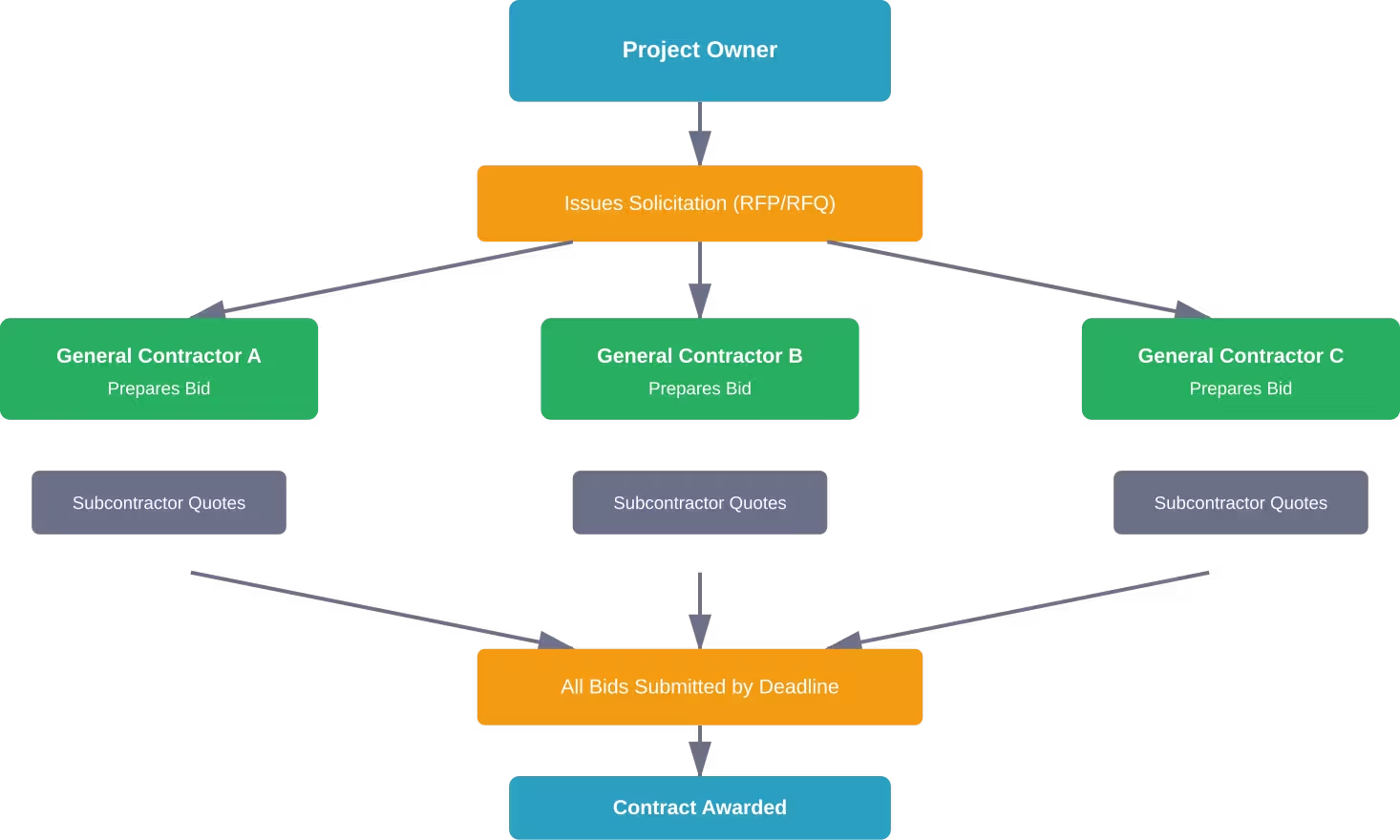
Construction bidding involves multiple stakeholders working through a structured process:
- Project owners initiate bidding by defining project requirements and issuing solicitations. These might be private developers, government agencies, or facility owners who need construction services.
- General contractors respond to solicitations by preparing comprehensive bids that cover the entire project scope. They coordinate subcontractor quotes, estimate direct costs, and add overhead and profit margins.
- Subcontractors provide trade-specific estimates to general contractors for specialized work like HVAC, electrical, plumbing, or grading. As educational resources note, subcontractors use the same estimating processes as general contractors but focus on their specific trade scope.
- Design professionals—architects and engineers—often assist owners during bid evaluation, reviewing technical submittals and answering contractor questions during the bidding period.
- Procurement specialists manage the administrative process, ensuring bidding follows legal requirements, deadlines are met, and evaluations remain fair and consistent.
The Construction Bidding Process: 7 Core Steps
Construction bidding follows a structured sequence that moves from opportunity identification through contract award. Understanding each phase helps contractors allocate resources effectively and avoid costly missteps.
Step 1: Project Announcement and Solicitation
Owners announce construction opportunities through formal solicitations. Government projects appear on platforms like SAM.gov, where federal agencies post contract opportunities including pre-solicitation notices, solicitation notices, and award notices.
Private projects typically circulate through construction plan rooms, industry networks, or direct invitations to pre-qualified contractors. The solicitation document outlines project scope, requirements, submission deadlines, and evaluation criteria.
Real talk: monitoring the right channels separates contractors who see opportunities early from those scrambling at the last minute.
Step 2: Bid/No-Bid Decision
Not every opportunity deserves pursuit. Contractors evaluate projects against criteria like:
- Project type and scope alignment with company capabilities
- Geographic location and travel requirements
- Contract size relative to bonding capacity
- Schedule compatibility with existing workload
- Owner reputation and payment history
- Competition level and win probability
- Profit margin potential
Strategic contractors develop systematic bid/no-bid frameworks rather than chasing every lead. Resources spent preparing losing bids represent opportunity costs that could’ve gone toward more winnable work.
Step 3: Document Review and Site Assessment
Once committed to bidding, contractors thoroughly review all project documents including drawings, specifications, contract terms, and technical requirements. According to educational institutions like NYU SPS, this review phase includes analyzing general conditions, understanding subcontractor scopes, and identifying planning requirements for developing accurate estimates.
Site visits provide crucial context that drawings can’t convey. Contractors assess access constraints, existing conditions, utilities, soil conditions, and logistical challenges that impact cost and schedule.
Smart contractors document everything during site visits—photos, measurements, questions, and observations that inform estimating assumptions.
Step 4: Cost Estimating and Takeoff
This is where bids win or lose. Contractors perform detailed quantity takeoffs, measuring every material component from the drawings. They then apply unit costs for materials, labor, equipment, and subcontractor work.
Carnegie Mellon University research notes that cost estimation in construction often represents an exercise in professional judgment rather than merely compiling data. Estimators must account for project-specific factors like site conditions, schedule compression, weather risks, and resource availability.
The estimate builds from direct costs (materials, labor, equipment) up through indirect costs (supervision, temporary facilities, permits) to overhead and profit. Subcontractors provide quotes for specialized trades, which general contractors incorporate into comprehensive bids.
Step 5: Risk Assessment and Contingency
Every project carries uncertainty. Contractors identify potential risks like:
- Design ambiguities or incomplete drawings
- Unknown subsurface conditions
- Material price volatility
- Schedule constraints and weather impacts
- Labor availability in the project location
- Owner changes and scope creep potential
Quantifying these risks allows contractors to build appropriate contingencies into bid prices rather than hoping problems don’t materialize.
Step 6: Bid Compilation and Submission
With estimates complete, contractors compile formal bid packages including required forms, pricing schedules, qualifications documentation, and supporting materials.
Timing matters critically here. Subcontractor quotes often arrive in the final hours before submission deadlines, forcing last-minute adjustments. Contractors must balance incorporating competitive sub-bids against the risk of errors during rushed assembly.
Government contracts frequently require electronically sealed bidding through secure portals, ensuring all bids remain confidential until the official opening time.
Step 7: Bid Opening, Evaluation, and Award
Public projects typically feature open bid openings where submitted prices are read aloud. Private projects may keep bid amounts confidential during evaluation.
Owners evaluate bids based on pre-established criteria. Low price isn’t always the winner—evaluation factors often include technical approach, schedule, past performance, safety records, and financial capacity.
According to the GSA, government contracting emphasizes conducting market research and competitive analysis before awarding contracts to ensure taxpayer value and contractor capability.
The winning contractor receives a notice of award or intent to award, triggering contract negotiations and finalization before construction begins.
De-Risk Your Bid Before Submission

Winning a bid with incomplete or untested design just shifts the problem into delivery. Powerkh steps in before submission to stress-check what you’re pricing – not the documents, but the build logic behind them. They look at how systems come together, where interfaces are tight, and where assumptions are likely to fail once work starts. This isn’t about adding contingency. It’s about exposing the parts of the design that will drive change after award, so your bid reflects real conditions, not best-case scenarios.
Get Your Bid Right
What Powerkh actually does for your bid:
- Reviews coordinated models to expose clashes that will affect quantities
- Flags missing or unclear details that distort scope and pricing
- Checks buildability of key elements before they are priced
- Identifies interfaces that typically drive variations after award
- Shows where design intent won’t carry through to site
Contact Powerkh before you submit and make sure your bid is based on what will actually be built.
Types of Construction Bidding Methods
Construction projects use different bidding approaches depending on owner preferences, project characteristics, and legal requirements. Each method carries distinct advantages and limitations that affect competition, pricing, and contractor selection.
Open Bidding (Open Tendering)
Open bidding allows any qualified contractor to submit proposals. Owners publicly advertise project opportunities, and interested contractors who meet minimum qualifications can participate.
This approach maximizes competition, potentially driving down prices through market forces. Government projects frequently mandate open bidding to ensure fair access and prevent favoritism.
But there’s a tradeoff. More competition means lower win rates for individual contractors and higher collective costs as multiple firms invest resources preparing bids. Quality can vary widely when the door opens to any minimally qualified bidder.
Selective Bidding (Invited Bidding)
Selective bidding restricts participation to pre-qualified contractors whom the owner invites. Only firms meeting specific criteria—experience, bonding capacity, past performance—receive solicitations.
This method improves quality control by limiting competition to proven contractors. It reduces the owner’s evaluation burden since all bidders meet baseline standards. Invited contractors face better win probabilities, justifying the resources spent preparing detailed proposals.
Private owners prefer selective bidding for complex projects where contractor capability matters as much as price. The downside? Potentially higher costs due to reduced competition and possible exclusion of capable but lesser-known contractors.
Negotiated Bidding
Rather than competitive solicitation, negotiated bidding involves the owner selecting a contractor and negotiating terms directly. This typically happens when:
- The project requires specialized expertise only certain contractors possess
- Fast-track schedules demand early contractor involvement
- Design-build delivery integrates design and construction services
- Previous positive relationships warrant sole-source engagement
Construction management at risk and design-build project delivery methods, as outlined in joint guidance from the AIA and Associated General Contractors of America, often involve negotiated selection rather than low-bid competition.
Negotiated approaches facilitate collaboration and risk-sharing but require strong owner oversight to ensure fair pricing without competitive pressure.
Serial Tendering
When owners have multiple similar projects planned, serial tendering establishes framework agreements with contractors for a series of future projects. Rather than rebidding each individual project, the owner negotiates rates and terms once, then issues work orders as projects arise.
This approach reduces administrative burden and creates workload continuity for contractors. However, it potentially reduces competition since the same contractors handle all work under the agreement.
Two-Stage Bidding
Two-stage bidding splits technical and price evaluation into separate phases. Stage one evaluates qualifications, approach, and technical merit without pricing. The owner shortlists the most qualified bidders, who then submit pricing in stage two.
This method emphasizes quality and capability over low price alone. It works well for complex projects where technical solutions vary significantly and price comparisons require equal scopes.
| Bidding Method | Competition Level | Quality Control | Best For |
|---|---|---|---|
| Open Bidding | Maximum | Variable | Public projects, price-sensitive work |
| Selective Bidding | Moderate | High | Complex projects, private owners |
| Negotiated | Minimal | Highest | Specialized work, design-build, fast-track |
| Serial Tendering | Low | Consistent | Multiple similar projects |
| Two-Stage | Moderate | High | Technical complexity, varying approaches |
Understanding RFIs, RFQs, and RFPs
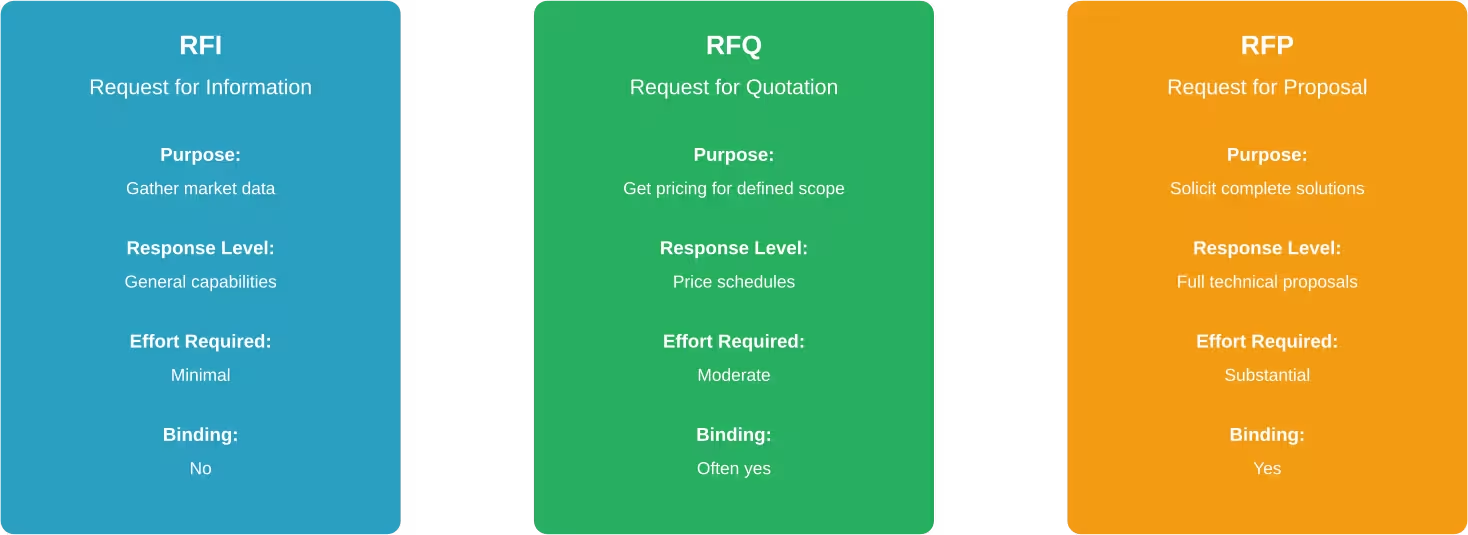
Construction solicitations come in different flavors, each serving distinct purposes. Recognizing these differences helps contractors respond appropriately and avoid wasting effort on mismatched opportunities.
Request for Information (RFI)
According to GSA guidance, an RFI is used when an agency is gathering information. Owners issue RFIs to understand market capabilities, available solutions, typical costs, or industry approaches before formally soliciting bids.
RFIs aren’t binding solicitations—they’re research tools. Contractors respond with general capability statements rather than detailed bids. The owner uses responses to refine project requirements and determine appropriate procurement strategies.
Smart contractors engage with RFIs strategically. Response shows interest and capabilities, potentially positioning the firm favorably when formal solicitations emerge. But RFIs require minimal investment since they don’t directly lead to contracts.
Request for Quotation (RFQ)
RFQs seek price quotations for well-defined scopes of work. The owner has clearly specified requirements and primarily wants to know what contractors will charge.
RFQs typically involve straightforward work where technical approaches don’t vary significantly. Material supply, standard installations, or routine maintenance work often use RFQ processes.
Responses focus on pricing schedules, delivery timelines, and basic qualifications. Evaluation emphasizes price comparison since technical specifications are predetermined.
Request for Proposal (RFP)
RFPs solicit comprehensive proposals including technical approach, management plans, schedules, qualifications, and pricing. Owners use RFPs when they need contractors to propose solutions, not just quote prices for predefined work.
RFPs demand substantial preparation effort. Contractors must demonstrate they understand the project requirements, have viable approaches for execution, possess necessary resources and experience, and offer competitive pricing.
Evaluation criteria typically include both technical and cost factors. The lowest price doesn’t automatically win—owners balance cost against solution quality, schedule feasibility, and contractor capability.
Construction Cost Estimating Best Practices
Accurate estimating forms the foundation of successful bidding. Underestimate and lose money. Overestimate and lose opportunities. According to research from Texas A&M University’s architecture program, cost estimating requires input from dedicated cost estimators, project managers, subcontractors, and material suppliers, bringing clarity to the project scope and financial requirements.
Systematic Quantity Takeoff
Quantity takeoff measures all materials and work items from construction drawings. This tedious but critical process determines how much concrete, steel, lumber, drywall, mechanical systems, and every other component the project requires.
Successful estimators work systematically through drawings, documenting quantities in organized formats that allow verification and adjustment. Digital takeoff tools accelerate this process while reducing mathematical errors, but the fundamental discipline remains the same—measure everything once, verify critical items twice.
Accurate Unit Cost Application
Once quantities are established, estimators apply unit costs representing material, labor, and equipment expenses per measurement unit. These costs come from:
- Historical company data from similar past projects
- Current vendor and supplier quotations
- Published cost databases and estimating guides
- Subcontractor bids for trade-specific work
- Market research on current pricing trends
Smart estimators adjust published unit costs for project-specific factors like location, timing, market conditions, and unique site constraints rather than blindly applying average values.
Comprehensive Subcontractor Solicitation
General contractors typically subcontract a significant portion of project work to specialized trades. Getting competitive, complete subcontractor quotes directly impacts bid competitiveness.
Best practices include soliciting multiple quotes per trade, clearly defining scope boundaries to avoid gaps or overlaps, and verifying that sub-bids include all required work, materials, and conditions.
The tricky part? Subcontractor quotes often arrive in the final hours before bid deadlines, forcing rapid evaluation under pressure. According to the Associated General Contractors of America, the practice of bid shopping—soliciting lower quotes after contract award—represents an abhorrent business practice that threatens bidding integrity.
Risk Identification and Contingency
Every project carries uncertainty. Effective estimating identifies specific risks and builds appropriate contingencies rather than adding arbitrary percentages.
Consider factors like:
- Design completeness and potential for changes
- Site conditions and subsurface unknowns
- Schedule constraints and associated costs
- Material price volatility during project duration
- Labor availability in the project market
- Weather impacts on productivity
Quantifying these risks allows targeted contingencies on high-uncertainty items rather than blanket markups that may overprice the bid.
Overhead and Profit Structure
Beyond direct job costs, contractors must recover company overhead expenses and earn reasonable profit margins. Overhead includes office staff, facilities, utilities, insurance, bonding, equipment ownership, estimating costs, and business development expenses.
Establishing appropriate overhead rates requires understanding annual costs and projected revenue volumes. Profit margins vary by project type, risk level, market competition, and strategic value on competitively bid work.
Estimate Review and Validation
Before submission, experienced estimators review completed bids for completeness and reasonableness. Does the total price align with preliminary expectations? Are there obvious omissions? Do unit prices reflect current market conditions?
Peer review by another estimator or project manager catches errors before they become costly mistakes. Comparing the estimate against historical data from similar projects provides validation that numbers fall within expected ranges.
Common Bidding Challenges and Solutions
Construction bidding presents recurring obstacles that contractors must navigate to compete effectively while protecting profitability.
Incomplete Design Documents
Contractors frequently bid projects with incomplete or ambiguous design documents. Missing details force assumptions that introduce risk—assume too conservatively and the bid becomes uncompetitive; assume optimistically and face change order battles later.
The solution? Document all assumptions clearly in bid submissions. Issue requests for information (RFIs) during the bidding period to clarify ambiguities. Consider qualifications that limit liability for unforeseen conditions related to incomplete design.
Compressed Bidding Timelines
Short timeframes between solicitation release and submission deadlines compress the work of reviewing documents, estimating costs, soliciting subcontractor quotes, and assembling proposals into frantic sprints that increase error risks.
Successful contractors maintain organized estimating processes, leverage digital tools for efficiency, cultivate reliable subcontractor networks that respond quickly, and sometimes make strategic no-bid decisions when timelines don’t allow proper due diligence.
Last-Minute Subcontractor Shopping
Subcontractors often delay submitting quotes until just before general contractor bid deadlines, creating pressure to accept whatever arrives without proper evaluation. Some subs engage in bid peddling—submitting artificially low quotes to get listed in bids, then claiming errors after award to negotiate higher amounts.
Mitigation strategies include establishing relationships with reliable subcontractors, soliciting quotes early with clear deadlines, and evaluating sub-bids for completeness rather than just low price.
Scope Ambiguities and Gaps
Construction projects involve complex interfaces between trades and systems. Scope gaps where no contractor includes specific work items create problems during construction. Scope overlaps where multiple contractors price the same work and inflate bids unnecessarily.
Careful document review, clear scope definitions in subcontractor solicitations, and explicit exclusion lists in bid submissions help manage these interface risks.
Price Disclosure and Bid Shopping
In some markets, unethical practices like bid shopping undermine the integrity of competitive bidding. General contractors may use subcontractor quotes to shop for lower prices after bid submission or contract award, or project owners may disclose winning bid amounts to solicit lower proposals.
Industry organizations including the Associated General Contractors of America have issued joint statements opposing these practices. Contractors protect themselves through careful subcontractor agreements, clear contract terms prohibiting quote disclosure, and professional relationships built on integrity rather than just low price.
Winning More Construction Bids: Strategic Approaches
Beyond technical estimating accuracy, winning bids consistently requires strategic positioning and competitive intelligence.
Selective Pursuit Strategy
Chasing every opportunity spreads resources thin and reduces win rates. Successful contractors develop selective pursuit strategies focused on projects that align with:
- Core capabilities and past experience
- Target market sectors and geographies
- Appropriate project sizes and types
- Existing client relationships
- Strategic growth objectives
Pursuing fewer, better-matched opportunities with higher win probabilities generates better results than high-volume, low-probability bidding.
Relationship Development
Owners who know and trust contractors through past performance or relationship-building efforts often provide competitive advantages during evaluation. Relationship-based advantages compound over time as satisfied clients become repeat customers and referral sources.
Investing in client relationship management, maintaining communication beyond active projects, and demonstrating reliability builds the reputation that influences future opportunities.
Competitive Intelligence
Understanding who else is bidding, their typical pricing strategies, and their competitive strengths helps position proposals effectively. Market research reveals typical pricing ranges, identifies competitor advantages worth countering, and uncovers opportunities where competition may be weak.
According to the GSA, conducting market research and competitive analysis before pursuing government contracts helps determine if opportunities represent good fits and how to compete effectively.
Value Engineering and Alternative Proposals
When design documents include expensive specifications or approaches, contractors can propose value engineering alternatives that achieve project objectives at lower costs. Alternative proposals demonstrate problem-solving capability and potentially create pricing advantages.
However, this strategy works best when solicitations allow alternatives and evaluation criteria reward innovation rather than strict conformance.
Presentation Quality and Responsiveness
Technical proposal quality matters, particularly for negotiated or best-value procurements. Clear writing, organized presentation, responsive answers to evaluation criteria, and professional document assembly distinguish serious competitors from also-rans.
Contractors who invest in proposal development skills, templates, and processes produce more compelling submissions that score higher during evaluation.
Technology in Construction Bidding
Digital tools have transformed construction estimating and bidding over the past decade, accelerating processes while improving accuracy.
Digital Takeoff and Estimating Software
Cloud-based estimating platforms allow contractors to perform quantity takeoffs directly on digital plans, automatically calculating measurements and quantities. These tools link quantities to cost databases, streamlining estimate preparation and reducing mathematical errors.
Integration between takeoff, estimating, and bidding modules creates seamless workflows from initial quantity measurements through final bid assembly.
Project Management and Bid Management Platforms
Comprehensive construction management platforms include bid management functionality that organizes opportunities, tracks pursuit status, manages document versions, coordinates team contributions, and archives submitted bids for future reference.
These systems improve pursuit discipline by imposing structured workflows and capturing institutional knowledge that survives personnel turnover.
Online Plan Rooms and Bid Portals
Government agencies and private owners increasingly use online portals for distributing bid documents, managing addenda, facilitating questions, and receiving electronic submissions. According to SAM.gov, government contract opportunities are accessible through centralized online systems where contractors can search, filter, and respond to solicitations.
Electronic sealed bidding maintains confidentiality until official opening times while eliminating physical document handling and delivery logistics.
Collaboration Tools
Cloud collaboration platforms enable distributed teams to work on estimates simultaneously, with real-time updates visible across locations. This capability proves especially valuable when coordinating input from estimators, project managers, and specialty consultants across multiple offices.
Federal Government Construction Bidding
Government contracting follows specific procedures designed to ensure fair competition and taxpayer value while complying with regulatory requirements.
Registration Requirements
Contractors pursuing federal work must register in the System for Award Management (SAM.gov), which consolidates multiple registration systems into a single platform. This free registration validates business identity, records representations and certifications, and makes contractors visible to federal buyers.
Small business certifications provide access to set-aside opportunities reserved for specific business categories. According to the GSA, contractors should pursue work as small businesses when eligible to increase accessible opportunities.
Finding Federal Opportunities
SAM.gov serves as the centralized source for finding and bidding on federal contract opportunities. The platform allows contractors to search active solicitations, save searches for automated notifications, and download complete bid packages.
Federal agencies also offer specialized contract vehicles like Multiple Award Schedules (MAS), Government-wide Acquisition Contracts (GWAC), and Multiple Award Construction Contracts (MACC) that provide streamlined access to opportunities for pre-qualified contractors.
Understanding Federal Procurement Rules
Federal contracting operates under the Federal Acquisition Regulation (FAR), which establishes policies and procedures governing all federal purchases. Understanding FAR requirements for bidding, performance, and compliance represents essential knowledge for contractors pursuing government work.
Common requirements include wage determinations under the Davis-Bacon Act, buy American provisions, small business subcontracting plans, and detailed cost/pricing data submissions.
Contract Vehicles and IDIQ Contracts
Indefinite Delivery/Indefinite Quantity (IDIQ) contracts establish framework agreements where contractors compete for individual task orders issued over the contract period. Multiple Award Construction Contracts represent one form of IDIQ specifically for construction work.
Becoming a contract holder on these vehicles requires competing successfully once, then accessing ongoing opportunities only available to holders. This approach benefits both agencies (streamlined procurement) and contractors (reduced recompetition for similar work).
Ethical Considerations in Construction Bidding
Competitive bidding relies on integrity among all participants. Several practices threaten the fairness and effectiveness of construction bidding processes.
Bid Shopping and Bid Peddling
Bid shopping occurs when general contractors use subcontractor quotes to solicit lower prices after bid submission or contract award. This practice undermines subcontractors who provided competitive quotes in good faith and degrades the integrity of competitive pricing.
Bid peddling is the mirror practice where subcontractors submit artificially low quotes to get listed in bids, then claim errors and demand higher amounts after award when the general contractor has limited alternatives.
The Associated General Contractors of America has issued joint statements with subcontractor associations firmly opposing both practices as abhorrent behaviors that threaten bidding integrity.
Bid Rigging and Collusion
Bid rigging involves competitors conspiring to manipulate competitive bidding through practices like:
- Complementary bidding where competitors submit artificially high bids
- Bid rotation where competitors take turns being the low bidder
- Market allocation where competitors divide territories or customers
- Bid suppression where competitors agree not to bid
These practices violate antitrust laws and carry severe civil and criminal penalties. Legitimate competition requires independent bidding decisions without coordination or communication about pricing strategies.
Unbalanced Bidding
Unbalanced bidding involves manipulating unit prices within a bid to gain cash flow advantages or exploit anticipated quantity changes. While some forms are legal, extreme unbalancing that misrepresents costs or creates unfair advantages may be challenged or disqualified.
Transparent, balanced pricing that reflects actual anticipated costs maintains ethical standards and protects contractors from disputes about unreasonable unit prices.
Accurate Representation
Bid submissions constitute formal offers and often contractual commitments. Misrepresenting qualifications, experience, capacity, or intended performance approaches violates ethical standards and potentially legal requirements.
Contractors build reputations through consistent honest representation and reliable performance that matches bid commitments.
Frequently Asked Questions
What’s the difference between construction bidding and construction estimating?
Estimating is the process of calculating project costs based on quantities and unit prices. Bidding is the broader process that includes estimating plus risk analysis, pricing strategy, overhead, profit, and formal proposal submission.
How long does the construction bidding process typically take?
Timelines vary by project size. Small projects may take about two weeks, while larger commercial or infrastructure projects can require 4–12 weeks or more to prepare bids.
Can contractors submit bids for projects outside their normal geographic area?
Yes, but it introduces challenges such as unfamiliar regulations, higher costs, and limited local relationships. Contractors often partner with local firms or adjust pricing to manage these risks.
What happens if a contractor makes a mistake in their bid after submission?
Policies vary. Some projects allow withdrawal for proven errors before contract award, but after signing, corrections are difficult and may require legal or contractual solutions.
Do construction bids always go to the lowest bidder?
Not always. Public projects often select the lowest qualified bidder, while private and complex projects may use best-value selection based on experience, quality, and approach in addition to price.
How do contractors know if their bid was competitive after losing?
Public projects often release bid results, while private projects may not provide feedback. Contractors use available data and industry insights to improve future bids.
What’s the role of bid bonds in construction bidding?
Bid bonds ensure that the selected contractor will sign the contract and provide required guarantees. If the contractor withdraws, the owner can claim compensation from the bond.
Conclusion: Mastering Construction Bidding for Long-Term Success
Construction bidding represents far more than just quoting prices. It’s a comprehensive competitive discipline that demands technical estimating expertise, strategic market positioning, risk management acumen, and operational discipline.
Contractors who consistently win profitable work understand that successful bidding starts long before reviewing solicitation documents. It begins with strategic market selection, relationship development, capability building, and systematic processes that convert opportunities into contracts.
The fundamentals remain constant across project types and delivery methods: thoroughly understand scope requirements, accurately estimate costs through detailed quantity takeoffs and current pricing, identify and price risks appropriately, solicit competitive subcontractor quotes, apply reasonable overhead and profit, and submit compelling proposals that demonstrate capability and value.
But beyond technical execution, winning bidders recognize that not every opportunity deserves pursuit. Selective bidding focused on the right projects produces better results than high-volume approaches that spread resources thin while diluting win rates.
Technology continues transforming bidding processes, making digital tools and online platforms essential infrastructure rather than optional enhancements. Contractors who leverage these tools effectively gain productivity advantages that translate into competitive positioning.
Looking forward, construction bidding will continue evolving with increased transparency through online platforms, greater emphasis on qualifications alongside price through best-value procurement, and growing importance of documented past performance and safety records.
The contractors who thrive will combine technical estimating accuracy with strategic market intelligence, maintain ethical standards that build long-term reputation, invest in technology and process improvement, and focus relentlessly on delivering the performance that converts won bids into satisfied clients and future opportunities.
Ready to improve bidding performance? Start by evaluating recent bid results. Which projects were won or lost and why? What patterns emerge in estimating accuracy, competition intensity, and selection criteria? Use this analysis to refine pursuit strategies, strengthen estimating processes, and focus resources on opportunities with the highest win probability and profit potential.
Construction bidding success isn’t about winning every bid—it’s about winning the right bids at prices that support sustainable profitable growth while building the reputation and relationships that create competitive advantages for years to come.

Our Case Studies
We have handled 200+ BIM & VDC projects for commercial, industrial, and residential sectors.
Our work includes:
Formwork design automation
Our client from
California, USA
Suspended ceiling design automation
Our client from
New York, USA
Wall framing design automation
Our client from
California, USA