Have any questions? Contact us!
Join our team!
Request a free quote or consultation

A shear wall is a structural element designed to resist lateral forces from wind and earthquakes that would otherwise cause buildings to collapse or experience severe damage. These vertical walls transfer horizontal loads down to the foundation, working as part of the building’s lateral force-resisting system to maintain structural stability and safety.
When designing any structure, engineers must account for two fundamentally different types of loading: gravity loads that push straight down, and lateral forces that try to push buildings sideways. That second category—lateral forces—is where shear walls become absolutely critical.
According to Wikipedia, a shear wall is an element of a structurally engineered system designed to resist in-plane lateral forces, typically wind and seismic loads. Without these specialized structural components, buildings would lack the rigidity needed to withstand the horizontal forces that threaten structural integrity during storms and earthquakes.
The term “shear” refers to the type of stress these walls experience. When lateral forces hit a building, shear walls resist the resulting shear stresses and bending moments, transferring these loads safely down to the foundation. Think of them as the structural backbone that keeps buildings upright when nature pushes from the side.
How Shear Walls Work: The Mechanics Behind Lateral Resistance
Here’s the thing—not all walls in a building serve the same purpose. Standard partition walls divide interior spaces but provide minimal structural support. Shear walls, by contrast, are engineered specifically to handle horizontal forces.
When wind or seismic forces act on a building, they create lateral loads that attempt to push the structure sideways or cause it to rack (deform into a parallelogram shape). Shear walls resist this racking action through their in-plane stiffness and strength.
The load path works like this: lateral forces hit the building’s exterior, transfer through floor and roof diaphragms, then channel into the shear walls. These walls, acting as vertical cantilevers, resist the forces and transfer them down through the foundation and into the ground.
A typical timber shear wall consists of braced panels constructed using structural plywood sheathing, specific nailing patterns at the edges, and supporting framing members. The sheathing material, combined with properly spaced fasteners, creates a stiff panel that resists racking deformation.
Primary Materials Used in Shear Wall Construction
Shear walls can be constructed from several different materials, each with distinct performance characteristics and appropriate applications. The material choice depends on the building type, seismic zone, design loads, and construction methods.
Reinforced Concrete Shear Walls
Concrete shear walls are among the most common in commercial and high-rise construction. These walls combine concrete’s compressive strength with steel reinforcement that handles tensile stresses.
According to PEER research, reinforced concrete structural walls serve as the primary seismic lateral-force-resisting components in most industrial and nuclear facilities. Squat reinforced concrete shear walls—those with aspect ratios smaller than 2.0—have very high stiffness and strength, though their behavior under earthquake loading presents specific engineering challenges.
The reinforcement pattern in concrete shear walls is critical. Vertical and horizontal rebar creates a grid that controls cracking and provides ductility during seismic events. Boundary elements at wall edges provide additional confinement where compression stresses concentrate.
Steel Plate Shear Walls
Steel plate shear walls have become increasingly popular, particularly in high seismic areas. According to research published in the AISC Engineering Journal, steel plate shear walls are rapidly becoming an appealing alternative for lateral resistance in earthquake-prone regions.
The 2005 AISC Seismic Provisions introduced comprehensive design requirements for steel plate shear wall systems, establishing them as a code-recognized lateral force-resisting system. These walls typically consist of steel infill plates connected to boundary columns and beams.
The advantage? Steel plate shear walls offer excellent strength-to-weight ratios and ductility. The thin steel plates buckle under load but continue to resist forces through tension field action, providing reliable performance during major seismic events.
Wood-Frame Shear Walls
Residential and light commercial construction predominantly uses wood-frame shear walls. These consist of wood framing members (typically dimensional lumber like 2×4 or 2×6 studs) with structural sheathing panels attached.
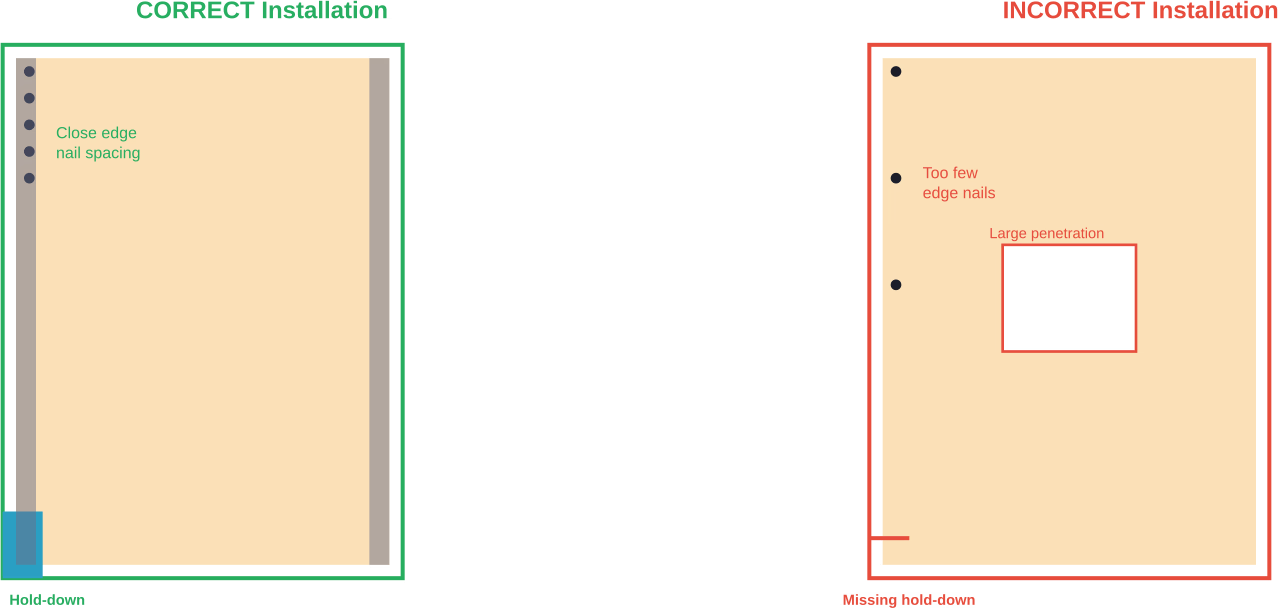
The sheathing material—usually plywood or oriented strand board (OSB)—is what actually resists the lateral forces. The fastener pattern (nail spacing and type) dramatically affects the wall’s capacity. Closer nail spacing at panel edges increases shear resistance.
Proper shear wall construction requires attention to details like hold-downs at wall ends (to resist uplift) and proper connections to the foundation and floor/roof diaphragms above.
Cold-Formed Steel Shear Walls
Cold-formed steel (CFS) framing has gained traction as a durable, dimensionally stable alternative to wood framing. CFS shear wall design requires specific considerations to avoid common mistakes and achieve optimal performance, as outlined in professional training materials.
CFS shear walls use light-gauge steel studs with structural sheathing attached via screws. The steel framing won’t rot, warp, or attract pests, making it attractive for certain applications. However, design calculations differ from wood-frame walls due to the steel’s different material properties.
| Material Type | Best Applications | Key Advantages | Considerations
|
|---|---|---|---|
| Reinforced Concrete | High-rises, commercial buildings, critical facilities | High strength, fire resistance, durability | Heavy, requires formwork, longer construction time |
| Steel Plate | Seismic zones, tall buildings, retrofits | Excellent ductility, high strength-to-weight ratio | Requires specialized detailing, higher material cost |
| Wood-Frame | Residential, light commercial, low-rise | Cost-effective, fast construction, readily available | Lower capacity, moisture sensitivity, fire rating concerns |
| Cold-Formed Steel | Residential, light commercial, coastal areas | Dimensionally stable, pest-resistant, non-combustible | Thermal bridging, specialized fasteners required |
Strategic Placement: Where Shear Walls Go in Buildings
Placement strategy can make or break a shear wall system’s effectiveness. Random wall locations won’t work—engineers must consider load paths, symmetry, and functional requirements.
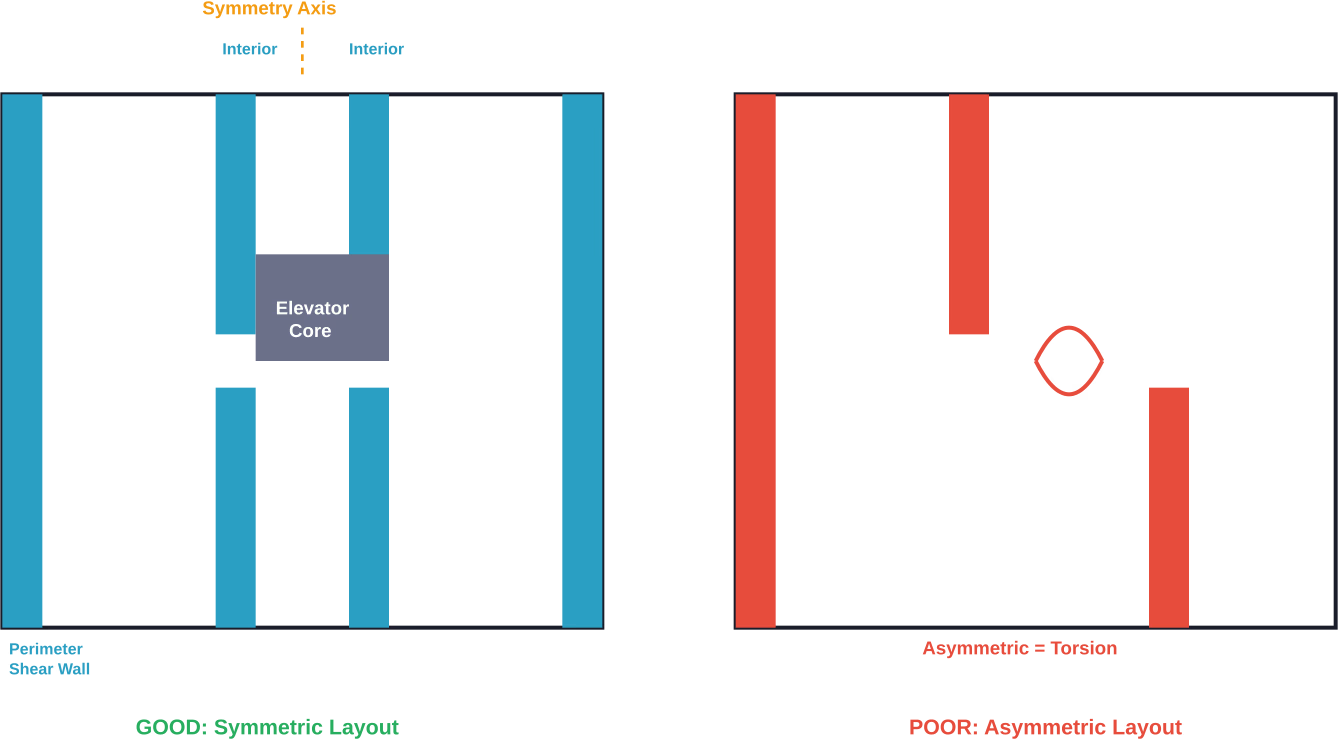
The goal is to create a balanced system where shear walls are distributed throughout the building plan. Symmetrical placement reduces torsional responses during earthquakes. When lateral forces create twisting motions because shear walls concentrate on one side of a building, structural damage intensifies.
Real talk: shear walls need continuous load paths. A shear wall on the third floor accomplishes nothing if it doesn’t align with walls on the second floor, first floor, and down to the foundation. Breaking this continuity forces loads to transfer through other elements not designed for those stresses.
Exterior vs. Interior Shear Walls
Both exterior and interior shear walls serve lateral resistance functions, but their placement affects architectural planning and structural efficiency differently.
Exterior shear walls often align with the building perimeter, providing both enclosure and structural functions. This dual purpose can be efficient, though architectural requirements for windows and doors may limit where exterior shear walls can be placed effectively.
Interior shear walls offer more flexibility in continuous vertical alignment since they’re less constrained by window requirements. They can align with corridor walls, elevator shafts, or stairwells—elements that already run continuously through multiple floors.
The comparative analysis comes down to project-specific factors. High-rise buildings often use core walls (interior shear walls surrounding elevator and stair shafts) as their primary lateral system. Low-rise buildings might rely more heavily on perimeter shear walls integrated into the exterior envelope.
Arrangement Considerations for Different Building Functions
Building function dramatically influences feasible shear wall arrangements. Residential buildings can accommodate more interior shear walls since unit layouts repeat predictably. Office buildings need large open floor plates, limiting interior wall locations.
Hospitals present particular challenges. Operating rooms, imaging suites, and patient wards all have different layout requirements. Shear walls must provide necessary lateral resistance while accommodating functional adjacencies and circulation patterns.
Parking structures represent the opposite extreme—minimal interior walls to maximize parking efficiency. Perimeter shear walls or alternative systems like moment frames become necessary.
Design Considerations and Engineering Requirements
Designing shear walls involves significantly more complexity than slapping up a wall and calling it structural. Multiple factors must be calculated and coordinated.
Load Calculations and Capacity Design
Engineers must first determine the lateral loads the building will experience. Wind loads depend on the structure’s height, geographic location, exposure category, and surface area. Seismic loads depend on ground motion parameters, soil conditions, building mass, and structural period.
Once design forces are established, engineers calculate the required shear wall capacity. This involves determining how many shear walls are needed, their length, their material properties, and their connection details.
The capacity calculation isn’t just about shear strength. Overturning moments create uplift forces at wall ends that must be resisted by hold-down anchors or sufficient dead load. Sliding resistance at the wall base requires proper anchorage to the foundation.
Aspect Ratio Effects
A shear wall’s aspect ratio—the ratio of height to length—significantly affects its behavior. Tall, slender walls (high aspect ratio) behave more like cantilever beams, with bending behavior dominating. Short, long walls (low aspect ratio) behave more like deep beams, with shear deformations controlling.
According to PEER research, squat shear walls with aspect ratios smaller than 0.5 exhibit particularly complex behavior patterns. Their very high stiffness and strength come with uncertainties regarding failure modes and expected performance during major earthquakes.
Design codes typically provide different equations and capacity reduction factors based on aspect ratio, recognizing these behavioral differences.
Connection Details That Make or Break Performance
The weakest link principle applies ruthlessly to shear wall systems. A shear wall can only be as strong as its connections to adjacent elements.
Foundation anchorage represents the critical base connection. Anchor bolts must transfer shear forces and uplift forces into the foundation. According to ASCE design guidance, masonry shear wall anchorage has undergone significant code changes in recent years, reflecting improved understanding of connection behavior.
Roof and floor diaphragm connections also matter immensely. Lateral forces from these horizontal diaphragms must transfer into the vertical shear walls. Inadequate connections here create a disconnect—the shear walls can’t do their job if forces can’t reach them.
Wood-frame shear walls need special attention at panel edges. Nail spacing, edge distance, and fastener type all affect capacity. Using the wrong nails or spacing them incorrectly can reduce capacity by 50% or more.
Fire Resistance and Building Code Requirements
Shear walls must satisfy multiple building code requirements simultaneously—not just structural capacity, but also fire resistance, accessibility, and other provisions.
According to NIST research on cold-formed steel shear walls, fire performance represents a critical design consideration. Testing has established monotonic load-displacement capacity and fire resistance characteristics for various CFS shear wall configurations.
NIST specimen CFS02 was subjected to symmetric-amplitude reverse-cyclic shear deformation, with specimens defined as reaching destruction at 2.8% drift ratio. This type of testing helps establish both structural and fire performance parameters that feed into building code requirements.
Concrete and masonry shear walls inherently provide excellent fire resistance due to their non-combustible construction and thermal mass. Wood-frame and cold-formed steel walls require gypsum board or other fire-resistant materials to achieve required fire ratings.
Common Installation Mistakes and How to Avoid Them
Theory meets reality on the construction site, and that’s where shear wall performance gets determined. Perfect engineering means nothing if construction execution falls short.
Missing or improperly installed hold-downs ranks among the most critical errors. These anchors resist the uplift forces at shear wall ends. Forgetting them, using the wrong model, or failing to properly bolt them to the framing completely compromises the wall’s capacity.
Inadequate nailing represents another frequent problem in wood-frame construction. Field nailing (in the middle of panels) versus edge nailing serve different purposes. Edge nailing provides the actual shear resistance. Skimping on edge nails or using incorrect spacing dramatically reduces capacity.
Panel layout matters more than many installers realize. Blocking must be installed behind panel edges where they don’t fall on framing members. Without this backing, edge nailing can’t develop proper capacity.
Penetrations through shear walls—for plumbing, electrical, or HVAC—must be properly accounted for. Large unplanned openings can severely compromise capacity. When penetrations are necessary, they need engineering review to verify adequate remaining capacity.
Quality Control Checkpoints
Smart builders implement quality control checkpoints specifically for shear wall installation:
- Verify correct sheathing material and thickness before installation begins
- Confirm proper fastener type, length, and quantity on site
- Mark edge nailing zones clearly to prevent field vs. edge nailing confusion
- Inspect hold-down installation before covering with finishes
- Document any field changes or penetrations for engineering review
- Verify continuous load path from roof through each floor to foundation
Nonplanar Shear Walls and Advanced Configurations
Not all shear walls are simple flat planes. Complex architectural requirements sometimes demand nonplanar configurations—walls with angles, curves, or intersections.
L-shaped and T-shaped shear walls combine two or more wall segments at angles. These configurations can be highly effective, but they introduce complexity in analysis and detailing. The wall segments interact, and forces don’t distribute uniformly.
C-shaped or U-shaped configurations (common around elevator cores) create particularly stiff systems. But wait—that stiffness comes with stress concentrations at corners that require careful reinforcement detailing.
Coupled shear walls represent another advanced configuration. Two separate wall panels connect through coupling beams at each floor level. This system combines the strength of individual walls with enhanced ductility from the coupling action.
Modern Analysis Methods and Modeling Techniques
Engineering analysis of shear walls has evolved considerably. Simple hand calculations work for basic configurations, but complex buildings demand sophisticated modeling.
Finite element analysis allows detailed investigation of stress distributions, particularly important for walls with openings, nonplanar configurations, or unusual loading conditions. The model discretizes the wall into small elements and solves for forces and deformations throughout the structure.
Nonlinear time-history analysis has become increasingly common for critical facilities and tall buildings in seismic zones. This method applies recorded or synthetic ground motion time histories to the structural model, calculating the response second by second. It reveals how the structure actually behaves during earthquakes, including when elements yield or crack.
Pushover analysis represents a middle ground—more sophisticated than linear elastic methods but less computationally intensive than full time-history analysis. The method applies gradually increasing lateral forces, tracking how the structure responds as elements reach their capacity and plastic hinges form.
Retrofitting Existing Buildings with Shear Walls
Many older buildings lack adequate shear wall systems by modern standards. Seismic retrofitting often involves adding new shear walls to deficient structures.
The challenge? Adding shear walls to occupied buildings creates construction complexity and disruption. Contractors must work around existing utilities, finishes, and building operations.
Steel plate shear walls have become particularly popular for retrofit applications. According to AISC research, their high strength-to-weight ratio and relatively thin profile make them attractive when adding lateral capacity to existing structures.
Foundation capacity represents a critical retrofit consideration. New shear walls impose additional demands on existing foundations. Sometimes the foundation needs strengthening before shear walls can be added.
| Retrofit Method | Typical Applications | Advantages | Challenges
|
|---|---|---|---|
| New concrete walls | Buildings with adequate space and foundation capacity | Highly effective, durable, fire-resistant | Heavy, foundation upgrades often needed, significant disruption |
| Steel plate shear walls | Tight spaces, high-rise buildings, seismic retrofits | Minimal thickness, high capacity, adaptable | Specialized labor required, cost, connection complexity |
| Reinforced masonry infill | Buildings with existing masonry, historic preservation | Works with existing conditions, traditional appearance | Labor-intensive, requires proper grouting and reinforcement |
| Wood-frame additions | Residential, light commercial, low seismic zones | Cost-effective, standard construction methods | Limited capacity, may not meet higher seismic requirements |
Cost Considerations and Budget Planning
Shear wall costs vary dramatically based on material choice, building height, seismic requirements, and regional labor rates. Providing specific pricing would be misleading given these variables, but understanding cost drivers helps with budget planning.
Material costs represent the most obvious expense. Reinforced concrete walls require formwork, concrete, reinforcing steel, and concrete placement—all labor-intensive. Steel plate walls have higher material costs but potentially faster installation.
Engineering costs shouldn’t be overlooked. Complex buildings in high seismic zones require detailed analysis, possibly including nonlinear modeling and peer review. These engineering costs represent a small percentage of total construction but are essential for proper performance.
Foundation requirements often drive costs more than the walls themselves. Shear walls create concentrated loads, potentially requiring larger footings or pile foundations. Foundation work is expensive, and upgrades here can significantly impact project budgets.
Get Shear Walls Built As Designed

Shear walls carry critical loads, so even small deviations can create serious issues during construction. Misplaced openings, alignment shifts, or coordination gaps don’t just slow work – they introduce risk into the structure. Powerkh checks how the design is being carried into construction and highlights where it starts to drift. They focus on layout, interfaces, and how work is actually executed on site. Instead of assuming everything matches the drawings, you see where it doesn’t, and what needs attention before it turns into a bigger problem.
Build Structural Elements Without Risks
What Powerkh identifies on your project:
- Where wall layout or openings don’t match the design intent
- Where structure and adjacent systems are out of alignment
- Where early-stage deviations are already appearing on site
- Where installed elements are drifting from the coordinated model
- Where issues can escalate if left unaddressed
Contact Powerkh and make sure your shear walls are built without hidden deviations that turn into costly problems later.
Future Trends in Shear Wall Design and Construction
Shear wall technology continues evolving. Emerging materials and construction methods are changing what’s possible.
Cross-laminated timber (CLT) represents an exciting development. These engineered wood panels can serve as structural walls with impressive strength and stiffness. CLT shear walls combine renewable materials with good seismic performance and faster construction than concrete.
Prefabrication is gaining traction across construction, including shear wall systems. Factory-built wall panels arrive on site with sheathing, hold-downs, and connections already installed. This approach improves quality control and speeds installation.
Self-centering wall systems represent advanced seismic design. These walls incorporate post-tensioning or other mechanisms that allow the wall to rock during earthquakes but return to vertical afterward, minimizing permanent damage.
Building information modeling (BIM) is transforming how shear walls are coordinated with other building systems. Clash detection identifies conflicts between shear wall locations and mechanical systems before construction begins, preventing costly field changes.
Conclusion: The Structural Backbone That Keeps Buildings Standing
Shear walls represent one of the most critical elements in modern construction, even though they often go unnoticed by building occupants. These specialized structural components resist the lateral forces that would otherwise cause buildings to rack, deform, or collapse during windstorms and earthquakes.
From reinforced concrete walls in high-rise towers to wood-frame shear walls in residential construction, the principle remains consistent: create stiff vertical elements that transfer horizontal forces down to the foundation. The materials and methods vary, but the engineering fundamentals stay the same.
Sound familiar? Every building taller than a single story deals with lateral forces. The question isn’t whether lateral resistance matters—it’s whether the structural system adequately addresses it.
Proper shear wall design requires careful attention to material selection, placement strategy, connection details, and quality construction. Shortcuts in any of these areas compromise performance when the building needs it most—during extreme wind or seismic events.
For building owners, developers, and construction professionals, understanding shear walls isn’t just technical knowledge—it’s essential for creating safe, durable structures that protect occupants and property investments. When planning new construction or evaluating existing buildings, ensure qualified structural engineers design and verify the shear wall system according to current building codes and site-specific conditions.
The structural integrity of the entire building depends on it.
Frequently Asked Questions
What’s the main difference between a shear wall and a regular wall?
A shear wall is specifically engineered to resist lateral forces from wind and earthquakes, transferring these horizontal loads down to the foundation. Regular partition walls primarily divide spaces and support vertical loads only. Shear walls require specific materials, connections, and continuous load paths that standard walls don’t need.
Can any wall be turned into a shear wall?
Not every wall can function as a shear wall. The wall must have proper sheathing material, adequate fastening, appropriate connections to the floor or roof diaphragms, hold-downs to resist uplift, and continuous load path to the foundation. Converting an existing wall to a shear wall requires engineering analysis and specific construction upgrades.
How thick does a shear wall need to be?
Thickness varies by material and design requirements. Wood-frame shear walls typically use 2×4 or 2×6 framing (3.5 to 5.5 inches actual thickness). Concrete shear walls often range from 6 to 12 inches or more depending on building height and loads. Steel plate shear walls can be much thinner – sometimes just 2 to 3 inches for the steel plate plus boundary framing.
Do shear walls need to run continuously from foundation to roof?
Yes, shear walls require vertical continuity to function properly. A shear wall must create a continuous load path from the roof level all the way down through each floor to the foundation. Breaking this continuity means lateral forces can’t transfer properly, compromising the entire lateral force-resisting system.
Where should shear walls be located in a house?
Shear walls should be distributed throughout the floor plan as symmetrically as possible to prevent torsion during lateral loading. Common locations include exterior perimeter walls, garage walls, and interior walls that run continuously through the building. The specific placement requires engineering analysis based on the building’s geometry and design loads.
How do openings for doors and windows affect shear wall capacity?
Openings reduce shear wall capacity significantly. Engineers must either design around openings using the solid wall segments on either side, or reinforce the opening with appropriate framing and connections. Large openings may require alternative lateral force-resisting systems or additional shear walls elsewhere to compensate for the reduced capacity.
What happens to a building without adequate shear walls during an earthquake?
Buildings lacking adequate shear walls can experience severe racking deformation, where the structure deforms into a parallelogram shape. This leads to structural damage, including cracked walls, broken connections, damaged finishes, and in severe cases, partial or complete collapse. Adequate shear walls keep the structure rigid and stable during seismic events.

Our Case Studies
We have handled 200+ BIM & VDC projects for commercial, industrial, and residential sectors.
Our work includes:
Formwork design automation
Our client from
California, USA
Suspended ceiling design automation
Our client from
New York, USA
Wall framing design automation
Our client from
California, USA