Have any questions? Contact us!
Join our team!
Request a free quote or consultation

If you search for laser scanning cost UK, you’ll quickly notice one thing: there’s no single number that fits every project. Some surveys cost a few hundred pounds. Others run into five figures. And most quotes sit somewhere in between, shaped less by square metres and more by what you actually need from the data.
In 2026, the laser scan survey price in the UK is still driven by practical realities. How big the site is. How easy it is to access. How accurate the output needs to be. And, most importantly, what deliverables are expected at the end. Scanning itself is often the fastest part. Turning raw data into usable drawings or BIM models is where time and cost add up.
This guide breaks down typical project ranges, the main price drivers, and what’s usually included or excluded in a laser scanning quote, so you can sense-check numbers before committing to a survey.
What Laser Scanning Actually Covers in 2026
Before talking about cost, it’s worth clarifying what most people mean by laser scanning today. A laser scan survey is not just someone turning up with a scanner and pressing a button.
A typical UK laser scanning project includes several stages:
- Planning and scope definition
- On-site data capture
- Registration and alignment of scans
- Quality control and error checking
- Data cleaning and structuring
- Optional modelling or drawing production
- Delivery and handover of files
The scan itself might take a few hours or a few days. Everything around it often takes longer. That distinction matters because most pricing is driven by processing and deliverables, not the time spent on site.
Laser Scanning Built Around Design Continuity at Powerkh
At Powerkh, we specialize in transforming raw laser scan data into intelligent BIM environments. We don’t treat Scan to BIM as a simple conversion; we use it as a strategic tool to carry design intent safely from early design through coordination and into construction.
Our laser scanning and reality-based services are embedded into a continuity-led workflow that supports projects at the moments where risk typically appears:
- Existing conditions capture and scan to BIM modelling
- Coordination and critical zone resolution
- Design versus site deviation checks
- Evidence-based progress and as-built verification
Applied this way, laser scanning delivers more than data. It reduces coordination risk, cuts down rework, and gives teams clear, evidence-based confidence that what’s designed is what gets built. Just as importantly, it keeps the laser scanning quote focused on real project value, not unnecessary detail or inflated scope.
Typical Laser Scanning Cost UK Ranges in 2026
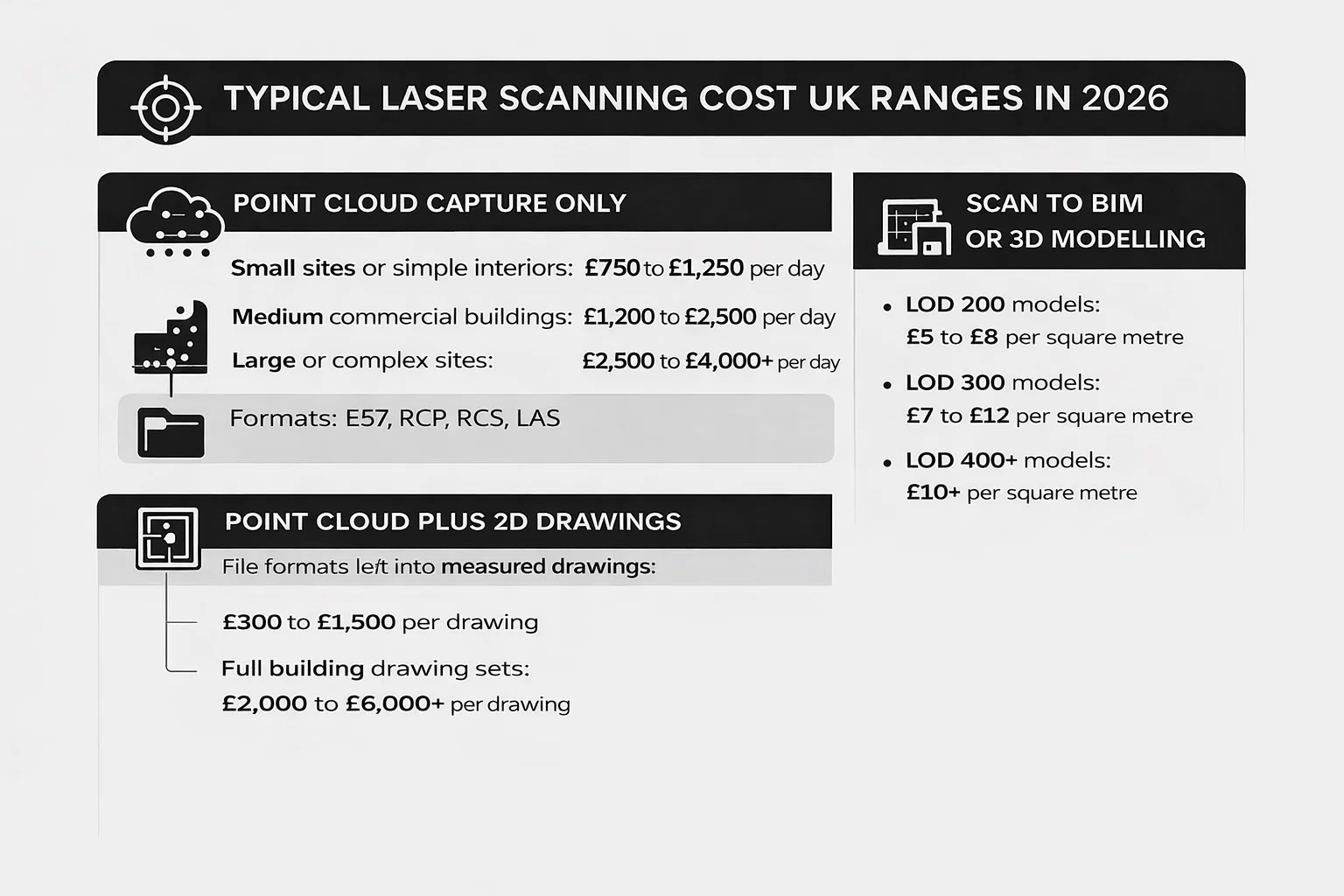
While no two projects are identical, there are common pricing bands that show up across the UK market. These are not fixed prices, but realistic ranges based on current practice.
Point Cloud Capture Only
For projects where the output is a registered point cloud with no drawings or models:
- Small sites or simple interiors: £750 to £1,250 per day
- Medium commercial buildings: £1,200 to £2,500 per day
- Large or complex sites: £2,500 to £4,000+ per day
This usually includes scanning, registration, and delivery of files in formats such as E57, RCP, RCS, or LAS.
Point Cloud Plus 2D Drawings
When the scan data is converted into measured drawings:
- Floor plans, elevations, or sections: £300 to £1,500 per drawing
- Full building drawing sets: £2,000 to £6,000+
- Complex industrial or heritage sites: higher, depending on detail
At this stage, modelling time becomes the main cost driver, not scanning.
Scan to BIM or 3D Modelling
For Revit or BIM models derived from scan data:
- LOD 200 models: £5 to £8 per square metre
- LOD 300 models: £7 to £12 per square metre
- LOD 400 or fabrication-level models: £10+ per square metre
Large buildings often reach total costs of £10,000 to £50,000+, especially when MEP systems are included.
Why Laser Scan Survey Price UK Figures Vary So Much
Many first-time clients assume pricing is based on floor area alone. In reality, square metres tell only part of the story. Two sites of the same size can produce very different quotes once access, accuracy, and deliverables are taken into account.
Size of the Site
Size matters, but not in a linear way.
A small site can take longer than expected if it is cluttered, irregular, or difficult to move through. A large open warehouse, on the other hand, may scan quickly despite its footprint. Site size affects cost through several practical factors:
- Number of scan positions required
- Time needed for scan registration
- Volume of data to process
- Length of quality control checks
As a rough guide:
- A small residential property may scan in 1 to 2 hours
- A medium office floor may take half a day
- A hospital, factory, or campus may require several days on site
Access Conditions and Safety Constraints
Access is one of the most underestimated cost drivers.
Projects become more expensive when scanning has to work around operational, safety, or environmental restrictions. This includes confined spaces, live environments such as hospitals or schools, night or weekend working, rail possessions or road closures, working at height, and hazardous or controlled areas.
These conditions increase cost because they require additional planning, stricter safety procedures, specialist equipment, and slower capture rates on site.
Accuracy Requirements and Tolerance Levels
Not all scans need the same level of accuracy.
A general layout scan used for space planning does not require the same tolerance as a scan supporting steel fabrication or installation checks. Higher accuracy requirements usually mean more scan positions, tighter registration control, additional time spent validating geometry, and involvement from more experienced operators.
Millimetre-level accuracy is achievable, but it comes at a higher cost due to the extra control and verification involved.
Deliverables and Outputs
Deliverables are usually the single biggest factor in final pricing.
Scanning itself is fast. Converting scan data into usable outputs takes time and specialist skill. Common deliverables include:
- Raw or registered point clouds
- 2D CAD drawings
- 3D CAD models
- Revit or BIM models
- Deviation analysis
- Virtual tours or TruViews
The more interpretation and modelling required, the higher the overall laser scanning quote will be.
Level of Detail and Modelling Scope
Level of Detail, or LOD, is often misunderstood. Higher LOD does not just mean more detail. It means more decisions and more manual work.
For example:
- Modelling structural elements only is faster than modelling full MEP systems
- Modelling selected zones is cheaper than modelling an entire building
- Architectural-only models cost less than coordination-ready BIM models
Clear scope definition at the start of the project can reduce modelling time and prevent unnecessary cost.
Location and Logistics
Location affects pricing in practical, unavoidable ways.
Travel time and accommodation, ferry crossings or remote access, security clearance requirements, and site induction processes all influence how a survey is planned and delivered. A site that is difficult to reach or tightly controlled can cost more than a larger but easily accessible location.
Urgency and Programme Pressure
Fast turnaround always costs more.
Typical uplifts seen in the UK market include:
- Express delivery (3 to 5 days): +20 to 30 percent
- Emergency delivery (24 to 48 hours): +40 to 50 percent
Accelerated programmes require reallocated resources and extended working hours, which is reflected in the price.
What Is Included and Excluded in a Laser Scanning Quote
Understanding what a laser scanning quote actually covers is essential. Many pricing misunderstandings come not from the headline number, but from assumptions about what is included by default and what sits outside the agreed scope.
What Is Usually Included in a Laser Scanning Quote
Most professional laser scanning quotes in the UK include the core technical steps required to capture and deliver usable scan data. This typically covers the site visit and on-site data capture, scan registration and alignment, basic cleaning of the point cloud, and quality control checks to ensure accuracy and consistency.
Quotes also usually include file export in the agreed formats, such as E57, RCP, RCS, or LAS, along with secure digital delivery of the final datasets. These elements form the baseline service and are generally expected unless stated otherwise.
What Is Often Excluded Unless Specified
Some services are not included by default and must be clearly defined in the scope if required. Detailed BIM modelling is a common example, as it involves significant additional interpretation and production time beyond scanning. Drawing revisions beyond the agreed scope, deviation or tolerance analysis, and clash detection services are also frequently excluded unless explicitly requested.
Ongoing data hosting, long-term cloud access, and additional site visits typically sit outside standard pricing as well. If these items are needed, they should be discussed early and reflected in the laser scanning quote to avoid unexpected costs later.
Example Project Scenarios and Costs
Small Plant Room Survey
- On-site scanning: 2 hours
- Processing: 1 day
- Output: point cloud plus 2D plans
- Estimated cost: £1,200 to £1,800
Medium Commercial Building
- On-site scanning: 1 to 2 days
- Output: full point cloud
- BIM model to LOD 300
- Estimated cost: £4,500 to £8,000
Large Industrial Facility
- On-site scanning: 3 to 5 days
- Output: coordinated BIM model
- Selected MEP systems included
- Estimated cost: £15,000 to £40,000+
How to Reduce Laser Scanning Costs Without Cutting Corners
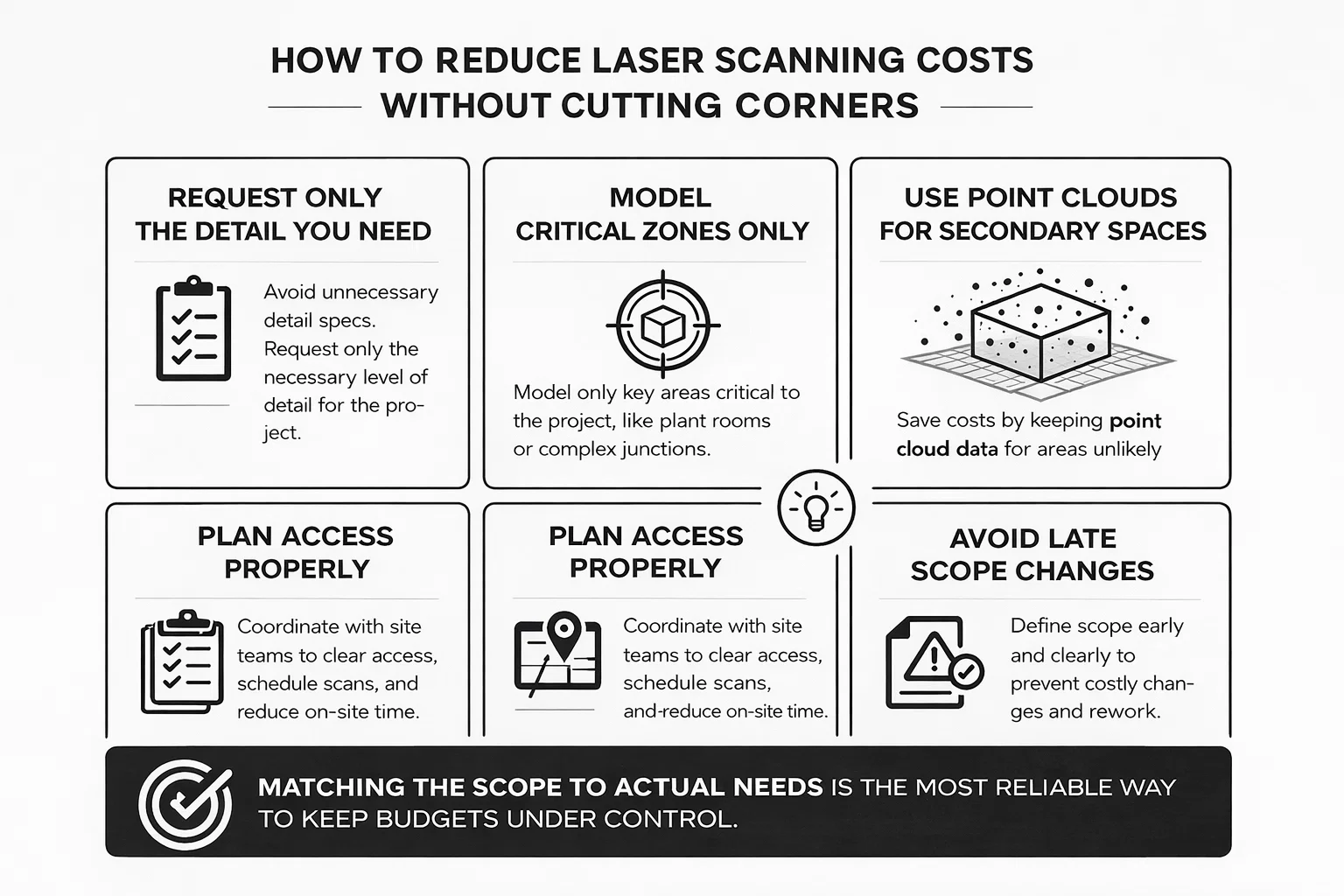
Laser scanning does not have to be expensive to be effective. In many projects, costs rise not because the work is complex, but because the scope is broader than it needs to be. A few thoughtful decisions at the start can keep budgets under control without sacrificing accuracy or reliability.
- Request Only the Detail You Need. Not every project requires high-detail outputs or tight tolerances across the entire site. If the scan is being used for layout planning or feasibility checks, a lower level of detail may be perfectly adequate. Avoid specifying high accuracy or advanced deliverables unless they serve a clear purpose.
- Model Critical Zones Only. Full-building modelling can be costly, especially for large or older structures. Often, only specific areas are critical to the project, such as plant rooms, interfaces with new construction, or complex junctions. Modelling these zones while keeping the rest as point cloud data can significantly reduce costs.
- Use Point Clouds for Secondary Spaces. Point clouds are highly accurate and fully measurable. For storage areas, circulation spaces, or parts of the building unlikely to be altered, retaining the data as a point cloud rather than converting it into drawings or models can save time and money without limiting future use.
- Plan Access Properly. Clear access, sensible sequencing, and coordination with site teams make a real difference. Removing obstacles, arranging escorts where needed, and scheduling scans outside peak activity can reduce on-site time and prevent costly delays or return visits.
- Avoid Late Scope Changes. Changes after scanning or modelling has begun often lead to rework. Defining deliverables, formats, and levels of detail clearly at the outset helps avoid revisions that add cost without improving outcomes.
Used well, laser scanning is efficient by nature. Matching the scope to the actual needs of the project is the most reliable way to keep the laser scanning quote proportionate and predictable.
Laser Scanning as an Investment, Not Just a Cost
Laser scanning is often viewed as an upfront expense, but its real value shows up later in the project. Accurate existing conditions reduce guesswork at the design stage and help teams avoid working from outdated or incomplete information. That alone can prevent clashes, redesigns, and site delays that cost far more than the scan itself. In refurbishment and retrofit projects especially, having reliable data from the start can change how confidently decisions are made.
In many cases, a single avoided error covers the full cost of scanning. Fewer site returns, clearer coordination between disciplines, and reduced rework during construction all contribute to savings that are difficult to achieve through traditional surveying alone. When scanning is planned early and scoped correctly, it becomes a practical risk management tool rather than a line item to minimise.
Final Thoughts
There is no single laser scan survey price UK-wide, and that is expected. Pricing reflects the realities of each project, including site conditions, access, accuracy requirements, and the level of certainty needed from the data. Two quotes can differ significantly and still both be correct, as long as they are aligned with their respective scopes and responsibilities.
The key to predictable pricing is clarity. When deliverables, levels of detail, and timeframes are clearly defined from the outset, laser scanning quotes become easier to compare and justify. In 2026, scanning is no longer a specialist add-on. It is a standard part of many projects, and understanding how its cost is structured helps teams use it effectively and with confidence.
Frequently Asked Questions
How much does laser scanning cost in the UK in 2026?
Laser scanning cost UK projects typically range from around £750 for small, simple surveys to £50,000 or more for large, complex sites with detailed BIM deliverables. Most projects fall somewhere in between. The final price depends on site size, access conditions, accuracy requirements, and what needs to be produced from the scan data.
What is the average laser scan survey price UK clients should expect?
For point cloud capture only, many UK projects fall between £750 and £2,500 per day. When 2D drawings or BIM models are required, costs increase due to modelling time, often bringing total project prices into the £3,000 to £10,000 range for typical commercial buildings.
What has the biggest impact on a laser scanning quote?
Deliverables usually have the biggest impact on a laser scanning quote. Scanning itself is relatively fast, but converting point cloud data into drawings or BIM models requires skilled labour and time. Access constraints, accuracy tolerances, and urgency also significantly influence pricing.
Is laser scanning priced per square metre?
Sometimes, but not always. BIM modelling is often priced per square metre, especially for LOD-based work. Scanning itself is more commonly priced per day or per site. Square metre rates alone rarely tell the full story, as complexity and access matter just as much as size.
What is usually included in a standard laser scanning quote?
Most quotes include site attendance, data capture, scan registration, basic point cloud cleaning, quality control, file export in agreed formats, and digital delivery. These form the baseline service. Anything beyond this, such as detailed modelling or analysis, should be clearly stated in the scope.
What is commonly excluded unless agreed in advance?
Detailed BIM modelling, drawing revisions beyond the agreed scope, deviation or tolerance analysis, clash detection, ongoing data hosting, and additional site visits are often excluded unless specifically requested. These items should always be confirmed before work begins.

Have a BIM Project? Talk To Us.
Contact UsOur Case Studies
We have handled 200+ BIM & VDC projects for commercial, industrial, and residential sectors.
Our work includes:
Formwork design automation
Our client from
California, USA
Suspended ceiling design automation
Our client from
New York, USA
Wall framing design automation
Our client from
California, USA