Have any questions? Contact us!
Join our team!
Request a free quote or consultation

Steel fabrication drawings are the backbone of any solid construction project involving metal. They’re not just lines on paper – they’re the detailed instructions that ensure every beam, column, and bolt comes together perfectly. As someone who’s seen projects go sideways without them, I can tell you: skimping here is asking for trouble. Costs can range from a modest $1,000 for a small job to over $100,000 for a massive skyscraper. In 2026, these prices are shifting with tech and market trends, so let’s unpack what you’re really paying for.
These drawings cover everything: exact dimensions, steel grades, weld details, and more. They’re what fabricators use to cut and shape steel, and what contractors rely on to assemble it all without headaches. I’ve watched teams scramble when drawings lack clarity – it’s not pretty, with delays and extra costs piling up. Whether you’re building a warehouse or a bridge, understanding the price tag helps you plan without getting burned. Below, I’ll walk you through the factors, models, and real-world numbers to keep your budget on track.
What Drives the Cost of Steel Fabrication Drawings?
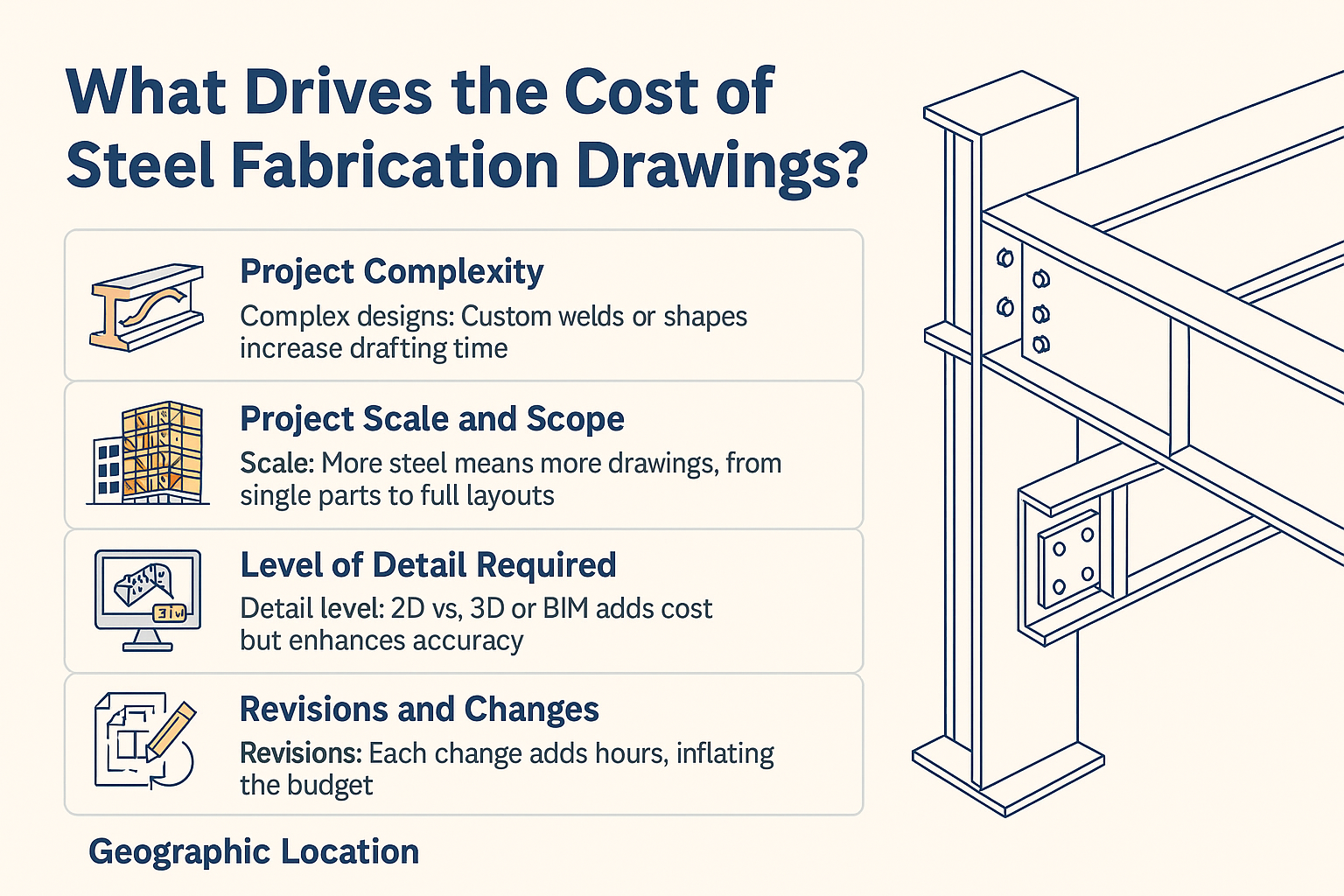
The price of these drawings isn’t a random number – it’s shaped by a handful of factors that add up fast. Knowing them upfront can save you from sticker shock.
Project Complexity
The more intricate your design, the pricier the drawings. A simple frame for a storage shed is quick to draft, but add curved beams, custom connections, or seismic requirements, and you’re looking at extra hours for detailers to map every angle and tolerance. Complex projects might need 3D modeling or clash detection, which bumps up costs significantly.
Project Scale and Scope
Size matters. A small residential project with 10 tonnes of steel needs fewer sheets than a 500-tonne high-rise. Larger jobs mean more components, views, and annotations, driving up the time and effort. For example, a single staircase might need a few drawings, while a factory requires hundreds, each detailing unique parts.
Level of Detail Required
Basic 2D drawings are cheaper, but if you want advanced features like BIM integration or detailed shop drawings with 3D renders, costs climb. These extras help catch errors early, but they demand specialized skills and software, adding to the bill.
Revisions and Changes
Changes mid-project are a cost killer. Each revision – say, tweaking a connection or adjusting dimensions – can add $200 to $2,000, depending on the scope. Frequent updates mean more time spent redrawing and verifying.
Geographic Location
Where you’re based affects pricing. Urban areas with high demand for skilled labor charge more. Rural or offshore markets might offer savings, but you’ll need to factor in communication and quality control.
- Complex designs: Custom welds or shapes increase drafting time.
- Scale: More steel means more drawings, from single parts to full layouts.
- Detail level: 2D vs. 3D or BIM adds cost but enhances accuracy.
- Revisions: Each change adds hours, inflating the budget.
- Location: High-cost cities push rates up compared to global options.
I’ve noticed folks often miss the revision trap. A quick chat with your team to lock in specs early can dodge a lot of extra charges.
Powerkh’s Expert Guide: Navigating Steel Fabrication Drawing

Powerkh is a UK-based company with offices in Ukraine and the USA, specializing in steel shop drawings and structural detailing. We provide precise and detailed steel drawings tailored to the needs of each project, ensuring alignment with architectural and engineering requirements. Our services are designed to support a variety of industries throughout the design and construction stages, offering clear, accurate documentation for steel structures.
Our team produces comprehensive shop drawings for critical steel components, including framing, connections, and foundations. These drawings serve as essential guidelines for fabrication and construction teams, ensuring proper assembly and minimizing errors. We use advanced software tools to create detailed, high-quality drawings that facilitate efficient communication and coordination across all project stakeholders.
Beyond detailing, we also offer project coordination services, addressing any challenges that arise during the construction process. Our approach helps ensure projects proceed smoothly, with accurate and reliable documentation that reduces the risk of delays and costly revisions.
Key Highlights:
- UK-based company with offices in Ukraine and the USA
- Specializes in steel shop drawings and structural detailing
- Supports a variety of industries with tailored steel detailing services
- Provides high-quality, precise drawings to guide fabrication and construction
- Uses advanced software tools for accurate, error-free documentation
- Offers project coordination to streamline the construction process
Pricing Models: How You Pay for Drawings
When it comes to paying for steel fabrication drawings, there are a few ways it’s typically done. Each has its own quirks, so picking the right one depends on your project’s needs.
Hourly Rates
Charging by the hour is common for flexible or evolving projects. In 2026, expect rates of:
- US: $70-$100 per hour, reflecting high labor costs and strict standards.
- Canada/UK/Australia: $50-$75 per hour, competitive due to steady construction markets.
- Offshore (e.g., India): $20-$30 per hour, popular for cost savings but requires careful quality checks.
A mid-sized project might take 100-300 hours, totaling $7,000-$30,000. Hourly works if you expect tweaks, but watch those hours – they pile up fast.
Per-Tonne Pricing
Some detailers charge based on the steel’s weight, typically $85-$100 per tonne. This ties costs to material volume, making it predictable for structural jobs. For example, a 100-tonne project could run $8,500-$10,000. It’s great for large builds but less common for small, custom work.
Flat Fees
Flat fees lock in a set price for the whole job. They’re ideal for well-defined scopes:
- Small projects: $1,000-$5,000, covering basic drawings.
- Medium projects: $5,000-$15,000, including detailed assemblies.
- Large projects: $20,000-$100,000+, with comprehensive shop drawings and BIM.
Flat fees offer budget certainty but require clear terms to avoid extra charges for revisions or add-ons.
- Hourly: Flexible, but track time to avoid surprises.
- Per-tonne: Ties to steel volume, great for big projects.
- Flat fee: Predictable, but define scope tightly.
From what I’ve seen, flat fees are a favorite for straightforward jobs. They keep things tidy, but hourly can be better if your design’s still fluid.
Cost Ranges by Project Size
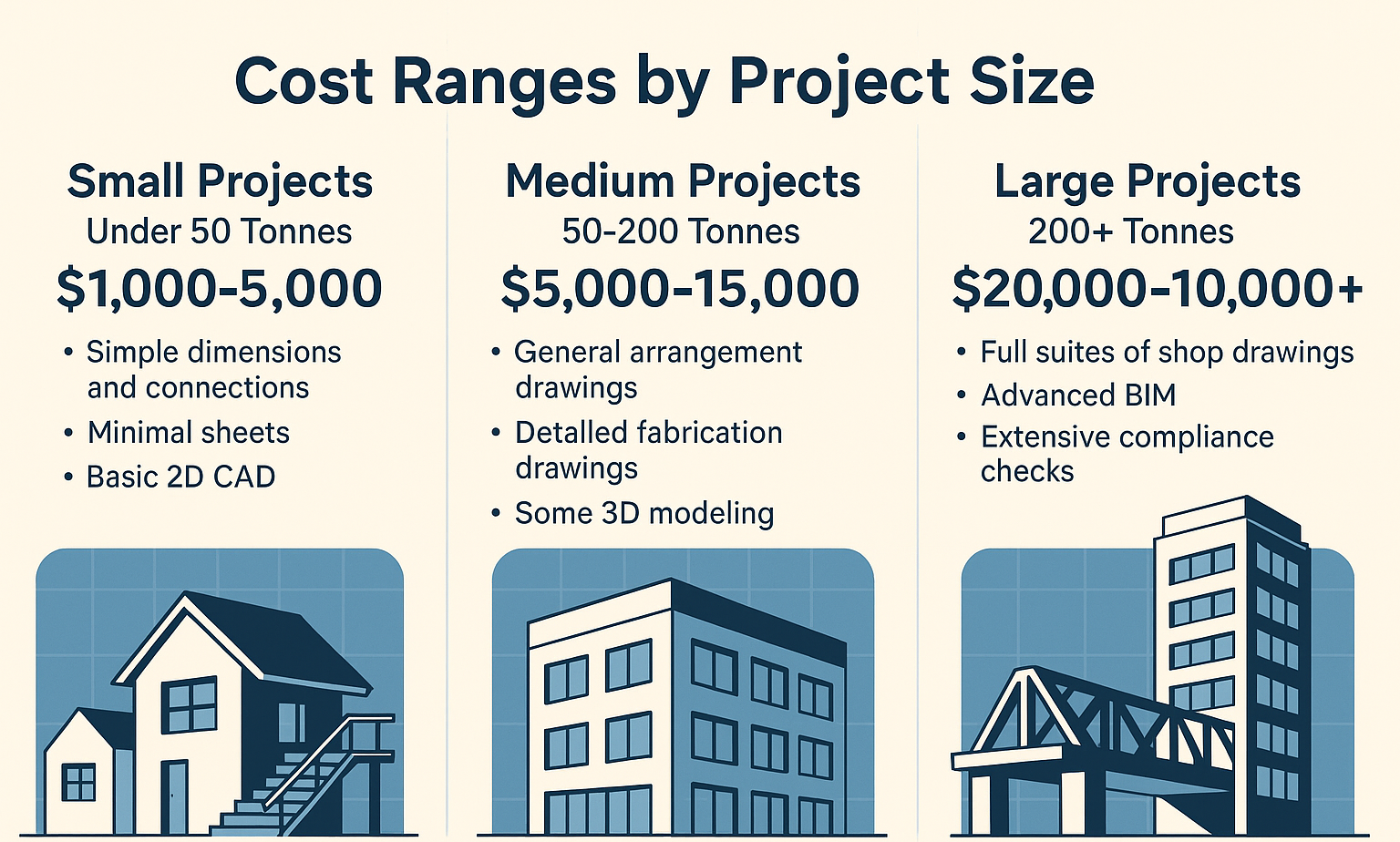
Let’s talk numbers – real, grounded estimates for 2026 based on project scale. These ranges give you a sense of what to expect.
Small Projects (Under 50 Tonnes)
Think home extensions, steel stairs, or small frames. These jobs need basic single-part and assembly drawings, costing $1,000-$5,000. With 10-50 tonnes, you’re looking at:
- Simple dimensions and connections.
- Minimal sheets, often 5-10 total.
- Basic 2D CAD, no heavy tech.
A staircase might hit $1,500 for a few detailed sheets. Keep it simple, and you’re at the lower end.
Medium Projects (50-200 Tonnes)
Warehouses, mid-rise offices, or retail spaces fall here. Costs range from $5,000-$15,000, covering:
- General arrangement drawings for layout.
- Detailed fabrication drawings for multiple components.
- Some 3D modeling for clarity.
A 100-tonne warehouse might cost $8,000, with extra if you add clash detection or revisions.
Large Projects (200+ Tonnes)
Skyscrapers, bridges, or factories are big leagues, with costs from $20,000 to $100,000+. These include:
- Full suites of shop drawings.
- Advanced BIM for clash detection.
- Extensive compliance checks for codes like AISC or Eurocode.
A 500-tonne bridge could hit $50,000, driven by intricate connections and rigorous verifications.
- Small: $1,000-$5,000, simple and quick.
- Medium: $5,000-$15,000, more components and detail.
- Large: $20,000-$100,000+, tech-heavy and complex.
I’ve learned small jobs swing the most – one custom detail can push a $2,000 job to $4,000. Always budget for surprises.
How Location Impacts Your Costs
Geography isn’t just a backdrop – it shapes what you pay for steel fabrication drawings. Labor markets, demand, and local standards all play a part.
High-Cost Regions
In places like the US, rates run $70-$100 per hour due to skilled labor shortages and high living costs. Cities like New York or San Francisco add 10-20% for demand and overhead. Strict codes like AISC mean extra time for compliance notations.
Competitive Markets
Canada ($50-$75/hour), the UK ($45-$65/hour), and Australia ($55-$75/hour) offer balanced pricing. Steady construction keeps rates stable, though urban hubs might nudge higher.
Offshore Options
Countries like India offer export rates of $20-$30 per hour, appealing for cost savings. Quality varies, so robust QA is a must. Time zones and communication can add hidden costs if not managed well.
Standards and Logistics
Local codes – like Eurocode in Europe – require specific details, adding hours. Cross-border projects might face shipping or collaboration costs, especially for physical drawings or frequent calls.
- US: $70-$100/hour, high due to standards and demand.
- Canada/UK/Australia: $45-$75/hour, competitive markets.
- Offshore: $20-$30/hour, budget-friendly but needs oversight.
- Code compliance: Adds time for regional requirements.
I’ve seen projects save by going offshore, but only with clear specs. Miscommunication can eat up any savings, so keep lines open.
The Hidden Costs of Overhead and Extras
The price you see isn’t just the detailer’s time – there’s a whole ecosystem behind it. Overhead can inflate costs significantly.
Software and Hardware
CAD tools like AutoCAD, Tekla, or Revit cost approximately $2,000-$7,000 per year per license. Workstations for 3D modeling aren’t cheap, and IT security adds up to protect designs.
Training and Quality Assurance
Skilled detailers need ongoing training to stay current, costing firms thousands annually. QA checks – where another pro reviews the work – add hours but prevent errors.
Project Management and Admin
Coordinating revisions, handling RFIs (requests for information), and managing approvals take time. Insurance for errors and omissions is another layer, ensuring firms cover potential mistakes.
Profit and Revisions
Firms aim for 10-15% profit margins, standard for the risk. Revisions are a big extra – $200-$2,000 each, depending on complexity. Rush jobs can add 20-50% to the bill.
- Software licenses: $6k-$7k/year per user.
- Training/QA: Ensures quality, adds hours.
- Admin: Covers coordination and insurance.
- Revisions/rush fees: $200-$2,000 per change, 20-50% for urgency.
Overhead feels steep, but it’s what keeps drawings reliable. I’ve noticed firms that cut corners here often deliver sloppy work – don’t fall for it.
Cost-Saving Strategies That Actually Work
You don’t have to break the bank for great drawings. Here are ways to keep costs down without sacrificing quality.
Define a Clear Scope
Nail down your needs early – materials, connections, and detail level. A tight scope reduces revisions, which can balloon costs. Share clear design intent with your detailer.
Use Industry Standards
Stick to codes like AISC or Eurocode for streamlined notations. It cuts drafting time and ensures compliance without extra tweaks.
Leverage Technology
BIM or CAD automation speeds up repetitive tasks, like generating standard parts. Clash detection saves on-site fixes, worth far more than the upfront cost.
Negotiate Smartly
Get multiple quotes – three is a good start. For bulk or repeat projects, ask for discounts. Per-tonne pricing can save on large jobs.
Track and Audit
Monitor hours on hourly jobs to catch inefficiencies. Regular check-ins keep revisions in check.
- Clear scope: Locks in requirements to avoid changes.
- Standards: Simplifies drafting, cuts time.
- Tech tools: BIM/automation reduces manual work.
- Negotiate: Compare quotes, seek bulk deals.
- Audit hours: Prevents budget creep.
I’ve learned that a little planning goes a long way. One project I followed saved 15% by using templates for standard beams – small moves, big wins.
What’s Next for Drawing Costs in 2026 and Beyond
The future’s shaping up with some shifts that could tweak pricing. Here are the key factors:
- AI and Automation: AI-driven generative design could cut drafting time by 10-20% with optimized layouts, and CAD automation (e.g., scripting for standard parts) is trimming hours, but new tools require upfront costs for software and training.
- Steel Prices: Volatile steel prices, forecasted to rise 2–5% in 2026, could increase drawing prices due to more complex specs, with global supply chain issues adding uncertainty.
- Sustainability: Specifying greener materials like recycled steel adds 5-10% to costs due to extra notations, though efficient designs may reduce long-term expenses.
- Cloud Tools: Real-time cloud platforms cut admin time, and remote work may narrow regional price gaps, making offshore options more competitive.
The trend’s exciting – tech could make drawings cheaper and smarter, but stay ready for short-term bumps.
Wrapping Up: Budgeting for Your Next Project
Steel fabrication drawings are a non-negotiable investment for any steel project. From $1,000 for a small job to $100,000+ for a mega-build, costs hinge on complexity, scale, and tech. Pick your pricing model wisely – hourly for flexibility, flat for predictability. Factor in overhead, plan for revisions, and use tech to save where you can.
Start by mapping your project’s scope and getting multiple quotes. It’s not the most thrilling task, but it’s what keeps your build on time and budget. Trust me, a little prep here saves a lot of stress on-site.
FAQs
What’s included in the cost of steel fabrication drawings?
Costs cover labor (detailing, QA), software (CAD/BIM), overhead (training, insurance), and revisions. Prices range from $1,000 for small jobs to $100,000+ for large, complex projects.
Why do revisions add so much to drawing costs?
Revisions require redrawing, rechecking, and updating documents, often taking hours. Each change can cost $200-$2,000, depending on the complexity and scope of adjustments.
How does BIM affect steel fabrication drawing costs?
BIM adds $1,000-$10,000 for 3D modeling and clash detection, increasing upfront costs but saving money by catching errors before fabrication or construction begins.
Is outsourcing cheaper than in-house drafting for drawings?
Outsourcing often saves 30-50% vs. in-house ($60k/year salaries + overhead). Freelancers charge $20-$100/hour or $85-$100/tonne, but ensure clear communication for quality.
Our Case Studies
We have handled 200+ BIM & VDC projects for commercial, industrial, and residential sectors.
Our work includes:
Formwork design automation
Our client from
California, USA
Suspended ceiling design automation
Our client from
New York, USA
Wall framing design automation
Our client from
California, USA