Have any questions? Contact us!
Join our team!
Request a free quote or consultation

How Much Do Scan Building Services Cost and What You Should Budget For
Scan building services have become a standard part of modern construction workflows – especially when projects involve renovation, coordination, or facility documentation. But the cost of turning real-world structures into accurate BIM models isn’t fixed. It changes based on how detailed the output needs to be, how complex the site is, and what kind of deliverables you’re asking for. Whether you’re planning a single-family scan or a full-scale industrial capture, getting clarity on pricing helps you avoid scope creep and keeps decision-making grounded in facts.
Turning Real Spaces Into Digital Models: What Scan Building Services Actually Do
Scan building services are all about capturing the exact physical layout of a structure and translating it into a detailed digital model. It starts with laser scanning – usually using LiDAR or photogrammetry – to collect millions of data points from the building or site. What you get from that is a point cloud: a spatially accurate snapshot of the real world, down to every slope, wall, pipe, or beam.
From there, the data is processed and used to create a BIM model, often in Revit or a similar platform. These models aren’t just 3D shapes – they carry information about materials, systems, and structural logic. Whether you’re planning a renovation, managing facility assets, or preparing for prefabrication, this kind of modeling gives you something far more useful than flat drawings: an accurate, editable replica of the real thing that actually lines up with how the building is built.
What Really Affects the Cost of Scan to BIM

Scan to BIM isn’t priced by gut feel. It’s based on what you’re asking for and how hard it is to deliver. These are the factors that move the number up or down:
- Project size: More square meters means more time on-site and more time modeling. A 1,000 sq. ft. shop takes less effort than a multi-floor building.
- LOD (Level of Detail): LOD 200 gets you basic geometry. LOD 400-500 includes systems, materials, and fabrication-level details – and takes a lot longer.
- Structural complexity: Flat surfaces are fast. Angled walls, exposed services, or old facades slow things down – in both scanning and modeling.
- Required accuracy: ±10mm works for planning. ±2mm means more scanning passes, higher-end equipment, and tighter QA.
- Access conditions: Clean, empty space is easy. Crowded sites, rooftops, or tight basements need more setup and often different tools.
- Output requirements: Raw point clouds are cheaper. A Revit model with labeling, tagging, and coordination-ready structure adds hours – and cost.
If you want a solid quote, define these up front. The more guessing your provider has to do, the less accurate the number’s going to be.
Powerkh: Where Scan Data Becomes Project Intelligence

Powerkh is a UK-based company with offices in the United States and Ukraine and, specializing in digital design and Building Information Modeling (BIM) services. Our core focus is on Scan to BIM, where we convert Point Cloud data into detailed 3D as-built models. These models accurately represent construction projects, aiding in design planning, constructability analysis, and project execution.
We provide precise architectural, structural, and MEP (Mechanical, Electrical, and Plumbing) modeling services. Using data from industry-standard laser scanners, we deliver BIM models at various Levels of Development (LOD 100 to LOD 500). Our team ensures seamless integration into Revit software and supports applications like clash detection, refurbishment planning, and building lifecycle management. We also offer cloud-based visualization tools for better team collaboration.
Our services include Point Cloud data processing, 3D BIM modeling, and 2D as-built drawings. By combining global expertise and localized insights, we help clients streamline construction workflows and improve project outcomes.
Scan Building Services: What Different Projects Actually Cost

There’s no single price that works across the board. A basic home scan and a refinery walkthrough live in completely different worlds, both in terms of complexity and budget. Cost depends on the type of structure, the level of detail you need, and how much ground you’re trying to cover. Below is a breakdown of what typical projects cost – and why.
1. Small Residential Projects
These are usually straightforward: homes, duplexes, smaller remodels. Think clean geometry, minimal MEP complexity, and lower detail requirements.
Typical scope:
- Exterior and interior walls
- Floors, windows, doors
- Basic roof geometry
- Minimal or no mechanical detailing
Cost range:
- LOD 200: $2,500-$5,000
- LOD 300-400: $5,000-$8,000
For homeowners or designers doing renovation planning, this level of output is usually enough. Models are lean, focused, and quick to turn around.
2. Mid-Sized Commercial Buildings
Office spaces, schools, retail centers – buildings with more structure, more systems, and more variables. These often involve multiple floors, vertical circulation, and integrated HVAC or electrical routing.
What’s usually included:
- Multi-level floor plans
- Staircases and elevators
- Structural framing
- MEP system routing (light)
Cost range:
- LOD 200: $8,000-$15,000
- LOD 300-400: $15,000-$30,000
The jump in cost comes from the extra labor involved in modeling systems and navigating bigger, more segmented spaces. These projects may also need phasing or partial site access, which adds time.
3. Industrial Facilities and Infrastructure
These are heavy-duty projects: warehouses, factories, treatment plants, utility buildings – or anything with extensive piping, machinery, or steel structures.
Typical deliverables include:
- Detailed mechanical and structural systems
- Steel framing, supports, and platforms
- Complex MEP layouts
- Equipment clearances and safety zones
Cost range:
- LOD 200: $30,000-$50,000
- LOD 300-400: $50,000-$100,000+
Modeling here isn’t just about capturing walls – it’s about creating something teams can build from, coordinate around, and use for fabrication. Time on-site and modeling hours both scale with complexity.
4. Historic Preservation and Cultural Sites
These are often the most intricate – buildings with ornate detail, irregular geometry, and very little margin for error. Churches, cathedrals, museums, and heritage-listed facades all fall into this group.
Challenges include:
- High-resolution capture (±2mm or better)
- Irregular surfaces and aged materials
- Complex decorative elements
- Non-standard geometry
Cost range:
- LOD 200: $20,000-$40,000
- LOD 400-500: $50,000-$150,000+
These scans often require both terrestrial laser scanning and drone capture to hit the accuracy needed. And the models? They’re not basic shells – they’re high-fidelity records meant to last.
5. Specialized or Custom Structures
Transit hubs, stadiums, hospitals, underground networks – anything with unique geometry, limited access, or tightly integrated systems fits here.
What drives cost:
- Hybrid scanning approaches (e.g., drone + terrestrial)
- High LOD (400-500) across multiple disciplines
- Operational restrictions (night shifts, phased work)
- Compliance or stakeholder-driven documentation
Cost range:
- Starting around $50,000
- Can exceed $200,000+
These projects are often one-of-a-kind, and pricing reflects that. Most require a tailored scanning plan, multiple hardware setups, and phased delivery schedules.
How Scan to BIM Is Priced (And Which Model Fits Best)
There’s more than one way to price a Scan to BIM project, and choosing the right model early on can save you time, money, and a few headaches. It all depends on how complex your site is, how clearly defined your deliverables are, and how flexible your timeline needs to be.
Per Square Foot or Square Meter
This is the most common setup for commercial spaces, warehouses, and infrastructure projects. You’re billed based on the total scanned area – simple as that. Larger sites often get lower per-foot rates because of the volume.
Works best when:
- The layout is relatively open and repeatable
- Scope is clearly defined
- You’re scanning large floor plates or flat surfaces
Typical rates:
- Basic: $0.50 – $3.00 per sq. ft.
- High detail (LOD 400+): $3.00 – $10.00 per sq. ft.
Hourly Billing for Scanning and Modeling
Sometimes the scope isn’t fully nailed down, or the site has a lot of unknowns. Hourly rates keep things flexible. Scanning, point cloud cleanup, and BIM modeling are billed separately – so you only pay for what actually happens.
Works best when:
- You’re dealing with smaller or evolving sites
- You need quick changes midstream
- Modeling scope might shift based on scan results
Rate examples:
- Scanning: $200-$500/hour
- BIM modeling: $50-$150/hour
Just keep an eye on hours. What starts small can stretch fast if there’s no cap in place.
Fixed Price Packages
For repeatable building types – like schools, apartments, or standard office floors – fixed-price contracts offer predictability. You get a clearly defined set of deliverables, and the provider absorbs the risk if things take longer.
Works best when:
- You have a tight budget
- You know exactly what needs to be modeled
- The scope doesn’t change after kickoff
Typical examples:
- Small home: $2,500-$5,000
- Mid-size office: $10,000-$25,000
- Industrial facility: $50,000+
Fixed pricing is great for planning – just make sure your scope is locked before signing.
Custom Quotes for Complex Sites
Some projects don’t fit clean categories – airports, stadiums, hospitals, or historic buildings with high-detail requirements. These need tailored estimates that account for scanning conditions, deliverable formats, tech stack, and stakeholder needs.
Works best when:
- The site is hard to access or in active use
- Multiple scan methods are needed (e.g., drone + LiDAR)
- LOD 400-500 is required across disciplines
Typical budget range:
- $50,000-$200,000+ depending on scope
Expect the provider to ask a lot of questions up front – it’s not just pricing, it’s risk management.
Subscription or Ongoing Scanning Models
If you’re managing a large property portfolio or a facility with constant change, a subscription model might make more sense. You pay a monthly or yearly fee for access to scanning, model updates, and digital twin management.
Works best when:
- Your site is under ongoing renovation
- You need regular model refreshes
- You’re building a long-term digital twin
Typical cost structure:
- $1,000-$5,000/month for scanning access
- $500-$2,000/month for model updates and hosting
It’s less about one-time delivery and more about long-term data value.
Getting a Quote That Actually Matches Your Scope
The more details you can provide upfront, the more accurate and realistic your Scan to BIM quote will be. Start with the basics: total square footage, number of floors, the level of detail you’re aiming for (LOD 200? LOD 400?), and any special conditions like limited site access or active operations. Don’t forget to mention what kind of deliverables you need – a clean point cloud isn’t the same thing as a fully labeled Revit model.
It also helps to be honest about what’s fixed and what’s still undecided. If you’re unsure whether the MEP systems need to be modeled yet, say so. A good provider will walk you through what that changes in terms of time and cost. The goal isn’t just to get a number – it’s to get a number that holds up once the work starts.
Is It Worth It? Looking at the ROI of Scan Building Services
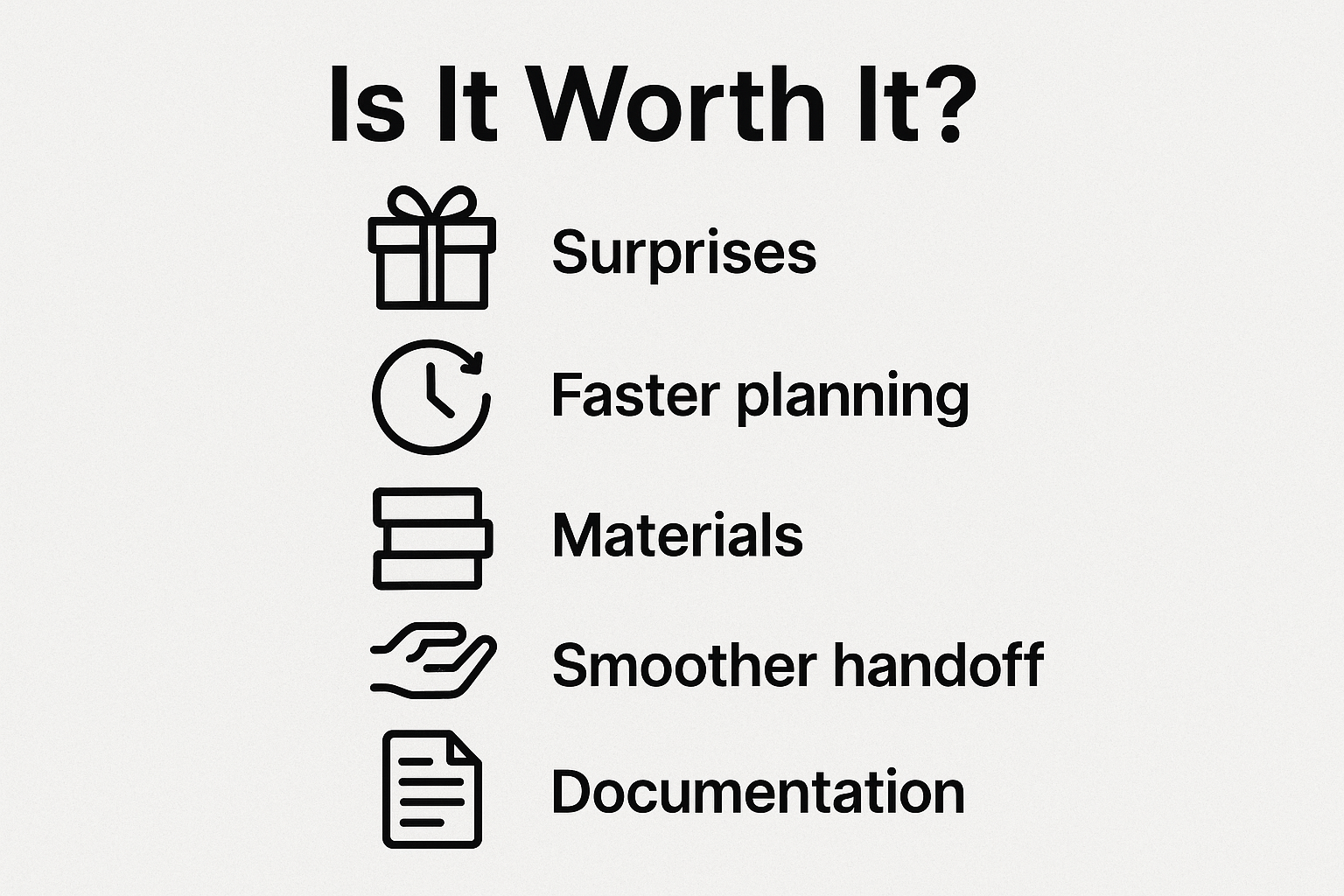
Scan to BIM isn’t just about pretty models. It’s about making real-world decisions easier, faster, and less expensive in the long run. If you’re weighing up whether the upfront cost is justified, here’s where it starts to pay off:
- Fewer surprises during construction: Accurate models mean fewer clashes, fewer RFIs, and less rework. That alone can save thousands before the first wall goes up.
- Faster planning and permitting: Having detailed, verified as-built data makes it easier to coordinate with stakeholders and sail through approvals.
- Better use of materials and labor: With clean geometry and correct dimensions, teams waste less and fabricate with confidence.
- Smoother handoff to facility management: A well-structured BIM model can double as a long-term asset. Think digital twin, not just handover file.
- Reusable documentation for future work: Renovations, retrofits, inspections – it’s all easier (and cheaper) when you’re not starting from scratch.
If you’re managing a complex build or anything with tight tolerances, the ROI adds up quickly. What looks like a high initial cost often turns into one of the smartest spends on the project.
Conclusion
There’s no magic number when it comes to scan building services. Some projects fall on the low end because they’re simple and contained. Others climb quickly due to detail requirements, access issues, or tight tolerances. But across the board, one thing stays consistent – the better you define your scope, the more accurate your estimate will be, and the more value you’ll get from the model.
If you’re serious about avoiding rework, planning smarter, or future-proofing your documentation, the upfront cost of Scan to BIM usually makes a lot of sense. Just make sure the team handling it knows what they’re doing – and gives you a quote that matches reality, not wishful thinking.
FAQ
1. How much does it cost to scan a typical building?
It really depends on the size and how much detail you need. A small home might come in around $3,000 to $7,000, while commercial and industrial spaces can range anywhere from $15,000 to $100,000+. The cost goes up if you’re asking for fabrication-level detail or tight tolerances.
2. Can I get just the point cloud without a full BIM model?
Yes, most providers offer that option. It’s cheaper and faster, but keep in mind you’ll still need someone to work with that data. If your team isn’t set up for it, having the model delivered in Revit or another structured format may save you time later.
3. Do I need a full LOD 400 model for a renovation project?
Probably not. In most cases, LOD 200 or 300 is enough for planning, permitting, and general design coordination. If you’re not fabricating directly from the model, going higher might just add unnecessary cost and file weight.
4. Is Scan to BIM only for big buildings?
Not at all. While the ROI becomes more obvious with complex or high-value structures, small residential projects can benefit too – especially for remodels where original plans are missing or outdated.
Our Case Studies
We have handled 200+ BIM & VDC projects for commercial, industrial, and residential sectors.
Our work includes:
Formwork design automation
Our client from
California, USA
Suspended ceiling design automation
Our client from
New York, USA
Wall framing design automation
Our client from
California, USA