Have any questions? Contact us!
Join our team!
Request a free quote or consultation

Point cloud work sounds simple on paper. You scan a space, get a sea of points, and move on. In reality, the price swings a lot with scope, access, accuracy targets, and how far you want to go after scanning. A quick capture for basic as-builts is one thing. A dense multi level survey with tight tolerances and full BIM deliverables is another.
This guide breaks down what drives the number on your quote. No buzzwords, no magic formulas. Just the levers that matter in the real world so you can set a budget, push back on avoidable extras, and know when higher accuracy is worth paying for.
What Point Cloud Services Actually Cover
Pricing models are not universal, but based on market data, you can expect the following ballpark figures:
- Small projects (a single object, room, or small retail unit): $250 to $3,000. These are usually short jobs that can be finished in a day or two, with relatively simple processing afterward.
- Medium projects (multi-floor buildings, industrial facilities, or complex campuses): $3,000 to $10,000. The added square footage and detail increase the number of scans required, as well as the time spent aligning and cleaning data. If CAD or BIM outputs are part of the package, costs tend to rise toward the higher end.
- Large projects (stadiums, refineries, offshore platforms, or heritage sites): $10,000 to $100,000+. At this level, scanning often involves multiple teams, high-precision equipment, and weeks of processing work. These projects typically demand full deliverables for engineering, renovation, or management, which pushes costs into the upper range.
For specialized objects like mechanical parts, pricing can also be per item. A medium-complexity part such as a car rim may cost around $800 to scan and process, while something dense like a transmission system with many small components can run $1,200 or more. The upfront cost might look high, but in industries like automotive or aerospace, the precision gained often prevents expensive mistakes later.
Powerkh: Scan to BIM Done Right

At Powerkh, we help teams turn raw point clouds into usable models that move projects forward. If you already have scans, we take it from there. If you are still planning a survey, we can advise on coverage, targets, and accuracy so the data fits the end use.
We convert point cloud data into detailed Revit models and clean 2D as-builts. Our models cover architectural, structural, and MEP systems with the right level of development for your scope, typically LOD 100 to LOD 400 or 500. Beyond modeling, we support coordination tasks like clash checks and constructability reviews, and we can prepare shop drawings where needed.
How We Work
You send the scans and basic brief, and we align on scope, deliverables, and timelines. We work with data from common laser scanners and formats, then register, clean, and position the cloud correctly in Revit. From there, we build the model, validate key dimensions, and package everything for handoff with optional 2D drawings. Communication stays simple and frequent, so you always know where things stand.
What You Can Expect
- Point cloud to BIM conversion and data processing
- Revit models with architectural, structural, and MEP systems
- LOD 100 to LOD 400 or 500, depending on scope
- 2D as-built drawings from the model
- Optional shop drawings and coordination support
If you need an interactive 3D BIM model from your point cloud, we will build it with the accuracy and structure your team needs. Share your scans and a short brief, and we will come back with a clear scope, pricing, and timeline.
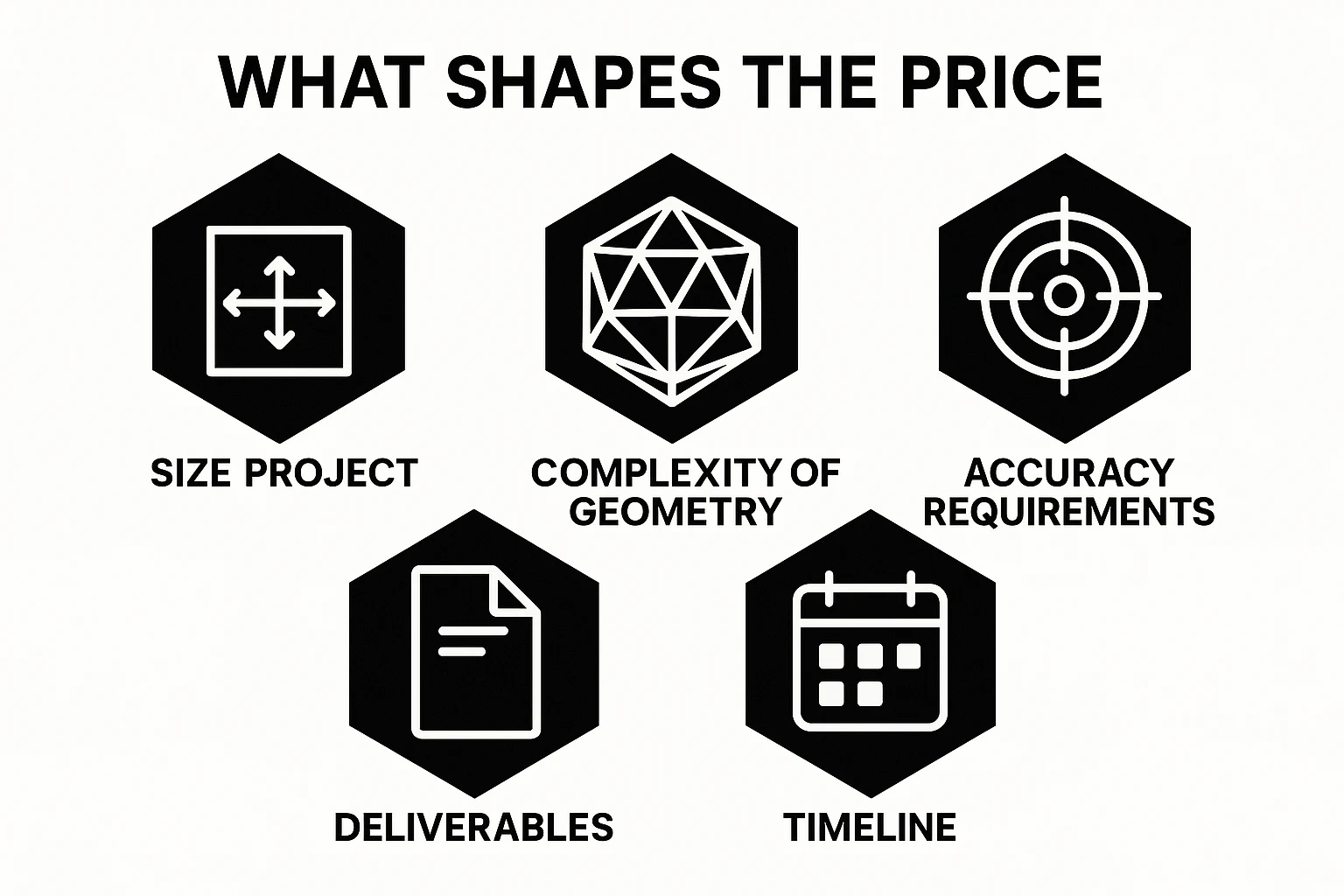
What Shapes the Price
Not all scans are created equal. The final number on a quote depends on several moving parts, and knowing them helps you understand where costs can creep in or where savings are possible. These are the main factors that push a quote up or down:
1. Size and Scope of the Project
Scanning a single statue, a small office, or a retail shop might only take a day on-site with limited processing afterward. On the other hand, a refinery, bridge, or hospital wing can require weeks of scanning from multiple positions, plus coordination between teams. The larger and more complex the footprint, the more time is needed both in the field and in the data cleanup phase.
2. Complexity of Geometry
Flat walls and simple structures can be captured quickly. By contrast, a dense pipe rack, mechanical room, or ornate historic facade demands a higher-resolution point cloud and more manual refinement. Every additional layer of detail translates into extra hours aligning scans, removing noise, and producing accurate geometry.
3. Accuracy Requirements
Budget scanners might have a tolerance of a centimeter or more, which is fine for rough layouts but useless for fabrication or quality control. Industrial-grade equipment can reach 0.1 mm accuracy, and the most advanced setups go beyond that. The higher the accuracy you need, the more specialized the gear and the operators must be, which naturally drives up the cost.
4. Deliverables
Some clients only want the raw point cloud, while others expect fully processed CAD drawings, BIM models, or analysis-ready files. Converting millions of points into Revit, AutoCAD, or SolidWorks deliverables takes time and skilled labor. The more polished and usable the end product, the higher the price tag.
5. Access and Logistics
If a site is easy to reach and has no restrictions, costs stay lower. But if scanners need to be set up in remote or dangerous areas, if safety permits are required, or if work has to happen at night to avoid disrupting operations, expect the quote to reflect that. When possible, shipping an object to a scanning lab is far more cost-efficient than mobilizing a team to your site.
6. Timeline
Every provider can work faster if needed, but speed comes at a premium. A scan and model that might normally take two weeks to deliver will cost significantly more if you ask for it in three days. Rush fees cover extra staff, extended work hours, and sometimes even additional equipment.
Cost Examples You Might Recognize
To make the ranges less abstract, here are some real-world style scenarios that show how scope and requirements affect pricing:
- Retail Unit Fit-Out: A convenience store chain wants quick as-built data for a remodel. Scanning the space might cost $2,000 to $3,000. Because the area is relatively small and straightforward, the provider can capture it in a single day and deliver basic drawings or models for planning.
- Car Part Reverse Engineering: A workshop scans a rim to design aftermarket versions. The job costs around $800 with processing. At first glance the rim looks simple, but the spokes, bore, and center disc require precision to ensure a replacement fits perfectly. For industries like automotive, even a few millimeters off can compromise performance.
- Hospital Wing Renovation: Detailed scans of multiple floors, including mechanical systems, could run $20,000 or more depending on required accuracy. Healthcare spaces are dense with piping, cabling, and equipment, which means more scanning positions and higher data resolution. In this case, the model isn’t just for reference but for coordination with engineers and contractors.
- Heritage Site Digitization: A castle or archaeological site may cross into $50,000+, given the need for dense data and careful handling. Preservation projects usually demand high accuracy, and scanning teams often face access challenges such as fragile surfaces or limited time on site. The cost reflects both the technical requirements and the expertise needed to avoid damage.
- Large Infrastructure: A stadium or refinery project can top $100,000 if full coverage and BIM-ready deliverables are expected. These jobs require multiple crews, extended time on site, and advanced processing to align thousands of scans into a coherent dataset. The end product is typically a high-detail BIM model used for design, operations, and maintenance.
Why Paying More Sometimes Saves You Money
It can be tempting to choose the cheapest provider or even invest in a low-cost scanner of your own. On the surface, it feels like a smart way to cut expenses. In reality, accuracy and deliverables matter far more than the upfront figure. A poor scan often means doing the work twice, which wastes both time and money. And while consumer-grade hardware might be fine for hobby projects, it simply cannot deliver the precision needed for engineering, fabrication, or safety-critical work.
By contrast, industrial-grade services bring more than just better equipment. You are also paying for trained technicians who understand how to avoid gaps in data and who know how to adapt in challenging environments. High-end scanners capture detail down to fractions of a millimeter, and the processing pipelines are designed to deliver CAD-ready models that can be used immediately. The consistency across multiple scans and projects ensures that you are working with reliable information every time.
For construction, manufacturing, and heritage projects, this reliability is what really saves money. Good data up front prevents costly rework, keeps schedules on track, and reduces the risk of mistakes that could compromise safety or design integrity. In other words, paying more often buys you fewer surprises later.
How to Budget Smart for Point Cloud Work
If you are trying to plan for scanning costs, it helps to think ahead. A little preparation can prevent surprise charges and make sure the final deliverables are exactly what you need. Here are a few practical steps to follow:

Define Scope Early
Be clear on whether you only need raw point cloud data or if you also expect CAD drawings, BIM models, or shop-ready files. Providers price differently depending on the deliverables, so setting expectations from the start keeps quotes realistic.
Gather Site Info
Supplying existing floor plans, site images, or notes on access conditions helps the scanning team estimate time and complexity. Even simple details, like whether a site is occupied or has tight working hours, can change the quote.
Ask for Sample Deliverables
Not all point clouds or BIM models are created equal. Request sample files to make sure the format, level of detail, and quality match what your team can actually use. This prevents paying for something that looks impressive but doesn’t integrate with your workflow.
Balance Detail With Need
Overspecifying accuracy drives up costs quickly. If you only need rough layouts, a lower level of development is usually enough. On the other hand, cutting corners on accuracy for prefabrication or engineering work can create expensive problems later. Aim for the right level of detail for the job, not the maximum possible.
Plan for Processing Time
Scanning itself is often the faster part of the job. Converting millions of points into aligned, cleaned, and structured files takes time. Build this into your schedule so you are not surprised by a longer-than-expected turnaround.
Keep a Contingency
Projects rarely go exactly as planned. Additional spaces may need to be scanned, accuracy requirements might shift, or the client may request extra deliverables midstream. Having a buffer in your budget ensures these changes don’t derail the project.
Smart budgeting doesn’t mean choosing the cheapest quote. It means understanding the levers that affect cost, setting expectations clearly, and allowing for the unexpected so you can stay on schedule without blowing the budget.
Final Thoughts
So, how much do point cloud services cost in 2025? The short version: anywhere from a few hundred dollars for a simple scan to six figures for large industrial or heritage projects. The long version is that price depends entirely on scope, complexity, accuracy, and deliverables.
For a small object or a room, expect $250 to $3,000. For medium facilities or mechanical parts, budget $3,000 to $10,000. For large or highly complex projects, prepare for $10,000 to $100,000+. The key is knowing what you need and matching it with the right provider.
If you’re entering this space for the first time, treat scanning as an investment, not a checkbox. Good data pays for itself in fewer surprises, smoother coordination, and better decisions down the line.
Frequently Asked Questions
What is a point cloud and why does it cost money to process?
A point cloud is a collection of millions of 3D points captured by laser scanners or photogrammetry. The raw data looks like a dense “cloud” of dots that represents surfaces and objects. Processing takes time because the scans must be cleaned, aligned, and converted into usable files like CAD drawings or BIM models, which requires skilled work and specialized software.
How much do small point cloud projects cost in 2025?
For simple projects like scanning a small room, retail space, or a single object, you can expect costs to start around $250 and go up to $3,000. These are usually quick jobs with minimal processing.
Is it cheaper to buy a scanner instead of hiring services?
Entry-level scanners are available for under $1,000, but they lack the accuracy required for professional use. Industrial-grade scanners cost between $15,000 and $40,000 or more. For most businesses, it is more economical to hire a service provider, since they bring both the equipment and the expertise.
What factors influence the price the most?
The biggest cost drivers are project size, geometry complexity, accuracy requirements, type of deliverables, site access, and turnaround time. For example, a tight deadline or a restricted site can increase costs even if the project itself isn’t especially large.
How do I make sure I’m not overpaying?
Define your scope clearly, ask for sample deliverables, and compare quotes from different types of providers. Make sure you balance cost with quality, because the cheapest option can end up being the most expensive if the scans are not usable.
Have a BIM Project? Talk To Us.
Contact UsOur Case Studies
We have handled 200+ BIM & VDC projects for commercial, industrial, and residential sectors.
Our work includes:
Formwork design automation
Our client from
California, USA
Suspended ceiling design automation
Our client from
New York, USA
Wall framing design automation
Our client from
California, USA