Have any questions? Contact us!
Join our team!
Request a free quote or consultation

Picture this: you’re knee-deep in planning a construction project, and everyone’s talking about shop drawings. They’re the unsung heroes that turn your architect’s grand vision into something a fabricator can actually build. But here’s the kicker – how much are these drawings going to set you back? I’ve been around the construction block a few times, and I know nailing down costs can feel like herding cats. Generally, you’re looking at $30 to $250 per sheet or $20 to $100 per hour, but the real number depends on your project’s specifics. Let’s dive into the nitty-gritty, so you can budget with confidence and avoid those “surprise” invoices.
What Are Fabrication Shop Drawings, Anyway?
Before we talk cash, let’s clarify what we’re paying for. Fabrication shop drawings are detailed technical plans that guide fabricators and contractors in building specific components, like steel beams, precast concrete panels, or custom cabinetry. They’re not your architect’s pretty renderings – these are precise blueprints with measurements, materials, and assembly instructions. Think of them as the GPS for turning raw materials into a finished product.
From conversations with contractors, I’ve learned these drawings are a lifeline. They catch mistakes before they happen on-site, saving time and money. In 2026, with tools like Building Information Modeling (BIM) becoming standard, shop drawings are more accurate than ever, but that precision comes with a cost we’ll unpack below.
Why They Matter
- Precision: Ensure every piece fits perfectly, from a steel column to a window frame.
- Coordination: Align architects, engineers, and fabricators to avoid miscommunication.
- Compliance: Meet building codes and standards, reducing legal risks.
- Cost Savings: Minimize errors and material waste, keeping your budget in check.
The Two Main Ways Shop Drawings Are Priced
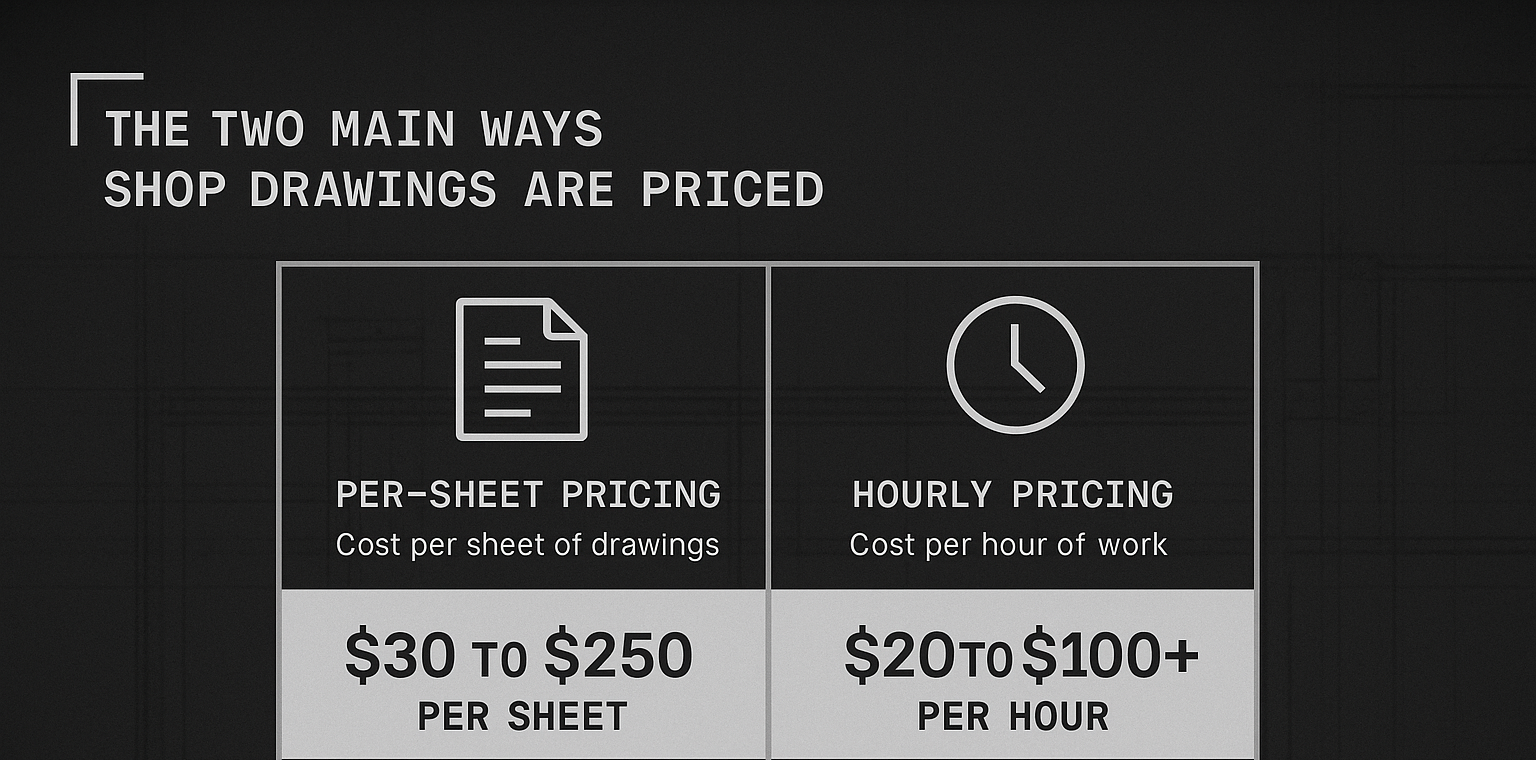
Shop drawing costs usually come in two flavors: per sheet or per hour. Each has its own logic, and picking the right one depends on your project’s vibe. Let’s break them down.
Per-Sheet Pricing
This is the “pay by the page” approach. Each sheet represents a specific view of your component – maybe a plan view or a detailed cross-section. Costs range from $30 to $250 per sheet, depending on who’s doing the work and how complex it is. Freelancers might charge $30 to $100 for simpler drawings, while established firms with BIM expertise often hit $100 to $250 for intricate ones.
- Why Choose It: It’s predictable. If you need 10 sheets at $100 each, you’re looking at $1,000, no guesswork. This is great for projects with a clear scope.
- Watch Out: Revisions can add up, and negotiation might be trickier if changes pile on.
Hourly Pricing
Here, you pay for the drafter’s time, not the number of pages. Rates start at $20 per hour for entry-level freelancers and climb to $50 to $100 or more for seasoned pros using advanced software. This model shines when your project is fluid or needs lots of back-and-forth.
- Why Choose It: Flexibility. If your design evolves, you’re not locked into a fixed sheet count.
- Watch Out: Costs can balloon if the scope creeps or revisions drag on. Always set a cap if you can.
I’ve seen both work well, but my take? Go per-sheet for straightforward jobs and hourly for complex ones where tweaks are inevitable.
Powerkh’s Guide to Fabrication Shop Drawing

Powerkh is a UK-based company that provides BIM (Building Information Modeling) services focused on prefabrication and fabrication in modular construction. Our company also has offices in Ukraine, and the USA, we work with clients across various regions to support architectural, structural, and MEP (Mechanical, Electrical, and Plumbing) aspects of construction. Our goal is to optimize manufacturing processes, improve project timelines, and enhance coordination using advanced digital tools.
At Powerkh, we specialize in creating detailed 3D prototypes and automating repetitive tasks to streamline modular construction. By allowing manufacturing and on-site work to proceed simultaneously, we help reduce project turnaround times. Our approach minimizes waste, ensures material accuracy, and improves safety by enabling off-site assembly in controlled environments. We work with clients in the industrial, commercial, and residential sectors.
Our services include BIM development for CNC manufacturing, design drafting, shop drawings, clash detection, and design-to-fabrication workflows. We use software such as Autodesk Revit, Dynamo, and Tekla to deliver accurate models and support project coordination. By aligning the efforts of engineers, fabricators, and construction teams, we help ensure that projects are completed efficiently and meet all required specifications.
Key Highlights:
- UK-based company with offices in the USA and Ukraine, specializing in prefabrication and fabrication BIM services.
- Supports modular construction by creating detailed 3D prototypes and automating tasks.
- Expertise in architectural, structural, and MEP aspects of construction.
- Focuses on reducing project timelines, minimizing waste, and ensuring material accuracy.
- Works across industrial, commercial, and residential sectors.
Key Factors That Shape the Cost
No two projects are identical, so shop drawing costs vary based on a handful of factors. Knowing these helps you avoid sticker shock.
1. Project Complexity
Simple components, like a basic steel beam or a rustic bench, need fewer views and less detail, keeping costs low. But something like a multi-drawer nightstand or a curved façade? That requires extra sheets for cross-sections and details, driving up the price.
2. Project Size and Scale
Bigger projects mean more drawings. A small home remodel might need 5-10 sheets, costing $500 to $2,000. A commercial high-rise could demand 50+ sheets, pushing costs to $5,000 or more. More elements, more time, more money.
3. Number of Revisions
Changes are the bane of budgets. A minor tweak might add $200, but a major redesign could cost $2,000 per change. Clear communication upfront can keep these in check.
4. Timeline Urgency
Need drawings ASAP? Expedited work often adds a 25-50% surcharge. Rush jobs mean overtime for drafters, and you’ll foot the bill.
5. Location and Expertise
Urban areas with high labor rates or specialized firms charge more – think $80-$100 per hour or $150-$250 per sheet. Rural drafters or freelancers might offer $20-$50 per hour or $30-$100 per sheet, but quality varies. Experience matters more than location.
6. Type of Building
Standard residential or commercial projects are cheaper. Specialized builds, like hospitals or airports with unique systems, demand more detail and higher costs.
One lesson I’ve picked up: Underestimating these factors is a rookie mistake. Get your specs locked in early to keep things predictable.
Breaking Down Costs by Drawing Type
Let’s get into the numbers, grounded in 2026 industry standards. These are average costs for different types of shop drawings, so you can ballpark your budget.
Structural Shop Drawings
These cover steel beams, columns, trusses, or precast concrete components. They’re technical and need high precision.
- Per Sheet: $80-$200. Simple beams might be $80; detailed rebar schedules hit $200.
- Hourly: $40-$80. A 30-hour project costs $1,200-$2,400.
- Example: A medium-sized warehouse needing 20 sheets at $120 each totals $2,400.
Architectural Shop Drawings
Think façade systems, interior fit-outs, or millwork like cabinets. They balance aesthetics and function.
- Per Sheet: $50-$150. Basic wall details might be $50; intricate cladding systems reach $150.
- Hourly: $30-$70. A 20-hour job costs $600-$1,400.
- Example: A retail store’s interior fit-out with 15 sheets at $100 each costs $1,500.
MEP Shop Drawings
These handle mechanical, electrical, and plumbing systems – HVAC ducts, wiring layouts, or piping. Coordination is key, so they’re pricier.
- Per Sheet: $100-$250. Simple piping layouts start at $100; complex HVAC coordination hits $250.
- Hourly: $50-$100. A 40-hour project costs $2,000-$4,000.
- Example: A hospital’s MEP system with 30 sheets at $150 each totals $4,500.
Rule of Thumb
Shop drawings typically cost about 5% of the total fabrication budget. For a $50,000 steel project, expect $2,500 for drawings. For a $20,000 millwork job, budget $1,000. These are averages – your mileage may vary.
How to Estimate Costs for Your Project
Ready to crunch numbers? Here’s a step-by-step to figure out your costs:
- Identify Needed Views: List the components (e.g., steel frames, cabinets) and views required – plan, elevation, cross-section, details, isometric. Simple items need 3-5 sheets; complex ones, 10-20.
- Choose a Pricing Model: Per-sheet for fixed scopes; hourly for evolving ones. Estimate 5-10 hours per sheet for complex drawings.
- Apply Average Rates: Use $80-$200 per sheet or $40-$80 per hour as a baseline. For example, 10 sheets at $120 each is $1,200; 20 hours at $60 is also $1,200.
- Factor in Extras: Add 10-20% for revisions ($200-$2,000 per change) and 25-50% for rush jobs.
- Get Quotes: Reach out to multiple providers. Compare not just price but turnaround time and experience with similar projects.
Pro tip: BIM software like Revit can streamline estimates. Ask providers if they use it – it often means faster, more accurate quotes.
Tips to Save Money Without Sacrificing Quality
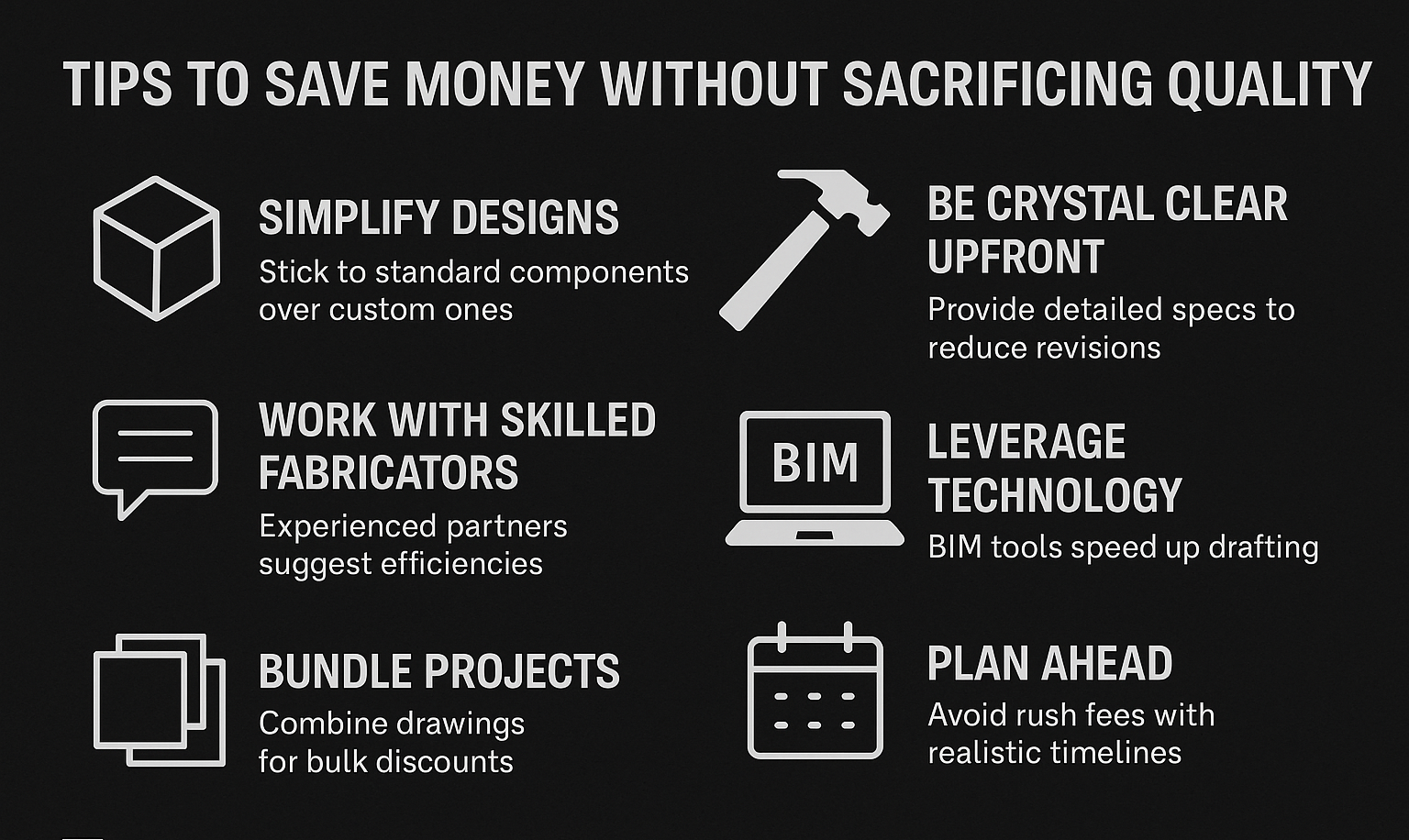
Nobody wants to overspend, but cutting corners can backfire. Here are practical ways to keep costs down while getting solid drawings:
- Simplify Designs: Stick to standard components over custom ones. A basic steel beam needs fewer details than a bespoke spiral staircase.
- Be Crystal Clear Upfront: Provide detailed specs – materials, finishes, hardware, assembly steps. This reduces revisions and saves time.
- Work with Skilled Fabricators: Experienced partners suggest efficiencies, like simpler joinery, cutting drafting hours.
- Leverage Technology: BIM tools speed up drafting and catch clashes early, potentially lowering hourly costs.
- Bundle Projects: If you have multiple components, combine drawings for bulk discounts. One client I know saved 25% this way.
- Plan Ahead: Avoid rush fees by setting realistic timelines. A week’s buffer can save hundreds.
These aren’t just theories – I’ve seen projects trim 20-30% off drawing costs with smart planning. It’s all about being proactive.
Choosing the Right Provider for Your Drawings
The person or team creating your shop drawings can make or break your project. Here’s what to look for:
- Experience: Seek providers with 10+ years and a portfolio of similar projects. Check for expertise in your field – structural, architectural, or MEP.
- Technology: Firms using BIM tools like Revit or Tekla deliver faster, more accurate results. Automation is a bonus.
- Communication: Look for testimonials praising responsiveness. A good provider keeps you in the loop on progress and changes.
- Cost vs. Quality: Freelancers at $30-$50 per sheet or $20-$50 per hour are budget-friendly but may lack polish. Firms at $100-$250 per sheet or $50-$100 per hour offer speed and reliability.
My advice? Don’t go for the cheapest option. A $500 savings now could mean $5,000 in fixes later if drawings miss the mark.
Real-Life Cost Examples
Let’s ground this in reality with a few scenarios I’ve seen or heard about:
- Millwork for a Home Renovation: A $20,000 kitchen cabinet project needed 10 sheets at $100 each, totaling $1,000. The precise drawings ensured perfect installation, no rework needed.
- Structural Steel for a Warehouse: A $50,000 steel frame job required 25 sheets at $120 each ($3,000). BIM clash detection saved $10,000 in potential errors.
- MEP for a Commercial Building: A $100,000 HVAC and plumbing system needed 40 sheets at $150 each ($6,000). Hourly billing at $60 for 50 hours would’ve been $3,000, but the sheet model was clearer for budgeting.
These examples show costs aren’t just numbers – they’re investments in a smoother build. Skimp here, and you’ll pay later.
Why Shop Drawings Are Worth the Cost
You might be tempted to see shop drawings as just another expense, but they’re a game-changer. They reduce errors, streamline communication, and ensure compliance, saving you from costly delays or legal headaches. In 2026, with construction costs rising, accurate drawings are your shield against material waste and rework.
I’ve talked to contractors who swear by them. One told me a $2,000 drawing set saved $20,000 in fixes on a misaligned steel structure. That’s the kind of ROI that makes you sleep better at night.
Final Thoughts: Budget Smart, Build Better
Fabrication shop drawings aren’t cheap, but they’re worth every penny when done right. Expect to pay $30-$250 per sheet or $20-$100 per hour, with total costs around 5% of your fabrication budget. Plan for complexity, revisions, and timelines to avoid surprises. Choose a provider with experience and tech savvy, and you’ll set your project up for success.
Ready to start? Get quotes now, lock in your specs, and build with confidence. Got a project in mind? I’d love to hear about it – drop a comment with your thoughts or questions.
FAQs
Are shop drawings necessary for every construction project?
Yes, for most projects involving prefabricated components like steel, concrete, or millwork, shop drawings are essential. They provide detailed instructions for fabrication and installation, catch potential errors early, and ensure compliance with building codes, saving time and money.
How long does it take to create shop drawings?
Turnaround time depends on complexity and provider workload. Simple drawings might take a few days, while complex projects (e.g., MEP systems) can take weeks. Rush jobs are faster but cost 25-50% more.
Can I reduce shop drawing costs without losing quality?
Absolutely. Simplify designs, provide clear specs upfront, work with experienced fabricators, and use BIM tools to streamline the process. Bundling multiple drawings or avoiding rush fees can also save 20-30%.
Who typically creates shop drawings?
Shop drawings are usually prepared by subcontractors, fabricators, or specialized drafting firms. Architects or engineers may provide the initial design intent, but drafters translate it into detailed, actionable plans.
Our Case Studies
We have handled 200+ BIM & VDC projects for commercial, industrial, and residential sectors.
Our work includes:
Formwork design automation
Our client from
California, USA
Suspended ceiling design automation
Our client from
New York, USA
Wall framing design automation
Our client from
California, USA


