Have any questions? Contact us!
Join our team!
Request a free quote or consultation

Figuring out what you’ll pay for structural BIM consultancy isn’t as simple as plugging numbers into a calculator. One project might need basic modeling for early-stage design, while another calls for detailed reinforcement layouts, clash detection, and coordination across disciplines. Same job title – very different scopes, timelines, and outcomes.
So what does that mean for your budget? In this article, we’ll break down what actually goes into the cost of structural BIM consulting, why those costs vary so much, and how to approach quotes in a way that saves you time, money, and surprises later on. Whether you’re pricing out a single beam or planning structural coordination across a multi-story commercial build, getting clear on the cost drivers up front can help you plan smarter.
Typical Price Ranges in 2026
Structural BIM consultancy is priced in a few different ways:
- Hourly rate: Usually between $33 and $43/hour, with experienced consultants or firms averaging around $50/hour.
- Per square foot: Around $0.30 to $0.90/sq ft for standard LOD 300-400, with higher pricing for detailed models.
- Fixed fee: Starting around $5,000 for small projects and easily reaching $100,000+ for large commercial scopes.
These are ballpark ranges. The real cost depends on how involved the scope is, what outputs you need, and how fast the work must be delivered.
What Structural BIM Consultants Actually Do
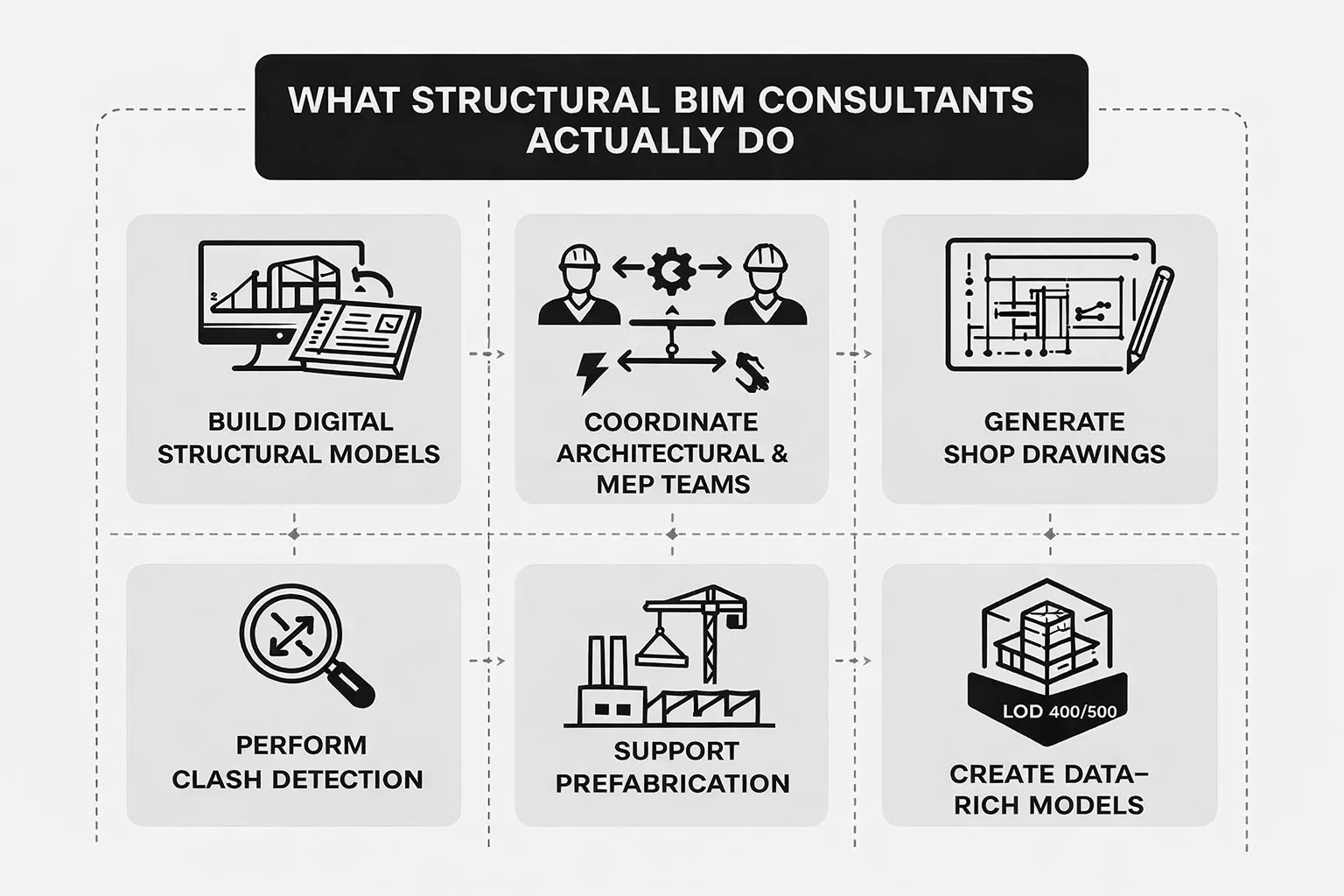
Before we jump into numbers, let’s define the work itself. Structural BIM consultants don’t just draw 3D beams in Revit. Their role can span:
- Building digital structural models based on architectural drawings.
- Coordinating with architectural and MEP teams.
- Generating shop drawings and reinforcement details.
- Performing clash detection.
- Supporting prefabrication and fabrication-ready deliverables.
- Creating data-rich models up to LOD 400 or 500 for construction or as-built handover.
They’re not just modelers. Many come from architectural or engineering backgrounds, but their primary role is to manage digital modeling, coordination, and data workflows that ensure what’s designed can be built accurately.
What Drives Structural BIM Costs?
Once you start digging into quotes for structural BIM support, you’ll notice the prices aren’t random. There’s a logic behind them, even if it’s not always spelled out clearly in the proposals. The total cost usually reflects a combination of technical effort, coordination complexity, and how well-defined your scope is at the start.
1. Level of Development (LOD)
This is probably the biggest factor.
- LOD 200: Conceptual geometry representing overall form and approximate dimensions.
- LOD 300: Accurate geometry suitable for coordination and construction documentation.
- LOD 350: Enhanced detail focused on system interfaces and coordination between disciplines, supporting clash detection.
- LOD 400: Fabrication-ready detail for manufacturing and assembly, with elements defined to support shop drawings.
- LOD 500: Verified as-built information reflecting what was actually constructed.
Going from LOD 200 to 400+ means more time, more accuracy, and higher cost.
2. Structural Scope and System Types
Just slabs and foundations? Relatively simple. Concrete, steel, framing, facade supports, and coordination? Time-consuming and costly.
More disciplines also mean more interaction with other consultants and more time spent resolving clashes.
3. Data Quality and Inputs
Clean CAD files save time. Incomplete PDFs or outdated drawings slow everything down. If your consultant has to guess what’s behind a wall or manually trace fuzzy linework, you’re already adding hours. Now, if you’re starting from point clouds, expect significantly higher modeling effort. Translating real-world scan data into an accurate, structured Revit model takes patience, precision, and often a bit of detective work. The better your inputs, the faster and cheaper your outputs.
4. Project Size and Shape
A regular-shaped three-story building is simpler than a curved, multi-volume structure with unique framing systems.
Scale helps with efficiency, but complexity erodes that quickly.
5. Timeline
Need a model in 3 days? That’ll cost more than a standard 4-6 week delivery. Tight timelines force teams to reshuffle priorities, add extra hands, or work outside normal hours. Expedited delivery almost always means added labor, and added labor shows up directly in the quote. When the schedule allows for a steady pace, pricing stays far more predictable.
6. Deliverables
Do you need just the 3D model? Or does it include 2D sheets, reinforcement details, quantity takeoffs, IFC exports, and shop drawings?
The more outputs you request, the more effort goes into cleaning, checking, and formatting everything.
7. Consultant Location and Setup
A solo freelancer in a low-cost region might charge $30/hour. A structured team in the US or UK with QA processes and bilingual support? Expect higher fees, but better coordination and reliability.
Why We Approach Structural BIM Differently at Powerkh

At Powerkh, we don’t just model structures – we carry design intent from early stages all the way through construction. As an engineering-led digital construction consultancy, we’ve delivered over 400 BIM and VDC projects across the UK, US, and Europe. That experience taught us something simple: if structural design isn’t clearly defined, protected during coordination, and verified on site, things slip. Fast.
That’s why our structural BIM consultancy isn’t limited to producing models. We support structural design development and prepare coordination-ready models. When construction begins, we verify what’s actually being built against what was intended using deviation monitoring and progress tracking. And yes, we handle the BIM automation and shop drawings too, but always tied back to engineering context.
If you’re budgeting for structural BIM services and looking for more than just modeling hours, we’re set up to help. Our process is built for continuity, not handoffs. And that saves our partners time, corrections, and the stress of late-stage surprises.
Planning Your Budget the Smart Way
Before you even ask for quotes, clarify your own needs. This saves time and keeps quotes comparable:
- What’s the total area and number of floors?
- Which structural systems are involved?
- What’s the required LOD?
- Do you need coordination with MEP/architecture?
- What’s your deadline?
- Do you need 2D outputs or only the model?
- Are your source files clean, or will cleanup be required?
All of this goes into the pricing logic. Being vague just leads to underestimates or expensive change orders.
Why Cutting Corners Can Cost You
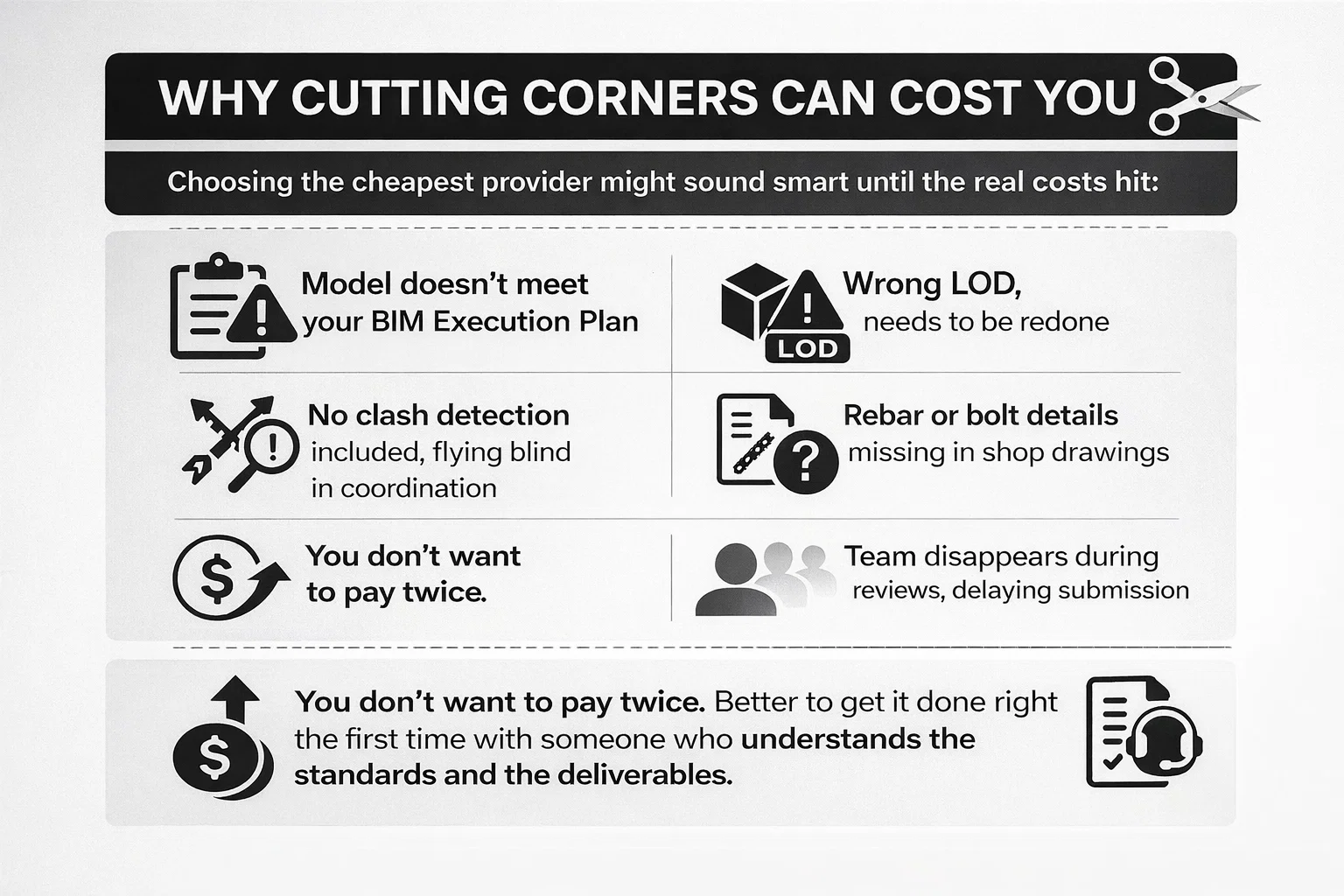
Choosing the cheapest provider might sound smart until the real costs hit:
- The model doesn’t meet your BIM Execution Plan.
- It’s built to the wrong LOD and needs to be redone.
- No clash detection included, so you’re flying blind during coordination.
- Reinforcement or bolt details missing in shop drawings.
- The team disappears during review cycles, delaying submission.
You don’t want to pay twice. Better to get it done right the first time with someone who understands the standards and the deliverables.
When Fixed Pricing Works (And When It Doesn’t)
Fixed pricing can be a great option, but only when the project is tightly scoped. If your design is stable, the structural systems are locked in, your input files are clean, and the deliverables are clearly outlined from the start, then a lump-sum fee gives everyone clarity.
But if you’re still making design changes or expect multiple rounds of feedback, fixed pricing can get awkward fast. In those cases, a flexible approach, like hourly billing or a base fee with add-ons, tends to be more practical and fair for both sides.
Realistic Price Scenarios
Some rough examples:
- Small house (LOD 300, basic model): $2,500 – $5,000
- 5-story apartment (LOD 350, shop drawings + coordination): $18,000 – $45,000
- Office building (LOD 400+, with fabrication + QTO): $60,000 – $120,000
Prices vary with scope, quality of inputs, and consultant experience.
Choosing the Right Consultant
Go beyond the price tag. Look for:
- Past project examples.
- Responsiveness and clarity in communication.
- Consistency in modeling standards.
- Familiarity with your region’s building codes.
- Flexibility in scope changes.
- Support after delivery (not every consultant offers this).
You’re not buying a file. You’re buying someone’s ability to think ahead, prevent issues, and support your team.
Conclusion
There’s no flat rate for structural BIM consultancy. It’s not a commodity. A small model for permit review and a fully coordinated, fabrication-ready model serve completely different purposes.
The better you define your scope, timeline, LOD, and outputs, the more accurate your quote will be. And the more you understand what drives pricing, the easier it’ll be to pick the right consultant.
Done well, structural BIM support won’t just deliver drawings. It’ll save time, reduce errors, and make your project easier to build.
FAQ
1. Is structural BIM consultancy charged per hour or per project?
It depends. Some consultants charge by the hour, especially when the scope is loose or evolving. Others offer a fixed project fee if everything’s clearly defined. There’s also hybrid pricing, like a base model fee plus hourly rates for coordination or revisions. What matters most is that the pricing model fits your actual workflow.
2. What’s the most expensive part of structural BIM work?
Usually, it’s not the modeling itself. It’s the level of detail (LOD), the number of disciplines involved, and the deliverables that stack up. Fabrication-level modeling, detailed rebar, tight coordination across trades – all of that takes time. And time is what you’re really paying for.
3. Can I save money by starting with a lower LOD and upgrading later?
Technically yes, but it often backfires. If you start at LOD 200 and then realize you need LOD 400 outputs for construction, someone will have to rebuild or heavily revise the model. It’s better to scope for what you actually need up front than pay twice for rework.
4. What should I include when asking for a quote?
Be specific. Share your drawings, total area, number of floors, deadline, target LOD, and whether you need 2D sheets, coordination, or QTO. If you’re working with scans or PDFs, mention that too. The more transparent you are, the more accurate your quote will be.
5. Why do Scan-to-BIM services cost so much more?
Because they’re way more involved. Modeling from a point cloud is slower than working from a clean CAD. It requires careful interpretation of messy, real-world geometry, not to mention validating and aligning scan data. If your site isn’t clean or recently captured, modeling gets even trickier.
6. Is it worth paying more for a consultant with in-house structural experience?
Almost always. A technically grounded team will flag issues early, build smarter, and reduce coordination headaches later. It’s not just about making things look right in Revit – it’s about making sure what’s modeled can be built, coordinated, and approved without surprises.

Have a BIM Project? Talk To Us.
Contact UsOur Case Studies
We have handled 200+ BIM & VDC projects for commercial, industrial, and residential sectors.
Our work includes:
Formwork design automation
Our client from
California, USA
Suspended ceiling design automation
Our client from
New York, USA
Wall framing design automation
Our client from
California, USA