Have any questions? Contact us!
Join our team!
Request a free quote or consultation

If you’ve ever asked for a quote for laser scanning, you’ve probably noticed how wide the price range can be. One project comes in at a few thousand, another at tens of thousands, and both sound similar on paper. That’s because you’re not just paying for someone to walk around with a scanner. You’re paying for accurate data, processing, modelling, and the expertise to turn a real building into something designers and engineers can actually use.
In most cases, laser scanning and existing conditions modelling is less about square footage alone and more about complexity, detail, and what you need at the end. A simple warehouse survey is one thing. A hospital renovation with dense services above the ceiling is a completely different job.
This guide breaks down what these services typically cost, what influences the price, and how to think about budgeting without overpaying or under-scoping the work.
What You Are Actually Paying For
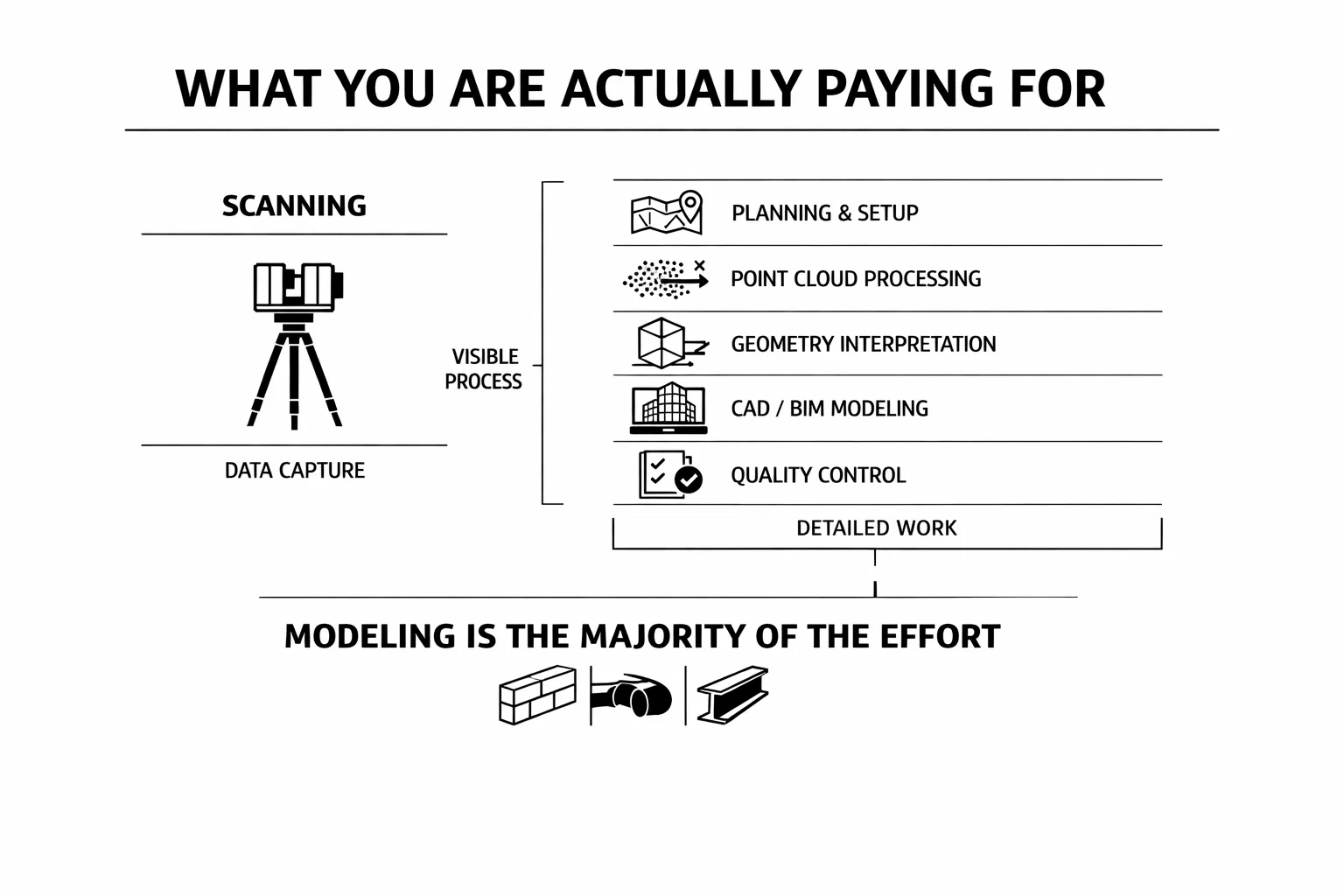
Many people assume the main cost is the scanning itself. Someone shows up with a tripod, presses a button, and collects data. In reality, scanning is only the visible part of the process. Most of the effort happens afterward.
A typical project includes several stages:
- Site planning and setup
- On-site scanning and photography
- Point cloud registration and cleaning
- Interpretation of geometry
- Creation of CAD drawings or BIM models
- Quality control and delivery
The modelling phase often takes far longer than the field work. Turning millions or billions of points into walls, floors, pipes, equipment, and structural elements requires skilled technicians who understand construction, not just software.
This is why modelling often accounts for the largest share of the budget.
Powerkh's Services for Laser Scanning and Existing Conditions Modelling

Powerkh is a UK-based company with offices in the USA and Ukraine, specializing in Virtual Design and Construction (VDC) and Building Information Modeling services that support projects from early planning to construction and facility management. Drawing on our experience from over 400 projects, Powerkh treats laser scanning and existing conditions modelling not as isolated tasks, but as a core part of an integrated engineering workflow. We convert point cloud data into accurate architectural, structural, and MEP models, develop 2D as-built drawings, and prepare coordination-ready datasets that help teams design with confidence. By delivering models at different Levels of Development, we align the scope and cost with the real needs of each project rather than applying a one-size-fits-all approach.
We collaborate with architects, engineers, contractors, and surveyors to ensure that the captured data becomes practical documentation, not just a technical deliverable. Our services include scan to BIM (LOD 100–500), BIM content creation (Revit families), BIM coordination, BIM automation, and specialized structural detailing (steel, rebar, precast, facade), all aimed at reducing errors and avoiding costly rework.This integrated approach directly relates to project costs because accurate modelling at the start often prevents expensive changes on site. In other words, investing in reliable existing conditions data is not just about documentation – it is about protecting the overall project budget and timeline.
Laser Scanning and Existing Conditions Modelling Costs Overview
Pricing for laser scanning and existing conditions modelling varies widely, but most projects fall into predictable ranges depending on building size, complexity, required accuracy, and deliverables. Costs can be viewed from three complementary perspectives: overall project scale, price per square foot, and distribution of effort across project phases.
By Project Size and Complexity
Across North America and Europe, project budgets generally align with the type of facility being surveyed.
1. Small Residential or Simple Buildings
$1,000 to $3,500:
This range typically applies to single-family homes, apartments, or small standalone structures. These projects usually feature straightforward layouts, minimal mechanical systems, and limited architectural complexity. The resulting documentation is most often used for renovation planning, extensions, or real estate purposes.
2. Small Commercial Facilities
$3,000 to $8,000:
This category includes spaces such as retail stores, restaurants, gas stations, and small offices. While more complex than residential properties, these buildings are generally accessible and manageable to survey. Mechanical systems are present but not overly dense, and modelling requirements remain moderate.
3. Standard Commercial Buildings
$5,000 to $15,000:
Office buildings, schools, multi-unit residential developments, and mid-scale renovation projects typically fall within this range. Costs vary depending on building height, system density, and the level of detail required in the final deliverables.
4. Industrial and Complex Facilities
$8,000 to $50,000+:
Industrial sites introduce additional challenges that significantly affect pricing. Dense piping networks, large equipment, restricted access areas, and ongoing operations can all reduce scanning efficiency. Higher accuracy requirements and safety constraints further increase effort. Large facilities with multiple structures often exceed this range.
5. Major Facilities or Specialized Projects
$50,000 to $200,000+:
Large-scale or highly specialized environments require extensive coordination and extremely detailed modelling. Typical examples include hospitals, airports, manufacturing plants, data centers, and historic preservation projects. These sites usually demand strict accuracy tolerances and integration across multiple disciplines.
Cost Per Square Foot
Many providers use floor area as a preliminary budgeting tool, particularly for modelling services. While this method offers a quick estimate, it does not fully capture complexity or technical challenges.
Typical scan-to-BIM pricing ranges include:
- $0.50 to $3.00 per sq ft – basic models
- $3.00 to $8.00 per sq ft – detailed architectural models
- $5.00 to $10.00+ per sq ft – complex or high-detail projects
- Up to $15 per sq ft – highly specialized facilities
Per-square-foot pricing becomes less reliable when buildings have unusual geometry or dense mechanical systems. For example, a 5,000 sq ft warehouse is far simpler to document than a historic church or a hospital wing of the same size.
By Project Phase
Understanding where the money goes helps avoid surprises and makes it easier to compare proposals from different providers.
Field Scanning
Estimated cost: $2,000 to $10,000+
This stage covers on-site data capture using terrestrial or mobile laser scanners. The cost depends largely on how much time the team needs to spend in the field and how complex the environment is. Pricing is influenced by the number of scan positions required, site accessibility, travel and mobilization, safety requirements, equipment type, and total time on site. Mobile scanning systems can reduce field time for large projects, while confined spaces, hazardous areas, or limited access can increase it.
Point Cloud Processing
Cost: often included in the base price or billed separately
After scanning, the raw data must be processed before it becomes usable. Some providers include this stage in their base price, while others list it as a separate item. Processing typically involves aligning scans into a single coordinate system, removing noise and irrelevant data, validating accuracy, and preparing the files for modelling. This phase requires specialized software and experienced operators, especially on large or complex projects.
Existing Conditions Modelling
Estimated cost: $2,000 to $20,000+
This stage converts the processed point cloud into usable drawings or BIM models. It is often the most expensive part of the project because it involves interpretation, engineering judgment, and manual work rather than automated processing.
Modelling complexity depends on several factors, including the required level of detail, the number of building systems included, structural complexity, documentation standards, and coordination needs. Projects that involve detailed MEP systems, fabrication-level accuracy, or coordination across multiple disciplines typically fall at the higher end of the cost range.
Key Factors That Influence Laser Scanning and Modelling Costs
Project pricing is shaped by several interconnected factors, including the required level of detail, building complexity, deliverables, timeline, location, and accuracy standards. Even projects of similar size can vary significantly in cost depending on these conditions.
Level of Development (LOD)
One of the strongest pricing drivers is the Level of Development (LOD), which defines how detailed and accurate the model must be.
- LOD 200 – Conceptual. This level includes basic geometry, general sizes, and approximate locations of elements. It is suitable for planning studies and early design work, resulting in lower costs and faster delivery.
- LOD 300 – Construction Ready. Models at this level contain accurate dimensions and reliable placement of building elements, making them suitable for design coordination. This is a common requirement for renovation projects.
- LOD 350 to 400 – Fabrication Detail. Higher LOD models feature highly precise geometry, detailed connections, and coordinated building systems. They support prefabrication and clash detection but require substantially more modelling time, which increases costs.
Moving from LOD 200 to LOD 300 can increase modelling effort by 30 to 50 percent, while higher levels may double or triple the workload.
Building Complexity
Cost is often driven more by complexity than by size. Two buildings with identical floor areas can require very different levels of effort.
Key complexity factors include intricate architectural forms, curved surfaces, historic structures with irregular geometry, dense mechanical, electrical, and plumbing systems, equipment-heavy spaces, multi-level interconnections, cluttered environments, and limited visibility of elements. Industrial facilities are frequently expensive not because of their scale, but because they contain thousands of components that must be documented accurately.
Deliverables
The type of output required at the end of the project has a direct impact on pricing.
- Lower-cost deliverables include raw point cloud data, registered scan files, and basic measurements, which are useful for teams that perform modelling in-house.
- Mid-range deliverables typically consist of 2D CAD drawings such as floor plans, elevations, and sections, commonly used in architectural workflows.
- Higher-cost deliverables include detailed BIM models, discipline-specific models for structural or MEP systems, coordination-ready datasets, and facility management models. These require substantial manual modelling and verification.
Timeline and Urgency
Most proposals assume a standard delivery schedule. Accelerated timelines often increase costs due to overtime work, additional staffing, prioritization over other projects, and expedited processing. Rush fees commonly add 25 to 50 percent to the base price.
Geographic and Logistics Factors
Location can significantly influence project cost. Expenses increase when work involves remote sites, travel and accommodation, limited local service providers, security requirements, difficult terrain, or restricted access hours. Urban areas may have higher labor rates but typically offer better equipment availability and support services.
Accuracy Requirements
Modern laser scanners are capable of millimeter-level accuracy, but achieving this precision requires careful planning and execution. Higher accuracy demands more scan positions, longer setup times, advanced equipment, additional quality control, and specialized workflows. Projects involving structural analysis or prefabrication often require strict tolerances, which further increases effort and cost.
Pricing Models Used by Providers
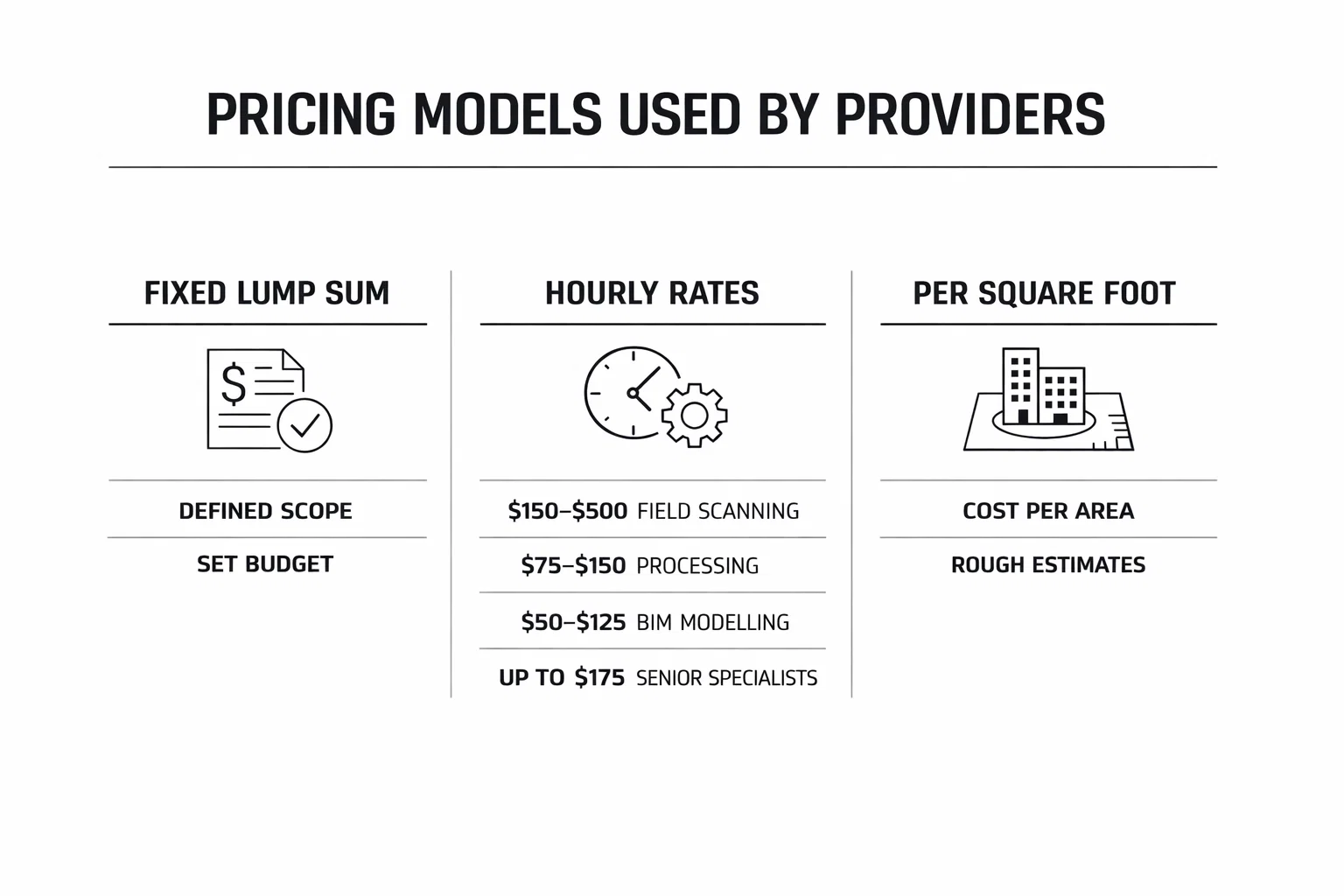
Service providers structure proposals in different ways depending on how clearly the project scope is defined.
A fixed lump sum is the most common option for well-defined projects. It offers a predictable budget, minimizes surprises during execution, and makes internal approvals easier. However, this approach requires detailed requirements upfront, since any missing information can lead to scope adjustments later.
Hourly rates are typically used when the scope is uncertain or likely to evolve. In this model, costs generally fall within the following ranges:
- $150 to $500 per hour – field scanning
- $75 to $150 per hour – processing
- $50 to $125 per hour – BIM modelling
- Up to $175 per hour – senior specialists
Per-square-foot pricing is often used for preliminary estimates, particularly for large facilities. While convenient for budgeting, it is less reliable for projects involving unusual geometry, dense building systems, or other factors that significantly affect modelling effort.
Why Professional Services Often Make Financial Sense
Some organizations consider buying or renting equipment instead of hiring specialists. While this can be practical for companies that perform scanning regularly, it is rarely cost effective for occasional projects. High-end scanners can cost tens or even hundreds of thousands of dollars, and they are only part of the investment. Skilled operators, specialized software, and training for data processing and modelling are also required. Outsourcing allows project teams to focus on design and construction tasks while experienced professionals handle reality capture and documentation.
Return on Investment
Laser scanning is often justified by the problems it prevents rather than the drawings it produces. Its value comes from reducing uncertainty and avoiding costly mistakes during design and construction. Documented benefits include reduced rework costs, fewer change orders, faster design phases, improved coordination between disciplines, more accurate prefabrication, better facility management data, and enhanced safety planning. Studies indicate that scanning can reduce rework by 5 to 15 percent of total project value, which can translate into substantial savings on large projects.
How to Get an Accurate Quote
To receive a reliable estimate, providers need clear and detailed information about the project. Useful inputs include the building size and type, the intended use of the data, the required level of detail, areas to be included or excluded, any existing drawings or plans, site photos, access constraints, and the desired timeline. When this information is incomplete, providers often respond with conservative pricing assumptions or later revise the proposal once the scope becomes clearer.
Final Thoughts
Laser scanning and existing conditions modelling costs vary because projects vary. Size matters, but complexity, detail, accuracy, access, and deliverables matter more. A small, cluttered plant room can cost more to model than an open warehouse many times its size. What you are really paying for is reliable information about the building as it actually exists, not as someone hopes it exists.
In most projects, the value shows up later. Accurate data reduces redesign, site surprises, coordination issues, and construction delays. The cheapest survey is not always the least expensive option once the project is underway. A well-scoped scan with the right level of detail usually saves time, money, and stress across the entire lifecycle of the work.
FAQ
1. How much does laser scanning usually cost?
Simple residential projects may start around one to three thousand dollars, while typical commercial buildings often fall between five and fifteen thousand. Complex industrial or institutional sites can reach tens or hundreds of thousands depending on scope and required detail.
2. What affects the price the most?
Detail level and complexity. Dense MEP systems, irregular geometry, restricted access, or strict accuracy requirements increase effort far more than floor area alone.
3. Is modelling included in scanning costs?
Not always. Some quotes cover only data capture, while others include processing and full BIM modelling. Always confirm exactly what deliverables are included.
4. Which phase is the most expensive?
Existing conditions modelling is usually the cost driver. Converting point cloud data into usable drawings or coordinated models requires significant manual work and technical judgment.
5. Can laser scanning reduce project costs overall?
Yes. It helps prevent rework, change orders, and delays caused by inaccurate or missing information. The savings often exceed the survey cost, especially on complex renovations.
6. How long does it take to complete a project?
Field scanning may take hours or days, but processing and modelling can take days to weeks depending on size and detail. Tight deadlines typically increase cost.

Have a BIM Project? Talk To Us.
Contact UsOur Case Studies
We have handled 200+ BIM & VDC projects for commercial, industrial, and residential sectors.
Our work includes:
Formwork design automation
Our client from
California, USA
Suspended ceiling design automation
Our client from
New York, USA
Wall framing design automation
Our client from
California, USA