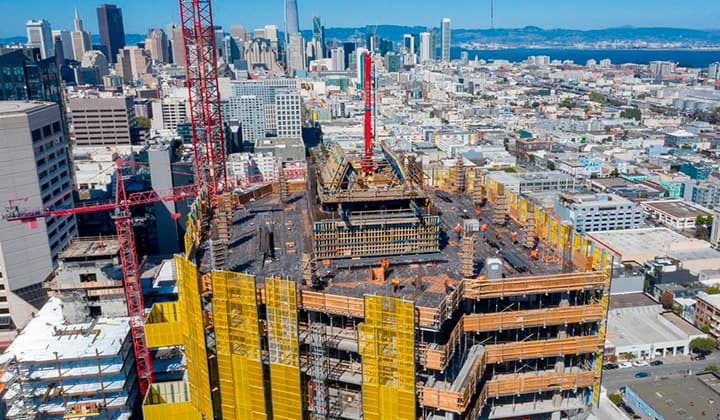
Have any questions? Contact us!
Join our team!
Request a free quote or consultation

If you’ve ever managed a construction project, you know the stress of keeping everything on track – crews, materials, timelines, all while dodging costly surprises. I’ve been geeking out over construction tech lately, and one question keeps coming up: what’s the real cost of 4D construction scheduling? It’s that cool process where you take a 3D model of your building and add a timeline, creating a virtual movie of the entire build. It’s like seeing the future, spotting issues like overlapping trades or delayed deliveries before they wreck your budget. But the price? It’s all over the place, from a few grand for a small job to six figures for a massive project. After digging through industry insights, I’m here to break it down with realistic numbers, explain what drives the costs, and share some tricks to get the most value. Let’s jump in and make sense of it all.
The Basics: What’s Driving 4D Scheduling Costs?
Before we get to the dollars and cents, let’s talk about what 4D construction scheduling actually involves. It builds on Building Information Modeling (BIM), where a detailed 3D model of your project – every wall, pipe, and beam – is paired with a schedule. This creates a dynamic simulation showing how the project unfolds over time, from groundbreaking to final touches. You can pause, rewind, or fast-forward to check phasing, spot conflicts (like two crews needing the same space), or plan logistics like crane movements.
The cost isn’t a simple number because it depends on a bunch of factors. It’s not just about running software; it’s about skilled people, complex models, and tailoring the output to your needs. Here’s what shapes the price tag:
- Project Size and Scope: A small renovation is way cheaper than a hospital or bridge with hundreds of tasks and trades.
- Model Detail (Level of Detail, or LOD): Basic models (LOD 100) are less work than construction-ready ones (LOD 400) with precise components.
- Provider Location: U.S. or Western European firms charge more due to higher labor costs, while offshore providers (like in Asia or Eastern Europe) can cut costs by 40-60%.
- Service Scope: Basic phasing visuals cost less than advanced simulations with real-time updates or pre-bid animations.
- Pricing Structure: Providers use hourly rates, fixed fees, per-square-foot charges, or ongoing team support, each with different impacts.
- Extras: Adding cost estimation (5D), virtual reality, or site logistics like material staging bumps up the bill.
From what I’ve seen, 4D can save 10-20% on project costs by catching issues early, which can mean hundreds of thousands in savings on a big job. But the upfront cost? That’s what we’re here to nail down.
Powerkh's Expertise in 4D Construction Scheduling

Powerkh is a UK-based company with offices in Ukraine and the USA, specializing in 4D construction scheduling services. By integrating cost and scheduling data into 3D models, we enable clients to better manage project timelines, budgets, and construction workflows.
Our 4D BIM solutions provide detailed digital models that connect construction schedules with cost projections, allowing teams to track progress, anticipate issues, and make data-driven decisions that help control both time and costs throughout the project lifecycle.
We serve a broad range of industries, including residential, commercial, and infrastructure projects. With locations in the UK, Ukraine, and the USA, we deliver precise and efficient BIM solutions that enhance collaboration and project management, ensuring timely, on-budget project delivery.
Key Highlights:
- UK-based company with offices in Ukraine and the USA
- Specializes in 4D construction scheduling integrating cost and schedule data with 3D models
- Focus on improving project management, budget control, and timeline accuracy
- Experienced across residential, commercial, and infrastructure projects
- Advanced BIM solutions for better collaboration and decision-making
- Reliable, data-driven approach to project delivery
Price Ranges: What You’ll Actually Pay
Pinpointing 4D scheduling costs is tricky since every project is unique, but I’ve pulled together averages from industry data as of September 2026. These figures come from insights on BIM service providers and construction tech trends, ensuring they’re grounded and realistic. They focus on outsourcing 4D services, not in-house costs like software or training. Let’s break it down by pricing model, with examples to keep it real.
Hourly Rate Pricing
Many providers charge by the hour, especially for flexible work or projects needing iterations. Here’s the scoop:
- U.S./Western Europe: $80-150 per hour for BIM specialists. For a mid-sized project (e.g., 50,000 sq ft office), expect 100-300 hours, totaling $8,000-45,000.
- Offshore (Asia/Eastern Europe): $25-60 per hour. The same project could run $2,500-18,000, making offshore a budget-friendly option if quality is solid.
When to Use Hourly Rates
- Small projects (under 10,000 sq ft): 50-100 hours ($4,000-15,000 in the U.S., $1,250-6,000 offshore) for basic phasing.
- Medium projects: 100-300 hours ($8,000-45,000 U.S., $2,500-18,000 offshore) for multi-trade coordination.
- Complex projects: 300-600 hours ($24,000-90,000 U.S., $7,500-36,000 offshore) for detailed logistics and updates.
Hourly rates are great when you need flexibility, like tweaking simulations as plans change. I’ve seen teams save by using offshore providers for initial setups and local ones for final reviews.
Fixed Lump Sum Pricing
For well-defined projects, providers offer flat fees, often for pre-bid presentations or full simulations. Here’s the range:
- Small Projects (under 10,000 sq ft): $5,000-15,000. A retail renovation needing basic phasing visuals fits here.
- Medium Projects (10,000-100,000 sq ft): $15,000-50,000. Think commercial buildings like offices or schools with clash detection and stakeholder walkthroughs.
- Large/Complex Projects (over 100,000 sq ft): $50,000-200,000+. High-rises, hospitals, or infrastructure like bridges hit this range, especially with real-time updates or complex logistics.
Why Choose Lump Sum?
- Predictable costs for clear scopes.
- Common for competitive bids where a polished 4D animation wows clients.
- Risk: Undefined scopes can lead to extra fees, so clarify deliverables upfront.
I’ve noticed lump sums work best when you know exactly what you need, like a one-off simulation for a client pitch.
Per Square Foot Pricing
Some providers tie costs to the building’s size, which scales with complexity:
- General Range: $0.50-2.00 per sq ft. Simple projects (low LOD, basic sequencing): $0.50-1.00 per sq ft. Complex projects (high LOD, logistics, animations): $1.50-2.00 per sq ft.
- Example: A 50,000 sq ft office could cost $25,000-100,000, depending on detail.
This model is popular for commercial or industrial builds where size predicts effort. It’s less common for small or highly customized projects.
Studio/Extended Team Model
For ongoing support, some providers act as an extended team, charging monthly retainers:
- Monthly Costs: $10,000-50,000, based on team size (2-5 BIM specialists at 100-200 hours/month).
- Project Duration: A 6-month engagement for a large project could run $60,000-300,000.
- Use Case: Ideal for complex projects needing constant updates, like hospitals or infrastructure.
This model suits long-term projects where real-time adjustments are key. I’ve seen it save time by keeping the same team in sync.
Overall Average Cost
For a typical mid-sized project (10,000-100,000 sq ft), expect $20,000-60,000 total for 4D scheduling services, covering model linking, simulations, clash detection, and a few revisions. In the U.S., it skews toward $40,000-60,000, while global averages (mixing local and offshore providers) drop to $15,000-40,000. These figures align with industry data showing 4D can save 10-20% on project budgets by reducing rework and delays – potentially $100,000-1M on a $5M project.
Hidden Costs and Add-Ons
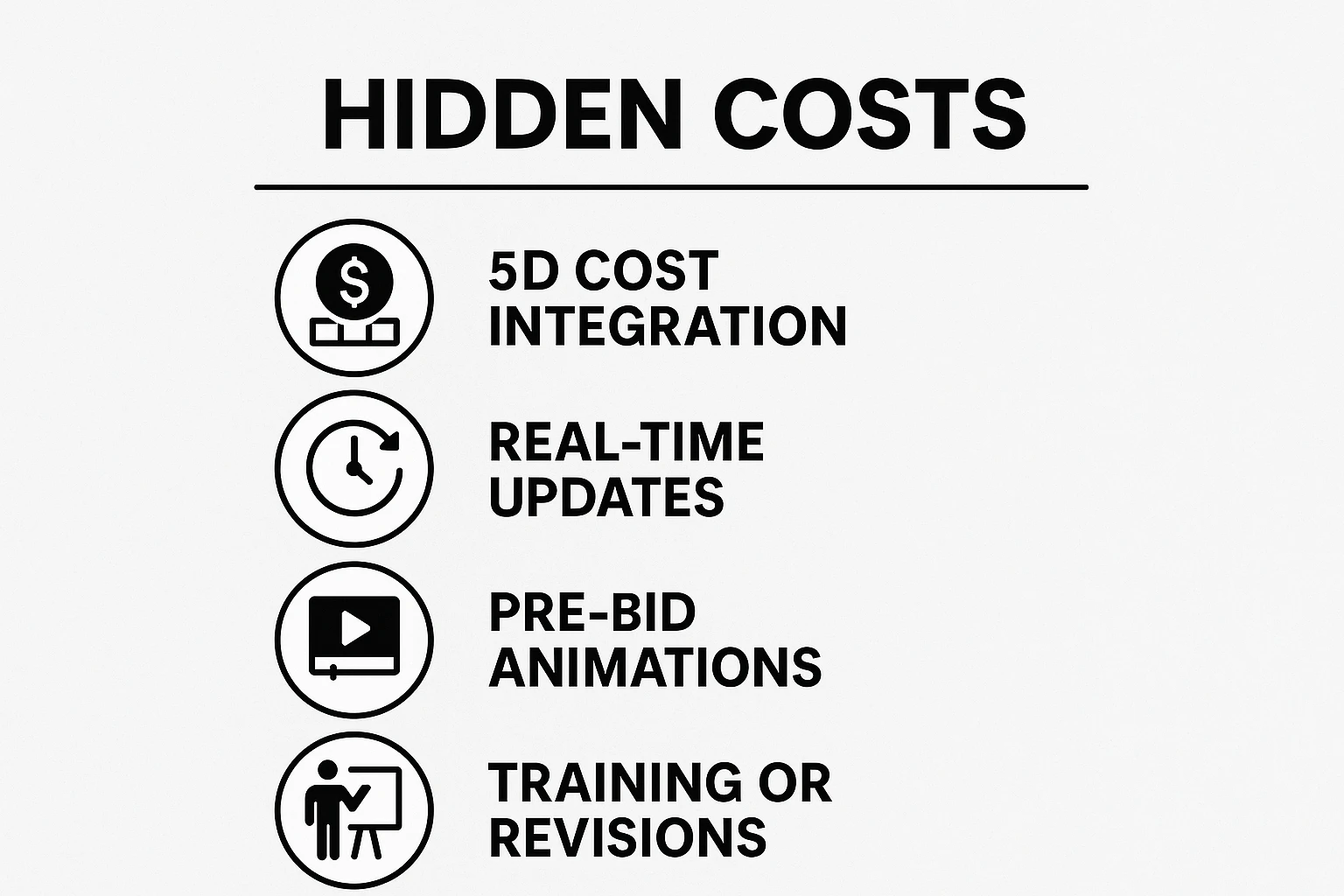
The base price is just the start. Extra features or requirements can push costs higher, so it’s good to know what might come up:
- 5D Cost Integration: Adding cost data for real-time budget tracking (the “fifth dimension”) adds 20-50% to the bill. A $30,000 4D job could jump to $36,000-45,000.
- Real-Time Updates: Linking simulations to live site data (e.g., progress reports) adds $5,000-20,000, depending on frequency and complexity.
- Pre-Bid Animations: Polished video walkthroughs for client presentations cost $2,000-10,000 extra, great for competitive bids.
- Advanced Logistics: Modeling crane paths, material staging, or temporary structures can add $5,000-25,000, especially for large sites.
- Training or Revisions: Extra iterations or team training (if not included) might cost $1,000-5,000 per round.
One thing I’ve learned is that these add-ons can be worth it for complex projects but might be overkill for smaller ones. Always ask what’s included in the quote to avoid surprises.
In-House vs. Outsourcing: Which Costs Less?
You might be tempted to handle 4D scheduling in-house to save money, but it’s not always cheaper. Let’s compare:
Outsourcing Costs
- Range: $5,000-200,000+, as detailed above.
- Pros: No need for software, training, or dedicated staff. Experts deliver tailored results.
- Cons: Less control over iterations, and offshore providers need quality checks.
In-House Costs
- Software Licenses: $1,000-5,000 per user/year for tools like those used in 4D simulations.
- Training: $500-2,000 per person, plus 20-40 hours of learning time.
- Hardware: $2,000-5,000 per workstation for BIM-capable machines.
- Staff: BIM specialists in the U.S. earn $60,000-120,000/year. A mid-sized project might take 100-300 hours, costing $6,000-36,000 in staff time alone.
- Total: $10,000-50,000 per project, plus $5,000-10,000 in setup costs.
When to Choose In-House
- Multiple projects yearly, where skills and tools are reused.
- Need for full control over data and iterations.
When to Outsource
- One-off or infrequent projects.
- Limited in-house expertise or budget for training.
I’ve seen smaller firms save big by outsourcing, while larger ones with regular projects invest in-house after a couple of jobs. For a single mid-sized project, outsourcing at $20,000-60,000 often beats building a team from scratch.
Strategies to Maximize Value
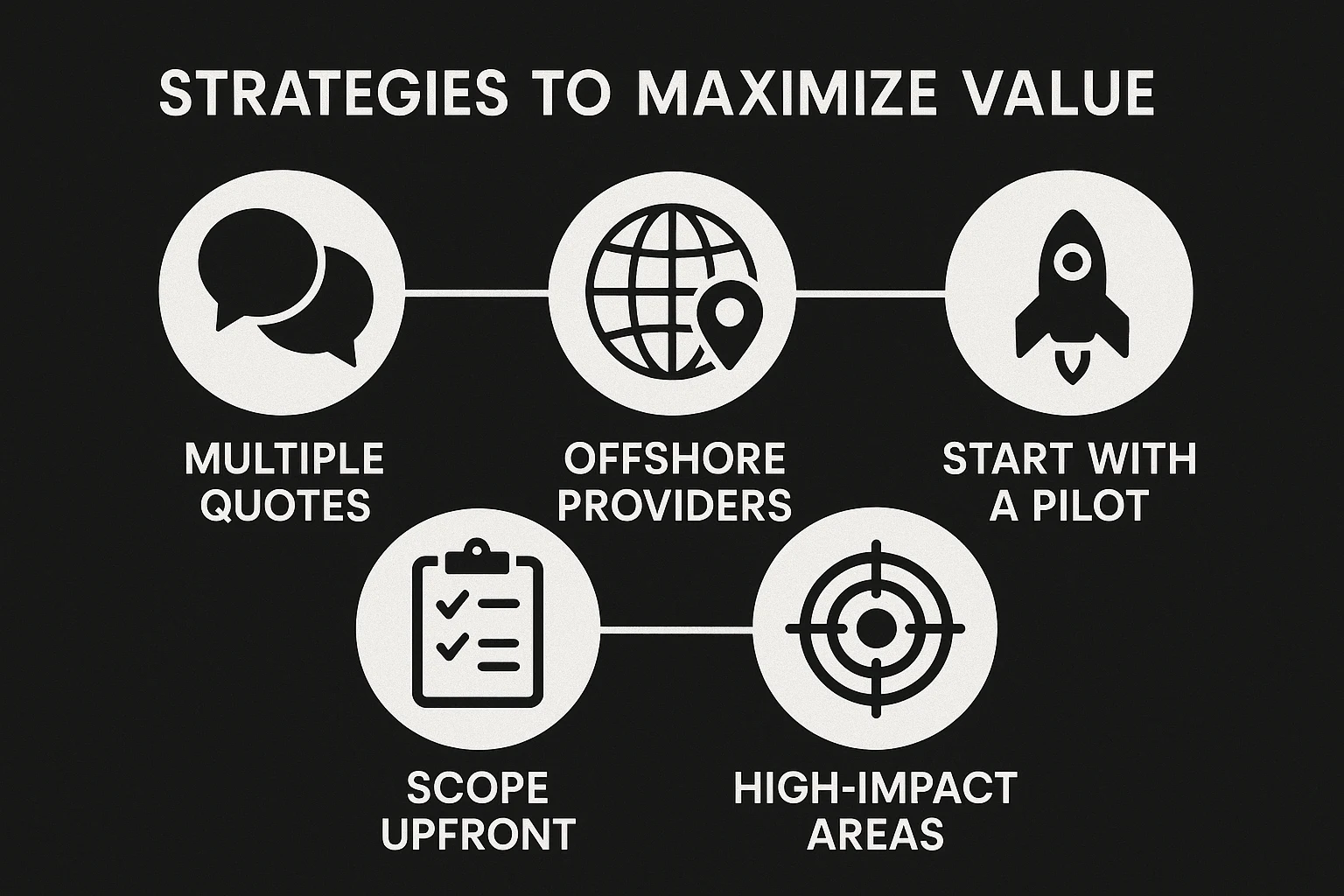
Getting the most out of your 4D budget is about being savvy. Here are practical tips I’ve picked up from watching teams navigate this:
- Get Multiple Quotes: Reach out to 3-5 providers to compare scope, experience, and turnaround (2-8 weeks is typical).
- Consider Offshore Providers: They can save 40-60%, but check certifications and past projects for quality assurance.
- Define Scope Upfront: Specify LOD, deliverables (e.g., animations, clash reports), and revision limits to avoid extra fees.
- Start with a Pilot: Test 4D on a single phase to prove ROI before committing to the whole project.
- Focus on High-Impact Areas: Prioritize clash detection or logistics planning, which deliver the biggest savings (10-20% of project costs).
One team I heard about saved 50% by mixing offshore modeling with local oversight. It’s all about balancing cost and quality.
Future Trends: Where Are Costs Headed?
Looking at 2026 and beyond, 4D scheduling costs are influenced by tech and market shifts. Here’s what’s on the horizon:
- Automation and AI: Tools that automate clash detection or schedule optimization could lower labor hours, potentially cutting costs by 10-20% in 2-3 years.
- Cloud-Based Platforms: These reduce hardware needs, making in-house setups cheaper and possibly lowering outsourced rates.
- Increased Competition: As more firms (especially offshore) offer 4D, prices may drop, particularly for small-to-medium projects.
- VR/AR Integration: Immersive walkthroughs are pricier now (adding $5,000-20,000), but as they become standard, baseline costs might rise slightly.
For now, the $20,000-60,000 average for mid-sized projects holds, but staying ahead of these trends can help you budget smarter.
Conclusion: Is 4D Worth the Investment?
After crunching the numbers, it’s clear that 4D construction scheduling is more than a shiny toy – it’s a strategic move that can save you from costly headaches. Whether you’re spending $5,000 on a small renovation or $200,000 on a massive infrastructure project, the ability to visualize sequences, catch clashes, and optimize resources often pays for itself. I’ve seen projects where a $40,000 4D model saved ten times that by avoiding delays. By shopping around, defining your scope, and weighing offshore vs. local options, you can make 4D fit your budget. As tech like AI and VR creeps in, costs might shift, but the value of staying ahead of the curve is undeniable. Ready to price out your project? Start gathering quotes, and you’ll see why 4D is worth its weight in gold.
FAQs
What are the main factors affecting 4D construction scheduling costs?
Costs depend on project size, complexity, provider location, and scope. Small projects (under 10,000 sq ft) cost $5,000-15,000, while large ones (over 100,000 sq ft) can hit $50,000-200,000. U.S. providers charge $80-150/hour vs. $25-60 offshore. Higher detail levels and add-ons like 5D cost estimation increase prices.
How much should I budget for a mid-sized construction project?
For a 10,000-100,000 sq ft project, like an office or school, budget $20,000-60,000, with U.S. providers averaging $40,000-60,000 and global options (including offshore) at $15,000-40,000. This includes simulations, clash detection, and revisions.
Can 4D scheduling save enough to justify its cost?
Yes, it can save 10-20% on project budgets by reducing rework and delays. For a $5M project, that’s $500,000-1M in savings, far outweighing the $20,000-60,000 cost for a mid-sized job, making it a smart investment.
How can I reduce 4D scheduling costs without sacrificing quality?
Get quotes from multiple providers, consider offshore firms (saving 40-60%), clearly define scope (e.g., LOD, deliverables), and start with a pilot phase. Focus on high-impact features like clash detection to maximize ROI while keeping costs in check.
Our Case Studies
We have handled 200+ BIM & VDC projects for commercial, industrial, and residential sectors.
Our work includes:
Formwork design automation
Our client from
California, USA
Suspended ceiling design automation
Our client from
New York, USA
Wall framing design automation
Our client from
California, USA