Have any questions? Contact us!
Join our team!
Request a free quote or consultation

Figuring out what you’ll pay for 3D architectural modeling feels a bit like estimating a home renovation – you know it’ll cost something, but the final number depends on a million details. I’ve spent years in the thick of BIM projects, renderings, and virtual walkthroughs, and I can tell you the range is wide: from $100 for a quick sketch to $5,000+ for a detailed commercial masterpiece. In 2026, with AI and VR reshaping the game, understanding these costs is more crucial than ever. It’s not just about dollars – it’s about getting value that saves time and headaches later. Let’s dive into the real numbers, unpack what drives them, and share some hard-earned tips to keep your budget on track without sacrificing quality.
What Goes Into 3D Architectural Modeling Costs
3D architectural modeling is all about turning flat plans into digital buildings you can explore, tweak, and test before breaking ground. The price tag reflects the effort, skill, and tech behind that process. From my time managing these projects, I’ve seen costs vary wildly based on a few key elements.
Time is the biggest factor – simple models might take 5-10 hours, while complex ones can demand 50+ hours of work. Expertise also plays a huge role; a rookie modeler might save you money, but a pro’s precision can prevent costly errors. Software like Revit or Maya isn’t cheap, adding 10-20% to the bill for high-end visuals. Revisions are another sneaky cost – vague instructions can spike prices by 20-30% as teams rework designs. In 2026, AI tools are cutting costs for basic tasks, but custom models for critical projects still need that human touch.
Why Time Matters
A basic residential render might wrap up in a few hours, costing $200-$700. A commercial BIM model, with intricate systems and data, could take days, pushing costs to $3,000-$5,000. Rush jobs add 25-50% to the tab, so planning ahead saves cash.
Software’s Hidden Impact
Tools like Blender (free) keep costs low, around $100-$700, but premium software like Revit or Maya with RTX rendering bumps prices to $300-$2,000 per image. AI-driven tools can shave 20% off basic models, landing at $100-$400, but they often need manual fixes for accuracy.
Powerkh’s 3D Architectural Modeling: Crafting Your Vision with Precision

Powerkh is a UK-based company offering 3D architectural modeling services, with additional offices in Ukraine and the USA. We create detailed digital models for architecture, engineering, and construction projects. Our 3D models integrate architectural, structural, and MEP components, helping clients visualize projects accurately before construction begins.
We use advanced modeling software to produce precise, data-driven representations that allow teams to identify potential issues early in the process. This approach helps reduce errors, improve coordination, and streamline workflows during both design and construction phases.
Our services are especially beneficial for complex projects that require collaboration across multiple disciplines. Our 3D models support better decision-making, ensuring that the construction process is efficient and stays aligned with the original design.
Key Highlights:
- UK-based company with offices in Ukraine and the USA
- Specializes in 3D architectural modeling for architecture, engineering, and construction projects
- Creates detailed, data-rich models that integrate architectural, structural, and MEP components
- Helps visualize projects accurately before construction starts
- Uses advanced modeling software to improve accuracy and reduce errors
- Supports better decision-making and coordination throughout the project lifecycle
Average Costs by Project Type
Different projects come with different price tags, depending on the building, detail, and output. Here’s what you’re looking at in 2026 for various 3D modeling tasks, based on real market rates.
Residential Modeling
For homes or small apartments, costs are generally more affordable due to simpler designs.
- Interior Renders: $200-$550 per image. These cover rooms with basic furnishings, lighting, and textures like wood or tile.
- Exterior Renders: $200-$700 per image. Includes details like brickwork, windows, or roofing materials.
- 3D Floor Plans: $50-$450 per view. Great for visualizing layouts or marketing to buyers.
Commercial Modeling
Larger buildings like offices or retail spaces require more work, driving up costs.
- Interior Renders: $275-$1,000 per image. Reflects complex layouts with multiple rooms or custom fixtures.
- Exterior Renders: $350-$700 for small buildings; $700-$2,000 for large ones like high-rises.
- Aerial Visualizations: $500-$2,000 per image. These include surrounding landscapes or urban settings for context.
Animations and Walkthroughs
Videos bring designs to life but come at a premium.
- Cost Range: $4,000-$15,000 per video (1-3 minutes). Prices depend on length and detail, with photorealistic animations hitting the higher end.
- VR/AR Walkthroughs: $1,000-$5,000. These add interactivity, like opening doors or adjusting lights.
BIM and Point Cloud Models
- BIM Models: $500-$5,000+ per project. Costs scale with Level of Detail (LOD 100-500) and features like clash detection or material estimates.
- Point Cloud Models: $500-$2,000. Used for renovations, these involve scanning existing structures for precise digital replicas.
Freelancers and small firms typically charge these rates, while larger agencies push costs to $1,000-$3,000 per image or $5,000-$10,000 for animations. Overseas providers offer lower rates – $600 per image or $50 per minute for videos – but quality and communication can be hit-or-miss. From what I’ve seen, small residential jobs stay in the $300-$800 range, while commercial BIM projects often climb to $3,000-$5,000.
What Drives Your Final Price Tag
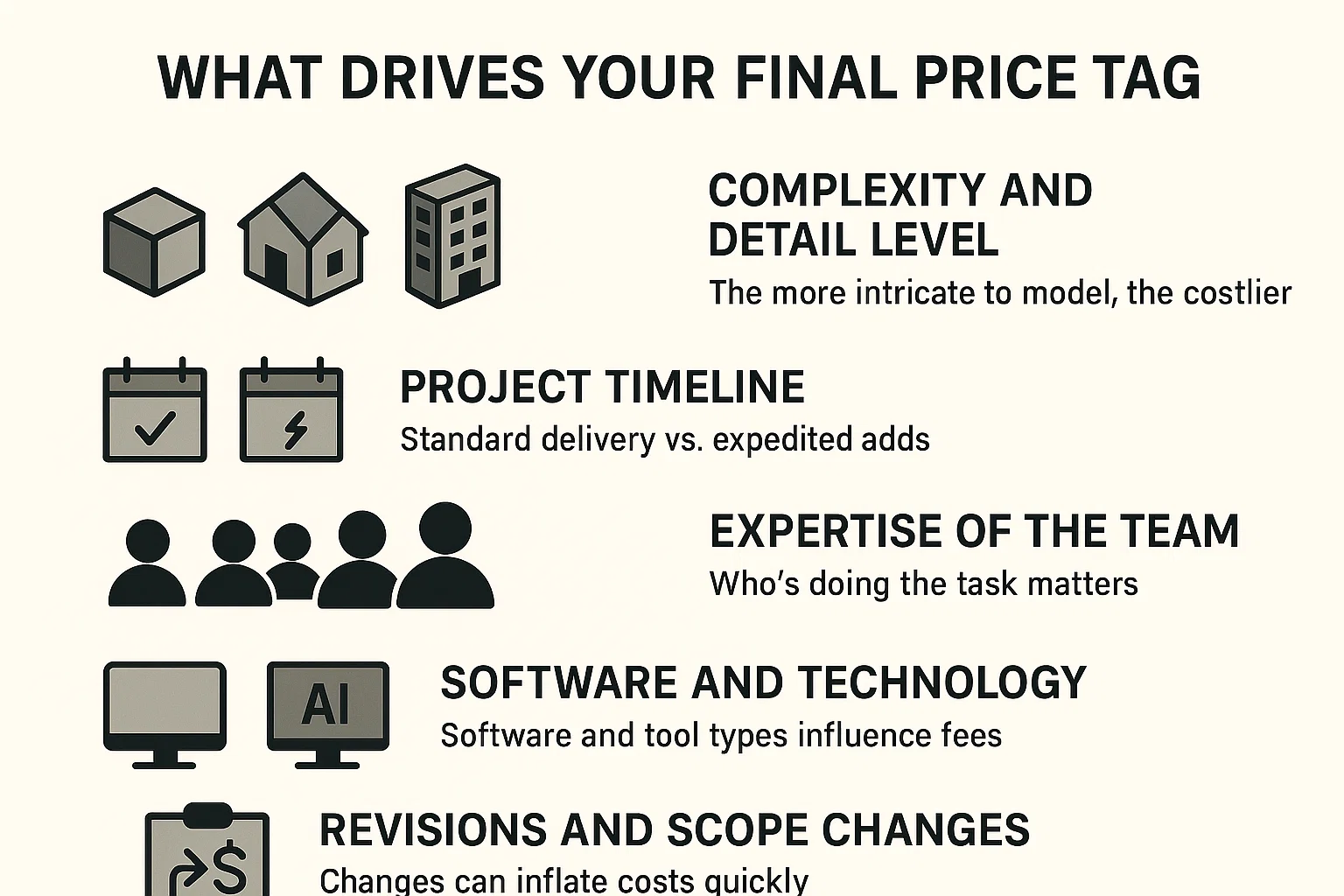
Every project’s cost is shaped by specific factors that can make or break your budget. Knowing these helps you plan smarter and avoid surprises.
Complexity and Detail Level
The more intricate the model, the higher the cost.
- Simple Models: $100-$500. Think low-poly concepts for quick planning.
- Medium Complexity: $200-$1,000. Includes basic residential interiors or exteriors with standard textures.
- High Complexity: $1,000-$5,000+. Covers detailed commercial BIM models with systems like HVAC or structural data.
Project Timeline
Deadlines can shift costs significantly.
- Standard Delivery (3-7 days): Keeps prices at $200-$2,000 for most renders.
- Rush Jobs (1-2 days): Add 25-50% surcharges, raising costs to $250-$2,500.
Expertise of the Team
Who’s doing the work matters.
- Junior Modelers: $20-$50/hour. Good for basic tasks but may lack polish.
- Experienced Freelancers (US): $23-$35/hour. Offers a balance of quality and affordability.
- Agencies: $100+/hour. Delivers top-tier, professional results.
- Overseas Talent: $10-$15/hour. Cheaper but risks delays or miscommunication.
Software and Technology
The tools used impact both quality and cost.
- Basic Tools (e.g., Blender): $100-$700. Free software lowers the entry point.
- Advanced Tools (e.g., Revit, Maya with RTX): $300-$2,000. Premium software adds 15-20% for high-fidelity outputs.
- AI Tools: $100-$400 for basic 2D-to-3D conversions, though manual tweaks may add $100-$200.
Revisions and Scope Changes
Changes can inflate costs quickly.
- Limited Revisions (2-3 rounds): Included in $200-$3,000 quotes.
- Excessive Revisions: Add 20-30%, pushing costs to $600-$3,900.
Purpose of the Model
Why you need the model affects pricing.
- Internal Planning: $200-$1,500. Focuses on function over aesthetics.
- Marketing Renders (Photorealistic): $800-$3,000. Prioritizes visual impact for sales or approvals.
- VR/AR Walkthroughs: $1,000-$5,000. Driven by interactivity and rendering demands.
I’ve seen projects go off the rails with unclear briefs, adding $500 in revisions to a $1,000 job. Nail down your needs early to keep costs in check.
Choosing the Right Pricing Model
How you pay for 3D modeling depends on your project’s clarity and goals. Here’s how the main models stack up in 2026.
Hourly Rates
Best for flexible or evolving projects, like early-stage designs.
- Averages: $50-$150/hour (US: $23-$35; overseas: $10-$15; agencies: $100+).
- Example: A 10-hour residential render at $30/hour costs $300.
- Pros: Flexible for changes but risks cost overruns if scope creeps.
Fixed or Per-Model Pricing
Ideal for defined deliverables, like a set number of renders.
- Averages: $200-$700 (residential), $350-$2,000 (commercial), $500-$5,000 (BIM models).
- Pros: Predictable costs but requires clear agreements on revisions.
Project-Based Pricing
Flat fee for the entire project, suited for large, well-defined scopes.
- Averages: $1,000-$5,000 for residential BIM, $3,000-$10,000 for commercial animations.
- Pros: Simplifies budgeting but needs detailed contracts to avoid scope issues.
Value-Based Pricing
Tied to the project’s impact, like securing investor approvals.
- Averages: $1,500-$5,000+ for high-stakes renders or VR tours.
- Pros: Aligns cost with value but requires understanding client goals.
I prefer fixed pricing for small, clear jobs – it’s straightforward. For projects with moving parts, hourly rates offer wiggle room. Always lock in revision limits to avoid surprises.
Budget-Saving Strategies That Work
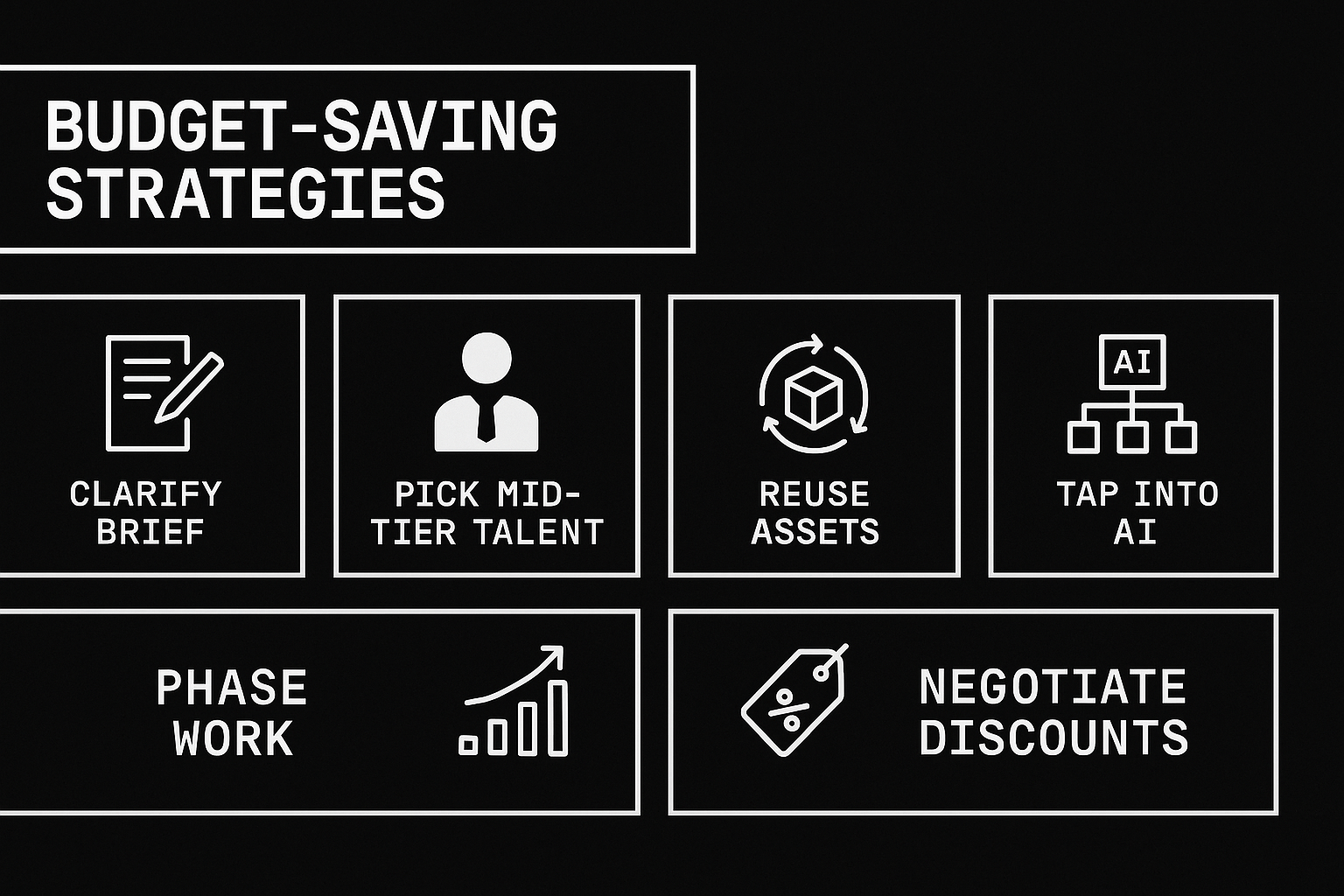
Cutting costs means working smarter, not settling for less. Here are effective ways to keep your budget in check while maintaining quality:
- Clarify Your Brief: Provide detailed 2D plans, reference images, or 3D assets to reduce modeling time by 20-30%, lowering costs from $1,000 to $700 for a typical render.
- Pick Mid-Tier Talent: Hire freelancers charging $500-$3,000 per project for quality work without agency markups of $1,000-$5,000.
- Reuse Existing Assets: Repurpose models across projects to save 30-50%, cutting a $1,000 render to $500.
- Tap Into AI Tools: Use AI-driven 2D-to-3D conversions ($100-$400) to save 20% over manual work, though complex models may need human adjustments.
- Phase Your Work: Model first ($200-$1,000), then render ($300-$2,000) to catch issues early and avoid expensive reworks.
- Negotiate Bulk Discounts: Secure 10-15% off for multiple renders, like reducing a $3,000 package to $2,550.
Clear planning can significantly cut costs – one client saved 25% on a $2,000 project by providing detailed CAD files upfront.
Real-World Examples: Costs in Action
Real cases illustrate how these strategies impact budgets:
- Residential Renovation: Point cloud modeling for an older home cost $800, with scans ensuring precise retrofits that saved $5,000 in construction errors.
- Apartment Complex: BIM modeling with clash detection cost $2,500, catching HVAC conflicts early and avoiding $15,000 in fixes.
- Commercial High-Rise: A $10,000 photorealistic animation with VR walkthrough boosted presales by 20%, proving its value for investor pitches.
- Small Office Render: A rushed $400 exterior render required a $1,200 redo for quality, showing that cutting corners can increase costs.
Smart spending upfront often prevents larger expenses later.
2026 Trends Shaping Costs
The modeling industry is evolving, with 2026 trends impacting pricing:
- AI-Powered Efficiency: AI retopology and 2D-to-3D converters reduce basic model costs by 20-30%, down to $100-$400, though custom work still costs $1,000+.
- Sustainability Requirements: Green simulations, like energy analysis, add $500-$1,500 to BIM projects for eco-compliance.
- VR/AR Demand: Interactive walkthroughs, costing $1,000-$5,000, are now standard for high-end marketing due to client demand for immersion.
- Global Rate Trends: Remote tools lower local premiums by 10-15%, keeping most renders at $200-$2,000 as global rates stabilize at $10-$35/hour.
These trends offer savings on basic tasks while encouraging investment in high-impact features like VR.
Closing Thoughts: Spend Smart, Build Better
In 2026, 3D architectural modeling costs span $100 for simple concepts to $5,000+ for intricate, data-rich designs. Whether you’re after a $300 residential render or a $10,000 VR animation, success lies in matching your budget to your goals – be it error prevention, planning, or marketing flair. My advice? Start with a crystal-clear brief, choose talent that fits your needs, and use tools like AI to streamline where possible. Treat modeling as an investment, not just a cost, and you’ll get results that elevate your project without draining your wallet.
FAQs
What’s the average cost for a 3D architectural render in 2026?
Residential renders cost $200-$700 for exteriors and $200-$550 for interiors. Commercial renders range from $275-$2,000, depending on size. Animations run $4,000-$15,000, and 3D floor plans are $50-$450.
How can I cut 3D modeling costs without sacrificing quality?
Supply detailed briefs with plans or assets to save 20-30% on modeling time. Choose freelancers at $500-$3,000, reuse assets, and use AI tools for basic tasks ($100-$400).
Why do some 3D modeling services cost so much?
High costs ($1,000-$5,000+) stem from complex models, premium tools (e.g., Revit, RTX), skilled labor ($23-$100/hour), or rush timelines (25-50% surcharges). Photorealistic or BIM models require more effort.
Are overseas providers a good deal?
Overseas talent ($10-$15/hour, $200-$600 per render) can save 30-50%, but delays or quality issues may add costs. Local providers ($23-$35/hour) offer reliability for critical projects.
Our Case Studies
We have handled 200+ BIM & VDC projects for commercial, industrial, and residential sectors.
Our work includes:
Formwork design automation
Our client from
California, USA
Suspended ceiling design automation
Our client from
New York, USA
Wall framing design automation
Our client from
California, USA