Vous avez des questions ? Contactez nous !
Rejoignez notre équipe !
Demander un devis ou une consultation gratuite

Estimating construction costs involves selecting the right method (conceptual, detailed, or unit cost), quantifying materials and labor, adding indirect costs like permits and overhead, and applying contingencies based on project phase. According to the Bureau of Labor Statistics, the Producer Price Index for construction has shown consistent volatility, with final demand goods increased 1.6 percent in March 2026, making accurate estimation more critical than ever.
Construction cost estimation stands as the foundation of every successful project. Get the numbers wrong, and everything else crumbles.
But here’s the thing—accurate estimation isn’t about guesswork or applying generic rules of thumb. It’s a structured process that combines historical data, current market conditions, and methodical calculation. The difference between a profitable project and a financial disaster often comes down to how well teams estimate costs before breaking ground.
Recent data from the Bureau of Labor Statistics shows construction pricing remains volatile. The Producer Price Index for final demand less foods, energy, and trade services increased 0.2 percent in March
after climbing 0.5 percent in both February and January, with prices for final demand less foods, energy, and trade services rising 3.6 percent over the 12 months ended in March—the largest 12-month advance since November 2025.
This volatility makes estimation even more critical. According to recent survey data, 55% of affordable housing developers cited high construction costs as one of the most significant barriers to 2026 projects, while another 39% pointed to price increases from tariffs as major obstacles.
So how do professionals navigate this complexity and produce reliable estimates? Let’s break down the methods, components, and strategies that actually work.
Understanding Construction Cost Estimation Fundamentals
Construction cost estimation is the process of calculating all expenses required to complete a project. This includes direct costs like materials and labor, plus indirect costs such as permits, insurance, overhead, and profit margins.
The goal isn’t just arriving at a number. Effective estimation provides a roadmap for budget control, helps secure financing, enables competitive bidding, and sets realistic expectations with clients.
Estimates evolve as projects progress. Early-phase estimates work with limited information and accept wider accuracy ranges. Later estimates incorporate detailed specifications and tighter tolerances.
How Estimate Accuracy Changes Through Project Phases
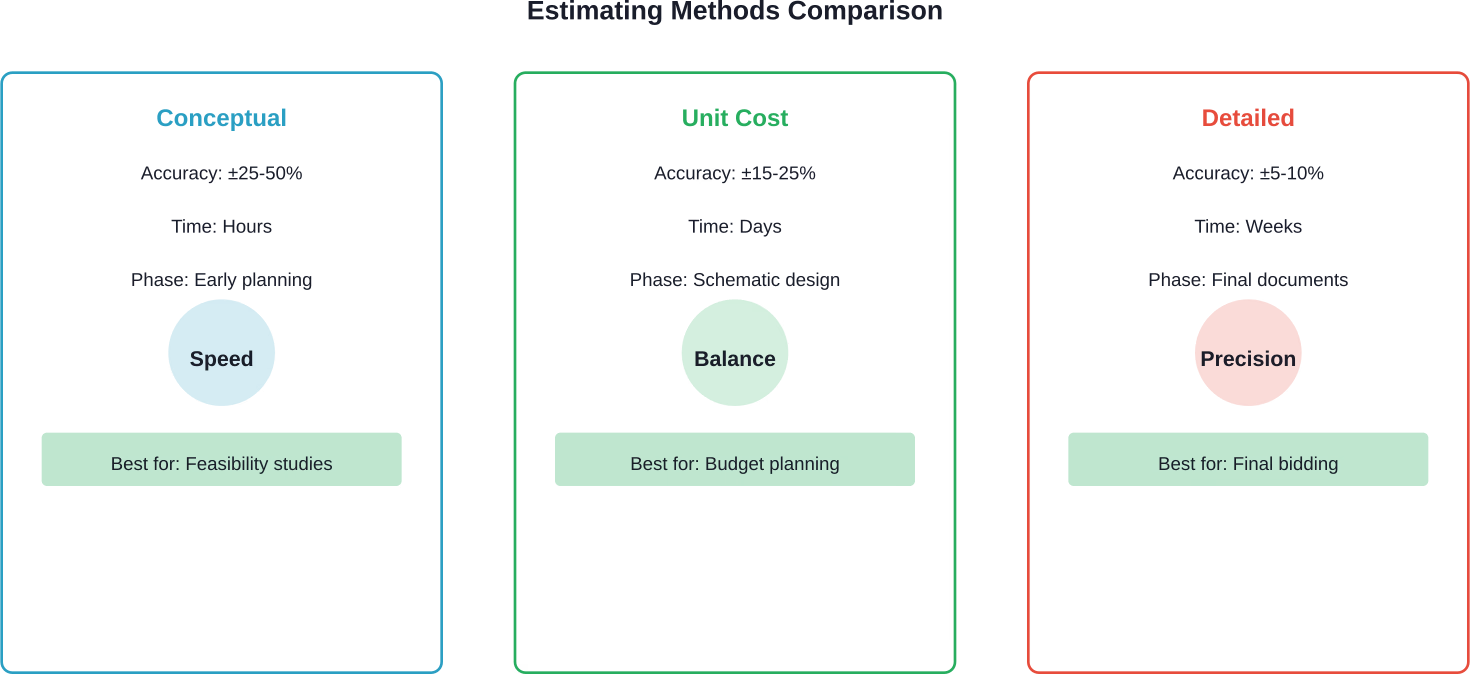
Estimation accuracy improves as design details emerge. Each project phase requires different estimation approaches and accepts different accuracy thresholds.
| Project Phase | Accuracy Range | Information Available
|
|---|---|---|
| Conceptual/Programming | ±25-50% | Basic program, site conditions, general scope |
| Schematic Design | ±15-25% | Preliminary drawings, basic materials, rough quantities |
| Design Development | ±10-15% | Detailed drawings, specified materials, refined quantities |
| Documents de construction | ±5-10% | Complete specifications, precise quantities, final details |
These accuracy ranges reflect the unavoidable uncertainty at each stage. A conceptual estimate might vary by 40%, and that’s acceptable—provided everyone understands the limitation.
Three Core Construction Estimating Methods
Different situations call for different estimation approaches. The three primary methods each serve specific purposes and work best at particular project stages.
Conceptual Estimating (Order of Magnitude)
Conceptual estimates use high-level numbers to assess project feasibility. They rely on past project data and expert judgment rather than detailed calculations.
This method works during initial discussions when detailed plans don’t yet exist. The estimate might use simple metrics like cost per square foot based on similar completed projects.
For example, if comparable office buildings cost $250-$300 per square foot, a 10,000 square foot project might be estimated at $2.5-$3 million. Quick, rough, but useful for go/no-go decisions.
The weakness? Accuracy sits in that ±25-50% range. Real talk: conceptual estimates can miss by hundreds of thousands of dollars. They’re directional, not definitive.
Unit Cost Estimating
Unit cost estimation breaks projects into measurable units and applies standard costs to each. It’s more detailed than conceptual estimating but less granular than full quantity takeoffs.
Common units include:
- Cost per square foot for different building types
- Cost per linear foot for roads or utilities
- Cost per bed for hospitals
- Cost per unit for apartment buildings
This approach works well during schematic and early design development phases. It provides better accuracy than conceptual estimates while requiring less time than detailed quantity surveys.
The key lies in using current, location-specific unit costs. A healthcare building in Seattle carries different unit costs than one in Atlanta, thanks to labor rates, material availability, and local building codes.
Detailed Estimating (Quantity Takeoff)
Detailed estimation involves measuring every component from construction documents and applying specific costs to each item. This is the gold standard for accuracy.
The process requires:
- Performing quantity takeoffs from drawings
- Calculating material costs for each component
- Estimating labor hours and applying wage rates
- Adding equipment costs and rental fees
- Including subcontractor quotes
- Adding overhead and profit margins
Detailed estimates take time. A single-family home might require 20-40 hours of estimation work. A commercial project could demand weeks of analysis.
But the payoff comes in accuracy and control. When construction documents are complete, detailed estimates can hit within 5-10% of actual costs—tight enough for firm pricing and budget certainty.
Core Components of a Construction Cost Estimate
Regardless of which method gets used, comprehensive estimates address the same fundamental cost categories. Missing even one component can throw the entire estimate off.
Direct Costs: Materials and Labor
Materials represent the physical components that become part of the finished structure. This includes lumber, concrete, steel, finishes, fixtures, and everything else that gets permanently installed.
Material costs fluctuate based on market conditions. The recent volatility in construction pricing makes this particularly challenging. Material suppliers may only hold quotes for 30-60 days, meaning estimates need regular updating for long-duration projects.
Labor costs cover the wages paid to workers who install materials and perform construction work. This includes:
- Base hourly wages or salaries
- Payroll taxes and benefits
- Workers’ compensation insurance
- Union requirements where applicable
Labor productivity varies significantly. A skilled crew might install 1,000 square feet of drywall daily, while a less experienced team manages only 600. Estimators must account for actual productivity rates, not theoretical maximums.
Equipment Costs
Equipment costs cover machinery needed for construction. This includes rental fees for excavators, cranes, lifts, and specialized tools.
Some equipment gets charged per day, others per week or month. The estimate needs to account for how long each piece remains on site. Mobilization and demobilization costs—getting equipment to and from the site—add another layer.
Fuel, operators, and maintenance create additional expenses that can’t be overlooked.
Subcontractor Costs
Most projects involve multiple specialized subcontractors. Electrical, plumbing, HVAC, roofing, and other trades typically provide their own bids based on project specifications.
General contractors incorporate these subcontractor quotes into the overall estimate. Smart practice involves getting multiple quotes for each trade and vetting subcontractors for reliability, not just low price.
Indirect Costs and Overhead
Indirect costs don’t show up in the finished building but are essential to project completion. These include:
- Building permits and inspection fees
- Insurance and bonding
- Temporary utilities and site facilities
- Project management and supervision
- Office overhead allocated to the project
- Waste disposal and cleanup
Overhead typically runs 10-20% of direct costs, though this varies by company size and project type.
Contingencies and Profit
Contingencies protect against unforeseen conditions and cost overruns. The contingency percentage should match the estimate’s accuracy level and project risk profile.
Early-phase estimates might carry 15-20% contingencies. Final estimates with complete documentation might use 5-10%. High-risk projects like renovations in occupied buildings warrant larger contingencies than new construction on open sites.
Profit margin covers business sustainability and growth. Typical construction profit margins range from 5-15%, depending on project type, competition, and risk.
| Cost Category | Typical Range | Key Considerations
|
|---|---|---|
| Materials | 30-50% of total | Market volatility, delivery timing, waste factor |
| Labor | 20-40% of total | Productivity rates, wage scales, benefits |
| Equipment | 5-15% of total | Rental duration, operators, mobilization |
| Subcontractors | 20-40% of total | Trade-specific, availability, reliability |
| Overhead | 10-20% of direct costs | Company size, project duration |
| Contingency | 5-20% | Project phase, risk level, unknowns |
| Profit | 5-15% | Market conditions, competition, risk |
Step-by-Step Process for Creating Detailed Estimates
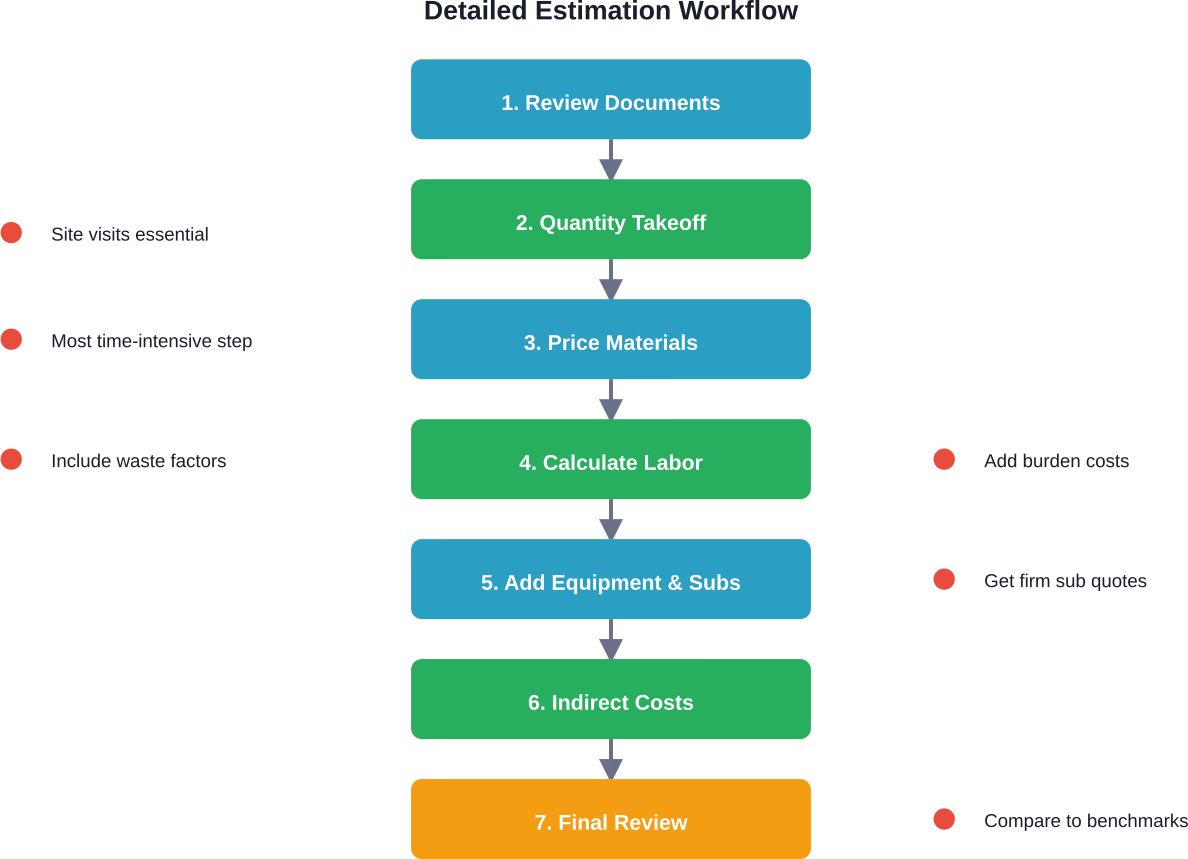
Detailed estimation follows a systematic workflow. Skipping steps or rushing the process leads to errors that cost money later.
Step 1: Review Project Documents Thoroughly
Start by studying all available drawings, specifications, and site information. Understanding the full scope prevents missing major components.
Look for conflicts between drawings and specifications. Note areas where details seem incomplete or unclear. Document questions to ask the design team.
Site visits matter. Walking the actual location reveals conditions that drawings might not capture—existing utilities, access limitations, soil conditions, adjacent structures.
Step 2: Perform Quantity Takeoff
Quantity takeoff means measuring and counting every component that needs estimation. This includes square footage of different materials, linear footage of elements, volume of concrete, number of fixtures—everything.
Modern estimating software can speed this process, but manual takeoffs using scaled drawings still work. The key is consistency and accuracy.
Organization matters enormously. Break quantities into logical divisions matching how work gets performed. This might follow CSI MasterFormat divisions or project phases.
Step 3: Price Materials
Apply current material costs to quantities. Get supplier quotes for major items rather than relying solely on historical data or generic cost books.
Add waste factors. Not all material purchased becomes part of the building. Concrete gets over-ordered for safety, lumber produces cutoffs, tile breaks during installation. Waste factors vary by material but typically run 5-15%.
Account for delivery costs, storage requirements, and material handling.
Step 4: Calculate Labor Requirements
Estimate labor hours needed for each task based on crew size, productivity rates, and working conditions. Standard labor productivity databases provide baseline numbers, but adjust for project-specific factors.
Apply wage rates including taxes and benefits. Labor burden—the additional costs beyond base wages—often adds 30-50% to the hourly rate.
Step 5: Add Equipment and Subcontractor Costs
List all equipment needed and estimate rental duration. Include operators where required.
Incorporate subcontractor quotes for specialized work. Verify that sub quotes include all required scope and align with project specifications.
Step 6: Calculate Indirect Costs
Add all project-specific indirect costs: permits, insurance, temporary facilities, project management time, supervision costs.
Apply company overhead percentage to cover office expenses, estimating time, marketing, and other business costs not directly tied to this project.
Step 7: Apply Contingency and Profit
Add contingency based on risk assessment and estimate confidence level. Higher risk or less detailed plans warrant larger contingencies.
Add profit margin appropriate for the project type and market conditions.
Step 8: Review and Validate
Check the estimate against industry benchmarks and past similar projects. Does a $2.5 million estimate for a 10,000 square foot office make sense if comparable buildings cost $200-$300 per square foot? That would suggest the estimate is on the low end or potentially missing items.
Have a second person review major estimates. Fresh eyes catch errors the original estimator might miss.
Fix Cost Drift Before It Hits Your Budget

Cost estimates break when design intent shifts between design, coordination, and site. Powerkh works inside that gap – keeping key decisions consistent, resolving high-risk areas early, and checking what’s being built against what was designed so estimates stay grounded in reality.
Catch Cost Risks Early
Here’s how they help keep your estimates accurate:
- Review design readiness before pricing is fixed
- Resolve clashes in critical zones before they turn into cost changes
- Check constructability, tolerances, and assumptions early
- Monitor design vs site deviations with engineering input
- Verify actual installed progress against planned scope
Contact Powerkh to keep your cost estimates aligned with what actually gets built.
Common Construction Estimating Mistakes to Avoid
Even experienced estimators make mistakes. Recognizing common pitfalls helps avoid them.
Scope Gaps and Omissions
The most expensive mistake is leaving things out entirely. Missing a whole system—say, forgetting to estimate the HVAC ductwork or site drainage—creates massive budget shortfalls.
This often happens when estimators assume certain work is included in subcontractor quotes, but the subs assumed it was separate. Clear scope definition and communication prevent this.
Outdated Pricing Data
Using cost data from years ago or different geographic regions produces inaccurate estimates. Construction costs vary dramatically by location and change over time.
According to Census Bureau data, private construction spending hit a seasonally adjusted annual rate of $1,661.2 billion in January 2026. The market remains active but volatile.
Current, location-specific pricing is essential. Generic cost books provide useful starting points but need adjustment for local conditions.
Ignoring Site Conditions
Site-specific challenges drive costs up. Rock excavation costs far more than digging through soft soil. Sites with difficult access require smaller equipment and more labor hours. Existing structures or utilities create work-around costs.
Geotechnical reports, surveys, and site visits reveal these conditions. Skipping this step invites surprises during construction.
Underestimating Labor Productivity Factors
Labor productivity databases show ideal conditions. Real projects face weather delays, coordination issues, rework, and learning curves that slow productivity.
Winter work in cold climates takes longer. High-rise construction with limited staging areas reduces efficiency. Renovation work in occupied buildings creates constant interruptions.
Adjust labor estimates for actual working conditions, not theoretical maximums.
Inadequate Contingencies
Setting contingencies too low—or eliminating them to hit a budget target—creates problems when inevitable changes arise. No project executes exactly as planned.
Industry practice involves pressure to reduce estimates to win bids, only to face losses when contingencies prove insufficient.
Contingencies should reflect real risk, not wishful thinking.
Leveraging Technology for Better Estimates
Estimating software has transformed the process from spreadsheets and calculators to digital takeoffs and automated pricing.
Digital takeoff tools let estimators measure directly from PDF plans, automatically calculating quantities and reducing manual measurement errors. Changes to plans can be updated quickly without redoing entire takeoffs.
Cost databases integrated with estimating software provide current pricing that updates regularly. Some platforms pull real-time material costs from supplier APIs.
Cloud-based collaboration allows multiple team members to work on estimates simultaneously. Subcontractors can enter their own numbers, which flow into the master estimate automatically.
That said, technology doesn’t replace expertise. Software produces output based on the inputs and assumptions provided. An experienced estimator using spreadsheets will outperform a novice using expensive software.
Industry-Specific Estimation Considerations
Different project types face unique estimation challenges that require specialized knowledge.
Construction résidentielle
Home construction estimation benefits from relatively standardized components and well-established unit costs. A single-family home estimate typically includes foundation, framing, roofing, exterior finishes, interior finishes, mechanical systems, and site work.
Customization level affects accuracy. Production homes following standard plans estimate more reliably than highly custom designs with unique details.
Soft costs like permits, design fees, and financing charges can add 10-15% beyond construction costs.
Commercial Building Construction
Commercial projects involve complex systems, higher performance standards, and stricter code requirements. The Bureau of Labor Statistics tracks separate Producer Price Indexes for office buildings and healthcare facilities, recognizing their distinct characteristics.
Tenant improvement work requires coordinating with occupied spaces, working off-hours, and meeting tight schedules—all factors that increase costs beyond base construction rates.
Rénovation et réaménagement
Renovation estimation carries the highest uncertainty. Hidden conditions—deteriorated framing, asbestos, outdated wiring, plumbing issues—emerge once demolition begins.
Smart renovation estimates include larger contingencies (15-25%) and allowances for probable discoveries. Invasive investigation before estimating reduces surprises but adds upfront cost.
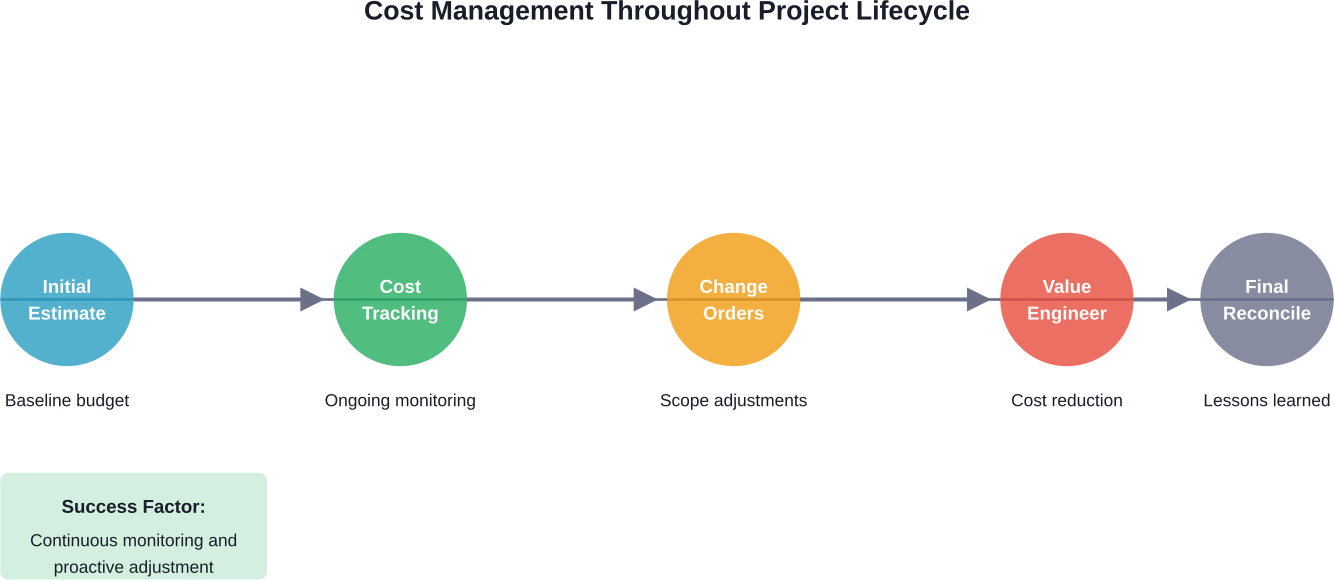
Managing Costs Beyond the Initial Estimate
Creating an accurate estimate is only the beginning. Managing costs throughout construction determines actual profitability.
Change Order Management
Changes to scope, design modifications, and unforeseen conditions trigger change orders. Each change requires estimating the cost impact and getting owner approval before proceeding.
Delayed change order approval creates a backlog of unapproved work that clouds budget tracking. Process discipline matters—estimate changes immediately, document everything, and get written approval.
Cost Tracking and Forecasting
Compare actual costs against estimates regularly. This reveals where the project stands financially and whether the estimated assumptions are holding true.
If lumber costs 15% more than estimated, that overrun will compound across the entire project unless addressed. Early detection allows corrective action—value engineering, scope adjustments, or owner notifications.
Ingénierie de la valeur
When estimates exceed budgets, value engineering identifies cost savings without compromising essential function. This might mean alternate materials, simplified details, or different construction methods.
Effective value engineering maintains project quality while reducing cost. Poor value engineering just cuts corners and creates problems later.
Building Estimation Skills and Expertise
Construction estimating combines technical knowledge, experience, and judgment. Building these skills takes time and deliberate practice.
Learning from Historical Project Data
The best estimators maintain detailed records of past projects. They track actual costs against estimates, document what went right and wrong, and build institutional knowledge.
This historical data becomes increasingly valuable. It shows real productivity rates for specific crews, actual waste factors for materials, and typical cost overruns for particular project types.
Understanding Construction Methods
Good estimators understand how buildings get built. They know sequencing, crew sizes, equipment requirements, and realistic production rates.
Field experience provides this understanding. Estimators who’ve worked in construction have inherent advantages over those who’ve only worked with drawings and numbers.
Staying Current with Market Conditions
Construction markets change constantly. Material prices fluctuate, labor rates shift, new products emerge, and methods evolve.
The Bureau of Labor Statistics provides regular updates on construction price indexes. According to their March 2026 data, prices for final demand for less foods, energy, and trade services rose 3.6 percent over 12 months—the kind of information that must factor into current estimates.
Trade publications, supplier relationships, and industry associations help estimators stay informed.
Mastering Cost Estimation for Project Success
Construction cost estimation isn’t guesswork dressed up with spreadsheets. It’s systematic analysis combining technical knowledge, current market data, and hard-earned experience.
The method matters—conceptual estimates serve early planning, unit costs work for budgeting and preliminary design, and detailed takeoffs provide the accuracy needed for firm pricing. Each has its place.
The components matter—materials, labor, equipment, subcontractors, indirects, overhead, contingency, and profit all require careful attention. Miss one, and the whole estimate falls apart.
The follow-through matters—creating a brilliant estimate means nothing if costs aren’t tracked, changes aren’t managed, and lessons aren’t learned for next time.
Market conditions in 2026 make accuracy more critical than ever. With the Producer Price Index showing continued volatility and factors like tariffs affecting material costs, tight estimation provides competitive advantage and protects profitability.
Start building better estimates today. Review past projects to understand where estimates hit or missed. Invest in current cost data for your specific market. Develop systematic processes that ensure consistency. And remember—the goal isn’t perfection, it’s continuous improvement toward greater accuracy and better project outcomes.
Whether bidding commercial work, planning a custom home, or managing renovation projects, mastering construction cost estimation separates successful projects from financial disasters. The fundamentals outlined here provide the foundation. Experience and dedication build expertise over time.
Questions fréquemment posées
What’s the most accurate method to estimate construction costs?
Detailed estimating based on complete quantity takeoffs from construction documents provides the highest accuracy, typically within ±5-10% of actual costs. This method requires measuring every component, applying current unit costs, and accounting for all labor, materials, equipment, and indirect expenses. However, it only works when complete construction documents exist. For earlier project phases, unit cost or conceptual methods are more appropriate despite lower accuracy.
How much does construction cost per square foot?
Construction costs per square foot vary enormously based on building type, location, quality level, and market conditions. There’s no single answer. Simple warehouse structures might cost $80-$120 per square foot, while custom homes run $150-$400+ per square foot, and specialized facilities like hospitals can exceed $500 per square foot. Geographic location dramatically affects these numbers—coastal urban markets cost significantly more than rural areas. Always use location-specific, project-type-appropriate data rather than generic national averages.
What percentage should I add for contingency in a construction estimate?
Contingency percentages should match the estimate’s accuracy level and project risk. Conceptual estimates warrant 15-25% contingencies due to high uncertainty. Design development estimates typically use 10-15%, while detailed estimates from complete construction documents might use 5-10%. Renovation projects with unknown existing conditions justify higher contingencies (15-25%) than new construction on well-understood sites. Never eliminate contingencies just to meet a budget—unexpected conditions arise on virtually every project.
How long does it take to create a detailed construction estimate?
The timeline depends on project size and complexity. A residential home might require 20-40 hours of estimating work. Small commercial projects often need 40-80 hours. Large or complex projects can demand several weeks of full-time estimation effort. Rushing the estimate to save time nearly always costs more in missed items and errors than the time saved. Teams performing regular estimation work develop efficiency, but thoroughness matters more than speed.
Can I estimate construction costs without detailed plans?
Yes, using conceptual or unit cost methods. These approaches rely on high-level information—square footage, number of units, basic program requirements—combined with historical cost data from similar projects. The trade-off is accuracy: these estimates typically fall within ±25-50% of actual costs. They’re useful for feasibility studies, preliminary budgeting, and early decision-making, but shouldn’t be treated as firm pricing. Detailed estimates require detailed plans.
What are the biggest factors that cause construction cost overruns?
Scope changes rank as the most common cause—owners changing requirements mid-project, designs evolving beyond original intent, or discovering additional work needed. Unforeseen site conditions create the second major category, particularly in renovation work where hidden problems emerge during demolition. Material price volatility, especially in unstable markets, causes overruns when estimates lock in pricing but actual purchases occur months later at higher costs. Inadequate contingencies and overly optimistic productivity assumptions also contribute significantly.
How do I account for price increases in long-duration projects?
For projects lasting multiple years, build escalation factors into the estimate. Historical inflation data and current market trends inform appropriate escalation percentages. The Bureau of Labor Statistics Producer Price Index data shows construction costs rising 3.6 percent over the 12 months ended March 2026. Apply escalation to the portions of work scheduled for later project phases. Material suppliers often won’t hold quotes beyond 30-60 days, so include allowances for price adjustments. Some contracts include escalation clauses that allow price adjustments based on documented market changes.

Nos études de cas
Nous avons géré plus de 200 projets BIM et VDC pour les secteurs commerciaux, industriels et résidentiels.
Notre travail comprend
Automatisation de la conception des coffrages
Our client from
California, USA
Automatisation de la conception des plafonds suspendus
Our client from
New York, USA
Automatisation de la conception de l'ossature des murs
Our client from
California, USA