¿Tiene alguna pregunta? Póngase en contacto con nosotros
¡Únete a nuestro equipo!
Solicitar presupuesto o consulta gratuita

If you’ve ever walked into a newly built office, hospital, warehouse, or apartment complex and thought, “This just works,” you were experiencing the result of good structural and MEP design. Not the architecture. Not the finishes. The invisible systems that hold the building up and make it function every day.
Structural and MEP design support sits right at the center of that effort.
It is not just about drawing beams or routing ducts. It is the technical coordination layer that ensures everything fits together, performs properly, complies with regulations, and can actually be built without chaos on site.
In this article, we’ll break down what structural and MEP design support really means, what it includes, why it matters more than most people realize, and how it directly impacts cost, timelines, and long term building performance.
Understanding Structural Framework and System Support
Structural design support focuses on the load-bearing framework of a building and how it safely transfers forces such as gravity, wind, and seismic loads into the ground.
It is not limited to initial structural calculations. This support continues throughout design development and construction, adapting to changes and resolving technical challenges as they arise.
Structural design support typically includes:
- Structural analysis and load calculations
- Foundation design and detailing
- Reinforced concrete and steel detailing
- Slab and beam layout optimization
- Structural modeling in BIM environments
- Review of architectural updates with structural adjustments
- Shop drawing review and site coordination
As projects evolve, layouts shift, openings are introduced, and system requirements change. Structural support ensures the framework responds to these adjustments without compromising safety or efficiency.
Physical Support for MEP Systems
There is also a practical aspect that often goes unnoticed – the physical support of MEP systems. Ducts, pipes, and cable trays cannot simply be installed without proper structural backing. They rely on pipe hangers, cable tray brackets, equipment frames, duct supports, and anchoring systems to remain secure and stable.
When these support elements are properly designed, they ensure correct load distribution, control vibration, and provide long term durability. Without adequate support, building systems can fail prematurely or introduce unnecessary stress to the structure. While this level of detailing may seem minor at first glance, it plays a critical role in overall reliability and ongoing maintenance.
Integrated Structural and MEP Design at Powerkh

Powerkh works at the core of structural and MEP design support, combining engineering expertise with digital coordination to ensure that buildings are not only well designed, but practical to construct. As a UK-based BIM & VDC company with offices in the United States and Ukraine, we focus on integrating architectural, structural, and MEP systems into coordinated, construction-ready models that reduce risk and improve project efficiency.
We develop detailed 3D BIM models, carry out structured coordination processes, perform clash detection, and prepare shop drawings that support fabrication and on-site installation. Our team handles structural detailing, MEP modeling, scan-to-BIM conversions, BIM Automation, and prefabrication workflows, ensuring that all components align before construction begins. By bringing structure and building systems together within a unified digital environment, we help project teams avoid costly conflicts, maintain clarity across disciplines, and move forward with greater confidence.
What MEP Design Support Really Covers
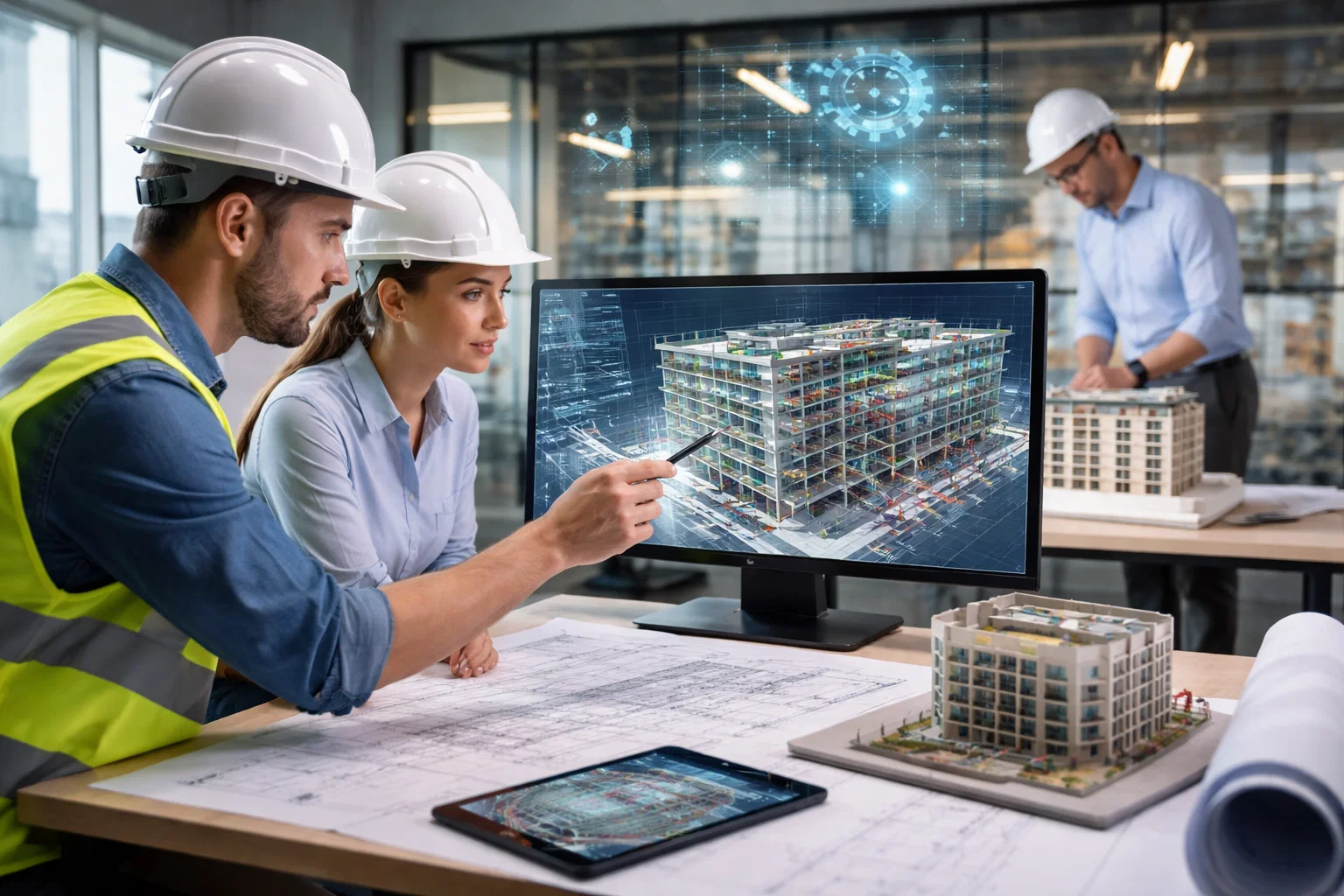
Now let’s talk about MEP – Mechanical, Electrical, and Plumbing.
MEP systems are often described as the lifelines of a building. They control temperature, air quality, lighting, power distribution, water supply, drainage, and fire protection.
Without them, a building is just a shell.
MEP design support involves planning, coordinating, and refining these systems to ensure performance, safety, and compliance. It is not just about installing equipment. It is about designing systems that work together smoothly.
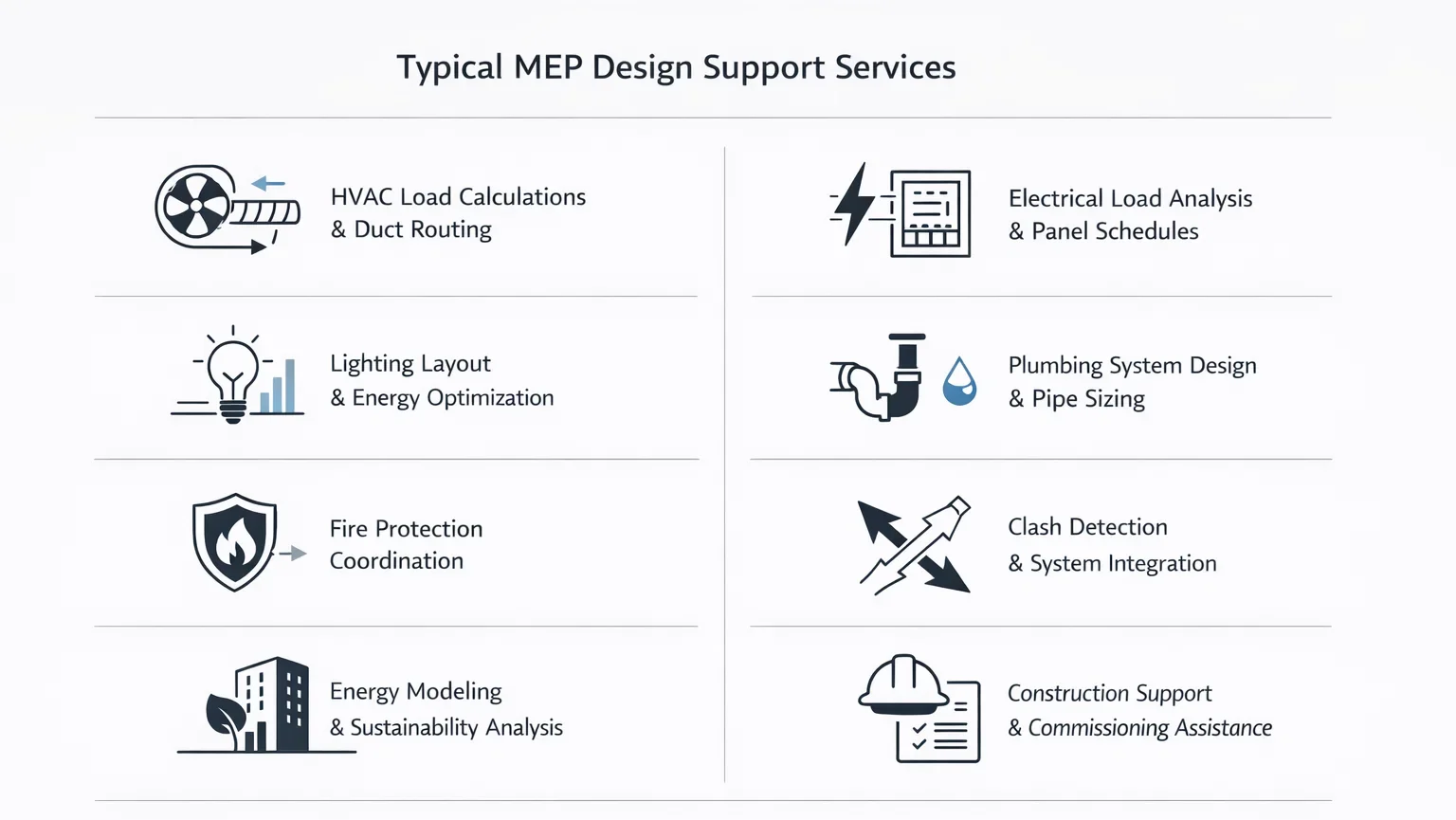
Typical MEP design support services include:
- HVAC load calculations and duct routing
- Electrical load analysis and panel schedules
- Lighting layout and energy optimization
- Plumbing system design and pipe sizing
- Fire protection coordination
- Clash detection and system integration
- Energy modeling and sustainability analysis
- Construction support and commissioning assistance
One thing people often underestimate is how tightly these systems interact with the structure.
Ducts need space. Pipes require slopes. Cable trays require clearance. Equipment needs maintenance access.
MEP design support ensures these requirements are identified early and integrated intelligently into the structural and architectural framework.
Integrated Coordination in Structural and MEP Design
True coordination in a building project happens at the intersection of structure, systems, technology, and people. It is not just about avoiding clashes on drawings. It is about aligning disciplines, tools, and communication from the very beginning. The following sections outline why structural and MEP teams must function as one system, how BIM enables that integration, and why collaboration matters just as much as technology.
Why Structural and MEP Must Work as One System
In theory, structural and MEP disciplines could develop their designs separately. In practice, that approach almost always leads to conflict.
A structural beam cannot pass through an air handling duct. A plumbing riser cannot be routed through a post-tension slab without careful planning. An electrical room must align with the structural grid. These are not minor details – they directly affect constructability.
When structural and MEP teams collaborate from the beginning, the project becomes more efficient and significantly less risky. Early coordination typically includes shared BIM models, regular coordination meetings, integrated design reviews, clash detection using 3D software, and early space planning for equipment and routing.
This approach allows potential conflicts to be identified and resolved before construction begins. It saves time, reduces rework, and prevents costly on-site adjustments.
The Role of BIM in Digital Coordination
One of the most significant shifts in project delivery over the past two decades has been the adoption of Building Information Modeling.
Instead of working from isolated 2D drawings, teams now operate within coordinated digital environments. BIM enables real time design updates, accurate quantity extraction, improved clash detection, better visualization for clients, centralized documentation, and stronger collaboration between disciplines.
Clash detection tools allow engineers to overlay structural and MEP models to identify spatial conflicts early in the process. This reduces site rework, improves scheduling accuracy, and strengthens communication between consultants and contractors. It also increases transparency, since all stakeholders reference the same coordinated model.
The Human Element Behind Coordination
Technology alone does not guarantee coordination. Structural and MEP design support relies just as much on communication as it does on software.
Effective teams hold regular coordination meetings, share updates openly, clarify assumptions early, document decisions clearly, and encourage interdisciplinary input. Breaking down silos between structural engineers, MEP engineers, architects, and contractors leads to better outcomes.
When disciplines work independently, issues tend to surface late. When collaboration happens early, solutions develop faster. The principle is straightforward, but applying it consistently requires discipline and openness from everyone involved.
Structural and MEP Design Support in Renovation and Repurposing
New construction is challenging, but renovation projects often introduce even greater complexity. When a building is repurposed – for example, when a warehouse is converted into office space or a historic property becomes a hotel – structural and MEP design support becomes critical.
Existing buildings come with uncertainties. There may be limited structural capacity, outdated mechanical systems, incomplete documentation, tight spatial constraints, or gaps in code compliance. These conditions require thorough evaluation before any upgrades or modifications can move forward.
Design support teams begin by assessing current conditions and performing structural evaluations to determine how new loads or systems can be introduced safely.
On the MEP side, this may involve:
- Upgrading HVAC systems for higher occupancy
- Replacing aging electrical infrastructure
- Improving water efficiency
- Introducing fire protection systems
- Integrating renewable energy solutions
The core challenge is integrating modern systems into existing structures without compromising structural integrity or altering architectural character. Achieving that balance demands precise analysis and well considered engineering decisions.
Building Performance and Regulatory Assurance
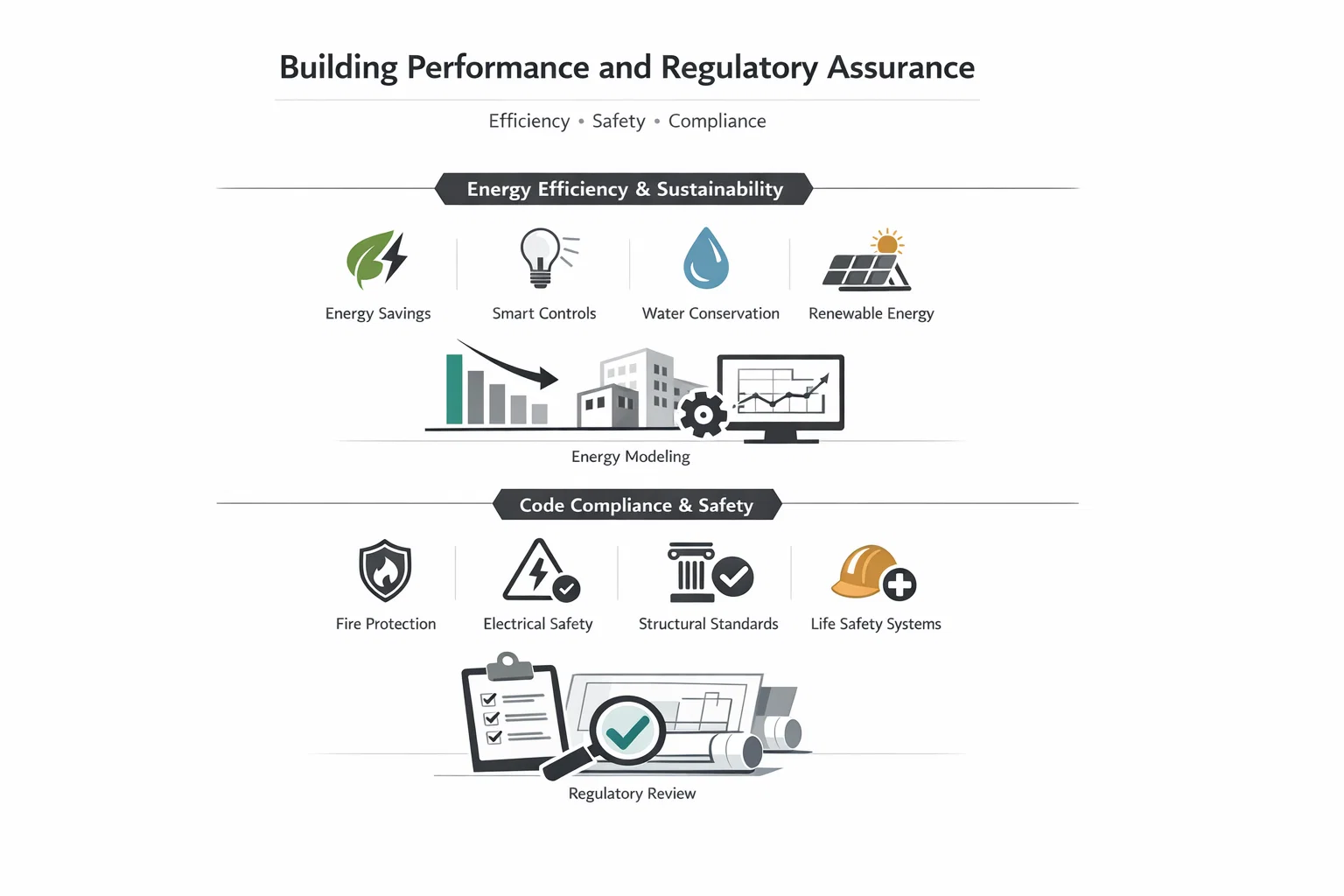
Building performance today is measured not only by how well a structure stands, but by how efficiently and safely it operates over time. Structural and MEP design support connects these priorities, balancing energy goals with strict regulatory requirements to ensure the building performs as intended from day one.
Eficiencia energética y sostenibilidad
Contemporary structural and MEP design support places strong emphasis on performance. Beyond ensuring that systems function correctly, engineers aim to reduce energy demand and improve long term efficiency.
Mechanical systems are selected and configured to minimize consumption while maintaining indoor comfort. Lighting and controls are designed to respond intelligently to occupancy and usage patterns. Plumbing systems are specified to conserve water. Renewable energy sources and automation platforms may be integrated where appropriate. Energy modeling is often used to evaluate projected performance before construction begins.
These measures contribute to lower operating costs and, in many cases, support sustainability certification goals. Crucially, design support ensures that these strategies are technically sound and realistically implementable.
Code Compliance and Safety
At the same time, every project must satisfy applicable building regulations. Requirements related to structural capacity, fire protection, electrical safety, and sanitation cannot be treated as secondary considerations.
Design support teams verify that structural assumptions align with governing standards, confirm fire resistance ratings and protection systems, ensure electrical distribution meets safety criteria, and review plumbing layouts for compliance. Life safety systems are coordinated to function as an integrated whole.
Addressing these issues during design reduces the likelihood of approval setbacks and limits exposure to future operational or legal risk.
Construction Oversight and Risk Control
Design responsibility does not end once drawings are issued. Structural and MEP support teams remain involved during construction to ensure that the approved design is implemented correctly and adapted where necessary.
During this phase, they review shop drawings, respond to contractor queries, adjust details based on site conditions, inspect installations, and support system testing and commissioning. Commissioning is particularly critical for MEP systems, as it confirms that HVAC systems are properly balanced, electrical networks operate as intended, and plumbing systems function safely. A solution that appears coordinated on paper must prove reliable in real conditions.
This continued involvement directly reduces project risk. Early identification of conflicts prevents urgent redesigns. Integrated planning helps avoid oversizing or undersizing systems. Clear, coordinated documentation minimizes uncertainty for contractors. The result is fewer change orders, reduced delays, controlled material use, and stronger compliance management.
Ultimately, structured oversight improves predictability, and predictability is essential for keeping projects on schedule and within budget.
Reflexiones finales
Structural and MEP design support is what turns a concept into something that can actually be built. It aligns structure with systems, resolves conflicts before they reach the site, and keeps projects grounded in technical reality. Without it, even strong architectural ideas can unravel during construction.
At its core, this support is about coordination and control. It protects budgets, reduces surprises, and improves performance over the long term. When structure and building systems are planned together, the result is not just a compliant building, but a predictable and efficient one.
PREGUNTAS FRECUENTES
1. What does structural and MEP design support actually include?
It includes structural analysis, system modeling, coordination between disciplines, clash detection, documentation, and often construction-phase assistance. The goal is to ensure that structural and building service systems are accurate, aligned, and ready for execution.
2. Why can’t structural and MEP systems be designed separately?
Because they physically intersect. Beams, ducts, pipes, cable trays, and equipment all compete for space. If they are developed independently, conflicts are almost guaranteed. Coordination prevents those issues before construction begins.
3. How does design support reduce project risk?
It identifies problems early, clarifies documentation, and aligns all disciplines before work starts on site. This reduces change orders, delays, rework, and budget overruns.
4. Is BIM required for effective structural and MEP support?
While not mandatory, BIM makes coordination significantly more efficient. It allows teams to visualize systems in 3D, detect clashes early, and manage updates in a shared digital environment.
5. Does design support end when drawings are issued?
No. In many projects, support continues through construction. Engineers review shop drawings, respond to field questions, and assist with system testing to ensure the built result matches the design intent.

¿Tiene un proyecto BIM? Hable con nosotros.
Contacte con nosotrosNuestros casos prácticos
Hemos gestionado más de 200 proyectos BIM y VDC para los sectores comercial, industrial y residencial.
Nuestro trabajo incluye:
Automatización del diseño de encofrados
Our client from
California, USA
Automatización del diseño de falsos techos
Our client from
New York, USA
Automatización del diseño del entramado de muros
Our client from
California, USA