¿Tiene alguna pregunta? Póngase en contacto con nosotros
¡Únete a nuestro equipo!
Solicitar presupuesto o consulta gratuita

Construction is the point where drawings stop being theoretical and start being tested by reality. Details that looked clean in coordination meetings suddenly meet tight voids, delivery delays, and subcontractor sequencing. RIBA Stage 5 is the construction phase, and it is often where BIM either proves its value or quietly falls apart.
RIBA Stage 5 BIM support is about keeping the information model accurate, coordinated, and usable while the building is physically taking shape. It is not a handover moment. It is an active management phase.
This article breaks down what Stage 5 BIM support actually involves, how it functions during live construction, and why it plays such a critical role in protecting both design intent and delivery performance.
What Changes at RIBA Stage 5
Earlier stages focus on developing and coordinating the design. By the time Stage 5 begins, the expectation is that the technical design is complete and ready to build. But construction introduces variables that no model can fully predict. Site conditions shift. Suppliers substitute materials. Sequencing constraints affect installation.
At this stage, BIM becomes an operational tool rather than a design platform. The model must respond to real time changes. Information has to move quickly between architect, contractor, engineers, and specialists. If the model freezes at Stage 4, it immediately starts drifting away from what is being built.
What Does “Support” Actually Mean in This Context?
The word support can sound vague. In the context of RIBA Stage 5 BIM, it does not mean passive oversight or occasional advice. It means structured, ongoing involvement during construction.
Support here is active. It is practical. It is tied directly to site progress and information control.
At Stage 5, BIM support typically includes:
- Continuous model updates as construction progresses.
- Coordination between contractor and design team models.
- Reviewing and resolving clashes triggered by site changes.
- Integrating approved variations into the federated model.
- Verifying fabrication and shop drawings against the design model.
- Maintaining drawing consistency across all disciplines.
- Developing accurate as built model data.
In simple terms, support means keeping the model aligned with reality. It ensures the digital information does not fall behind the physical build.
Without this structured involvement, BIM risks becoming static while the site continues to evolve. Stage 5 support prevents that gap from forming.
Core Functions of Stage 5 BIM Support
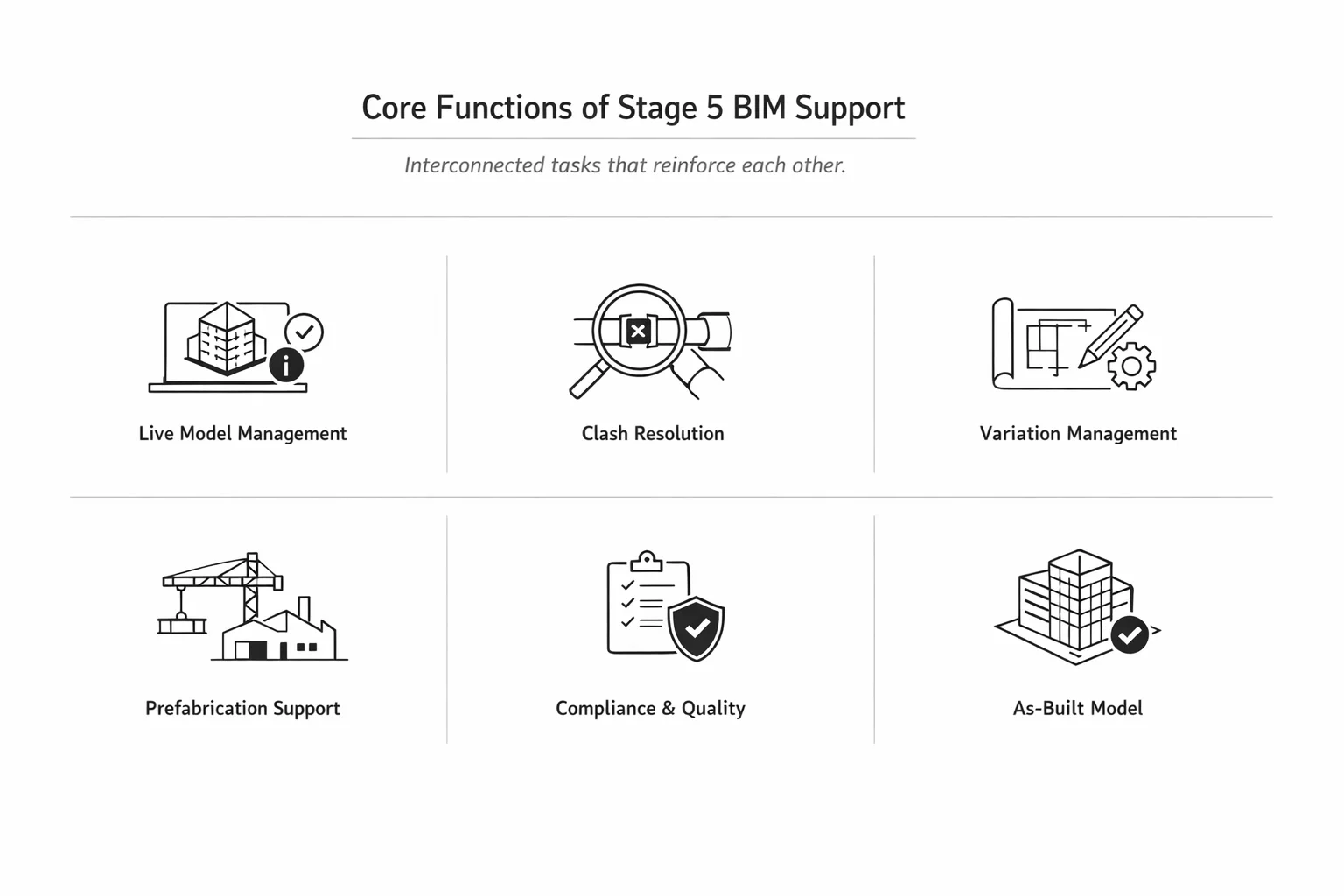
Stage 5 BIM support covers several interconnected areas. Rather than isolated tasks, these functions overlap and reinforce each other.
Live Model Management During Construction
Construction generates constant information. Requests for information, site instructions, and design clarifications all affect the model. Stage 5 BIM support manages this flow.
Model elements are updated when revisions are approved. Drawings and schedules are synchronized with the latest changes. Outdated information is removed from circulation. This reduces the risk of site teams building from superseded drawings, which is more common than most teams admit.
The model becomes a live reference point rather than a static design archive.
Ongoing Coordination and Clash Resolution
Clash detection does not end once technical design is complete. In fact, new conflicts often appear when subcontractors produce fabrication models or when tolerances are tested on site.
Stage 5 BIM coordination includes reviewing contractor models, checking installation zones, and running updated clash tests. It also involves validating prefabricated elements against actual site conditions.
Small spatial conflicts, such as bracket interference or service offsets, can escalate into schedule delays if left unresolved. Addressing them digitally before installation protects both time and cost.
Managing Variations and Design Adjustments
Construction rarely proceeds without change. Clients request refinements. Engineers adjust details. Regulatory requirements may evolve.
Stage 5 BIM support ensures that these variations are integrated properly. Revisions are logged. Model updates are coordinated across disciplines. Drawings reflect approved changes.
This controlled approach prevents fragmented documentation. It also makes cost assessment clearer, since quantity changes can be reviewed directly from the updated model.
Supporting Prefabrication and Fabrication
Modern projects increasingly rely on off site fabrication. Steel frames, rebar assemblies, facade panels, and MEP modules are often manufactured using model data.
Stage 5 BIM support checks that fabrication models align with the coordinated design. It verifies tolerances and ensures that design intent is preserved during production. Accurate geometry reduces waste and improves installation efficiency.
Without this layer of review, fabrication errors can translate into expensive on site modifications.
Compliance and Quality Oversight
Construction must comply with regulatory standards. Fire safety layouts, accessibility clearances, insulation performance, and structural details all require consistent verification.
BIM at Stage 5 supports this process by acting as a controlled information source. Updated layouts can be reviewed against approved design criteria. Changes can be checked for unintended regulatory impacts.
It is not a substitute for inspection, but it strengthens quality control by keeping information transparent and traceable.
Developing the As Built Model
By the end of construction, the building inevitably differs in small ways from the original design. Stage 5 BIM support records these changes.
Model geometry is adjusted to reflect site measurements. Final equipment specifications are incorporated. Contractor supplied data is integrated.
The result is an as-built model that reflects reality rather than aspiration. This is particularly important for long term asset management and facility operations.
How We Support RIBA Stage 5 in Practice at Powerkh

En Powerkh, we approach RIBA Stage 5 BIM support as a matter of design continuity. Construction is where intent is most vulnerable. Drawings get interpreted, interfaces get tightened, and site realities test earlier decisions. Our role is to stay close to that intent and help ensure that what was designed is what actually gets built.
We are an engineering-led digital construction consultancy working across the UK, US, and Europe. During Stage 5, our focus shifts toward coordination under pressure and reality-based verification. We review coordinated models before construction starts, identify high-risk interfaces such as plant rooms and risers, and support teams in resolving issues before they escalate on site. We also carry out deviation monitoring, comparing design intent with installed conditions using scan-based or other site data, so that real risks are visible early rather than discovered late.
Our support does not stop at coordination. We provide evidence-based progress verification and as-built verification to help teams close the gap between model and reality. That includes checking installed elements, validating key deviations, and supporting clean handover information. In simple terms, we help project teams maintain control of information during construction, so the model remains aligned with what is physically delivered.
The Practical Impact on Construction Teams
Stage 5 BIM support is not just a technical exercise. It shapes how the site actually functions day to day. When information is stable and coordinated, work flows more predictably.
In practical terms, it leads to:
- Subcontractors working with greater confidence because they are building from current information.
- Shorter, more focused coordination meetings.
- Fewer assumptions on site when revisions are clearly documented.
- Reduced friction between trades due to shared, aligned references.
- Faster resolution of site queries.
There is also a human side to this. Construction environments can become tense when drawings conflict or information feels unreliable. Clear and up to date models reduce that tension. They give teams something solid to rely on.
It may not look dramatic from the outside, but steady coordination quietly prevents the kind of crises that stretch budgets and disrupt programmes.
Why Stage 5 BIM Support Is Often Underestimated
Some teams assume that BIM work slows down once technical design is complete. In practice, the opposite can happen. Construction generates more information than earlier phases.
Another common misunderstanding is that contractors will manage all coordination independently. While contractors manage construction sequencing and logistics, cross discipline model alignment still requires structured oversight.
Underestimating Stage 5 BIM support often leads to fragmented updates, inconsistent documentation, and as built models that no longer match what was constructed.
It is easier to maintain model integrity throughout construction than to rebuild it at the end.
Conclusión
RIBA Stage 5 BIM support is about control during the most demanding phase of a project. It keeps the model aligned with what is being built, manages revisions, supports fabrication, and protects compliance. It bridges the gap between digital intent and physical delivery.
Construction places pressure on every decision made earlier in the project. Without active BIM management, that pressure exposes weaknesses in coordination and documentation. With structured Stage 5 support, the project moves forward with clearer communication and fewer surprises.
In simple terms, Stage 5 BIM support keeps the building and the model speaking the same language. And during construction, that clarity is not a luxury. It is essential.
PREGUNTAS FRECUENTES
1. Is BIM still important once construction has started?
Yes, and arguably even more than before. During construction, decisions move faster and mistakes cost more. BIM at Stage 5 keeps drawings, models, and site work aligned so teams are not building from outdated information.
2. Who is responsible for BIM during RIBA Stage 5?
It depends on the contract and project setup, but typically the contractor manages construction delivery while architects or specialist BIM consultants oversee model integrity and coordination. What matters most is that someone is clearly responsible for keeping the model current and coordinated.
3. Does Stage 5 BIM support mean redesigning the project?
No. At this point, the design should already be defined. Stage 5 BIM support is about managing changes, resolving clashes, and reflecting approved variations. It protects intent rather than rethinking it.
4. How does BIM help reduce construction risk?
By identifying spatial conflicts early, tracking revisions properly, and keeping documentation consistent. When information is controlled, there is less guesswork on site. That usually means fewer delays and less rework.
5. What happens if BIM is not maintained during construction?
The model quickly becomes unreliable. Drawings can contradict each other. As built data may be incomplete. Fixing that at the end of a project is far more difficult than maintaining it steadily throughout Stage 5.
6. Is Stage 5 BIM support only for large projects?
Not at all. While large commercial builds benefit greatly, smaller projects can also suffer from coordination gaps. Even a modest scheme can face costly issues if information is not managed properly during construction.

¿Tiene un proyecto BIM? Hable con nosotros.
Contacte con nosotrosNuestros casos prácticos
Hemos gestionado más de 200 proyectos BIM y VDC para los sectores comercial, industrial y residencial.
Nuestro trabajo incluye:
Automatización del diseño de encofrados
Our client from
California, USA
Automatización del diseño de falsos techos
Our client from
New York, USA
Automatización del diseño del entramado de muros
Our client from
California, USA