¿Tiene alguna pregunta? Póngase en contacto con nosotros
¡Únete a nuestro equipo!
Solicitar presupuesto o consulta gratuita

In many construction projects, design happens first and practical realities come later. That gap is where delays, cost overruns, and on-site improvisation tend to appear. Engineering-led design support flips that sequence. It brings technical expertise into the process from day one, so decisions are grounded in how the building will actually be built, not just how it looks on paper.
Instead of handing drawings to contractors and hoping everything aligns, engineers stay involved throughout planning, coordination, and execution. They test assumptions early, flag risks before they become expensive problems, and shape solutions that work in the real world. The result is a smoother path from concept to completion, with fewer surprises along the way.
Understanding the Concept in Plain Terms
At its core, engineering-led design support is a project delivery approach where technical engineering expertise drives the design and construction process from the outset. Engineers help define what is feasible before major decisions are locked in, which fundamentally changes how a project develops.
- Instead of: Design → Engineering checks → Construction
- You get: Engineering insight → Coordinated design→ Constructible solution → Controlled delivery
This approach often overlaps with integrated delivery models such as design-build or construction management, but it is not tied to any specific contract type. It is primarily about workflow and mindset rather than formal structure.
Key characteristics include:
- Engineers involved from the concept stage
- Designs developed with construction methods in mind
- Continuous coordination across disciplines
- Early identification of risks and constraints
- Data-driven decision making
- Accountability across both design and execution
In this model, engineering is not a support function. It becomes the backbone of the project.
Engineering-Led Design Support at Powerkh

Powerkh is a UK-based company with offices in the USA and Ukraine, delivering BIM, VDC, and engineering services that reflect a genuinely engineering-led approach to project support. We work alongside architects, engineers, contractors, and developers from early stages, helping turn concepts into coordinated, buildable solutions. Instead of treating modeling as a final step, we use it as a decision-making tool – identifying clashes, constructability issues, and system conflicts before they reach the site. This allows teams to move forward with confidence, knowing the design has been tested against real-world conditions.
Our expertise encompasses BIM modeling (LOD 100–500), BIM coordination, BIM content (Revit families), scan to BIM, BIM automation, prefabrication & fabrication, and comprehensive structural detailing, including steel, rebar, precast, and facade. By combining technical expertise with advanced digital tools, we help align architectural, structural, and MEP systems so they function as one coherent design rather than separate layers. The goal is straightforward: reduce uncertainty, minimize rework, and support smoother project delivery. Powerkh ensures that engineering-led design support is not just a theory, but a consistent, hands-on involvement that keeps projects on track from planning through construction.
Key Benefits of Engineering-Led Design Support
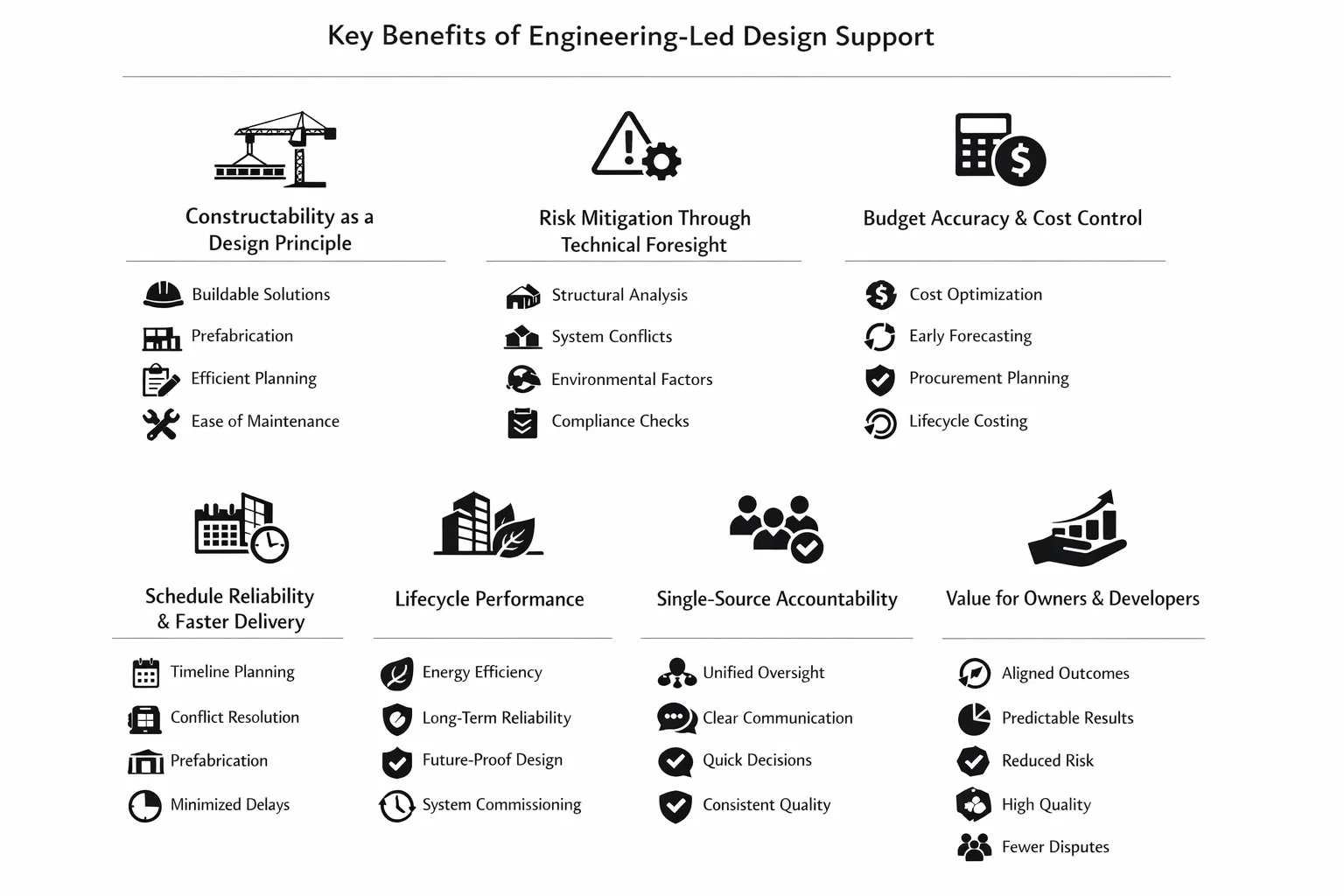
Engineering-led design support delivers value across every stage of a project, from early planning to long-term operation. By grounding decisions in technical reality rather than assumptions, this approach improves buildability, reduces uncertainty, and creates more predictable outcomes for owners and project teams.
1. Constructability as a Design Principle
One of the central ideas behind engineering-led design support is constructability – designing something that can be built efficiently, safely, and realistically under actual site conditions. Engineering-led teams bring practical field knowledge into the design process by considering material delivery and installation methods, access for different trades, long-term maintenance requirements, realistic tolerances and construction sequencing, and opportunities for prefabrication to improve quality. Addressing these factors early helps prevent redesign during construction, which can otherwise consume significant time and resources.
2. Risk Mitigation Through Technical Foresight
All construction projects carry risk, from environmental factors to coordination failures. Engineering-led support reduces exposure by identifying technical issues before they escalate.
Key Focus Areas:
- Structural vulnerabilities
- System conflicts
- Load assumptions
- Condiciones medioambientales
- Regulatory compliance risks
- Equipment compatibility
With modern modeling and simulation tools, engineers can analyze performance and scenarios in advance. This proactive approach is especially critical for complex facilities where failure is not acceptable.
3. Budget Accuracy and Cost Control
Cost overruns usually stem from many small issues rather than a single major error. Engineering-led design support improves financial control by addressing these factors early, optimizing material efficiency and system sizing, reducing late design changes, planning procurement strategies including long-lead items, and evaluating lifecycle costs alongside upfront expenses. As a result, budgets become more predictable and owners face fewer unexpected costs.
4. Schedule Reliability and Faster Delivery
Delays can have serious financial and operational consequences, which is why projects guided by engineering insight tend to maintain more reliable timelines by addressing key constraints in advance. Schedule improvements come from designing with construction sequencing in mind, resolving conflicts before work begins, planning procurement early, identifying opportunities for prefabrication, and minimizing downtime for existing operations. For renovations or occupied facilities, phased solutions can allow work to proceed without shutting down critical systems.
5. Lifecycle Performance Beyond Construction
Engineering-led support considers how a building will function over decades, not just how it will be built. This long-term perspective addresses energy efficiency and sustainability, operational reliability, maintainability and access, compatibility with future technologies, and safety over extended use. Commissioning and performance verification often ensure that systems operate as intended before handover, reducing post-occupancy issues.
6. Single-Source Accountability
Fragmented responsibilities often lead to disputes when problems arise, while engineering-led delivery typically consolidates oversight within one entity or a tightly integrated team. This structure creates clear communication channels, enables faster decision making, maintains consistent quality standards, reduces disputes, and builds greater trust among stakeholders. With shared responsibility for both design and execution, issues are resolved collaboratively rather than assigned blame.
7. Value for Owners and Developers
For owners, the primary advantage is confidence in the outcome. Engineering-led design support aligns technical decisions with project goals from the start.
Key Gains Include:
- Alignment between design intent and final result
- Predictable cost and schedule performance
- Reduced risk exposure
- Improved quality and reliability
- Fewer change orders and disputes
- A smoother transition from concept to operation
The ultimate objective is not simply completing construction, but delivering a facility that performs as expected from the first day of use.
From Fragmented Delivery to Engineering-Led Collaboration
Traditional project delivery often separates design, engineering, and construction into distinct phases. Engineering-led design support reshapes this structure by bringing technical expertise forward and encouraging continuous collaboration. The result is fewer surprises during construction and better alignment between intent and execution.
Why Traditional Processes Fall Short
Many projects still follow a fragmented design-bid-build path in which responsibilities pass sequentially from one party to another:
| Architect-led design → Engineering review → Contractor pricing → Construction-stage issues |
Each transition introduces uncertainty. Design teams may not fully account for site realities, contractors may interpret documents differently, and late changes quickly become expensive. Risk accumulates silently until it surfaces in the field during execution.
Typical consequences include on-site rework, change orders, schedule delays, budget overruns, reduced design quality, and safety concerns. Because these outcomes occur so frequently, they are often treated as unavoidable. Engineering-led support challenges that assumption by resolving technical and coordination issues before construction begins.
The Role of Engineers at the Front End
The most significant change happens early, before designs are finalized. When engineers participate from the outset, they can assess whether a concept is realistic, buildable, and economically sound, while suggesting alternatives that reduce risk without compromising intent.
Early input commonly addresses:
- Structural systems and material selection
- Integration of building systems
- Site constraints and logistics
- Code compliance strategies
- Prefabrication opportunities
- Energy performance considerations
- Long-lead equipment requirements
Decisions such as choosing a structural system affect far more than calculations. They influence foundations, sequencing, procurement timelines, and overall cost. Addressing these factors early helps prevent downstream disruptions and improves budget and schedule reliability.
The Power of Integrated Teams
Engineering-led design support also relies on breaking down communication barriers. Instead of isolated disciplines working sequentially, the project team functions as a coordinated unit that may include engineers, architects, contractors, fabricators, owners and operators, and specialty consultants. Information moves continuously rather than through formal handoffs, and decisions are made collaboratively. This integrated environment reduces misunderstandings, accelerates problem solving, and strengthens accountability, since all participants share responsibility for the outcome.
Technology as an Enabler, Not the Goal
Advanced digital tools play a major role in engineering-led design support, especially in BIM-driven workflows, but the technology itself is not the point – what matters is how it is used.
Modern engineering teams rely on virtual environments to test, coordinate, and optimize designs through 3D modeling of structures and systems, performance simulations, energy analysis, clash detection between disciplines, quantity takeoffs, construction sequencing models, and digital fabrication data.
In MEP coordination, intelligent models can simulate airflow, electrical loads, or plumbing performance, allowing conflicts between systems to be identified long before installation begins. The value lies not just in visual clarity, but in the actionable insight that leads to better decisions.
Where Engineering-Led Design Support Creates the Greatest Impact
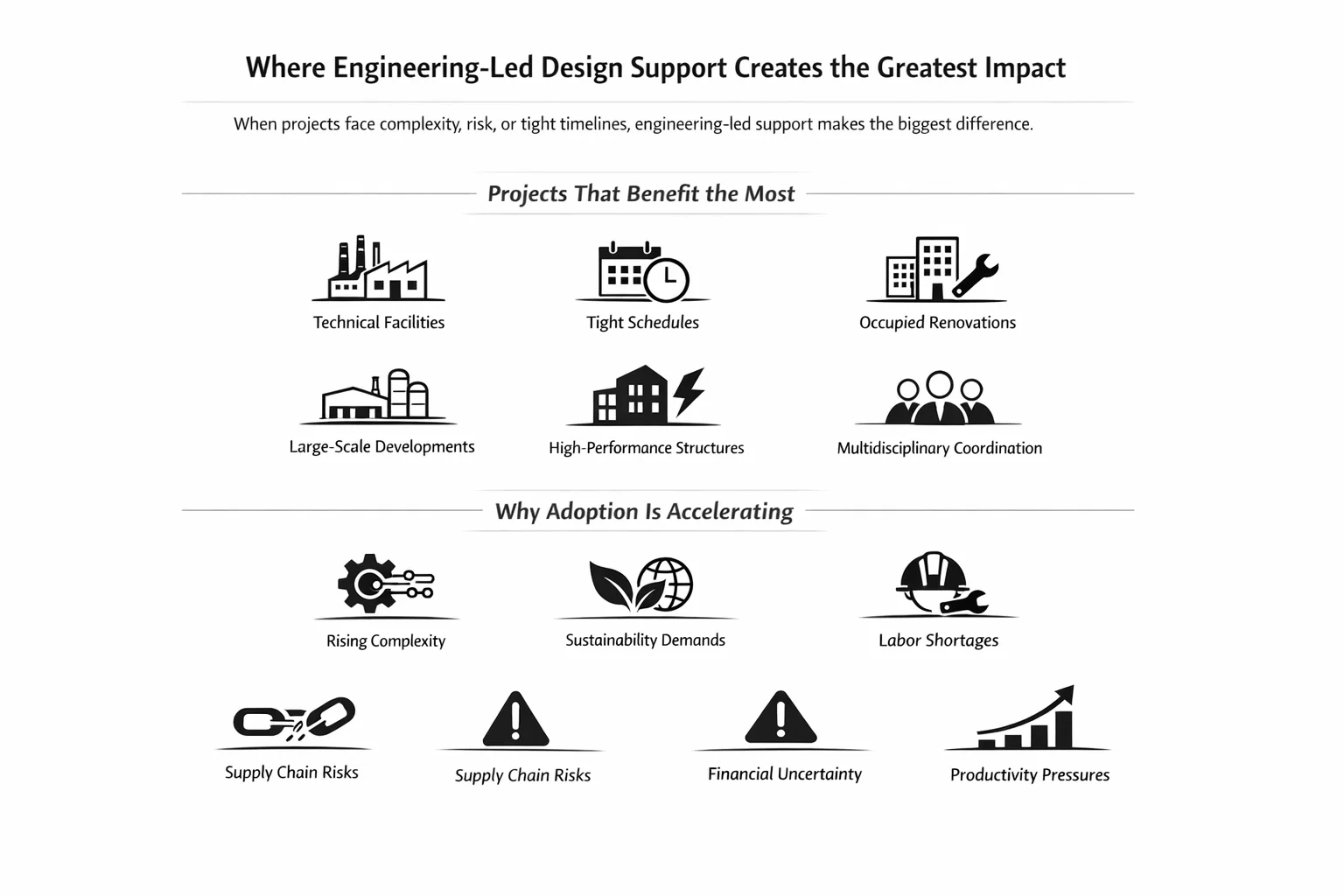
While not every project requires a fully engineering-led approach, its advantages become most apparent when complexity, risk, or time pressure increase. As construction projects grow more demanding and unpredictable, many teams are turning to this model to maintain control over outcomes.
Projects That Benefit the Most
Engineering-led design support is especially valuable on projects where coordination is complex and mistakes are costly. This includes complex technical facilities, tight schedules, renovations in occupied buildings, large-scale industrial developments, high-performance or energy-intensive structures, and projects requiring extensive multidisciplinary coordination. In these situations, the margin for error is small, and resolving issues late can have serious financial or operational consequences.
Why Adoption Is Accelerating
Engineering-led delivery is gaining traction as traditional fragmented processes become harder to manage. This shift is driven by increasing building complexity, rapid technological change, growing demand for sustainability and efficiency, labor shortages and productivity constraints, supply chain instability, and higher financial risks. As these pressures intensify, integrated, engineering-driven approaches offer a practical way to reduce uncertainty and keep projects on track.
Reflexiones finales
Engineering-led design support changes the role of engineering from a checkpoint to a guiding force. Instead of fixing problems after they appear, teams prevent them by making technically sound decisions early. That shift leads to designs that can actually be built as intended, with fewer surprises during construction and fewer compromises along the way.
It does not make projects simple, but it makes them controllable. Budgets become more predictable, schedules more realistic, and outcomes closer to what was originally planned. In a field where uncertainty is often treated as normal, engineering-led support offers a more disciplined and reliable path from concept to operation.
PREGUNTAS FRECUENTES
1. What is engineering-led design support in simple terms?
It means engineers are involved from the start and help shape the design so it is practical, buildable, and technically sound, not just visually appealing on paper.
2. How is it different from traditional project delivery?
Traditional delivery separates design, engineering, and construction into stages. Engineering-led support integrates them early, so constraints and risks are addressed before construction begins.
3. Does this approach replace architects or contractors?
No. It strengthens collaboration. Architects focus on design intent, contractors on execution, while engineers ensure the solution works technically and can be delivered without major issues.
4. Is it only useful for large or complex projects?
It is most valuable when complexity or risk is high, but any project can benefit from early technical clarity, especially when budgets or timelines are tight.
5. Does it increase project cost?
Upfront design effort may be higher, but total project cost is often lower because fewer changes, delays, and errors occur during construction.
6. Why is it becoming more common?
Buildings are more complex, timelines are tighter, and mistakes are more expensive. Engineering-led delivery helps teams manage that complexity with fewer surprises and better control.

¿Tiene un proyecto BIM? Hable con nosotros.
Contacte con nosotrosNuestros casos prácticos
Hemos gestionado más de 200 proyectos BIM y VDC para los sectores comercial, industrial y residencial.
Nuestro trabajo incluye:
Automatización del diseño de encofrados
Our client from
California, USA
Automatización del diseño de falsos techos
Our client from
New York, USA
Automatización del diseño del entramado de muros
Our client from
California, USA