¿Tiene alguna pregunta? Póngase en contacto con nosotros
¡Únete a nuestro equipo!
Solicitar presupuesto o consulta gratuita

Dewatering in construction is the process of removing groundwater and surface water from excavation sites to create dry, stable working conditions. This essential technique uses pumps, wells, and drainage systems to lower water tables, prevent flooding, and ensure safe construction. Multiple methods exist including wellpoints, deep wells, and sump pumping, each suited to different soil conditions and project requirements.
Walk onto any major construction site where excavation goes below the natural water table, and there’s a good chance dewatering operations are in full swing. The sound of pumps, the sight of discharge pipes, and the careful monitoring of water levels—these aren’t optional extras. They’re fundamental to keeping workers safe and projects on schedule.
But what exactly is dewatering? And why does it matter so much?
Dewatering is the systematic removal of groundwater and surface water from a construction site using pumps, wells, and drainage systems. It creates the dry, stable conditions necessary for safe excavation and foundation work. Without proper dewatering, construction sites face flooding, soil instability, and significant safety hazards.
Why Dewatering Is Essential in Construction
Groundwater doesn’t wait for permission to enter an excavation. The moment digging exposes soil below the water table, water begins seeping—or rushing—into the work area.
Here’s what happens without proper dewatering:
- Excavations flood, halting all work
- Soil becomes unstable and loses bearing capacity
- Trench walls collapse, creating severe safety hazards
- Foundation pours become contaminated with water
- Equipment gets damaged or stuck in saturated soil
- Project timelines extend, costs escalate
The U.S. Geological Survey documented dewatering applications in major infrastructure projects, including the Tennessee-Tombigbee Waterway in Mississippi, where engineers needed to dewater as much as 46 meters of an unconfined aquifer. Traditional methods had limitations with partially penetrating trenches and anisotropic aquifer conditions.
Dewatering solves these problems by lowering the water table below the excavation depth, maintaining dry conditions throughout construction. The process also stabilizes surrounding soil, preventing settlement of adjacent structures.
How Construction Dewatering Works
The fundamental principle behind dewatering is straightforward: remove water faster than it enters the excavation.
Natural evaporation helps with surface water, but it’s nowhere near sufficient for most construction sites. Dewatering systems use pumps with large air-handling capacity to remove both groundwater seeping through soil and surface water from precipitation.
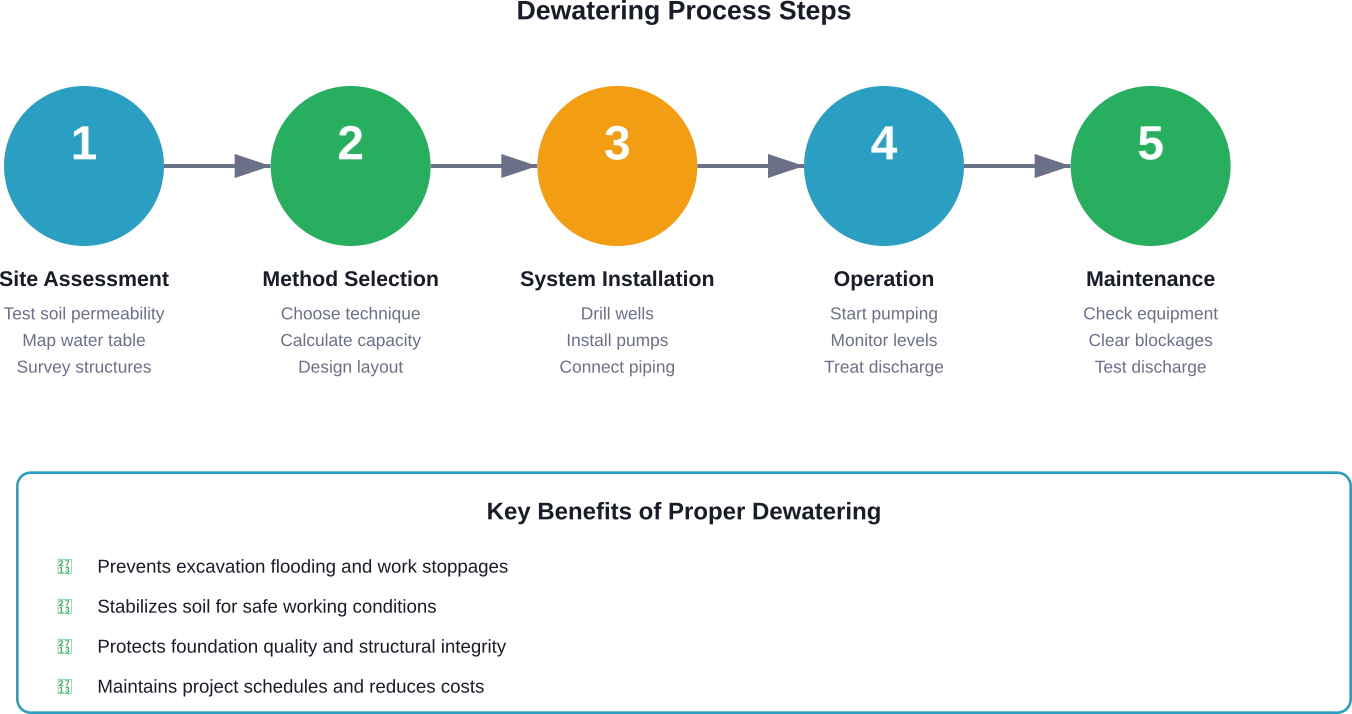
The process typically involves several key steps:
First, engineers assess site conditions. Soil type, groundwater levels, excavation depth, and proximity to existing structures all influence the dewatering approach. Sandy soils drain differently than clay. Shallow excavations need different solutions than deep basement digs.
Next comes system installation. Depending on the method selected, this might mean drilling wells, installing wellpoints around the excavation perimeter, or setting up sump pits at low points.
Then pumping begins. Submersible pumps, vacuum pumps, or centrifugal pumps move water from the ground to discharge points. Discharge locations must comply with local regulations—water can’t just flow anywhere.
Throughout construction, monitoring continues. Water levels need constant checking to ensure the system maintains adequate drawdown. The Environmental Protection Agency requires turbidity benchmark monitoring for construction dewatering under the Construction General Permit to control sediment in discharged water.
Use Powerkh for BIM Modeling and Coordination

If your team needs help with models, detailing, and project coordination, Powerkh offers technical BIM support that fits that part of the job. The company provides BIM and VDC services for construction teams, including BIM modeling, BIM coordination, scan to BIM, structural detailing, prefabrication support, and BIM automation. That gives teams a way to improve project information before it turns into field problems.
Need More Accurate BIM Support for the Project?
Talk with Powerkh to:
- create coordinated BIM models from project data
- identify clashes before they affect construction
- prepare detailed drawings for shop and fabrication work
👉 Contact Powerkh to review your project and BIM needs.
Major Dewatering Methods for Construction Sites
No single dewatering method works for every situation. Engineers select techniques based on soil conditions, excavation depth, water inflow rates, and project constraints.
Sump Pumping
The simplest approach. Contractors dig sumps (collection pits) at the lowest points of the excavation, allowing water to collect by gravity. Pumps then remove the accumulated water.
Sump pumping works well for shallow excavations in low-permeability soils where water inflow is manageable. It’s cost-effective and requires minimal equipment.
The downside? Sump pumping doesn’t lower the water table. It only removes water after it enters the excavation. In high-permeability soils or deep excavations, water enters too quickly for sumps to handle effectively.
Wellpoint Systems
This method uses a series of closely spaced small-diameter wells (wellpoints) installed around the excavation perimeter. The wellpoints connect via header pipes to vacuum pumps that create suction, drawing groundwater before it reaches the excavation.
Wellpoint dewatering effectively lowers the water table in sandy soils and silts. The typical drawdown limit is about 5 to 6 meters from a single-stage system. For deeper excavations, contractors install multi-stage systems with wellpoints at progressively lower elevations.
Installation is relatively quick. Wellpoints are typically 25-50mm in diameter, spaced 1-3 meters apart depending on soil permeability.
Deep Well Systems
When excavations extend beyond wellpoint capabilities, deep well systems take over. These use larger diameter wells (150-300mm) drilled to significant depths, each equipped with a submersible pump.
Deep wells can achieve drawdowns of 30 meters or more, making them suitable for basement construction, underground parking structures, and major infrastructure projects. Each well operates independently with its own pump, providing system redundancy.
The method works in most soil types, including low-permeability formations where wellpoints struggle. Well spacing typically ranges from 6 to 30 meters, depending on aquifer characteristics.
Installation costs are higher than wellpoints, but deep wells offer greater drawdown capacity and flexibility.
Eductor Systems
Eductors use high-pressure water to create a venturi effect, pulling groundwater from wells without mechanical pumps downhole. The system requires a high-pressure water supply and works well in fine sands and silts where wellpoints might clog.
This method handles water with high sediment content effectively. It’s particularly useful when flammable gases might be present, since eductors have no electrical components in the wells.
Selecting the Right Dewatering Method
Every construction site is different. Soil testing reveals permeability, which determines how quickly water moves through the ground. High permeability means faster water movement and potentially higher pumping requirements.
Excavation depth directly influences method selection. Shallow digs might need only sump pumping. Medium depths suit wellpoint systems. Deep excavations require deep wells or multi-stage approaches.
Adjacent structures matter too. Dewatering lowers the water table not just at the excavation but in surrounding areas. This can cause settlement of nearby buildings if not managed properly. Recharge wells sometimes pump water back into the ground beyond the excavation to maintain water levels under existing structures.
| Method | Best Soil Types | Typical Depth Limit | Relative Cost
|
|---|---|---|---|
| Sump Pumping | Low permeability clays | Shallow (0-3m) | Low |
| Wellpoint System | Sands, silts | 5-6m single stage | Moderate |
| Deep Wells | Most soil types | 30m+ | High |
| Eductor System | Fine sands, silts | 15-20m | Moderate-High |
Environmental and Regulatory Considerations
Dewatering isn’t just about removing water—it’s about doing so responsibly. Discharged water often contains sediment, and regulations strictly control where and how it can be released.
The EPA’s Construction General Permit covers stormwater discharges from construction sites, including dewatering operations. According to EPA guidance published in 2022, operators must conduct turbidity benchmark monitoring for dewatering discharges to control sediment levels.
The EPA requires specific monitoring and inspection protocols for construction dewatering to ensure compliance. Discharge water typically needs treatment to remove suspended solids before release to surface waters, storm drains, or sanitary sewers.
Treatment methods include:
- Sediment basins that allow particles to settle
- Filter bags that trap sediment while passing water
- Geotextile dewatering tubes for high-sediment applications
- Chemical treatment for fine particles
According to research from North Carolina State University, geotextile tubes have gained popularity as sludge dewatering alternatives. These high-strength permeable fabrics allow water to escape while retaining solids, and they resist biological, chemical, and UV degradation.
Local permits often impose additional requirements beyond federal regulations. Some jurisdictions require discharge to sanitary sewers rather than storm drains. Others mandate specific pH ranges, flow rates, or pollutant limits.
Calculating Dewatering Requirements
How much water will pumps need to move? That depends on several factors.
Soil permeability is the primary driver. Laboratory testing or field pump tests determine how quickly water flows through the formation. Engineers use this data with excavation dimensions and desired drawdown to calculate required pumping capacity.
The basic calculation considers:
- Excavation area and depth
- Soil hydraulic conductivity (permeability)
- Hydraulic gradient (water table slope)
- Required drawdown depth
- Safety factor for equipment redundancy
Complex projects often require computer modeling to predict water table response and optimize well placement. The ASCE’s Underground Construction Engineering Technical Committee has documented lessons learned from deep excavation techniques in complex urban environments, highlighting the importance of proper analysis.
Pump capacity needs a safety margin. If calculations suggest 500 liters per minute, actual pump capacity should be 750-1000 liters per minute to handle variations and provide backup.
Common Dewatering Challenges and Solutions
Real talk: dewatering rarely goes exactly as planned. Here’s what actually happens on job sites.
Higher Than Expected Water Inflow
Soil boring logs provide estimates, but underground conditions vary. A gravel seam that wasn’t detected during testing can dramatically increase water inflow.
The solution? Have backup pump capacity ready. Many contractors install 150% of calculated capacity to handle surprises.
Wellpoint Clogging
Fine particles and iron bacteria can clog wellpoint screens, reducing effectiveness over time. Regular maintenance and periodic redevelopment of wellpoints keeps them flowing.
In severe cases, switching to eductor systems provides better resistance to clogging.
Settlement of Adjacent Structures
When dewatering lowers the water table under existing buildings, soil consolidation can cause settlement and structural damage.
Monitoring programs track settlement of nearby structures. If movement exceeds thresholds, recharge wells can inject water back into the ground to support water levels beyond the excavation zone.
Discharge Permit Violations
Sediment levels exceeding permit limits shut down operations. Treatment systems need proper sizing from the start, not after violations occur.
According to ASCE presentations on excavation systems, water control challenges require careful planning and often sustainability-focused design solutions to meet modern environmental requirements.
Benefits Beyond Dry Excavations
Effective dewatering delivers advantages that extend beyond simply keeping the hole dry.
- Worker Safety: Dry excavations are safe excavations. Standing water creates slip hazards, obscures tripping dangers, and increases risk of trench collapse. Dewatering eliminates these hazards.
- Improved Soil Bearing Capacity: Water-saturated soil is weak. Remove the water, and the same soil can support significantly higher loads. Foundation elements placed in dewatered excavations rest on firm, stable ground.
- Quality Control: Concrete poured underwater or in wet conditions suffers reduced strength and durability. Proper dewatering ensures clean, dry placement conditions and superior concrete quality.
- Schedule Adherence: Flooded excavations halt work. Crews stand idle. Equipment sits unused. Dewatering keeps projects moving forward on schedule, avoiding costly delays.
- Ahorro de costes: While dewatering systems represent an upfront investment, they prevent expensive problems. Removing water proactively costs far less than dealing with collapsed trenches, contaminated concrete, or extended schedules.
Dewatering Success Requires Planning
Construction dewatering isn’t an afterthought to address when water appears in the excavation. Successful projects incorporate dewatering planning early in design.
Soil investigation provides the foundation for good dewatering design. Borings should extend below planned excavation depths to characterize groundwater conditions accurately. Permeability testing reveals how water moves through the formation. Groundwater level monitoring tracks seasonal variations.
Method selection follows from site data. Soil type, excavation depth, and proximity to existing structures guide the choice between wellpoints, deep wells, or other techniques. Complex sites might use combinations of methods.
Environmental compliance requires attention from the start. Understanding discharge regulations and treatment requirements prevents violations and project shutdowns.
Monitoring throughout construction ensures the system performs as designed. Water levels, pump operation, discharge quality, and adjacent structure movement all need regular checking.
When dewatering works correctly, it’s almost invisible. The excavation stays dry, work proceeds safely and efficiently, and water discharges legally. That’s the goal.
But achieving that goal requires expertise, proper equipment, and attention to detail. Cutting corners on dewatering creates problems that cost far more than doing it right from the beginning.
For contractors and engineers planning excavation projects, investing in proper dewatering design and implementation pays dividends in safety, quality, and schedule performance. The alternative—discovering inadequate water control after excavation begins—leads nowhere good.
Understanding what dewatering is and how to implement it effectively separates successful construction projects from troubled ones. The water will always be there. The question is whether it’s controlled or controlling the project.
Frequently Asked Questions About Construction Dewatering
How long does dewatering take before excavation can begin?
The time required to lower the water table depends on soil permeability and the amount of drawdown needed. In sandy soils, wellpoint systems might achieve adequate drawdown within 24-48 hours. Low-permeability clays can take several days or even weeks to dewater effectively. Deep well systems in major projects often begin pumping weeks before excavation starts.
Can dewatering damage nearby buildings?
Yes, if not properly managed. Lowering the water table beneath existing structures can cause soil consolidation and settlement, potentially damaging foundations and causing cracks. Monitoring programs track movement of adjacent buildings, and recharge wells can maintain water levels beyond the construction zone when necessary to protect nearby structures.
What happens to the water removed during dewatering?
Discharged water must comply with environmental regulations. After treatment to remove sediment and other pollutants, water typically discharges to storm drains, sanitary sewers, or surface waters under permit requirements. Some sites use retention basins where water settles before discharge. Local regulations determine acceptable discharge locations and required treatment levels.
Is dewatering required for all excavations?
Not necessarily. Shallow excavations above the water table don’t require groundwater dewatering, though surface water management might still be needed. Once excavation depth extends below the seasonal high water table, dewatering becomes necessary. The depth at which this occurs varies by location and soil conditions.
How much does construction dewatering cost?
Costs vary widely based on method, duration, and site conditions. Sump pumping for shallow excavations might cost a few thousand dollars. Complex deep well systems for major projects can exceed hundreds of thousands of dollars. Factors affecting cost include pump rental or purchase, installation labor, power consumption, discharge treatment, monitoring, and maintenance over the project duration.
What permits are needed for dewatering?
Most construction dewatering operations require discharge permits under the Clean Water Act. The EPA’s Construction General Permit covers many sites, though individual states often administer their own programs. Local municipalities may impose additional requirements for discharges to their storm drain or sewer systems. Permit applications should begin early in project planning to avoid delays.
Can dewatering continue during winter in cold climates?
Yes, but it requires additional precautions. Discharge pipes need insulation or heat tracing to prevent freezing. Pump equipment may require heated enclosures. Ice accumulation at discharge points creates hazards and drainage problems. Many contractors use glycol-based antifreeze solutions in exposed piping, though discharge water itself typically remains above freezing due to groundwater temperatures.

¿Tiene un proyecto BIM? Hable con nosotros.
Contacte con nosotrosNuestros casos prácticos
Hemos gestionado más de 200 proyectos BIM y VDC para los sectores comercial, industrial y residencial.
Nuestro trabajo incluye:
Automatización del diseño de encofrados
Our client from
California, USA
Automatización del diseño de falsos techos
Our client from
New York, USA
Automatización del diseño del entramado de muros
Our client from
California, USA