¿Tiene alguna pregunta? Póngase en contacto con nosotros
¡Únete a nuestro equipo!
Solicitar presupuesto o consulta gratuita

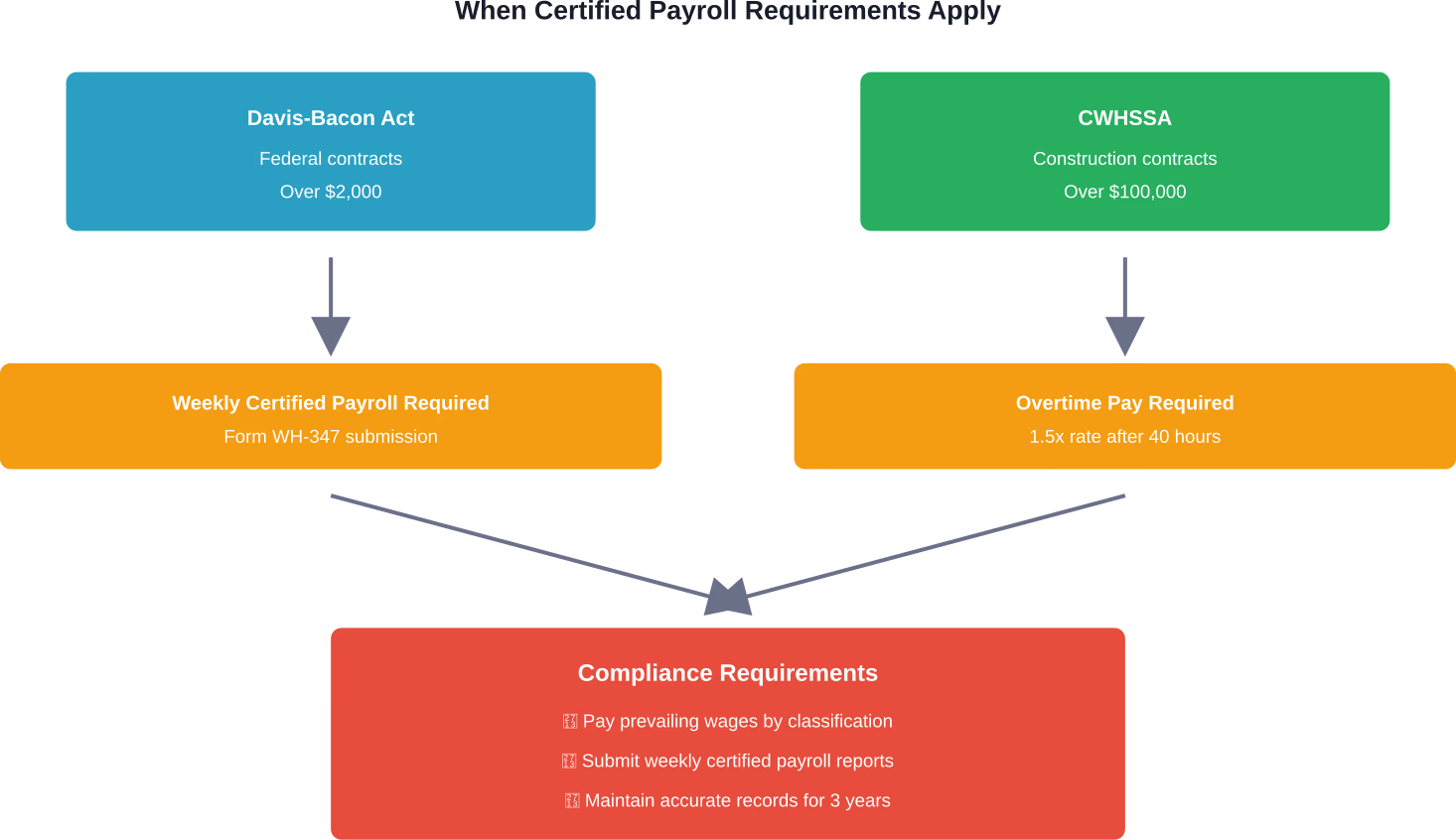
Certified payroll is a mandatory weekly reporting requirement for contractors and subcontractors working on federally-funded construction projects over $2,000. It verifies compliance with the Davis-Bacon Act by documenting that workers receive prevailing wages. Contractors submit Form WH-347 to prove proper payment of laborers and mechanics on government construction contracts.
Construction contractors working on government-funded projects face a unique compliance requirement that doesn’t apply to private work. It’s called certified payroll, and getting it wrong can result in penalties, contract disputes, or even being barred from future federal projects.
But what exactly is certified payroll? Why does the government require it? And how do construction companies stay compliant without drowning in paperwork?
This guide breaks down everything contractors and subcontractors need to know about certified payroll reporting in construction.
Understanding Certified Payroll
Certified payroll is a special weekly payroll report that contractors submit to prove they’re paying workers the legally required prevailing wage rates on federally-funded construction projects. The requirement comes from the Davis-Bacon and Related Acts, which protect construction workers on government contracts.
Unlike standard payroll, certified payroll includes specific worker information, detailed hours worked, wage classifications, and a signed statement of compliance. Contractors must submit these reports weekly to the contracting agency or project owner.
The reports use a standardized format — typically Form WH-347 — provided by the U.S. Department of Labor. Properly completed certified payroll forms satisfy the requirements outlined in parts 3 and 5 of Title 29 of the Code of Federal Regulations.
Who Needs to File Certified Payroll?
According to the Department of Labor, certified payroll applies to contractors and subcontractors working on:
- Federal government or District of Columbia contracts exceeding $2,000
- Construction, alteration, or repair projects (including painting and decorating)
- Public buildings or public works projects
- Projects financed wholly or partially by federal loans or grants
Every contractor and subcontractor engaged on a covered project must submit certified payroll. This includes prime contractors, first-tier subcontractors, and lower-tier subcontractors.
The Davis-Bacon Act and Related Laws
The Davis-Bacon Act is the federal law that established the certified payroll requirement. Passed in 1931, it requires payment of prevailing wages on federally funded or assisted construction projects.
Here’s the thing though — Davis-Bacon doesn’t stand alone. Approximately eighty federal statutes incorporate Davis-Bacon prevailing wage requirements. These are collectively called Davis-Bacon and Related Acts (DBRA).
The Department of Labor’s Wage and Hour Division administers DBRA and determines prevailing wage rates for various construction job classifications in different geographic areas. These wage determinations specify the minimum wages contractors must pay for each classification.
Contract Work Hours and Safety Standards Act
Construction contracts also fall under the Contract Work Hours and Safety Standards Act (CWHSSA) when the contract value exceeds $100,000 or $150,000 for prime contracts covered under the DBA that are subject to the Federal Acquisition Regulations. CWHSSA requires overtime pay at one and one-half times the basic rate for hours worked beyond 40 in a workweek.
For contracts subject to CWHSSA, certified payroll reports must clearly distinguish between straight time and overtime hours. This is tracked on Form WH-347 where contractors enter hours in designated ST (straight time) and OT (overtime) boxes.
What's Included on Certified Payroll Reports
Certified payroll reports contain significantly more detail than standard payroll documents. Each weekly report must include specific information for every laborer and mechanic who performed work on the covered project.
Form WH-347 requires the following information:
| Information Category | Required Details
|
|---|---|
| Worker Information | Name, address, Social Security number, work classification |
| Hours Worked | Daily hours by date, straight time vs. overtime breakdown |
| Wage Rates | Hourly rate, overtime rate, fringe benefits |
| Gross Earnings | Total straight time earnings, overtime earnings |
| Deductions | All deductions itemized with purpose and amount |
| Net Pay | Total wages paid after deductions |
Worker Classifications Matter
Proper classification is critical. The Davis-Bacon Act requires workers to receive the prevailing wage rate for their specific job classification in that geographic area. Misclassifying a worker — even unintentionally — can result in underpayment violations.
The Department of Labor publishes wage determinations that list prevailing wage rates for various construction trades and classifications. Contractors must identify which classification applies to each worker and pay accordingly.
Who Must Appear on the Reports
Certified payroll reports must include:
- Any owner or partner performing construction work on the project
- Trade journeymen, apprentices, and trainees
- Working foremen or supervisors performing construction work
- Watchmen, guards, and traffic control personnel on the project site
Administrative staff, managers who don’t perform construction work, and delivery drivers who merely drop off materials typically don’t need to appear on certified payroll.
Form WH-347: The Standard Certified Payroll Form
Form WH-347 is the Department of Labor’s official form for certified payroll reporting. While contractors aren’t required to use this exact form, any alternative must contain all the same information and meet the same certification requirements.
The form has two main sections. The first section contains a grid where contractors enter detailed payroll information for each worker. The second section is the compliance statement that an authorized representative must sign.
The Certification Statement
Here’s what makes certified payroll different from regular payroll: the signed certification statement. This statement declares under penalty of perjury that the information is accurate and that workers received the required wages.
The statement of compliance certifies that:
- The payroll information is correct and complete
- Workers received the wages shown and were paid prevailing rates
- No deductions were made except those shown
- Records supporting the payroll will be maintained and made available for inspection
This certification carries legal weight. False certification can result in criminal prosecution, contract termination, and debarment from future government contracts.
State and Local Prevailing Wage Laws
Federal Davis-Bacon requirements aren’t the only prevailing wage laws contractors need to worry about. Many states and municipalities have their own prevailing wage statutes that apply to state-funded or locally-funded construction projects.
State prevailing wage laws often mirror Davis-Bacon but may have different thresholds, reporting requirements, and wage determinations. Some states require electronic submission of certified payroll through specific online portals.
Contractors working on projects with multiple funding sources may need to comply with both federal and state prevailing wage requirements. When requirements conflict, contractors must meet the more stringent standard.
How to Complete and Submit Certified Payroll
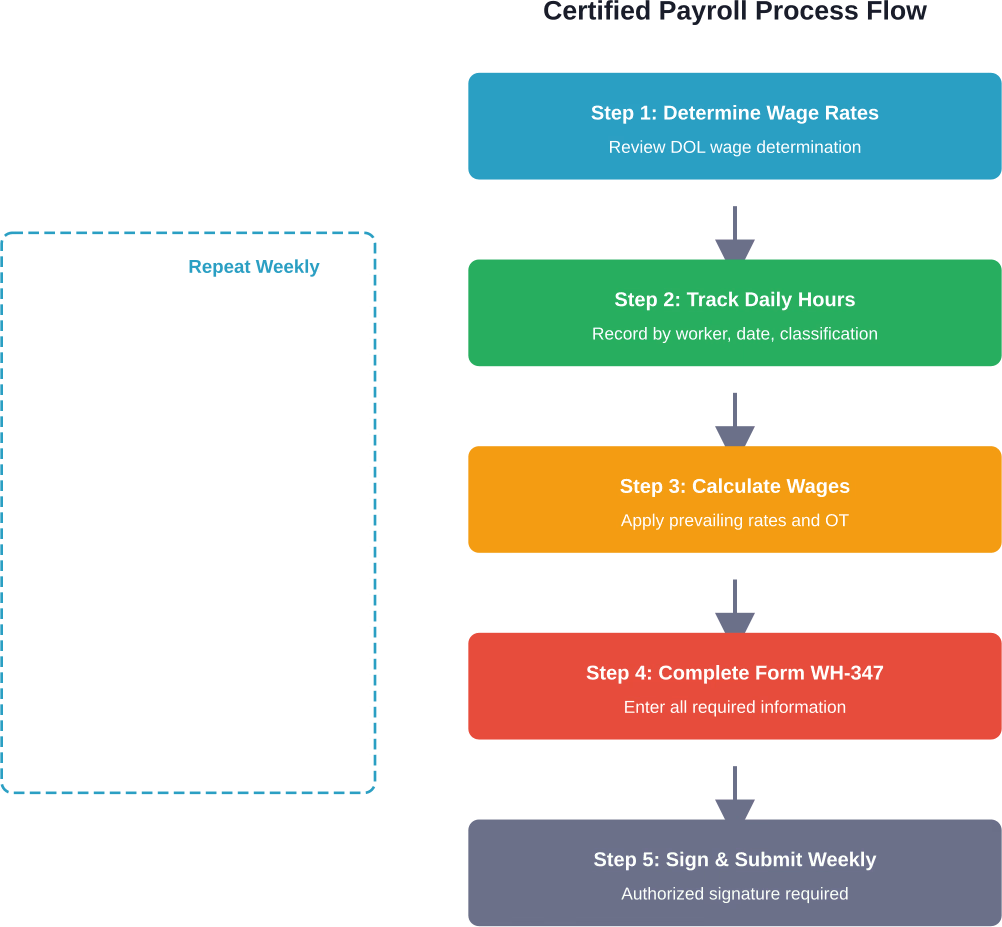
Completing certified payroll correctly requires attention to detail and consistency. Even minor errors or omissions can trigger compliance issues.
Weekly Submission Deadlines
Certified payroll reports must be submitted weekly. Each report covers a single payroll period (typically one week) and is due to the contracting agency within seven days of the end of that pay period.
Late submission can delay project payments. Many federal contracts include clauses allowing the government to withhold payment until contractors provide all required certified payroll documentation.
Common Mistakes to Avoid
The most frequent certified payroll errors include:
- Incorrect worker classifications leading to wage underpayment
- Missing or incomplete worker information
- Failing to show fringe benefits properly
- Not distinguishing between straight time and overtime hours
- Mathematical errors in wage calculations
- Missing or improper signatures on the certification statement
- Including ineligible deductions
Contractors should establish quality control procedures to review certified payroll reports before submission.
Handling 1099 Workers and Subcontractors
Independent contractors and 1099 workers present special challenges for certified payroll. Generally, true independent contractors don’t appear on certified payroll reports because they’re not employees.
But here’s where it gets tricky. The Department of Labor applies a strict test to determine whether someone is truly an independent contractor or should be classified as an employee for Davis-Bacon purposes. Worker classification under Davis-Bacon doesn’t necessarily match IRS classification.
If a contractor misclassifies employees as independent contractors to avoid certified payroll requirements, this constitutes a serious violation. The Department of Labor can reclassify workers and require back payment of prevailing wages.
Subcontractors must submit their own certified payroll reports. Prime contractors are responsible for ensuring subcontractors comply with prevailing wage requirements, even though each tier of contractors files separately.
Recordkeeping and Retention Requirements
Certified payroll reporting doesn’t end with submission. Contractors must maintain detailed records supporting their certified payroll reports for at least three years after project completion.
Required records include:
- Basic employee identification and contact information
- Daily time records showing hours worked by project
- Wage rate calculations and payment records
- Records of deductions and their purposes
- Copies of submitted certified payroll reports
- Documentation supporting worker classifications
These records must be made available for inspection by the Department of Labor or the contracting agency upon request. Failure to maintain proper records can result in penalties even if workers were paid correctly.
Keep Your Certified Payroll Clean

Certified payroll has to reflect what actually happens on site. If reported hours, roles, or work don’t match reality, it creates risk immediately. Powerkh gives you a clear view of real site activity so your records aren’t based on assumptions or incomplete reporting.
Make Your Payroll Records Match Site Reality
Powerkh helps you verify and support what you report:
- Confirms that reported work matches actual site activity
- Shows who is working, where, and on what tasks
- Flags inconsistencies before payroll is submitted
- Provides clear evidence if records are questioned
- Reduces corrections and compliance exposure
Contact Powerkh now and make sure your certified payroll holds up under review.
Penalties for Non-Compliance
Certified payroll violations carry serious consequences. The Department of Labor has multiple enforcement tools to address non-compliance.
| Violation Type | Potential Consequence
|
|---|---|
| Wage underpayment | Back pay to workers, liquidated damages |
| Late or missing reports | Withheld contract payments, compliance actions |
| False certification | Criminal prosecution, contract termination |
| Repeated violations | Debarment from federal contracts (up to 3 years) |
| Recordkeeping failures | Civil penalties, presumption of violation |
Debarment is particularly damaging. A debarred contractor cannot receive federal contracts or work as a subcontractor on federal projects during the debarment period. This effectively shuts a construction company out of all government work.
Software and Technology Solutions
Managing certified payroll manually is time-consuming and error-prone. Many construction contractors now use specialized software to streamline the process.
Certified payroll software typically offers:
- Automated Form WH-347 generation from time tracking data
- Built-in wage determination databases
- Classification assignment tools
- Compliance checking before submission
- Electronic submission to contracting agencies
- Integrated recordkeeping and document retention
Some construction payroll providers specialize in government contract compliance and include certified payroll functionality. These solutions integrate time tracking, payroll processing, and certified payroll reporting into a single system.
For contractors who frequently work on federal projects, investing in certified payroll software often pays for itself through time savings and reduced compliance risk.
Benefits Beyond Compliance
While certified payroll is fundamentally a compliance requirement, it offers some unexpected benefits for construction businesses.
Detailed tracking of labor costs by project and classification provides valuable data for project management and future bidding. Contractors gain better visibility into actual labor expenses versus estimates.
The discipline required for certified payroll often improves overall payroll accuracy and recordkeeping practices. These improvements carry over to private projects as well.
For workers, certified payroll provides transparency and assurance that they’re receiving legally required wages. This can improve worker satisfaction and help contractors attract skilled labor.
Having a proven track record of certified payroll compliance also strengthens a contractor’s reputation when bidding on federal projects. Contracting officers look favorably on contractors with clean compliance histories.
Working With Payroll Providers
Many construction contractors outsource certified payroll to specialized payroll service providers. This approach offers several advantages, particularly for companies that occasionally work on federal projects but don’t have dedicated compliance staff.
When evaluating payroll providers for certified payroll services, look for:
- Specific experience with construction payroll and Davis-Bacon compliance
- Knowledge of both federal and state prevailing wage requirements
- Ability to handle multiple simultaneous projects with different wage determinations
- Electronic submission capabilities
- Audit support services
- Integration with existing time tracking or project management systems
The right provider becomes a compliance partner, not just a service vendor. They should proactively identify potential issues and help contractors avoid violations.
Conclusión
Certified payroll represents a significant compliance obligation for construction contractors working on federal projects. The requirement stems from decades-old legislation designed to protect construction workers and ensure fair wages on government-funded work.
While the paperwork can seem burdensome, certified payroll serves important purposes. It provides transparency, protects workers, and creates accountability for how taxpayer money is spent on construction projects.
Contractors who establish solid systems for tracking labor, calculating prevailing wages, and preparing accurate reports can handle certified payroll efficiently. The key is treating it as an integral part of project management rather than an afterthought.
Whether managing certified payroll in-house or working with specialized providers, construction companies must prioritize compliance. The penalties for violations far outweigh the cost of getting it right from the start.
For contractors pursuing federal construction work, certified payroll expertise isn’t optional — it’s essential. Take the time to understand the requirements, implement proper procedures, and maintain meticulous records. Your business reputation and future government contracting opportunities depend on it.
Preguntas frecuentes
Do I need certified payroll for state-funded construction projects?
It depends on state law. Many states have their own prevailing wage statutes requiring certified payroll for state-funded projects. The threshold amounts, reporting forms, and submission processes may differ from federal requirements. Check with your state’s labor department or the contracting agency to determine specific requirements.
Can I use my own payroll format instead of Form WH-347?
Yes, but your format must contain all the same information required on Form WH-347 and include the signed certification statement. Many contractors find it simpler to use the standard form to ensure they don’t miss required elements. The Department of Labor provides an online fillable version of Form WH-347 for convenience.
What happens if I discover an error after submitting certified payroll?
Submit a corrected report as soon as possible. If the error resulted in worker underpayment, pay the affected workers immediately and document the correction. Include an explanation with the corrected report. Promptly correcting errors shows good faith and generally results in better outcomes than trying to hide mistakes.
How do I classify workers who perform multiple roles on a project?
Workers performing multiple job classifications must be paid the prevailing wage for each classification based on the hours spent in that classification. Daily time records should track which classification applies to each hour worked. On the certified payroll report, show separate entries for each classification or clearly indicate the hours in each classification.
Are fringe benefits required under Davis-Bacon?
Prevailing wage determinations include both basic hourly rates and fringe benefit rates. Contractors must pay the total prevailing wage, but they have options for how to provide the fringe benefit portion. They can pay it as cash wages, contribute to bona fide benefit plans, or use a combination of both. The method used must be clearly shown on certified payroll reports.
Do certified payroll requirements apply to private construction projects?
No. Davis-Bacon and certified payroll requirements only apply to federally funded or assisted construction projects. Private construction projects funded entirely with private money don’t require certified payroll unless state or local prevailing wage laws apply. However, contractors working on both public and private projects must carefully track which workers and hours apply to each type of project.
How long does the Department of Labor have to investigate certified payroll violations?
The statute of limitations for back wage claims under the Davis-Bacon Act is generally two years, or three years for willful violations, according to the Portal-to-Portal Act

Nuestros casos prácticos
Hemos gestionado más de 200 proyectos BIM y VDC para los sectores comercial, industrial y residencial.
Nuestro trabajo incluye:
Automatización del diseño de encofrados
Our client from
California, USA
Automatización del diseño de falsos techos
Our client from
New York, USA
Automatización del diseño del entramado de muros
Our client from
California, USA