¿Tiene alguna pregunta? Póngase en contacto con nosotros
¡Únete a nuestro equipo!
Solicitar presupuesto o consulta gratuita

A WIP (Work in Progress) report in construction is a financial document that tracks ongoing projects by showing costs incurred, revenue earned, billing amounts, and profit margins. It serves as the primary tool for contractors to monitor project health, manage cash flow, and ensure accurate revenue recognition throughout the construction cycle.
Construction companies deal with projects that span months or even years. During that time, money flows in and out, materials get ordered, labor gets paid, and clients receive invoices. But here’s the thing—traditional financial statements like balance sheets and income statements don’t tell the whole story when projects are still underway.
That’s where the WIP report comes in.
For construction business leaders and those who work with them, the Work-in-Progress (or WIP) report serves as the ultimate “single source of truth” for assessing a contractor’s financial health and project performance. Without it, general contractors and specialty contractors alike would be flying blind, unable to determine whether projects are actually profitable or just appear that way on paper.
Understanding the WIP Report Fundamentals
A Work-in-Progress report—often referred to as a Job Schedule, Contracts-in-Progress, or WIP Schedule—provides a detailed snapshot of every active construction project. It shows where each project stands financially, how much has been spent, what revenue can be recognized, and whether the project is tracking toward profit or loss.
The report compiles critical data that standard accounting reports simply can’t capture. While a balance sheet might show total assets and liabilities, it won’t reveal that Project A is 70% complete but only 45% billed, creating a potential cash flow problem down the road.
Construction accounting differs fundamentally from other industries because revenue recognition doesn’t happen at a single point of sale. Instead, revenue gets recognized gradually as work progresses. This approach allows for matching the revenue earned with the expenses incurred during the same period, providing a more accurate picture of project profitability.
Why Construction Companies Need WIP Reports
In the world of business, financial statements like the income statement, balance sheet, and cash flow statement are fundamental tools for evaluating financial performance. Yet, in the construction industry, there’s an additional and if not more critical report: the Work-in-Progress (WIP) report.
The reason? Construction projects create unique accounting challenges:
- Projects extend across multiple accounting periods
- Costs accumulate before revenue can be billed
- Progress doesn’t always align with payment schedules
- Materials may be purchased months before installation
- Change orders alter project scope mid-stream
Without accurate WIP reporting, contractors can’t answer essential questions: Are we making money on this project? Can we afford to take on new work? Do we have sufficient cash flow to cover upcoming expenses?
Key Components of a Construction WIP Report
Every comprehensive WIP report includes several critical data points that work together to paint a complete financial picture of ongoing projects.
Contract Amount and Project Value
This represents the total agreed-upon price for the project, including approved change orders. As projects evolve and clients request modifications, this number adjusts accordingly. Tracking the original contract amount separately from the adjusted contract amount helps identify scope creep and its financial impact.
Costs to Date
This captures all expenses incurred on the project up to the reporting date—materials, labor, subcontractor payments, equipment rental, and allocated overhead. Accurate cost tracking is essential because this figure drives the percentage of completion calculation and directly impacts revenue recognition.
Estimated Costs at Completion
Also called the total estimated costs, this projection represents what the contractor expects to spend by project completion. This number should be regularly updated as actual costs come in and remaining work gets reassessed. The difference between estimated costs and the contract amount determines the projected profit margin.
Percentage of Completion
This metric shows how far along the project has progressed. Most construction companies calculate it using the cost-to-cost method: divide costs to date by estimated total costs. If a project has incurred $930,000 in costs and total estimated costs are $1,000,000, the project is 93% complete.
Earned Revenue
This represents the revenue recognized based on the percentage of work completed, providing a more accurate measure of progress than billing alone. It helps construction companies understand true project performance rather than just cash movement. Revenue earned equals the contract amount multiplied by the percentage complete.
Billed to Date
This shows the total amount invoiced to the client so far. Billing schedules often don’t align perfectly with work completion—clients may require monthly billing regardless of progress, or payment terms may be tied to specific milestones rather than actual percentage complete.
Overbilling and Underbilling
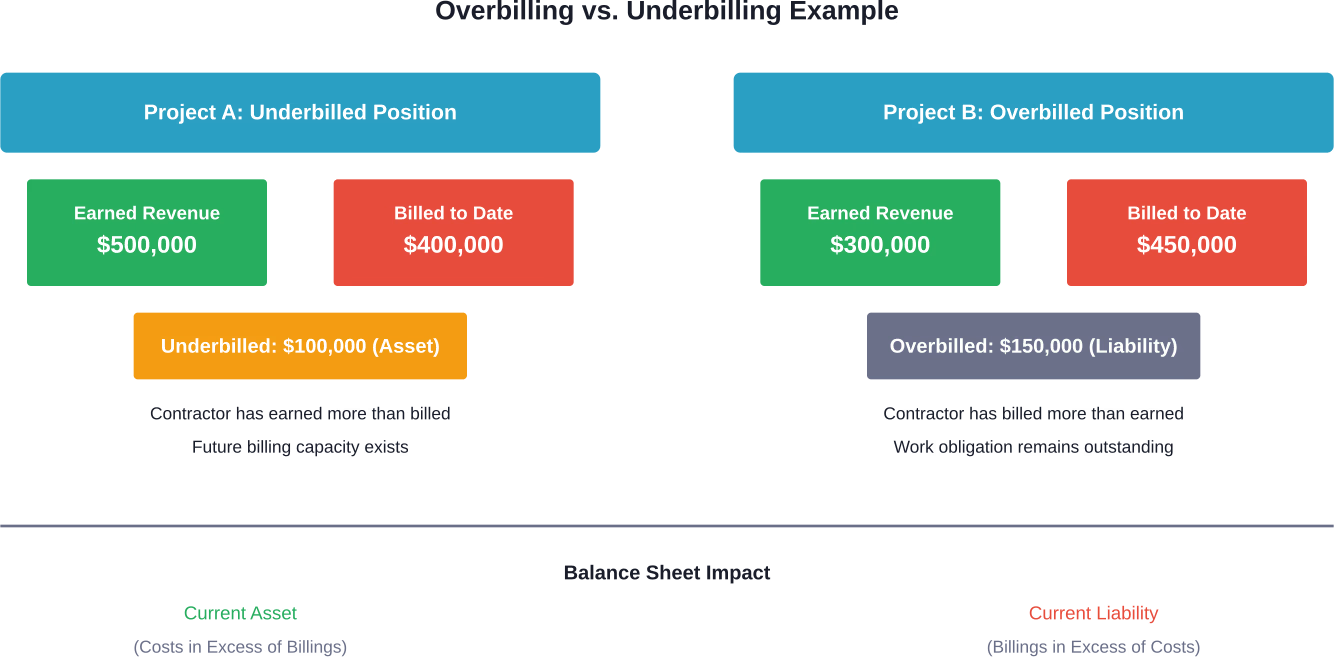
The difference between billed amounts and earned revenue creates either overbilling or underbilling. Overbilling occurs when invoiced amounts exceed earned revenue—the contractor has collected more cash than the work completed justifies. While this can benefit cash flow, excessive overbilling could lead to a cash crunch when the remaining work outpaces the remaining billable amount.
Underbilling happens when earned revenue exceeds billed amounts—the contractor has completed more work than they’ve invoiced. This ties up working capital and can strain cash flow, especially on large projects.
| WIP Component | What It Shows | Por qué es importante
|
|---|---|---|
| Contract Amount | Total project value including change orders | Defines revenue potential and scope boundaries |
| Costs to Date | Actual expenses incurred so far | Drives completion percentage and profit calculations |
| Estimated Total Costs | Projected final project costs | Determines expected profit margin and cost overruns |
| % Complete | Project progress measurement | Controls revenue recognition timing |
| Earned Revenue | Revenue recognized based on completion | Shows true financial performance vs. billing |
| Billed to Date | Amount invoiced to client | Indicates cash collection and billing status |
| Over/Underbilling | Billing vs. earned revenue gap | Reveals cash flow position and future billing capacity |
WIP Accounting and Revenue Recognition
Construction accounting operates differently from retail or service businesses because of the extended timeline of projects. Revenue recognition standards require contractors to match revenue with the period in which work actually occurs, not just when cash arrives.
The Financial Accounting Standards Board’s (FASB) new revenue standard, effective 2019 for nonpublic entities, emphasizes this principle. For construction companies, this means using percentage-of-completion accounting for most projects rather than completed-contract accounting.
Percentage of Completion Method
This is the dominant approach in construction WIP accounting. As work progresses, revenue gets recognized proportionally. A project that’s 60% complete should have 60% of its total revenue recognized, regardless of how much has been billed or collected. This approach allows for matching the revenue earned with the expenses incurred during the same period, providing a more accurate picture of project profitability.
The calculation works like this: Costs to Date divided by Estimated Total Costs equals Percentage Complete. Then Percentage Complete multiplied by Contract Amount equals Revenue Earned to Date.
Here’s a practical scenario: A $1,000,000 contract with $930,000 in estimated costs has incurred $465,000 in actual costs. That’s 50% complete ($465,000 / $930,000). Revenue earned should be $500,000 (50% × $1,000,000), even if the contractor has only billed $400,000 so far.
Construction in Progress on the Balance Sheet
WIP appears on the balance sheet as an asset when projects are underbilled—when earned revenue exceeds billing. This asset represents the contractor’s right to future payment for work already completed.
Conversely, overbilled projects create a liability called “billings in excess of costs” or “deferred revenue.” This represents the contractor’s obligation to complete work for which they’ve already been paid.
Properly categorizing these amounts ensures the balance sheet accurately reflects the company’s financial position. Lenders and bonding companies scrutinize these figures closely when evaluating a contractor’s financial health.
How WIP Reports Strengthen Construction Financial Management
WIP reports deliver insights that transform how construction companies operate. The benefits extend far beyond basic bookkeeping.
Cash Flow Management and Forecasting
Cash flow problems sink more construction companies than lack of work. WIP reports reveal underbilled positions that indicate upcoming invoicing opportunities. They also highlight overbilled projects that may face payment slowdowns as work catches up to billing.
By analyzing the billing position across all active projects, financial managers can forecast cash needs with much greater precision. This visibility helps with decisions about equipment purchases, hiring, and whether to pursue new projects.
Project Profitability Tracking
A project might look profitable on paper but actually be losing money. WIP reports expose this reality by comparing actual costs against estimates. When costs to date are tracking significantly higher than the percentage complete would suggest, that’s a red flag.
For instance, if a project is 50% complete by time or milestones but has already consumed 75% of the estimated budget, the project is headed for a loss unless corrective action gets taken immediately.
Bonding and Banking Relationships
Surety companies and lenders require WIP reports to evaluate a contractor’s financial stability. These institutions want to see that projects are progressing as planned, billing is keeping pace with costs, and profit margins are holding.
Clean, accurate WIP reporting builds credibility and can increase bonding capacity—the total value of work a contractor can have under contract simultaneously. Poor WIP reporting raises concerns and can limit growth opportunities.
Decision-Making and Strategic Planning
Should the company bid on a new project? Can it afford to invest in new equipment? WIP reports provide the data needed to answer these questions confidently.
They also reveal patterns across projects. Perhaps certain project types consistently run over budget, or specific clients always pay slowly. These insights drive better estimating, improved project selection, and smarter resource allocation.
Common WIP Reporting Mistakes and How to Avoid Them
Even experienced contractors make WIP reporting errors that distort financial reality. Awareness of these pitfalls helps prevent them.
Inaccurate Cost Tracking
When costs aren’t properly allocated to the correct projects, the entire WIP report becomes unreliable. Material deliveries that get charged to general overhead instead of specific jobs, or labor hours that aren’t tracked to project codes—these errors compound quickly.
Solution: Implement strict job costing procedures. Every expense should tie to a specific project or overhead category, with no exceptions.
Stale Cost Estimates
Using outdated estimates for costs at completion undermines the accuracy of percentage complete calculations and revenue recognition. As projects progress, estimates should be updated to reflect current reality—change orders, unforeseen conditions, productivity variations.
Solution: Review and update cost estimates monthly, not just at project start and finish. Project managers should provide regular feedback on remaining work and anticipated costs.
Inconsistent Reporting Periods
WIP reports lose value when they’re prepared sporadically or with inconsistent cutoff dates. Some projects might be updated through month-end while others reflect data from two weeks prior.
Solution: Establish a regular reporting schedule—typically monthly—and ensure all project data gets updated to the same cutoff date before running the report.
Ignoring Retention
Contract retention—the portion of each invoice that clients hold back until project completion—affects both billing and cash flow. WIP reports should clearly identify retention amounts and track them separately.
Solution: Include retention as a separate line item in WIP reports and monitor it closely, especially on projects nearing completion where retention release becomes imminent.
Overlooking Committed Costs
Purchase orders and subcontracts represent committed costs that will hit the project even though they haven’t been paid yet. Failing to include these in cost projections creates an artificially optimistic profit outlook.
Solution: Track committed costs separately and include them in estimated costs at completion. This provides a more complete picture of remaining financial obligations.
WIP Reporting Best Practices
Implementing strong WIP reporting practices elevates construction financial management from reactive to proactive:
- Monthly reporting cycles: Generate WIP reports on the same schedule as financial statements, typically monthly. This creates consistency and ensures timely identification of issues.
- Multiple stakeholders: Don’t limit WIP reports to the accounting department. Project managers, estimators, and executives all need access to this information, though perhaps in different formats or levels of detail.
- Variance analysis: Don’t just produce the numbers—analyze them. Compare actual performance to estimates, investigate significant variances, and document explanations. Understanding why projects deviate from plan is as important as knowing that they have.
- Integration with project management: WIP data should flow seamlessly from project management systems to accounting systems. Manual data entry introduces errors and delays. Modern construction software can automate much of this data transfer.
- Training and communication: Everyone involved in project execution affects WIP accuracy. Field personnel need to understand how time tracking impacts reporting. Project managers must grasp how their estimates and progress assessments drive revenue recognition.
| Best Practice | Implementation Approach | Expected Benefit
|
|---|---|---|
| Monthly Reporting | Fixed cutoff dates, standardized templates | Consistent, timely financial visibility |
| Real-Time Cost Tracking | Digital time tracking, automated expense allocation | Accurate, up-to-date project costs |
| Regular Estimate Updates | Monthly project manager reviews, documented changes | Reliable completion forecasts |
| Cross-Department Review | Joint meetings with PM, accounting, and executives | Shared understanding, faster issue resolution |
| Integración de sistemas | Connected project management and accounting platforms | Reduced errors, improved efficiency |
Fix Your WIP Before You Report It

A WIP report fails when it’s built on estimates instead of real site progress. If installed work, cost, and reported completion don’t line up, your numbers are wrong from the start. Powerkh checks what’s actually happening on site before it goes into your WIP, so you’re not reporting guesswork.
Report Numbers You Can Stand Behind
Powerkh shows exactly what supports your WIP:
- What is actually installed vs what is reported
- Where progress is overstated or understated
- Which costs don’t match real work on site
- Where the job is slipping without showing in reports
- What needs to be corrected before reporting
Contact Powerkh and make sure your WIP reflects what’s really happening on site.
How Construction Software Improves WIP Reporting
Manual WIP report creation consumes hours and introduces errors. Construction accounting software automates data collection, calculations, and report generation.
Modern platforms pull cost data directly from accounts payable, payroll, and material purchases. They track billing automatically from invoice generation. They calculate percentage complete based on cost ratios or manually entered progress assessments.
The result? WIP reports that generate in minutes instead of days, with far fewer errors and much greater detail. Project managers can drill down into individual cost codes. Executives can view consolidated summaries across all projects or filter by division, project type, or client.
But software is only as good as the data entered into it. Garbage in, garbage out remains true. The discipline of accurate job costing, timely data entry, and regular estimate updates still falls to the people using the systems.
Conclusión
WIP reports represent far more than an accounting requirement—they’re a strategic tool that reveals the true financial health of construction operations. While balance sheets show snapshots and income statements show historical results, WIP reports provide the forward-looking, project-specific insights that construction companies need to manage profitably.
Accurate WIP reporting requires discipline: meticulous job costing, regular estimate updates, consistent reporting periods, and integration between field operations and financial systems. The effort pays dividends through better cash flow management, improved project profitability, stronger banking relationships, and data-driven decision making.
For contractors serious about financial management, mastering WIP reporting isn’t optional. It’s the foundation on which sustainable, profitable growth gets built. Start by ensuring accurate cost tracking on every project, establish monthly reporting routines, and make WIP review a regular part of management meetings.
The construction companies that thrive aren’t necessarily the ones that win the most bids—they’re the ones that know their numbers, manage their projects based on data, and use tools like WIP reports to maintain financial clarity even as complexity grows.
Preguntas frecuentes
How often should construction companies prepare WIP reports?
Most construction companies generate WIP reports monthly, aligned with financial statement preparation. This frequency provides timely visibility into project performance without creating excessive administrative burden. Larger contractors or those with shorter-duration projects might report more frequently, while smaller firms with fewer, longer projects might find quarterly reporting sufficient – though monthly remains the industry standard.
What’s the difference between WIP and CIP in construction accounting?
WIP (Work in Progress) refers to the overall reporting methodology and the financial analysis of ongoing projects. CIP (Construction in Progress) is the specific balance sheet account that records costs accumulated on projects for the contractor’s own use – like building their own office or facility. For client projects, the balance sheet shows “costs in excess of billings” or “billings in excess of costs” rather than CIP.
Can small construction companies skip WIP reporting?
Even small contractors benefit from WIP reporting, though the format might be simpler. Any construction company with projects spanning multiple months needs visibility into project profitability, billing position, and cash flow. The principles remain the same whether managing two projects or two hundred – match revenue with costs, track billing against earned revenue, and monitor profit margins closely.
How does the percentage of completion get calculated?
The most common method divides costs incurred to date by total estimated costs at completion. This cost-to-cost method assumes that cost consumption mirrors work progress. Alternative approaches include units-of-delivery (square feet completed, floors finished) or labor hours expended versus estimated labor hours. The chosen method should reflect how the contractor can most reliably measure actual progress.
What happens when a WIP report shows a project losing money?
When WIP analysis reveals a projected loss, accounting standards generally require immediate recognition of the entire anticipated loss, even if the project isn’t complete. This conservative approach prevents overstating assets and income. Operationally, the contractor should investigate why costs are exceeding estimates, implement corrective measures if possible, and use the lessons learned to improve future estimating.
How do change orders affect WIP reports?
Approved change orders increase both the contract amount and estimated costs, affecting revenue recognition and profit calculations. Change orders should be added to WIP reports promptly once approved and executed. Pending change orders require more judgment – conservative practice suggests excluding them from contract value until approved, though their costs might already be incurred and should be tracked separately.
What role does WIP reporting play in financial audits?
Auditors scrutinize WIP reports closely because revenue recognition represents one of the highest-risk areas in construction accounting. They verify that percentage complete calculations are reasonable, cost estimates are current and supportable, and revenue recognition follows appropriate accounting standards. Well-maintained WIP reports with supporting documentation significantly streamline the audit process and reduce audit costs.

Nuestros casos prácticos
Hemos gestionado más de 200 proyectos BIM y VDC para los sectores comercial, industrial y residencial.
Nuestro trabajo incluye:
Automatización del diseño de encofrados
Our client from
California, USA
Automatización del diseño de falsos techos
Our client from
New York, USA
Automatización del diseño del entramado de muros
Our client from
California, USA