¿Tiene alguna pregunta? Póngase en contacto con nosotros
¡Únete a nuestro equipo!
Solicitar presupuesto o consulta gratuita

Quick Summary: Becoming a construction project manager typically requires a bachelor’s degree in construction management or a related field, hands-on construction experience, and often professional certification. According to the Bureau of Labor Statistics, construction managers earn a median salary of $106,980 annually as of May 2024, with employment projected to grow 9% from 2024 to 2034—well above the average for all occupations.
Construction projects worth millions of dollars rely on skilled leadership to turn complex blueprints into functional structures. But what does it actually take to become the person coordinating budgets, schedules, subcontractors, and safety protocols on a major build?
The path isn’t one-size-fits-all. Some reach project manager roles in four years. Others take much longer. The difference? A strategic combination of education, hands-on experience, and professional credibility through certification.
Here’s what actually gets candidates hired—and promoted—in 2026.
What Does a Construction Project Manager Actually Do?
Construction project managers plan, coordinate, budget, and supervise construction projects from start to finish, according to the Bureau of Labor Statistics. But that official description barely scratches the surface.
Real talk: the role involves juggling contractors who want more time, owners who want lower costs, and inspectors who want code compliance. All while keeping the schedule on track.
Key responsibilities include:
- Creating and managing project budgets, often worth millions
- Coordinating subcontractors, suppliers, and trade workers
- Ensuring compliance with building codes and safety regulations
- Managing project timelines and resolving scheduling conflicts
- Conducting site inspections and quality control assessments
- Communicating with architects, engineers, and project owners
The work environment shifts constantly. One day might involve reviewing plans in an office. The next requires navigating an active construction site wearing hard hats and safety gear.
As construction industry analyst Johnathan E. Mitchell notes in HR Future, there’s a growing “discrepancy between the existing workforce’s skills and the emerging requirements of modern construction practices.” New technologies and methods are reshaping how projects get built, which means managers need both traditional construction knowledge and comfort with digital tools.
BIM Coordination for Construction Project Management

Construction project managers need better visibility into design changes, documentation status, and coordination issues. Powerkh provides BIM modeling, BIM coordination, Scan to BIM, structural detailing, prefabrication support, and BIM automation. Their team helps organize project information through coordinated models, drawings, and supporting documentation.
Need BIM coordination for project delivery?
Talk with Powerkh to:
- build and update coordinated BIM models
- support drawing and documentation workflows
- improve visibility across design and construction data
👉 Contact Powerkh to review your drawings, scope, and BIM needs.
Education Requirements: Degree or No Degree?
Large construction firms typically prefer candidates who have both construction experience and a bachelor’s degree in a construction-related field, according to the Bureau of Labor Statistics. But the emphasis on “prefer” matters here.
Not everyone takes the same path.
Bachelor’s Degree in Construction Management
This is the most direct route. Construction management programs cover:
- Building science and construction methods
- Project scheduling and cost estimation
- Construction law and contract administration
- Safety management and quality control
- Blueprint reading and plan interpretation
Accreditation matters. Programs accredited by ABET (Accreditation Board for Engineering and Technology) or ACCE (American Council for Construction Education) carry more weight with employers. The University of Houston, University of Nebraska-Lincoln, and San Diego State University all maintain ABET or ACCE accreditation for their construction management programs.
According to Bureau of Labor Statistics data from 2023, workers with construction degrees had a median wage of $90,000, with 68% employed in occupations requiring at least a bachelor’s degree.
Master’s Degree: Worth It?
A master’s degree isn’t required, but it can accelerate career progression. Texas State University offers an online Master of Science in Construction Management specifically designed to prepare professionals for advanced certifications like the Certified Construction Manager (CCM) credential.
Graduate programs dive deeper into financial management, advanced project controls, and leadership development. For those aiming at senior PM or director-level roles, the additional education creates a competitive advantage.
Alternative Paths Without a Four-Year Degree
Some construction managers work their way up from trade positions. This route takes longer but provides unmatched hands-on knowledge.
Some experienced tradespeople seek to transition into project management roles. The common thread? They combine field experience with targeted coursework in project management fundamentals, estimating, and scheduling.
However, advancement opportunities may be more limited without formal education, especially at larger firms or for commercial projects.
Gaining Construction Experience
Here’s the thing though—no amount of classroom learning replaces actual construction experience. Employers want candidates who understand how buildings actually get built.
Entry-level positions that lead toward project management include:
| Position | Typical Salary Range | Key Focus
|
|---|---|---|
| Project Engineer | $50,000 – $75,000 | Technical coordination, plan review |
| Assistant Project Manager | $65,000 – $95,000 | Schedule management, subcontractor coordination |
| Field Engineer | $55,000 – $70,000 | On-site quality control, daily reports |
| Construction Coordinator | $48,000 – $65,000 | Document control, permit tracking |
The fastest promotions happen when candidates take ownership before the title changes. That means managing scopes independently, leading coordination meetings, and owning cost tracking—even as an assistant PM or engineer.
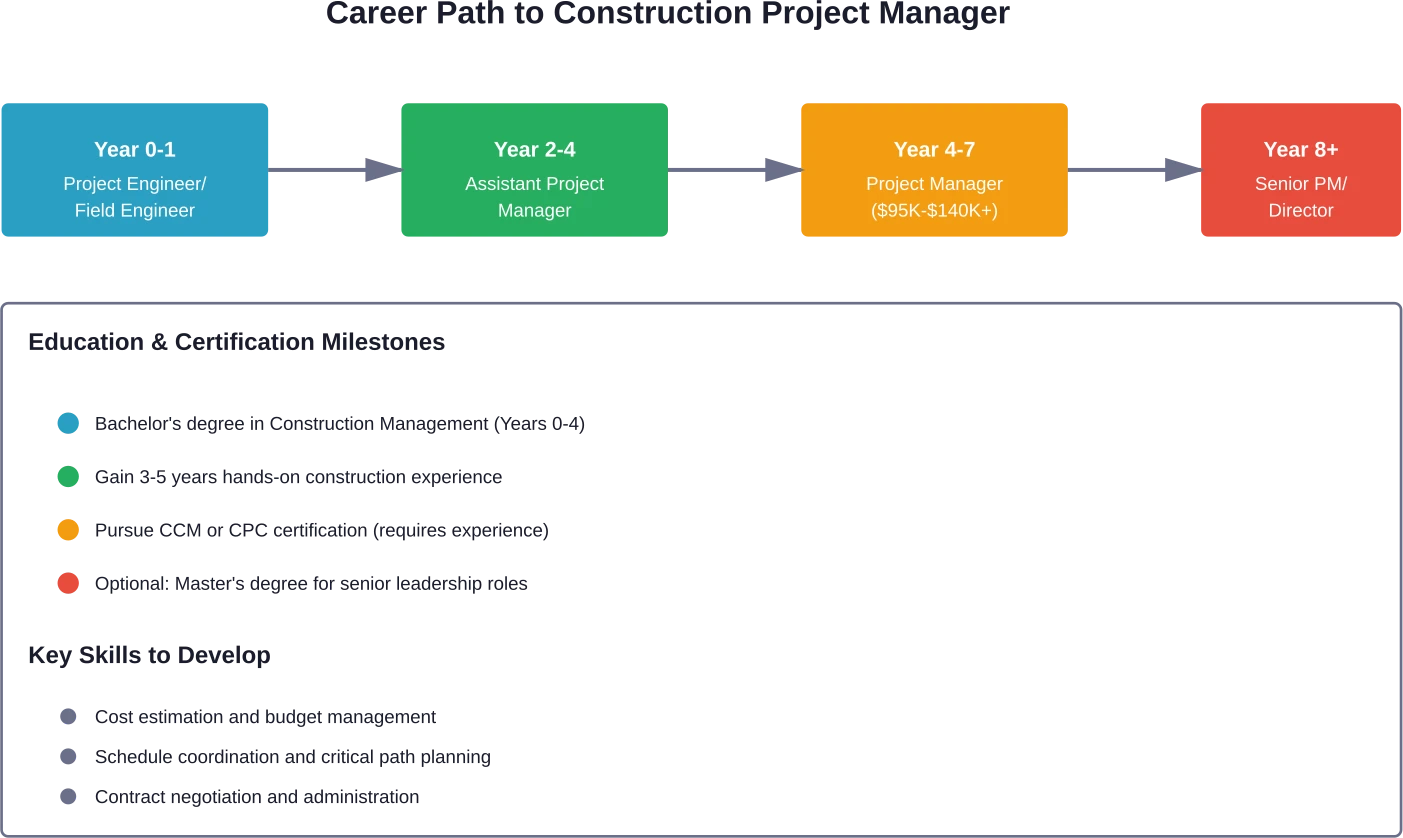
Most employers look for 3-5 years of construction experience before promoting someone to full project manager. But that timeline compresses for high performers who demonstrate leadership capability early.
Professional Certifications That Matter
Certification isn’t always required, but it creates clear differentiation in a competitive job market.
Certified Construction Manager (CCM)
The Construction Management Certification Institute offers the CCM credential, widely recognized across the industry. Candidates need a bachelor’s degree and 48 months of construction management experience (or more experience with less education).
According to data from Texas State University, Certified Construction Managers earn approximately 10% more than their non-certified counterparts. Beyond salary, hundreds of job postings specifically require or prefer CCM credentials.
Associate Constructor (AC) and Certified Professional Constructor (CPC)
The American Institute of Constructors offers a two-level certification program. The Associate Constructor (Level I) establishes foundational competency, while the Certified Professional Constructor (Level II) demonstrates advanced expertise.
These certifications emphasize ethical practice alongside technical knowledge—a key differentiator when firms evaluate candidates for leadership roles.
Project Management Professional (PMP)
While not construction-specific, the PMP credential from the Project Management Institute carries weight across industries. It’s particularly valuable for construction managers working on large commercial or infrastructure projects with complex stakeholder management.
Construction Project Manager Salary in 2026
The Bureau of Labor Statistics reports a median annual wage of $106,980 for construction managers as of May 2024. But salary ranges vary significantly based on experience, location, and project type.
| Experience Level | Typical Role | Salary Range
|
|---|---|---|
| Entry Level | Project Engineer | $50,000 – $75,000 |
| Mid-Level | Assistant Project Manager | $65,000 – $95,000 |
| Experienced | Project Manager | $95,000 – $140,000+ |
| Senior/Director | Senior PM/Director of Construction | $140,000 – $200,000+ |
Project management specialists—a broader category that includes construction—had a median wage of $100,750 in May 2024, according to the Bureau of Labor Statistics. The construction-specific premium reflects the technical complexity and safety responsibility inherent in building projects.
Geographic location matters considerably. Construction managers in metropolitan areas with high development activity typically earn above the median, while rural markets may pay less but offer lower cost of living.
Job Outlook and Market Demand
Employment of construction managers is projected to grow 9% from 2024 to 2034, according to the Bureau of Labor Statistics. That’s significantly faster than the 3% average growth rate across all occupations.
What’s driving demand? Housing shortages and infrastructure investment create sustained need for new construction. According to Texas A&M University’s construction management program, there’s an urgent need for new builds driven by capable leaders.
But here’s where it gets interesting. Demand isn’t evenly distributed across all specializations. Infrastructure projects, commercial development, and sustainable construction show particularly strong growth. Residential construction fluctuates more with economic cycles.
The construction industry also faces a workforce gap. Many experienced managers are approaching retirement, creating advancement opportunities for younger professionals with the right combination of education and certification.
Essential Skills Construction Project Managers Need
Technical knowledge matters, but soft skills often determine who advances fastest.
Critical competencies include:
- Comunicación: Translating technical plans for non-technical stakeholders, negotiating with subcontractors, resolving conflicts between trades
- Leadership: Managing teams without direct authority, maintaining morale under pressure, making decisive calls when problems arise
- Problem-solving: Adapting when materials arrive late, redesigning sequences when conditions change, finding cost savings without compromising quality
- Technical proficiency: Reading blueprints, understanding structural systems, evaluating construction methods, using project management software
- Financial acumen: Creating accurate estimates, tracking costs against budget, forecasting cash flow needs, managing change orders
AGC’s Construction Project Manager Course emphasizes pre-planning and its correlation with profitability. Poor planning leads to cost overruns, schedule delays, and safety incidents. Strong planning creates efficiency that cascades through the entire project.
Common Mistakes That Slow Career Growth
Some patterns consistently hold people back from reaching project manager roles:
- Staying too narrow for too long. Specializing in one trade or system provides deep knowledge, but project managers need breadth. Seek exposure to multiple construction disciplines.
- Avoiding responsibility. Waiting for formal authority before leading dooms candidates to extended timelines. Take ownership of scopes, coordinate meetings, solve problems—even before the title reflects it.
- Neglecting relationships. Technical skills get candidates in the door. Relationships with subcontractors, suppliers, and colleagues create opportunities. Construction remains a relationship-driven industry.
- Skipping certification. When two candidates have similar experience, the one with CCM or CPC credentials gets the offer. Certification demonstrates commitment and validates competency.
- Ignoring emerging technology. Building Information Modeling (BIM), drone surveying, and digital project controls aren’t optional anymore. Managers who resist technology get left behind.
Actionable Steps to Start Your Career Path
So what’s the actual plan? Here’s a realistic roadmap:
- Step 1: Get educated. Pursue a bachelor’s degree in construction management from an accredited program. If returning to school isn’t viable, consider associate degrees or certificate programs in construction technology while working in the field.
- Step 2: Start in an entry-level position. Project engineer, field engineer, or construction coordinator roles provide the foundation. Focus on learning how projects flow from preconstruction through closeout.
- Step 3: Build diverse experience. Work on different project types if possible—commercial, residential, industrial, infrastructure. Each develops different skills and perspectives.
- Step 4: Develop core competencies. Master cost estimating, scheduling, and contract administration. These three skills separate competent assistants from promotable managers.
- Step 5: Pursue certification. Once eligible, obtain CCM, CPC, or PMP credentials. The preparation process itself develops valuable knowledge, and the credential opens doors.
- Step 6: Take ownership. Don’t wait for permission to lead. Manage scopes independently, run coordination meetings, mentor newer team members. Demonstrate capability before the promotion conversation happens.
- Step 7: Keep learning. Construction methods, codes, and technologies evolve constantly. Continuing education through organizations like AGC (Associated General Contractors) maintains relevance.
Moving Forward With Your Construction Management Career
The construction industry needs qualified project managers. Infrastructure demands aren’t slowing down. The workforce gap continues widening as experienced managers retire.
That creates real opportunity for candidates who combine solid education, hands-on construction experience, and professional credentials. The timeline isn’t instant—expect 4-7 years from education through first PM role. But the career progression is clear, and the financial rewards are substantial.
Start with education. Build diverse experience. Earn certification. Take ownership before the title changes. And keep learning, because construction methods and technologies won’t stop evolving.
Ready to start? Research ABET or ACCE-accredited construction management programs, connect with local AGC chapters for networking opportunities, and explore entry-level positions at general contractors in your area. The path is straightforward for those willing to invest the time and effort.
Preguntas frecuentes
How long does it take to become a construction project manager?
Typically 4-7 years, including time for a bachelor’s degree and 3-5 years of construction experience. Some reach project manager roles faster by demonstrating leadership capability early, while others take longer depending on company structure and project complexity.
Can I become a construction project manager without a degree?
Yes, but it’s more challenging and typically takes longer. Working up from trade positions provides valuable hands-on knowledge, but many firms prefer candidates with formal construction management education, especially for commercial projects. Combining field experience with targeted coursework and certification improves advancement prospects.
What certifications do construction project managers need?
Certification isn’t always mandatory, but Certified Construction Manager (CCM), Certified Professional Constructor (CPC), and Project Management Professional (PMP) credentials significantly improve job prospects and earning potential. According to Texas State University data, CCM-certified managers earn approximately 10% more than non-certified peers.
What’s the difference between a construction manager and a project manager?
The terms are often used interchangeably in construction, but “construction manager” typically emphasizes the building process and trade coordination, while “project manager” may focus more broadly on schedule, budget, and stakeholder management. In practice, the roles overlap significantly, especially at general contractor firms.
Is construction project management a good career in 2026?
Employment projections suggest yes. The Bureau of Labor Statistics forecasts 9% job growth from 2024 to 2034—three times the average for all occupations. Median pay of $106,980 exceeds many other construction careers. However, the role involves significant responsibility and can be high-stress during critical project phases.
What software do construction project managers use?
Common platforms include Procore, PlanGrid, Bluebeam for document management; Primavera P6 or Microsoft Project for scheduling; and various estimating tools. Building Information Modeling (BIM) software like Revit or Navisworks is increasingly important. Proficiency with these tools has become a baseline expectation.
Do construction project managers work on-site or in an office?
Both. The role typically splits time between construction sites and office environments. Site visits for inspections, coordination meetings, and problem-solving are essential, but schedule development, cost tracking, and administrative work happen at a desk. The split varies by project phase and company structure.

Nuestros casos prácticos
Hemos gestionado más de 200 proyectos BIM y VDC para los sectores comercial, industrial y residencial.
Nuestro trabajo incluye:
Automatización del diseño de encofrados
Our client from
California, USA
Automatización del diseño de falsos techos
Our client from
New York, USA
Automatización del diseño del entramado de muros
Our client from
California, USA