¿Tiene alguna pregunta? Póngase en contacto con nosotros
¡Únete a nuestro equipo!
Solicitar presupuesto o consulta gratuita

MEP BIM support is often discussed as if it were a fixed service with a fixed price. In reality, it is anything but fixed. Costs depend on scope, detail level, coordination demands, and how long the support is required. A small residential scheme and a multi-storey hospital do not live in the same pricing universe.
This article breaks down what MEP BIM support actually includes, how providers calculate their fees, typical cost ranges, and what drives the final number up or down. It also looks at how to budget realistically and avoid common pricing surprises.
What Is Included in MEP BIM Support?
Before talking about cost, it helps to clarify what is being paid for. MEP BIM support is not just 3D modeling. It is ongoing technical assistance around mechanical, electrical, and plumbing systems within a BIM workflow. On average, projects may range from around $2,500 for small residential work to $50,000 and well beyond for large, complex facilities, depending on scope and duration.
Typical MEP BIM support may include:
- 3D modeling of HVAC, electrical, and plumbing systems.
- Clash detection and coordination meetings.
- Model updates after design revisions.
- Shop drawing preparation.
- LOD upgrades from concept to construction.
- As-built model adjustments.
- Scan-to-BIM integration for renovation projects.
- Ongoing model validation and QA checks.
In some projects, support starts at concept stage and continues until handover. In others, it is limited to coordination during construction. The scope defines the cost more than anything else.
How MEP BIM Support Is Priced
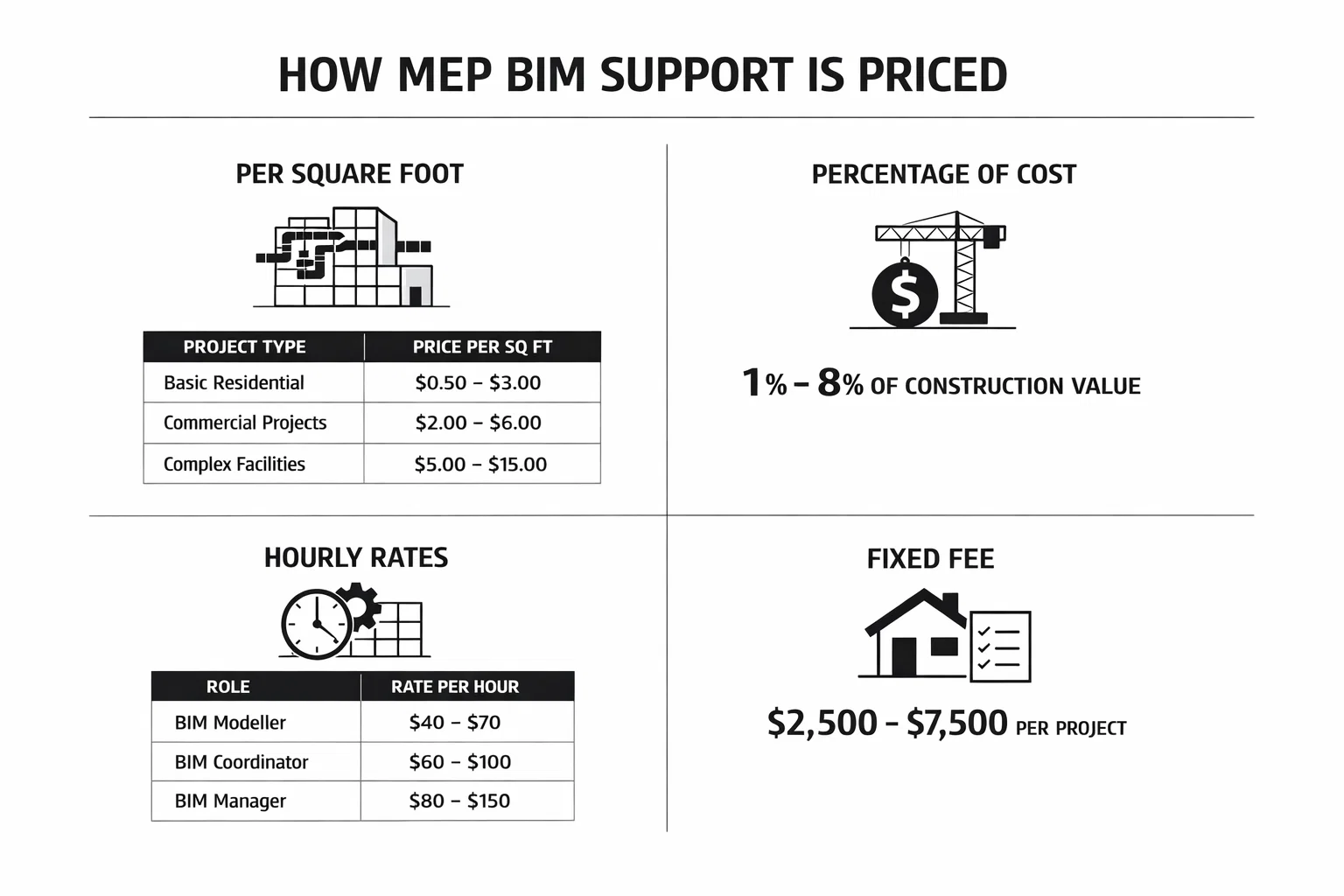
There is no single pricing formula. Providers usually structure their fees in one of four ways.
Precios por pie cuadrado
This is common for larger projects where scope is relatively defined.
Typical ranges:
- Basic residential modeling: $0.50 – $3.00 per square foot.
- Commercial coordination projects: $2.00 – $6.00 per square foot.
- Highly complex facilities: $5.00 – $15.00 per square foot.
The variation depends on system complexity, required level of detail, coordination intensity, and regulatory requirements.
Higher LOD means more time spent modeling connections, hangers, clearances, fabrication details, and asset data.
Porcentaje del coste de construcción
Some firms price MEP BIM support as a percentage of total construction value.
Typical range is 1% – 8% of total construction cost.
For example, on a $5 million project, MEP BIM support may fall between $50,000 and $400,000 depending on scope and lifecycle involvement.
This model is common when support runs through design and construction phases.
Tarifas por hora
For undefined or evolving projects, hourly billing is often used.
Typical hourly rates:
- BIM Modeller: $40 – $70 per hour.
- BIM Coordinator: $60 – $100 per hour.
- BIM Manager or Consultant: $80 – $150 per hour.
Scan-to-BIM services may be billed separately at $200 – $500 per hour for scanning and point cloud processing
Hourly pricing works well for short-term or advisory support but can become unpredictable if scope drifts.
Fixed Fee Projects
Smaller projects, such as single-family homes, are often quoted as fixed packages.
Typical range is $2,500 – $7,500 for basic residential MEP BIM support.
Fixed fees offer clarity but usually assume limited revisions.
Delivering Reliable MEP BIM Services at Powerkh

En Powerkh, we provide MEP BIM services as part of our broader BIM and VDC support across commercial, industrial, and residential projects. We handle 3D BIM modeling from LOD 100 up to LOD 400 and 500, depending on project requirements. Our work includes coordination and consultation services, Revit clash detection and resolution, and preparation of accurate models and documentation that teams can rely on during construction.
We also support projects that involve existing conditions through Scan to BIM services. This includes point cloud to BIM conversion, data processing, and preparation of 2D as-built drawings based on scanned data. For teams looking to improve efficiency, we offer BIM automation and scripting solutions to streamline repetitive workflows and enhance productivity.
Our process is structured. We begin with a project audit, reviewing drawings and scope to provide a clear budget and timeline. Once approved, our team moves into execution while staying in touch throughout the project. We adjust to requirement changes, support coordination needs, and continue providing assistance until completion. This approach helps ensure that MEP models are not only technically correct, but also aligned with the project schedule and documentation needs.
What Drives MEP BIM Support Costs Higher
The price does not increase randomly. Certain factors consistently push budgets up.
1. Project Size and Geometry
A 2,000 square foot residence is simple compared to a 200,000 square foot hospital with multiple risers, plant rooms, and interdependent systems.
Large floor areas mean more modeling hours, more clash detection cycles, and more documentation.
2. Level of Detail Requirements
LOD has a direct cost impact.
- LOD 100 – 200: Concept and schematic design.
- LOD 300 – 350: Construction documentation.
- LOD 400: Fabrication-ready detail.
- LOD 500: As-built verified models.
Moving from LOD 300 to LOD 400 can significantly increase modeling effort because it requires accurate fittings, fabrication-ready components, and installation-level detail.
That jump alone can double coordination time.
3. Type of MEP Systems
Not all systems require equal effort.
Mechanical systems in medical or industrial facilities are often the most expensive due to dense duct routing, performance requirements, and specialized ventilation zones.
Electrical systems with complex distribution boards and backup systems also require extensive coordination.
Plumbing in residential settings tends to be simpler and more predictable.
4. Renovation and Scan-to-BIM Requirements
Existing buildings introduce uncertainty.
Scan-to-BIM workflows involve laser scanning, point cloud processing, and model reconstruction.
This adds hardware, software, and labor costs. Renovation work is rarely straightforward.
5. Coordination Intensity
Some projects require weekly coordination meetings, constant clash resolution, and model updates after every site instruction.
Frequent revisions increase modeling time, management hours, and quality control effort.
Change orders can add $1,500 – $2,000 per revision cycle depending on scope.
Typical Cost Ranges by Project Type
While every project is different, certain patterns repeat.
Small Residential Projects:
- Coste: $2,500 – $7,500
- LOD: 200 – 300
- Systems: Standard HVAC, electrical, plumbing
- Coordinación: Limited
These projects often avoid scan-to-BIM and advanced coordination layers.
Mid-Sized Commercial Buildings:
- Coste: $15,000 – $50,000
- LOD: 300 – 350
- Systems: Zoned HVAC, lighting systems, fire protection
- Coordinación: Multi-discipline
Office buildings and retail centers fall into this range.
Large Industrial or Healthcare Facilities:
- Coste: $50,000 and up
- LOD: 400 – 500
- Systems: Specialized mechanical and electrical setups
- Coordinación: Intensive
In complex facilities, MEP support is not optional. It becomes central to risk management.
Internal Team vs Outsourcing
Some contractors build internal BIM teams. Others outsource.
Internal setup costs may include:
- Licencias de software: $2,500 or more annually per seat.
- Collaboration tools: $700 – $2,000 per user annually.
- Workstations: $3,000 per unit.
- Salaries: $4,000 – $10,000 per month depending on role.
Outsourcing removes hardware and recruitment overhead but transfers cost to service fees.
For short-term projects, outsourcing is often more cost-efficient.
Is MEP BIM Support Worth the Cost?
On paper, MEP BIM support can look expensive. When reviewing budgets line by line, it is easy to focus on modeling fees and coordination hours. What often gets overlooked is the cost of rework. And rework is rarely cheap.
Clash-related site conflicts do not just cause minor inconvenience. They can delay schedules, increase labor costs, force material reorders, and trigger redesign cycles that ripple across multiple trades. A single unresolved coordination issue in a plant room or riser can impact weeks of progress. In many cases, avoiding just one major conflict offsets a large portion of the BIM support investment.
Beyond construction, there is long-term value as well. Structured and accurate MEP data makes facility management easier, whether for maintenance planning, system upgrades, or compliance checks. When information is reliable from the start, the building operates more smoothly long after handover.
How to Control MEP BIM Support Costs
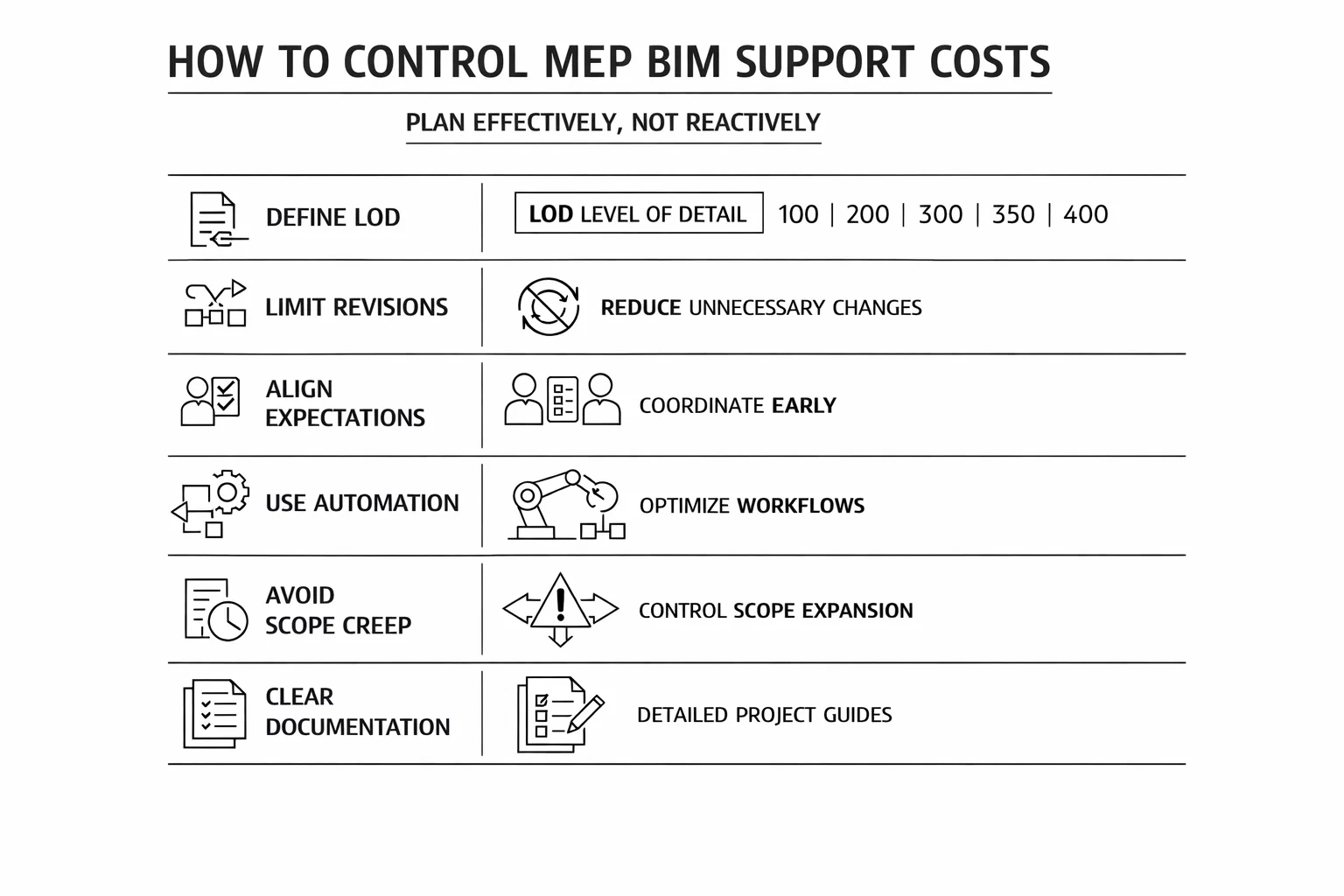
Cost control does not mean cutting quality. It means planning realistically.
Practical steps:
- Define LOD clearly at project start.
- Limit unnecessary model revisions.
- Align expectations between consultants early.
- Use automation where possible.
- Avoid late-stage scope expansion.
Clear documentation prevents scope creep.
Reflexiones finales
MEP BIM support costs range from a few thousand dollars for small residential projects to well over $100,000 for complex facilities. The final figure depends on size, system complexity, coordination intensity, and level of detail.
There is no universal number. What matters is understanding what is included in the service and how it connects to construction risk reduction.
A realistic budget, defined scope, and experienced coordination team make the investment predictable and measurable. Without that clarity, costs can drift. With it, MEP BIM support becomes a structured and manageable part of the project strategy.
PREGUNTAS FRECUENTES
1. What is the average cost of MEP BIM support?
There is no single number that fits every project. Small residential projects may fall between $2,500 and $7,500, while complex commercial or industrial projects can reach $50,000 or more. The final cost depends on size, system complexity, and required level of detail.
2. Is MEP BIM support charged per project or per hour?
Both models are common. Larger projects are often priced per square foot or as a fixed fee. Short-term coordination or advisory tasks are usually billed hourly. The structure depends on how clearly the scope is defined at the start.
3. Does higher LOD always mean higher cost?
In most cases, yes. Moving from LOD 300 to LOD 400 requires fabrication-level detail and more coordination effort. That means more modeling hours and more quality checks. The jump can be significant, especially on dense MEP projects.
4. Is MEP BIM support worth it for smaller projects?
For very simple builds, basic modeling may be enough. But even small projects benefit from clash detection and early coordination. Avoiding one major on-site conflict can justify the entire BIM support cost.
5. What increases MEP BIM costs the most?
Frequent design changes, unclear scope, and heavy coordination cycles usually drive costs up. Renovation projects with scan-to-BIM requirements also tend to be more expensive due to added data processing and verification work.
6. Can outsourcing reduce MEP BIM expenses?
It often can. Building an internal team means software licenses, hardware, and full-time salaries. Outsourcing shifts those overhead costs into a defined service fee, which can be more practical for project-based work.

¿Tiene un proyecto BIM? Hable con nosotros.
Contacte con nosotrosNuestros casos prácticos
Hemos gestionado más de 200 proyectos BIM y VDC para los sectores comercial, industrial y residencial.
Nuestro trabajo incluye:
Automatización del diseño de encofrados
Our client from
California, USA
Automatización del diseño de falsos techos
Our client from
New York, USA
Automatización del diseño del entramado de muros
Our client from
California, USA