¿Tiene alguna pregunta? Póngase en contacto con nosotros
¡Únete a nuestro equipo!
Solicitar presupuesto o consulta gratuita

MEP BIM consultancy rarely comes with a single, fixed price. Two projects may look similar on paper and still land in completely different fee ranges. The difference usually sits in scope, coordination depth, timelines, and the level of responsibility the consultant carries.
This article breaks down how MEP BIM consultancy fees are calculated, typical percentage ranges, hourly rates, staff-based pricing models, and what really pushes costs up or keeps them under control.
What Is Included in MEP BIM Consultancy?
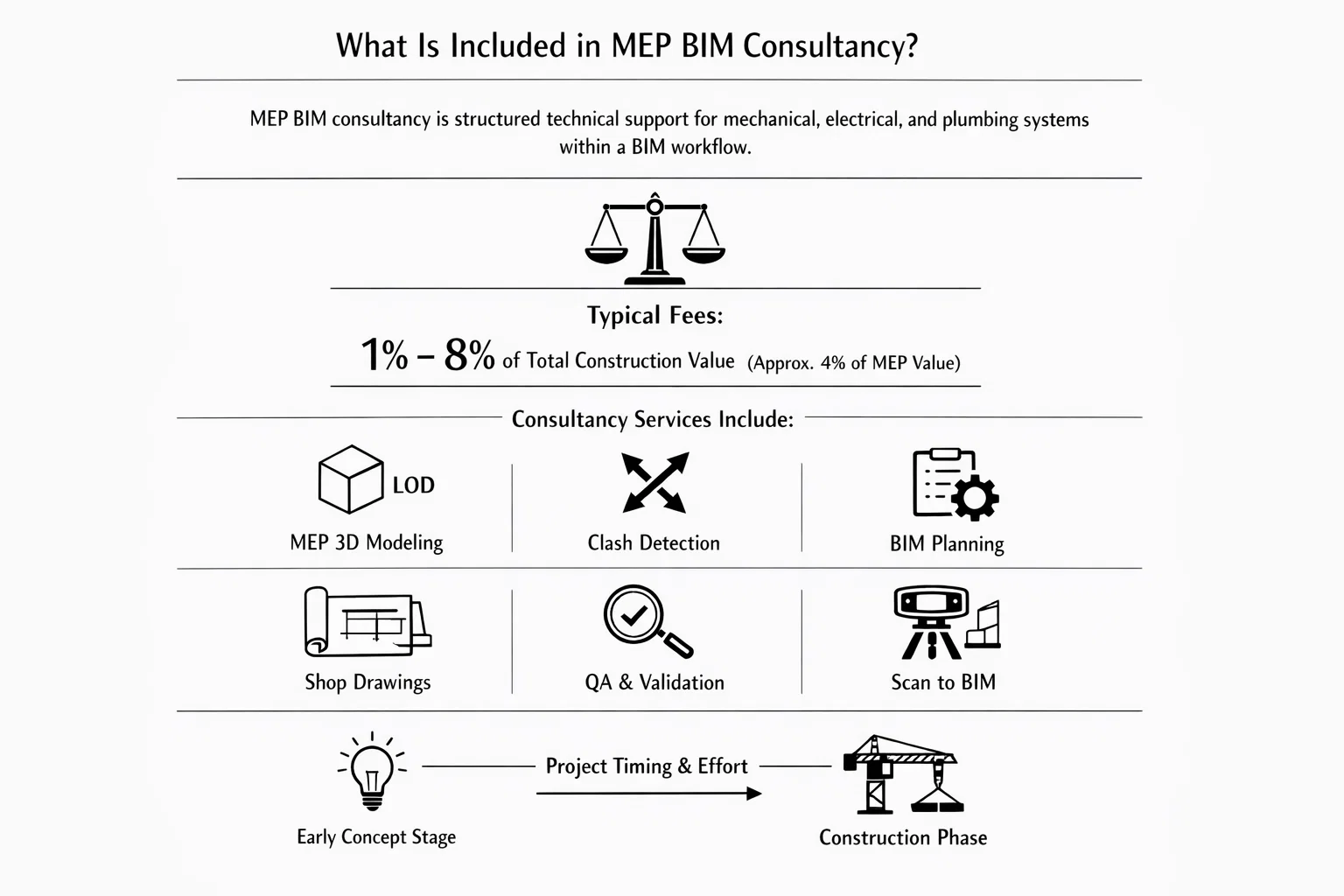
Before talking about numbers, it helps to define what is actually being paid for. MEP BIM consultancy is not just modeling ducts and pipes in 3D. It is structured technical support around mechanical, electrical, and plumbing systems within a BIM workflow.
On average, fees typically range between 1% and 8% of the total construction value (or around 4% of the MEP construction value), depending on scope, complexity, and coordination depth.
Depending on scope, consultancy may include:
- MEP 3D modeling at defined LOD levels.
- Clash detection and coordination reviews.
- BIM execution planning and standards setup.
- Shop drawing preparation.
- Model validation and QA checks.
- Scan to BIM integration for renovation projects.
- Ongoing updates during design revisions.
Some consultants are brought in at an early concept stage. Others join during detailed design or construction coordination. The timing changes the effort required, and effort directly affects cost.
The Three Main Pricing Models
MEP BIM consultancy is usually priced using one of three frameworks. Each has its logic. Each fits different types of projects.
1. Percentage of MEP Construction Value
This is one of the most common approaches.
Consultants charge a percentage of the MEP construction cost, not the total building cost. Typical market ranges often fall between 1% and 8% of total construction value.
Where the project sits in that range depends on сomplexity, сoordination intensity, project size, technical risk, and required detail level.
For example, a straightforward residential block with limited services may sit near the lower end. A hospital or data center with dense systems coordination may move toward the upper end.
It is important to understand that the MEP construction value refers to the systems themselves. It does not include the full construction budget.
2. Percentage of Total Construction Cost
Sometimes the MEP fee is expressed as a percentage of general construction cost. In that case, the consultant’s share often works out to around 0.5% to 2% of total construction cost.
This usually corresponds to the earlier model, just expressed differently. If MEP represents roughly 20 to 30 percent of total construction, then 4 percent of MEP may equal around 1 percent of total cost.
This approach simplifies conversations with clients who prefer one headline number.
3. Staff Cost Build-Up Model
For complex projects, especially those requiring heavy coordination, some consultancies calculate fees from the ground up.
This means estimating required roles, estimated hours per role, hourly cost per role, overheads, and profit margin.
Typical hourly ranges in the market might look like:
- Senior engineer: $90 to $150 per hour.
- BIM manager: $80 to $130 per hour.
- Design engineer: $60 to $100 per hour.
- BIM technician: $40 to $75 per hour.
- Administrative support: $30 to $50 per hour.
Once total staff hours are calculated, overhead and profit are added. A profit margin of around 10 percent is common, though it varies.
This model gives transparency. It also gives flexibility. If scope changes, hours can be adjusted.
¿Qué influye en el coste final?
Two projects can both be labeled as commercial office buildings and still require completely different consultancy effort. Several variables influence the fee.
Complejidad del proyecto
High density service environments require more coordination cycles. Think hospitals, laboratories, data centers, and industrial plants. More systems. More clashes. More revisions.
In these environments, MEP networks overlap in tight spaces and small adjustments in one system can ripple across several others. That means more review sessions, more model updates, and more engineering judgement applied at each stage. Complexity increases modeling hours and review time, and it rarely stays linear.
Nivel de detalle requerido
LOD requirements matter. LOD 200 is very different from LOD 400. Fabrication-ready models require significantly more precision.
At higher LOD levels, elements are no longer placeholders. They carry real dimensions, tolerances, and installation logic. Higher LOD means more time per element, and when multiplied across thousands of components, that time accumulates quickly.
Coordination Intensity
If a consultant must attend weekly coordination meetings, run clash detection cycles, issue reports, track resolutions, and re-test models, the workload increases. Clash management alone can represent a significant portion of consultancy effort.
Coordination is not a one-time task. It is iterative. Each design change can trigger new clashes, and each clash requires analysis, communication, and follow-up. That ongoing loop is where a large share of consultancy hours can sit.
Timeline Pressure
Tight deadlines often require additional staff, overtime, and parallel workflows. Speed almost always adds cost.
When schedules compress, the margin for review shrinks. Teams may need to allocate more resources simultaneously to keep progress steady. Acceleration usually means higher coordination effort in a shorter window.
Scope Clarity
Unclear scope is one of the biggest fee drivers. If deliverables are loosely defined, revisions multiply. Clear scope reduces surprises. It also protects both parties.
When responsibilities and outputs are not precisely documented, expectations drift. Extra coordination rounds, additional modeling detail, or late-stage changes can expand the workload quickly. A well-defined scope does not eliminate change, but it keeps it manageable.
Typical Cost Ranges by Project Size
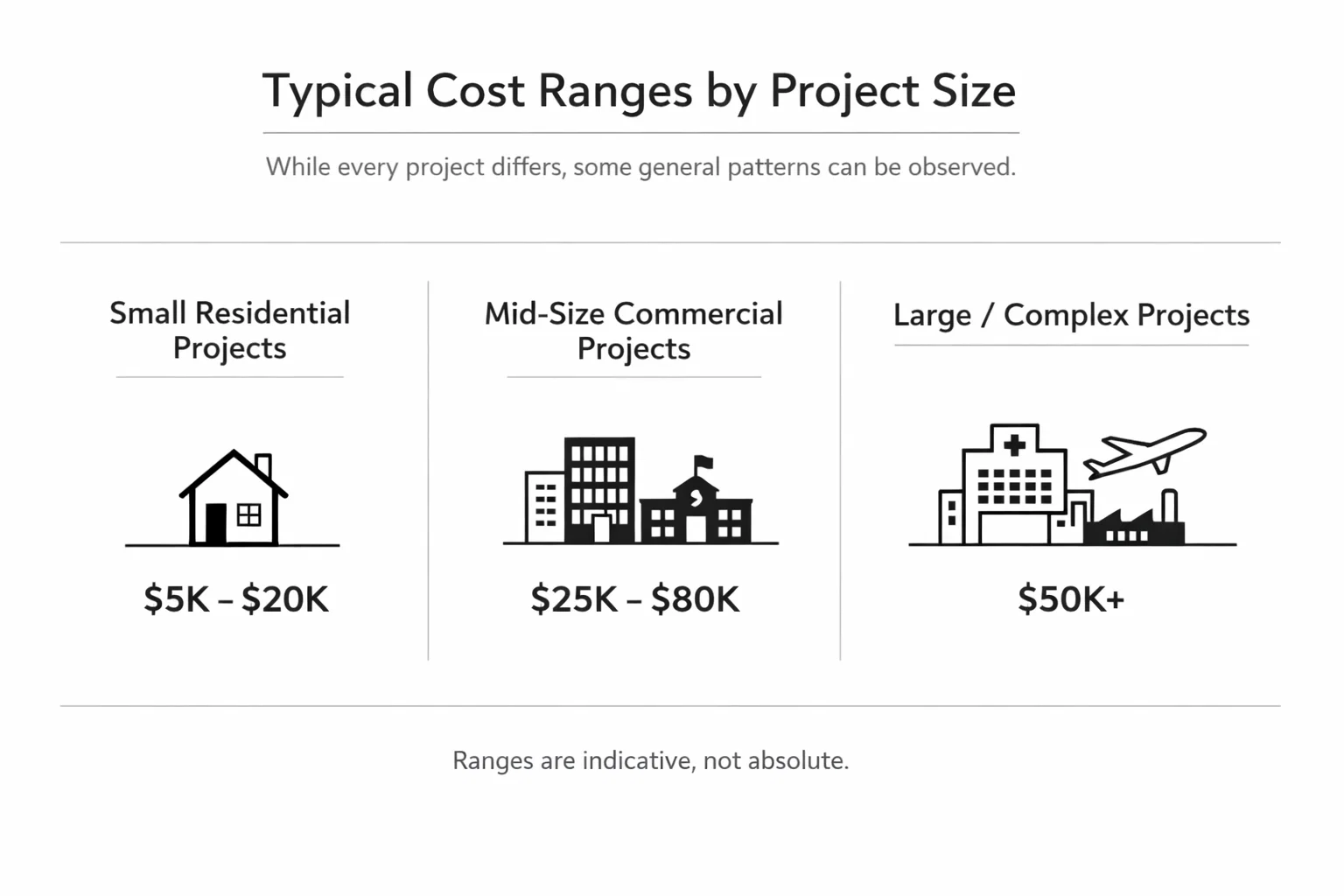
While every project differs, some general patterns can be observed.
Pequeños proyectos residenciales
For smaller residential schemes with moderate complexity and limited coordination cycles, total MEP BIM consultancy fees often fall in the range of $5,000 to $20,000. The final number depends on how detailed the models need to be and how many review rounds are required, but projects at this scale usually stay within that bracket.
Mid-Size Commercial Projects
Office buildings, schools, and retail centers typically require deeper coordination and clearer LOD targets. For these types of projects, consultancy fees commonly sit between $25,000 and $80,000. The variation largely comes down to how intensive the coordination process is and whether the models need to support detailed construction documentation.
Proyectos grandes o complejos
Hospitals, airports, industrial facilities, and high-rise developments operate in a different range altogether. Fees for MEP BIM consultancy on these projects can exceed $50,000 and continue well beyond that depending on duration and scope. When a staff-based pricing model is applied over a long project timeline, total consultancy costs may approach half a million or more, particularly where coordination risk and verification requirements are high.
These numbers are not fixed rules. They are directional ranges based on typical industry behavior.
Powerkh’s Approach to MEP BIM Consultancy and Cost Structure

En Powerkh, we position ourselves as an engineering-led digital construction consultancy supporting teams from design through construction. Our focus is design continuity. In simple terms, we help make sure what is designed is what gets built. That principle shapes the type of BIM consultancy we provide and, naturally, influences how effort is structured across a project.
Our services include structural and MEP design support, BIM modeling and coordination, critical zone resolution, laser scanning and existing conditions modeling, deviation monitoring, and as-built verification. We work across multiple RIBA stages, from early design through handover. This means our involvement can vary significantly depending on when a project team engages us and what level of coordination or verification is required.
Because we support both coordination and reality-based verification, the scope can range from preparing coordination-ready models to reviewing high-risk interfaces or comparing design intent against site conditions. The level of engineering input, coordination cycles, and model detail required will differ from project to project. As with any MEP BIM consultancy, the overall effort depends on complexity, stage of engagement, and the degree of risk the team wants to manage through structured digital workflows.
Is Hourly Pricing Better Than Percentage?
There is no universal answer.
Percentage models:
- Are easier to communicate.
- Scale naturally with project size.
- Work well when scope is stable.
Staff-based or hourly models:
- Offer more transparency.
- Allow flexibility when scope evolves.
- Protect consultants from underpricing complex coordination.
For projects with clear deliverables and defined stages, percentage pricing works well. For projects with evolving scope, staff-based models often make more sense.
Budgeting Smart and Seeing the Full Picture
The headline consultancy fee is rarely the final number. Additional costs can appear if they are not discussed early. These may include travel to site, software or platform access, extra coordination workshops, major redesign cycles outside the original scope, or extended support beyond the agreed timeline. None of these are unusual. Problems usually arise when they are assumed but never documented.
Realistic budgeting starts with clarity. Deliverables should be defined in detail. LOD targets need to be confirmed. Clash detection responsibilities must be clear. The number of coordination cycles, revision limits, and timeline expectations should be agreed before work begins. When those elements are written down, ambiguity drops and cost control improves.
Some project managers use structured fee worksheets to test different scenarios. Adjusting construction value, staff hours, profit margin, or scope boundaries can quickly show how sensitive the final number is. Even small changes in assumptions can shift the total in noticeable ways. That visibility helps avoid difficult conversations later.
It is also worth stepping back and asking whether the consultancy cost is being viewed in isolation. On paper, the fee may look significant. On site, a single unresolved clash can delay installation, increase labor hours, trigger material reorders, and force redesign. Avoiding one major coordination issue can offset a large portion of the consultancy fee.
There is long-term value as well. Well-structured MEP BIM data supports facility management, future upgrades, and renovation planning. That benefit rarely appears in early budget spreadsheets, but it becomes clear once the building is in use.
Reflexiones finales
MEP BIM consultancy cost is not a single number. It is a function of scope, coordination depth, detail level, and project risk.
Typical percentage ranges sit between 1 and 8 percent of MEP construction value. Hourly rates vary by role and expertise. Staff-based models add transparency, especially for complex projects.
The real question is not just how much it costs. The better question is whether the scope is defined well enough to justify the fee.
When scope is clear and coordination is handled early, consultancy stops feeling like an expense and starts looking more like risk management.
PREGUNTAS FRECUENTES
1. How much does MEP BIM consultancy typically cost?
There is no single number that fits every project. Most fees fall between 1 and 8 percent of the MEP construction value, or roughly 0.5 to 2 percent of total construction cost. Smaller and simpler projects sit lower. Complex, coordination-heavy buildings move higher.
2. Is percentage pricing better than hourly pricing?
It depends on the project. Percentage pricing works well when scope is stable and clearly defined. Hourly or staff-based pricing is often safer for complex schemes where coordination cycles and revisions are harder to predict. The key is clarity, not the formula.
3. What makes MEP BIM consultancy fees increase?
Usually it is complexity. High-density plant rooms, tight risers, multiple systems fighting for space, high LOD requirements, or compressed timelines all add effort. More coordination rounds mean more hours. It is rarely about modeling alone.
4. Does higher LOD always mean higher cost?
In most cases, yes. Moving from coordination level models to fabrication-ready detail requires more precision and time. That extra detail adds value, but it also increases modeling and review effort.
5. Can clear scope reduce consultancy cost?
Absolutely. When deliverables, clash cycles, LOD targets, and responsibilities are defined early, the process runs smoother. Fewer surprises usually mean fewer additional hours. Clarity protects both budget and timeline.
6. Is MEP BIM consultancy worth the investment?
On a spreadsheet, the fee can look significant. On site, one unresolved clash can cost more. Well-coordinated models reduce rework, delays, and material waste. That risk reduction is often where the real value sits.

¿Tiene un proyecto BIM? Hable con nosotros.
Contacte con nosotrosNuestros casos prácticos
Hemos gestionado más de 200 proyectos BIM y VDC para los sectores comercial, industrial y residencial.
Nuestro trabajo incluye:
Automatización del diseño de encofrados
Our client from
California, USA
Automatización del diseño de falsos techos
Our client from
New York, USA
Automatización del diseño del entramado de muros
Our client from
California, USA