¿Tiene alguna pregunta? Póngase en contacto con nosotros
¡Únete a nuestro equipo!
Solicitar presupuesto o consulta gratuita

When coordination fails, it rarely fails quietly. A duct hits a beam. A cable tray blocks a maintenance zone. Fabrication drawings pause while someone tries to untangle a ceiling that looks fine on paper. By that point, cost is no longer theoretical.
Design coordination and critical zone resolution exist to prevent that moment. They shift conflict detection from site to model. They also require time, discipline, and experienced oversight, which raises the practical question: what does it actually cost?
This article breaks down typical pricing structures, cost ranges, scope drivers, and how to align coordination budgets with real project risk.
What Design Coordination and Critical Zone Resolution Actually Cover
Before looking at numbers, it helps to clarify the scope. These services go beyond running a clash test.
Design coordination typically includes model federation across trades, clash detection and filtering, structured clash grouping by location, coordination meeting facilitation, tracking issue resolution, and verification of model updates.
Critical zone resolution narrows the focus further. It targets high-risk areas where systems converge or tolerances are tight. Think plant rooms, ceiling plenums, risers, transfer slabs, and prefabrication corridors.
On average, design coordination and critical zone resolution services for a medium commercial project tend to fall within a total budget range of £30,000 to £70,000 across the active coordination phase, although the exact figure depends heavily on trade density, project duration, and modelling depth.
This is not general modeling. It is structured conflict management. The goal is not a theoretical zero-clash model. The goal is an agreed, buildable solution before fabrication begins.
Typical Cost Ranges in 2026
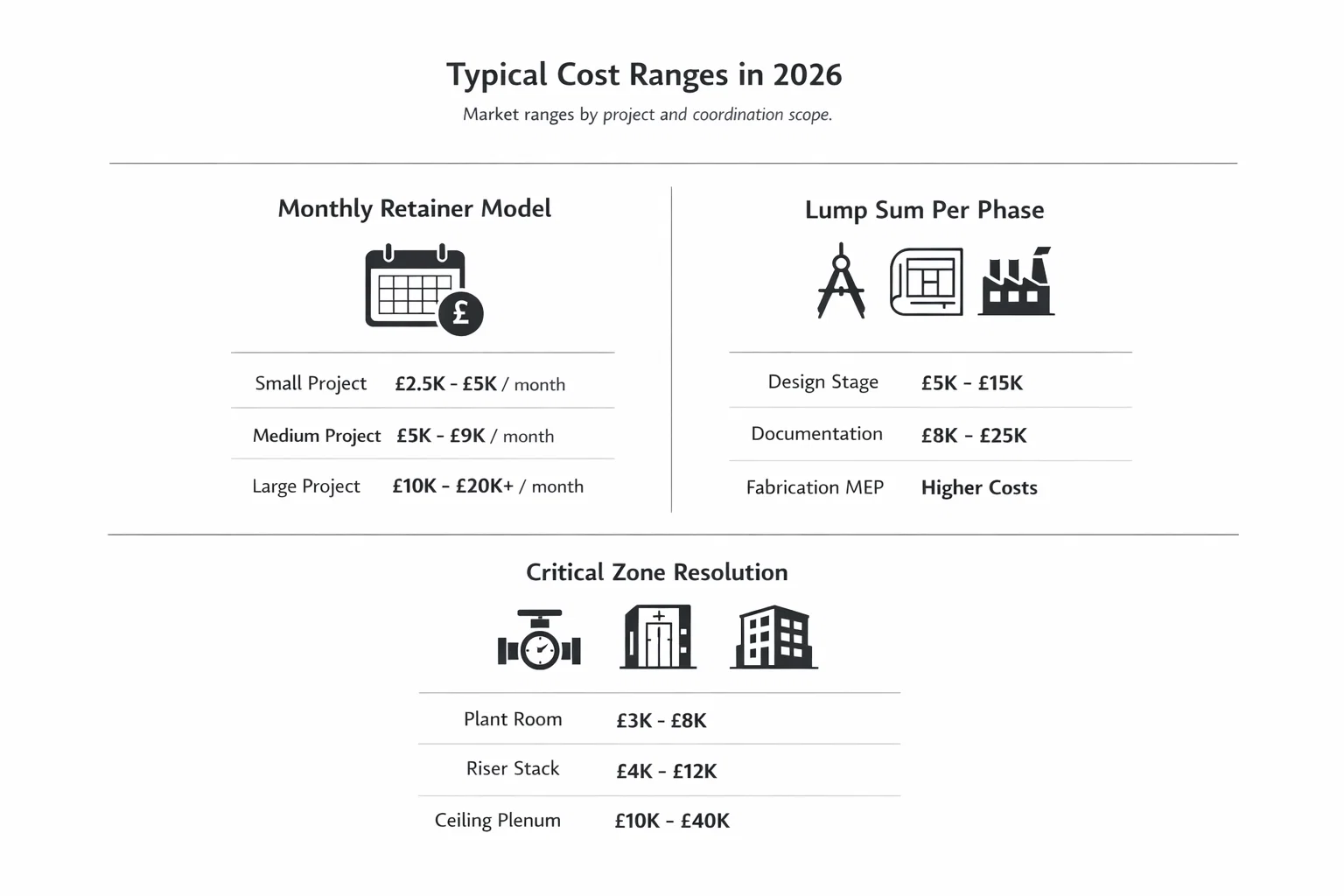
There is no universal rate. Pricing depends on project size, discipline complexity, and how early coordination starts. That said, market ranges have become more predictable in recent years.
Monthly Retainer Model
Many projects use a monthly coordination retainer.
Typical ranges:
- Small commercial project: £2,500 to £5,000 per month
- Medium commercial or mixed-use: £5,000 to £9,000 per month
- Large hospital, industrial, or data centre: £10,000 to £20,000+ per month
Retainers usually cover ongoing clash testing, reporting, and coordination meetings over the project phase.
Lump Sum Per Phase
Some firms price coordination by stage:
- Design Development coordination: £5,000 to £15,000
- Construction Documentation coordination: £8,000 to £25,000
- Fabrication-level coordination for complex MEP: Significantly higher
This approach works when scope and timeline are clearly defined.
Critical Zone Resolution Packages
When the focus is limited to high-risk zones rather than full-building coordination, pricing often scales by area and complexity.
For example:
- Single plant room resolution: £3,000 to £8,000
- Major riser stack coordination: £4,000 to £12,000
- Multi-floor ceiling plenum resolution: £10,000 to £40,000+
These figures vary based on discipline overlap and modelling detail.
Powerkh’s Approach to Design Coordination and Critical Zone Resolution

En Powerkh, we are an engineering-led digital construction consultancy supporting project teams from design through construction. Our Design Coordination & Critical Zone Resolution service is delivered during RIBA Stages 3 and 4, where coordination risk is highest and key decisions are still flexible. We focus on spatial coordination across structure, MEP, and architecture, with particular attention to plant rooms, risers, and constrained areas that typically create pressure on programme and budget.
Our work in this stage includes focused, risk-based clash resolution and model health and readiness reviews. The aim is clear – resolve key interfaces before design decisions are fixed. By concentrating coordination effort on the areas that create the most risk, we avoid unnecessary modelling in low-impact zones and keep the scope aligned with real project priorities.
Because we also provide structural and MEP design support, BIM modelling, and constructability reviews, coordination is not handled in isolation. It is part of a continuity-led workflow that carries design intent forward. This structured approach directly influences cost. When models are coordination-ready and intent is clearly defined, coordination becomes more efficient, meetings are more productive, and fewer issues reach the site.
What Drives the Cost
Two buildings with the same floor area can produce very different coordination budgets. Square metres matter, but they rarely tell the full story.
Discipline Density
A shell-only building is simple. Add HVAC, medical gases, fire protection, cable trays, sprinklers, and prefabricated racks, and coordination effort multiplies.
More systems mean more clash combinations, more routing decisions, and more stakeholder meetings.
Complex MEP environments are consistently more expensive to coordinate.
Model Maturity
If trade models are clean and follow a BIM Execution Plan, coordination is efficient.
If models are:
- Inconsistent in LOD.
- Misaligned to survey control.
- Missing clearance data.
- Built without naming standards.
Then coordination time increases. Someone must correct the structure before meaningful clash testing begins.
Level of Detail and Tolerance
Higher LOD does not simply mean more geometry. It means more responsibility.
LOD 200 coordination may focus on major routing. LOD 300 and above introduce precise spatial control. Fabrication-level coordination requires millimetre tolerance validation.
As tolerances tighten, review time increases. So does liability exposure.
Number of Trades Involved
A project with three coordinated trades behaves differently from one with ten.
Each additional trade increases model merge complexity, meeting time, issue tracking overhead, and revision cycles.
Coordination grows exponentially, not linearly.
Frequency of Coordination Cycles
Weekly clash cycles cost more than bi-weekly cycles. Overnight testing and structured reporting require time allocation.
Typical coordination programs include initial heavy clash pass, weekly issue reviews, update verification, and sign-off documentation.
Shorter programmes compress effort and raise costs.
How Critical Zones Affect Budget
Critical zones are high-risk by nature. They are often where coordination budgets either prove their value or expose gaps.
Examples of critical zones include:
- Central plant rooms.
- Main MEP risers.
- Dense corridor ceilings.
- Prefabrication rack corridors.
- Interface zones between new and existing structures.
Resolving these areas demands more than clash detection. It involves scenario testing, rerouting proposals, and negotiation between disciplines.
This increases cost because:
- Multiple iterations may be required.
- Trade leads must approve adjustments.
- Clearance modelling is introduced.
- Constructability validation becomes stricter.
Critical zone resolution often costs more per square metre than general coordination. But it also protects the highest-risk areas of the project.
In-House vs Outsourced Coordination Cost
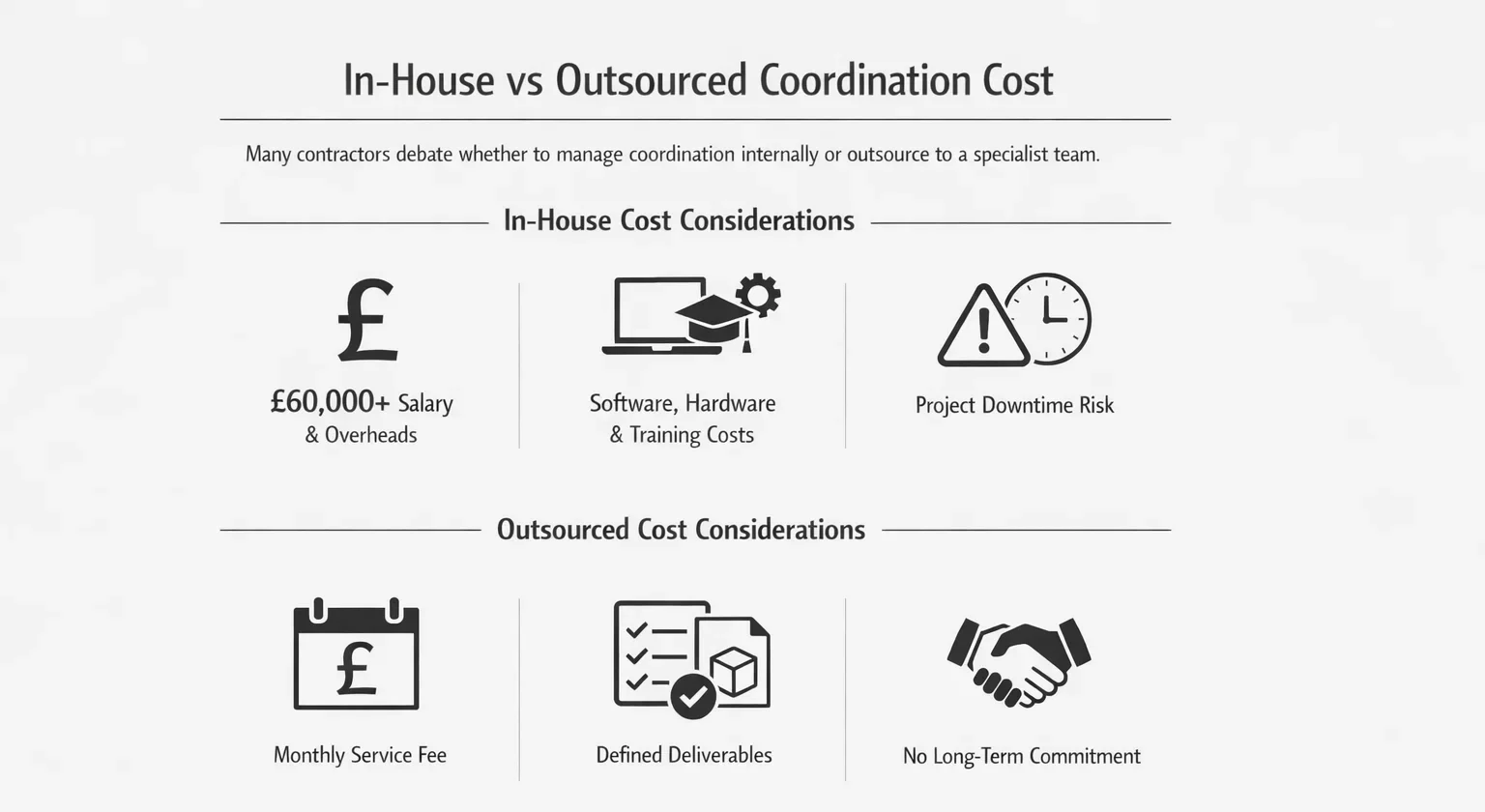
Many contractors debate whether to manage coordination internally or outsource to a specialist team.
In-House Cost Considerations
An internal coordination lead may carry salary and benefits, software licensing, hardware requirements, training costs, and project downtime risk.
A mid-level VDC manager salary can exceed £60,000 annually before overhead. Add software and management time, and real cost increases.
Outsourced Cost Considerations
Outsourced coordination is typically structured as monthly service fee, defined deliverables, no software seat purchase required, and no long-term employment commitment.
This converts fixed overhead into variable cost. It also introduces neutrality between trades, which can help resolve disputes faster.
That said, outsourcing requires a clear BIM Execution Plan and disciplined information flow. Without that structure, savings disappear.
What Is Usually Included in Coordination Pricing
A professional coordination package typically includes:
- Federated model setup.
- Clash matrix definition.
- Hard clash testing.
- Soft clash or clearance review where agreed.
- Issue tracking and reporting.
- Live coordination meetings.
- Verification of resolved clashes.
- Sign-off documentation.
Deliverables often include clash reports, annotated model views, and meeting minutes.
What May Be Excluded Unless Agreed
Certain tasks are frequently excluded from baseline pricing:
- Trade model creation.
- Full BIM modelling services.
- Detailed deviation analysis.
- Site scanning.
- Fabrication shop drawing production.
- Repeated late-stage redesign.
If coordination scope expands mid-project, costs rise accordingly.
Sample Budget Scenarios
To make this practical, consider three simplified examples.
Scenario 1 – Mid-Size Office Fit-Out
A mid-size office fit-out typically involves around five coordinated trades working within a ceiling space that is busy but not extreme. Weekly coordination sessions run for roughly three months, allowing clashes to be identified and resolved before installation begins. In this context, total coordination costs usually fall between £15,000 and £25,000. At first glance that may seem like a noticeable line item, but unresolved ceiling conflicts during fit-out can easily exceed that amount once delays, redesign, and labour downtime are factored in.
Scenario 2 – Hospital Extension
A hospital extension presents a very different coordination environment. It often brings together more than ten trades, including specialist systems such as medical gases, all competing for limited space within tight ceiling voids. Plant rooms become critical zones that require detailed modelling and structured resolution before fabrication. Over the full project duration, coordination costs in this setting typically range from £60,000 to £120,000 or more. While that figure may appear substantial, the cost of a single major MEP reroute during construction can quickly justify the investment.
Scenario 3 – Industrial Facility with Prefabrication
Industrial facilities that rely on prefabrication operate on a different level of precision. These projects usually involve dense MEP layouts, rack-based installations, and schedules driven by fabrication milestones. Coordination in this context is not simply helpful, it becomes foundational. Total coordination costs often sit between £80,000 and £200,000 or higher, depending on complexity. When prefabricated elements arrive on site, there is little room for improvisation. Certainty is required, and structured coordination provides that certainty before steel is cut and systems are assembled.
How to Keep Coordination Costs Proportionate
Costs rise when scope drifts or expectations remain unclear. A few structured decisions help keep budgets balanced.
- Define LOD expectations early.
- Limit high-detail modelling to critical zones.
- Ensure survey control is accurate before federation.
- Lock the clash matrix at project start.
- Avoid introducing new trades late.
Clear boundaries protect both schedule and budget.
Is Design Coordination Worth the Cost?
Coordination does not generate visible construction. It removes invisible risk. That can make it harder to justify at first glance.
But compare two outcomes. A coordinated digital model where clashes are resolved in hours and a field conflict that stops crews, triggers redesign, and delays procurement.
The difference rarely appears small in practice.
Design coordination and critical zone resolution should not be evaluated as overhead alone. They are risk control mechanisms tied directly to schedule protection, fabrication certainty, and margin preservation.
Reflexiones finales
Design coordination and critical zone resolution costs vary because projects vary. There is no flat rate that applies to every building.
Small commercial coordination may sit in the tens of thousands. Large infrastructure projects may require six-figure budgets. What determines value is not the size of the number, but whether it reflects actual risk.
When scoped properly, coordination aligns model intent with physical reality before materials are ordered and crews arrive. That shift from reactive correction to proactive control is where the real return appears.
PREGUNTAS FRECUENTES
1. How much should design coordination cost on a typical commercial project?
For a mid-size commercial building, coordination often falls somewhere between £15,000 and £70,000 depending on trade density, programme length, and modelling detail. Smaller fit-outs sit at the lower end. Complex MEP-heavy projects move upward quickly.
2. Why does coordination cost vary so much from project to project?
Because the risk profile changes. A simple office with a few services is very different from a hospital or industrial plant with tight voids and specialist systems. The number of trades, model quality, and required tolerance levels all affect the final figure.
3. Is critical zone resolution priced separately from full coordination?
Often yes. When the focus is limited to plant rooms, risers, or other constrained areas, it can be scoped and priced as a defined package. This keeps cost targeted rather than spreading effort across the entire building.
4. Does starting coordination earlier reduce cost?
In most cases, it does. When coordination begins during design development, routing changes are easier and faster. Waiting until fabrication increases rework and compresses timelines, which pushes costs up.
5. What usually increases coordination fees unexpectedly?
Late design changes, additional trades joining mid-programme, or poorly prepared models can all extend coordination cycles. Extra iterations mean extra hours, and that affects the budget.
6. Is coordination cheaper if managed in-house?
Not automatically. Internal teams still require salaries, software, and dedicated time. The real comparison is total cost and capacity. Some firms prefer outsourcing because it converts fixed overhead into a defined project fee.

¿Tiene un proyecto BIM? Hable con nosotros.
Contacte con nosotrosNuestros casos prácticos
Hemos gestionado más de 200 proyectos BIM y VDC para los sectores comercial, industrial y residencial.
Nuestro trabajo incluye:
Automatización del diseño de encofrados
Our client from
California, USA
Automatización del diseño de falsos techos
Our client from
New York, USA
Automatización del diseño del entramado de muros
Our client from
California, USA