¿Tiene alguna pregunta? Póngase en contacto con nosotros
¡Únete a nuestro equipo!
Solicitar presupuesto o consulta gratuita

If you have ever walked into a mechanical room halfway through construction, you already know why this topic matters.
Ducts crossing cable trays. Pipes colliding with structural beams. Ceiling voids packed so tight that one change forces five more. Everyone looking at each other asking, “Who was supposed to catch this?”
That moment is expensive.
Coordination and critical zone resolution exist to prevent exactly that scenario. But how much does it actually cost? And more importantly, how much does it save?
This article breaks down real-world pricing, what drives the numbers, and what you should realistically budget.
What Is Coordination and Critical Zone Resolution?
Before we talk numbers, we need clarity.
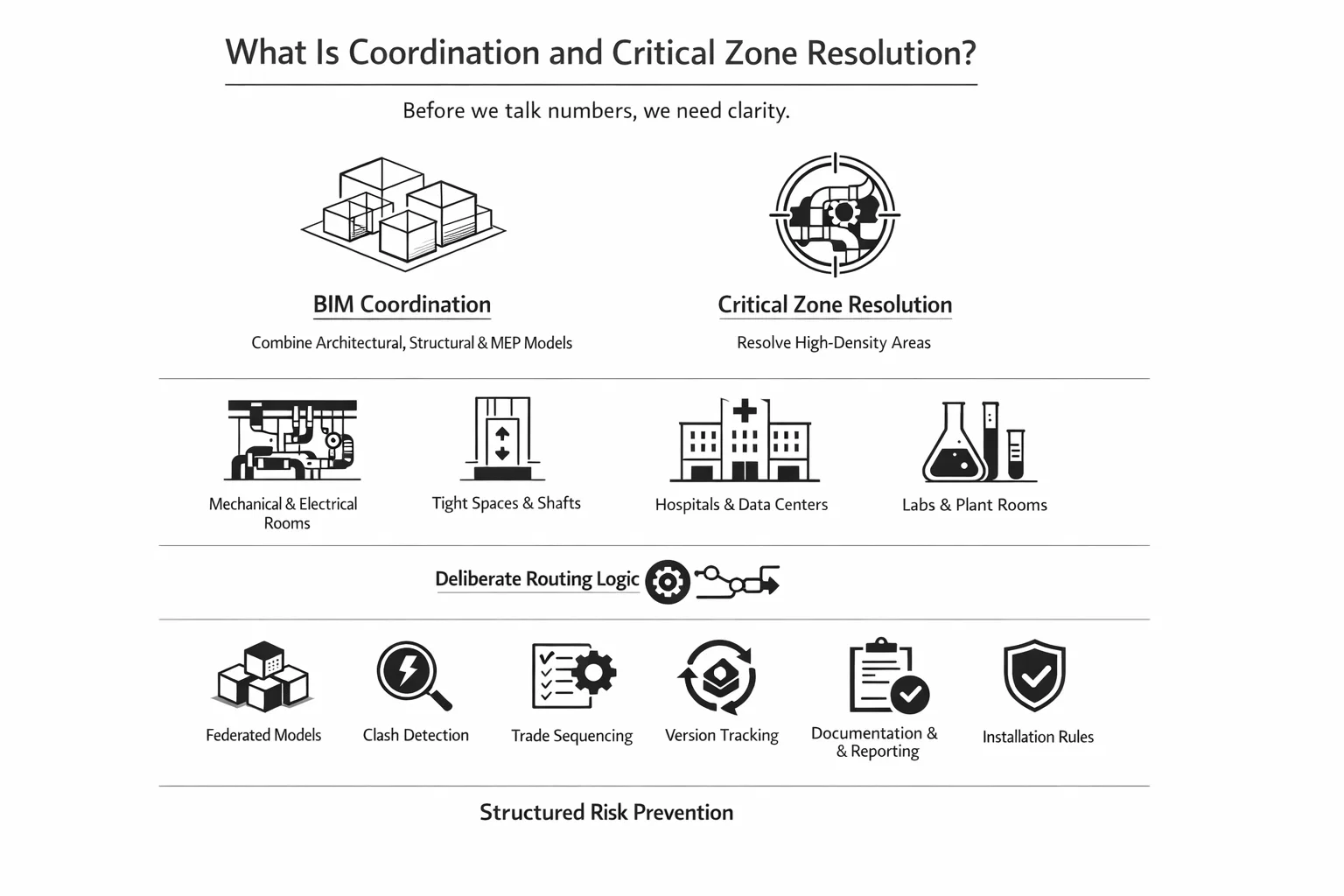
- Coordinación BIM is the structured process of combining architectural, structural, and MEP models to identify and resolve spatial conflicts before construction.
- Critical zone resolution focuses on high-density areas where multiple systems overlap and installation tolerance is minimal. These typically include mechanical rooms and electrical rooms, as well as vertical shafts and ceiling voids where space is tightly constrained. It also applies to plant rooms, laboratories, hospitals, and data centers, where the concentration of MEP systems makes precise coordination essential.
These areas demand deliberate routing logic, not trial and error.
Coordination is not just running clash detection software. It involves federated model management, systematic clash detection and categorization, and making clear trade sequencing decisions. It also includes ongoing model updates and version tracking, structured resolution meetings, thorough documentation and reporting, and the definition of installation rules. In short, it is structured risk prevention.
How Powerkh Manages Coordination and Critical Zones

Powerkh is a UK-based company with offices in the USA and Ukraine, and coordination and critical zone resolution are at the core of how we help clients control project costs before construction begins. We work with architects, engineers, contractors, and developers to move clash resolution from the jobsite to the model, where it belongs. Our focus is simple – reduce risk, improve constructability, and protect project margins through structured BIM coordination.
We provide BIM modeling, BIM coordination, MEP integration, clash detection, Scan to BIM, prefabrication modeling, and structural detailing. Using tools such as Revit and Navisworks, we integrate architectural, structural, and MEP systems into coordinated 3D models, identify conflicts early, and support resolution through clear reporting and coordination meetings. We also develop shop drawings and prefabrication-ready models to ensure what is built matches what was coordinated. Our approach is practical, data-driven, and aligned with real construction workflows – because coordination is not about software, it is about preventing costly surprises in the field.
How Coordination and Critical Zone Resolution Costs Are Structured
When it comes to pricing, coordination and critical zone resolution are typically calculated in four main ways: as a percentage of the total construction cost, as a percentage of the MEP contract value, as a fixed project fee, or as an hourly rate. Each approach reflects a different project structure and level of complexity.
1. Percentage of Construction Budget
Industry data consistently shows that BIM coordination typically costs between:
- 0.8 percent of total construction budget on standard projects
- Up to 2 percent of total construction budget on complex builds
For MEP-heavy projects, coordination and critical zone resolution can represent:
- Around 6 percent of the total MEP contract value
To put that into perspective, on a 25 million dollar commercial project, 0.8 percent would equal approximately 200,000 dollars, while 2 percent would reach about 500,000 dollars. If the MEP contract on that same project is 8 million dollars, allocating 6 percent for detailed MEP coordination would result in roughly 480,000 dollars.
2. Fixed Project Fees
For many contractors and developers, especially on mid-sized jobs, coordination is quoted as a lump sum.
Typical market ranges look like this:
- 3,000 to 10,000 dollars – small projects
- 10,000 to 30,000 dollars – medium commercial projects
- 30,000 to 80,000 dollars or more – larger or complex projects
Most small to medium coordination scopes fall between 10,000 and 49,000 dollars.
These figures usually include clash detection and critical zone analysis. Rarely is critical zone resolution priced separately. It is part of the broader coordination effort.
3. Hourly Rates
Some firms price coordination on an hourly basis.
- 25 to 49 dollars per hour – typical BIM coordination rates
The total cost depends on model complexity, the number of trades involved, the level of detail required, the number of clash resolution cycles, the frequency of coordination meetings, and the quality of the design models received. If a project requires 400 hours of coordination at 40 dollars per hour, the total would be 16,000 dollars. As complexity increases, the required hours rise accordingly.
Why Coordination Costs Vary - And What Is at Stake
Coordination pricing is not arbitrary. The numbers shift based on technical complexity, project timing, and the level of risk involved. To understand why budgets vary, you first need to understand what deeper coordination actually covers and what happens when it is overlooked.
What Critical Zone Resolution Adds
Critical zone resolution is more than additional clash detection. It defines installation priority, establishes trade sequencing logic, allocates control zones, validates maintenance clearances, and ensures prefabrication accuracy. In tight spaces, even minor adjustments can trigger wider consequences. If HVAC duct routing shifts by 100 millimeters, electrical conduit may need rerouting, fire protection lines adjust, structural hangers relocate, and access panels move. One unresolved clash can create a chain reaction. Critical zone resolution is designed to stop that ripple effect before it reaches the field.
Why Do Costs Vary So Much?
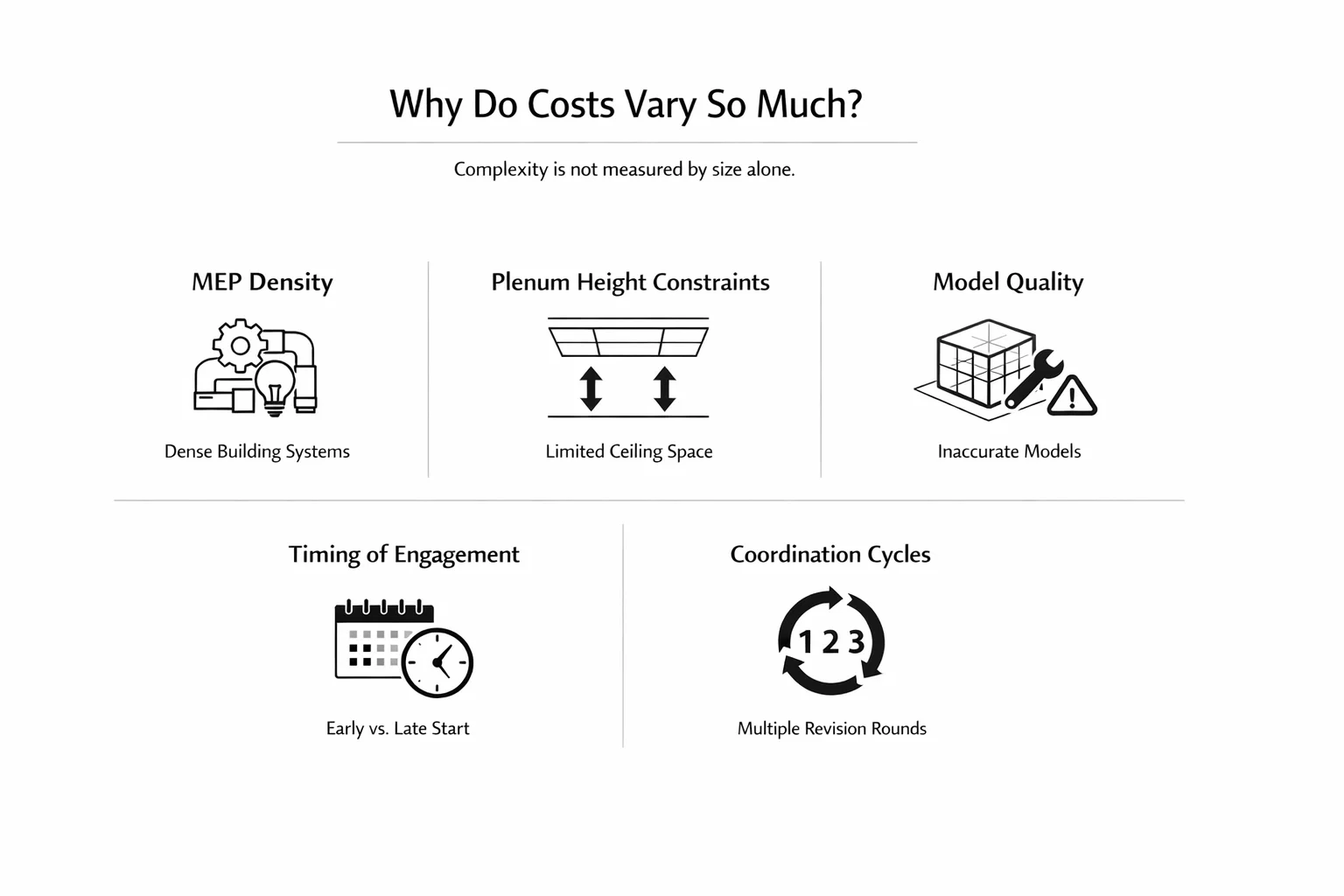
Two projects with similar square footage can have very different coordination costs because complexity is not measured by size alone.
1. MEP Density
The concentration of building systems has a direct impact on coordination effort. A warehouse with open ceilings requires far less coordination than a hospital with compressed plenum space. Greater system density results in more clashes, additional routing decisions, repeated coordination cycles, and ongoing revisions. Facilities such as hospitals, laboratories, and data centers require significantly more detailed coordination.
2. Plenum Height Constraints
Limited ceiling space adds another layer of difficulty. When plenum height is restricted, routing tolerance decreases, sequencing becomes more critical, and even small adjustments affect adjacent systems. This increases the number of coordination hours required.
3. Model Quality
The condition of incoming models also affects workload. If models are incomplete or misaligned, time must be spent cleaning and restructuring data before coordination can properly begin. Well-structured models reduce effort, while poor-quality inputs increase it.
4. Timing of Engagement
The stage at which coordination begins influences cost. Early coordination during design is more efficient and less expensive. Late-stage resolution after fabrication or partial installation becomes reactive and requires additional time. Addressing issues in a cold zone during design is more cost-effective than correcting them in a hot zone during construction.
5. Number of Coordination Cycles
Project dynamics also matter. Some projects resolve conflicts in two or three structured rounds, while others require multiple cycles due to design changes or stakeholder decisions. Each additional coordination round increases overall cost.
The Cost of Not Coordinating
Unresolved clashes are not minor issues. Field modifications can cost between 2,000 and 10,000 dollars per incident. Rework may account for 5 to 15 percent of total construction cost, and in extreme situations, up to 30 percent of project cost can be tied to rework and waste.
On a 20 million dollar project, losing 10 percent to rework equals 2 million dollars. If coordination cost 200,000 dollars, the remaining 1.8 million dollars was protected. This is why coordination is consistently viewed as a high-return investment rather than an optional expense.
Return on Investment and Budget Planning for Coordination
Understanding the cost of coordination only makes sense when viewed alongside its financial impact. Budgeting should not be based on fear of expense, but on clarity of risk and measurable return.
Real Return on Investment
Industry data shows that effective BIM coordination can reduce total project costs by around 8 percent, shorten project duration by more than 10 percent, and deliver up to a 10x return on the coordination investment. Even conservative assessments confirm that coordination typically pays for itself.
The goal is not to eliminate every clash. That is unrealistic. The objective is to shift problem-solving from the jobsite to the model. Resolving a clash digitally takes hours. Resolving it onsite can take days.
Practical Budgeting Framework
When planning coordination and critical zone resolution, budgeting should reflect project type and complexity.
- Standard Commercial Projects. Allocate around 1 percent of total construction cost. If MEP systems are dense, plan for 1.5 to 2 percent.
- MEP-Heavy Facilities. For hospitals, laboratories, data centers, and high-rise towers, budget 4 to 6 percent of the MEP contract value.
- Smaller Projects. For most small to mid-sized commercial jobs, a full coordination scope typically falls between 10,000 and 30,000 dollars.
What the Budget Should Cover
A coordination proposal should include federated model setup, regular clash detection reports, categorized clash logs, a resolution tracking matrix, a defined trade sequencing framework, established control zones, updated coordinated models, meeting facilitation, and final coordination sign-off documentation. If these elements are not clearly included, the lower price may come at the expense of reduced protection.
Conclusión
Coordination and critical zone resolution usually cost a small fraction of the overall project budget. Ignoring them can cost a multiple of that.
Most projects that struggle with overruns do not fail because of one dramatic mistake. They bleed slowly through small clashes, late changes, and trade conflicts that could have been resolved earlier. That is where coordination earns its keep.
You are not paying for software. You are paying to avoid rework, downtime, and frustration on site.
In construction, problems do not disappear. They either get solved in a meeting room, or in the field with tools in hand. One of those options is consistently cheaper.
PREGUNTAS FRECUENTES
1. How much should I budget for BIM coordination on a standard commercial project?
A practical benchmark is around 1 percent of the total construction cost. If the building has dense MEP systems or tight ceiling spaces, budgeting closer to 1.5 or 2 percent is more realistic.
2. Is critical zone resolution priced separately from BIM coordination?
In most cases, no. Critical zone resolution is typically part of the overall coordination scope. It requires additional focus in high-density areas, but it is rarely a standalone service with a separate fee.
3. Why does coordination cost more on hospitals and data centers?
These facilities have extremely dense MEP systems and limited routing space. That increases clash volume, sequencing complexity, and the number of coordination cycles required. More technical effort means higher coordination hours.
4. Can small projects justify spending 10,000 to 30,000 dollars on coordination?
In many cases, yes. Even a few field clashes can exceed that amount. If coordination prevents multiple rework incidents, it pays for itself quickly.
5. What is the biggest factor that increases coordination costs?
Late engagement. When coordination starts after fabrication decisions have been made or installation has begun, resolving conflicts becomes reactive and more labor-intensive. Early coordination is almost always more efficient.
6. Does coordination eliminate all clashes?
No, and it is not meant to. The goal is to resolve major system conflicts before construction starts and to minimize high-risk issues in critical zones. It reduces exposure. It does not promise a perfectly frictionless project.

¿Tiene un proyecto BIM? Hable con nosotros.
Contacte con nosotrosNuestros casos prácticos
Hemos gestionado más de 200 proyectos BIM y VDC para los sectores comercial, industrial y residencial.
Nuestro trabajo incluye:
Automatización del diseño de encofrados
Our client from
California, USA
Automatización del diseño de falsos techos
Our client from
New York, USA
Automatización del diseño del entramado de muros
Our client from
California, USA