¿Tiene alguna pregunta? Póngase en contacto con nosotros
¡Únete a nuestro equipo!
Solicitar presupuesto o consulta gratuita

BIM Information Management Support: How to Keep Naming, Classification and Parameters Consistent
Shortcuts in naming and parameters rarely look serious at the start. A few missing fields. Slightly different classifications. One consultant using a different naming logic. It feels manageable. Then coordination starts slipping, schedules misalign, and data becomes unreliable.
That is where BIM information management support makes a real difference. It keeps naming conventions, classification systems and parameters aligned so models stay usable from design through construction and handover.
This article explains why inconsistency happens, what it costs, and how structured BIM information management support prevents and fixes the problem.
Why Data Consistency Is a Bigger Problem Than It Looks
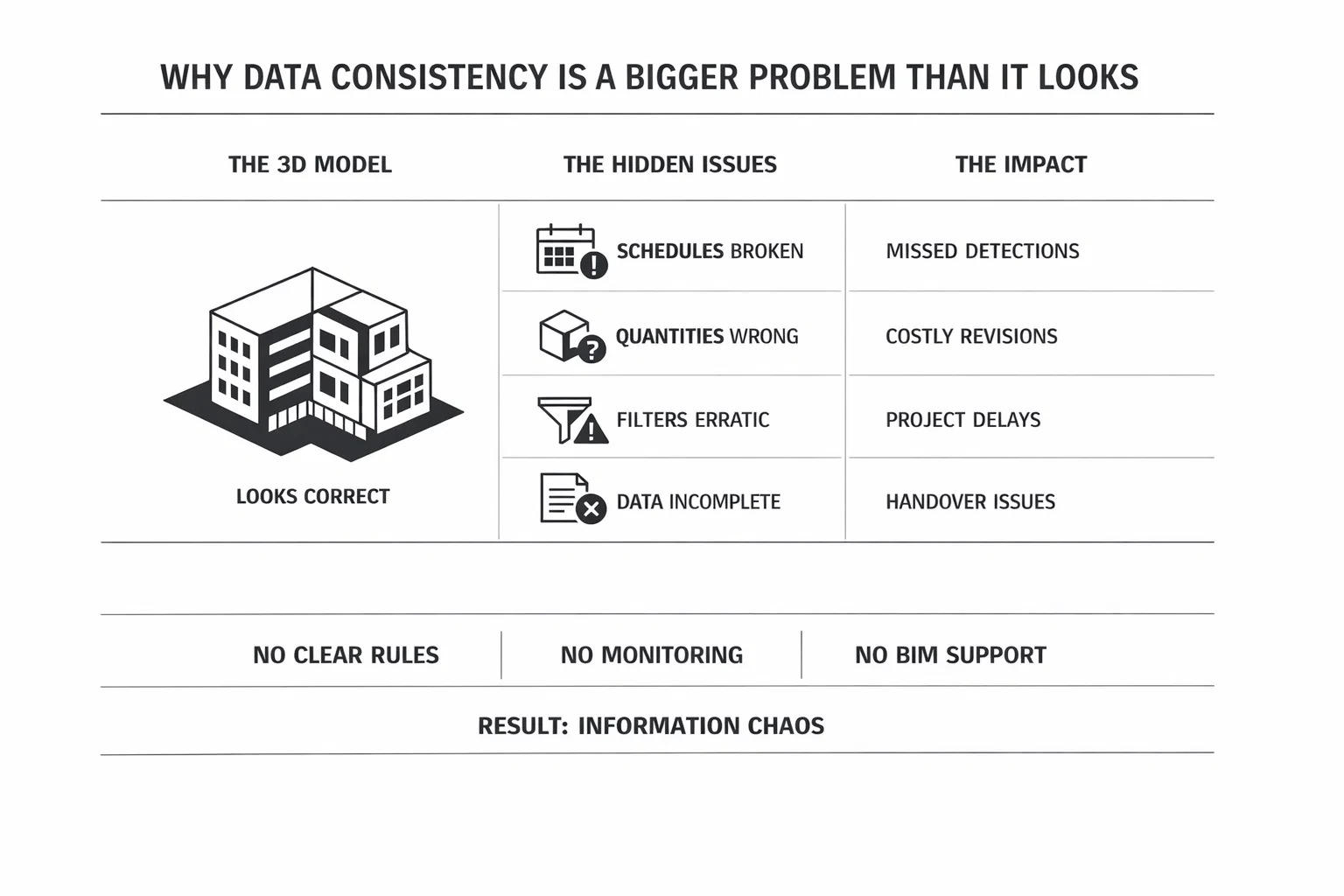
On paper, BIM promises a single source of truth. In reality, that only works if information is structured properly.
When naming, classification and parameters drift out of sync, the model may still look correct in 3D. But behind the scenes:
- Schedules stop pulling the right elements.
- Quantities become unreliable.
- Filters and views behave unpredictably.
- Asset data is incomplete at handover.
Teams often notice the issue late. By then, fixing it is expensive and frustrating.
The root cause is rarely technical incompetence. It is usually a lack of clear rules, monitoring, and ongoing BIM information management support.
Where Inconsistency Usually Starts
Every project has a moment when information standards are defined. Sometimes in the BEP. Sometimes in a shared spreadsheet. Sometimes verbally.
The gaps begin when naming rules are written but not enforced. Different consultants use slightly different classification systems. Parameters are added without coordination. Shared parameters are not centrally managed. No one checks compliance regularly.
It sounds minor. It never stays minor.
A door family with the wrong classification code can break procurement reports. A missing fire rating parameter can compromise compliance checks. A poorly structured naming format can make clash reports hard to interpret.
Over time, small deviations multiply.
Controlling Naming, Classification and Parameters Together
Information problems rarely exist in isolation. If naming is inconsistent, classification often follows. If classification drifts, parameters usually become unreliable. Treating these as separate technical issues misses the bigger picture. They are all part of the same data structure.
Strong BIM information management support looks at them together, not one by one.
Naming – The First Layer of Order
Naming is often seen as admin work. In practice, it shapes how teams read and trust the model.
Consistent naming supports clear model navigation, reliable model federation, structured clash reporting, and efficient issue tracking.
When naming logic is unclear, coordination slows down. Meetings drift into debates about what an element represents instead of how to resolve the issue.
Effective BIM information management support introduces standardised model naming formats, clear element naming conventions, agreed prefix and suffix logic, and automated validation checks.
It removes guesswork. That alone improves coordination speed.
Classification – Connecting Design to Delivery
Classification is more than a code attached to an object. It connects design information to cost plans, procurement systems and asset registers.
When classification is inconsistent:
- Cost plans fail to map correctly.
- Procurement schedules become unreliable.
- Asset registers need manual correction.
- Handover turns into a data clean-up task.
A common issue is partial adoption. One discipline follows the required framework. Another keeps legacy codes. A third adds custom classifications. The model technically works, but downstream workflows break.
Structured BIM information management support ensures one agreed classification framework, clear mapping rules across disciplines, centralised guidance for implementation, and ongoing compliance reviews.
Consistency at this level protects commercial workflows.
Parameters – Where Chaos Hides
Parameters are usually the quiet problem. They accumulate slowly.
Over time, models often contain duplicate parameters with similar names, inconsistent data types, redundant fields, and missing mandatory values.
Reporting becomes unreliable. Filters behave unpredictably. Data exports require manual correction.
It is common to see variations like “FireRating”, “Fire Rating” and “FR_Value” coexisting. All valid. None aligned.
Strong BIM information management support introduces a shared parameter library, controlled naming logic for fields, clear ownership of parameter creation, and regular audits.
The objective is not to limit teams. It is to protect clarity and prevent reporting breakdown.
The Commercial Impact of Getting It Wrong
Data inconsistency is not just a modelling inconvenience. It carries financial and contractual risk.
Typical impacts include:
- Delayed approvals.
- Rework during coordination.
- Disputes over deliverable compliance.
- Failed information requirements.
- Asset data rejection at handover.
Many organisations request BIM information management support only after problems become visible. By then, remediation is more expensive.
Preventive support is far more efficient. It protects both technical quality and commercial certainty.
A Simple Remediation Process That Works
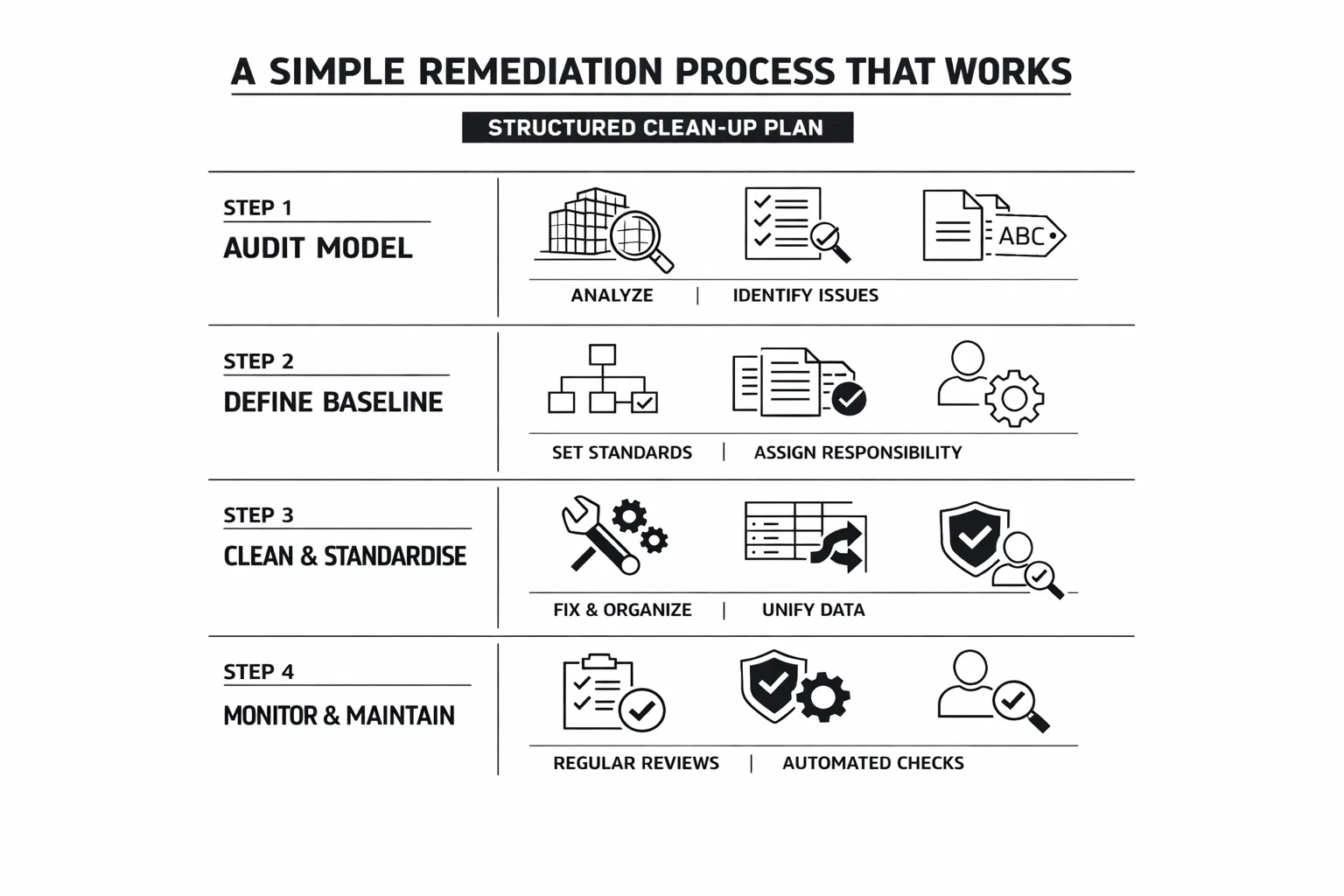
When a project already has data inconsistency, panic rarely helps. A structured clean-up plan works better.
Step 1 – Audit the Current Model Environment
The first move is not to fix anything. It is to understand what is actually happening inside the model. That means reviewing how well naming conventions are being followed, whether classification codes are applied consistently, how parameters are structured, and how all of this aligns with the agreed project standards.
This stage reveals more than most teams expect. It shows where deviations exist, how often they occur, and whether the issue is isolated to one discipline or spread across the entire project. Without this clarity, any attempt to correct the model risks becoming guesswork.
Step 2 – Define a Clear Data Baseline
Once the current condition is visible, the next step is to establish what the model should look like. This includes confirming the approved naming structure, the required classification system, the mandatory parameter set, and who is responsible for maintaining each part of the information framework.
The baseline needs to be practical. If it is overly complex or unrealistic for daily workflows, it will not hold. Strong BIM information management support focuses on clarity and usability, not on producing a thick document that no one consistently follows.
Step 3 – Clean and Standardise
With a clear baseline in place, the model can be corrected in a controlled way. This may involve renaming elements systematically, reassigning incorrect classification codes, merging duplicate parameters, and removing outdated or redundant fields.
Tools can accelerate parts of this process, especially when dealing with large datasets. However, tools alone do not solve structural issues. Governance and clear decision-making matter more than automation. The objective is not just to tidy the model, but to realign it with a coherent information structure.
Step 4 – Introduce Ongoing Monitoring
Cleaning the model once is not enough. Without monitoring, inconsistency gradually returns. Teams change, project phases shift, and new requirements appear.
Sustainable control comes from regular compliance reviews, automated validation checks where appropriate, clearly defined review milestones, and assigned ownership for data governance. Someone must be accountable for maintaining standards.
This is where long-term BIM information management support proves its value. It does not just correct problems. It prevents them from reappearing.
How Powerkh Delivers Practical BIM Information Management Support

En Powerkh, we regularly step into projects where information structure has started to drift. Naming conventions are applied differently across teams. Classification systems are only partially implemented. Parameters grow without control. It rarely starts as a major issue, but over time it affects coordination, reporting and handover.
We are an engineering-led digital construction consultancy supporting teams from design through construction. Our BIM modelling, coordination, automation and QA services are built around maintaining design continuity and protecting the integrity of project data. As part of our BIM information management support, we review naming logic, verify classification alignment, audit parameter structures and correct inconsistencies before they become commercial or contractual risks.
We combine structured model audits with engineering-led reviews. Through coordination support, deviation monitoring and as-built verification, Powerkh helps ensure that design intent is carried through to delivery and that the information behind the model remains usable. For us, BIM information management support is not a separate task. It is part of keeping projects stable, coordinated and ready for handover.
Preventing the Problem From Day One
The best projects treat information structure as part of design quality.
Practical measures include:
- Early agreement on naming logic.
- Clear classification mapping during Stage 2 or equivalent.
- Shared parameter templates before modelling starts.
- Defined data drop review checkpoints.
Teams often focus heavily on geometry coordination. Information structure deserves equal attention.
When structured BIM information management support is in place from the beginning, coordination improves naturally.
Governance, Asset Readiness and the Case for Ongoing Support
Information management often fails for two opposite reasons. Some teams barely define any rules. Others create long manuals that look impressive but are rarely used in daily work. Neither approach protects project data.
Effective governance sits somewhere in the middle. It is clear enough to follow, structured enough to enforce, and monitored often enough to stay relevant. The goal is alignment across teams, not bureaucracy for its own sake. A concise, well-applied standard will always outperform a detailed framework that no one actively checks.
This discipline has a direct impact on asset delivery. When naming, classification and parameters are controlled during design and construction, handover becomes a continuation of the workflow rather than a rescue operation. Asset tags align naturally with model elements. Maintenance data remains traceable. Product information connects logically to the right components. Even future digital twin initiatives become easier because the data foundation is already structured.
Without consistent BIM information management support, many teams experience the same pattern. The model appears complete, but asset data is fragmented. Classification codes do not match procurement systems. Parameters are partially filled. The final weeks of the project turn into a structured data clean-up exercise. That stage is always more expensive and more stressful than early control.
This is why information management should not be treated as a one-time setup. Projects change. Requirements evolve. New consultants join. Standards update. What was compliant six months ago may not be aligned today.
Ongoing BIM information management support introduces continuity. It provides regular monitoring, periodic audits, controlled updates to parameter libraries, and steady alignment with client information requirements. Instead of reacting to problems late, teams maintain control throughout the project lifecycle.
In practical terms, this reduces firefighting. It protects model usability. And it keeps commercial risk lower than most teams expect.
Reflexiones finales
BIM works best when information is as structured as geometry. Naming, classification and parameters are not administrative details. They are the backbone of reliable project data.
Without structure, models become visually impressive but operationally weak. With proper BIM information management support, data remains consistent, usable and commercially reliable from concept to handover.
Inconsistent naming can be corrected. Broken classification can be realigned. Duplicate parameters can be merged. What matters is having a structured, ongoing approach that prevents the problem from repeating.
That is where BIM information management support stops being optional and becomes essential.
PREGUNTAS FRECUENTES
1. What is BIM information management support in simple terms?
BIM information management support is structured oversight of how data is created, named, classified and maintained inside a BIM environment. It is not just model checking. It focuses on keeping naming conventions consistent, classification aligned and parameters controlled so the model stays reliable for coordination, reporting and handover.
2. When should a project bring in BIM information management support?
Ideally, at the start of design. That is when naming rules, classification frameworks and parameter structures are defined. In reality, many teams bring it in after inconsistencies start affecting coordination or deliverables. Early support is cleaner. Late support is more corrective.
3. Can inconsistent parameters really cause commercial risk?
Yes, and it happens more often than expected. If parameters are duplicated, misnamed or incomplete, schedules and reports can become unreliable. That can delay approvals, affect procurement mapping or create disputes about whether information requirements have been met.
4. Is this only relevant for large or complex projects?
No. Smaller projects feel the impact too, especially when multiple disciplines contribute to the same model. Even a modest development can struggle if naming and classification are not aligned. Scale increases complexity, but inconsistency creates friction at any size.
5. Does BIM information management support replace coordination?
It does not replace coordination. It strengthens it. Clean naming, consistent classification and controlled parameters make coordination more efficient. Teams spend less time interpreting the model and more time resolving actual design issues.
6. How do you prevent the same issues from returning after cleanup?
Cleanup without monitoring rarely lasts. Ongoing checks, clear ownership of standards and periodic audits are essential. BIM information management support works best as a continuous process, not a one-time correction exercise.

¿Tiene un proyecto BIM? Hable con nosotros.
Contacte con nosotrosNuestros casos prácticos
Hemos gestionado más de 200 proyectos BIM y VDC para los sectores comercial, industrial y residencial.
Nuestro trabajo incluye:
Automatización del diseño de encofrados
Our client from
California, USA
Automatización del diseño de falsos techos
Our client from
New York, USA
Automatización del diseño del entramado de muros
Our client from
California, USA