¿Tiene alguna pregunta? Póngase en contacto con nosotros
¡Únete a nuestro equipo!
Solicitar presupuesto o consulta gratuita

Quick Summary: Soft costs in construction are indirect expenses required to complete a project but don’t involve physical building work—like permits, design fees, insurance, legal services, and financing costs. These typically represent 20-30% of total project budgets and are critical for accurate budgeting, yet they’re often underestimated or overlooked, leading to cost overruns.
Construction projects come with obvious expenses: lumber, concrete, steel beams, and the crews that install them. But there’s another category of costs that often catches project owners off guard.
These are the expenses that don’t result in physical building components yet can make or break a project’s financial success. They’re called soft costs, and understanding them is essential for anyone involved in construction planning or budget management.
Here’s the thing though—soft costs aren’t just miscellaneous line items to gloss over. They represent a substantial portion of every construction budget and require just as much attention as materials and labor.
Understanding Soft Costs in Construction
Soft costs are all the indirect expenses necessary for a construction project that don’t involve physical building materials or the direct labor to install them. Think of them as everything required to make construction legally, financially, and logistically possible before, during, and after the physical work happens.
While hard costs cover tangible elements like concrete, steel, and the workers who pour foundations or frame walls, soft costs cover the intangible but equally essential services and requirements.
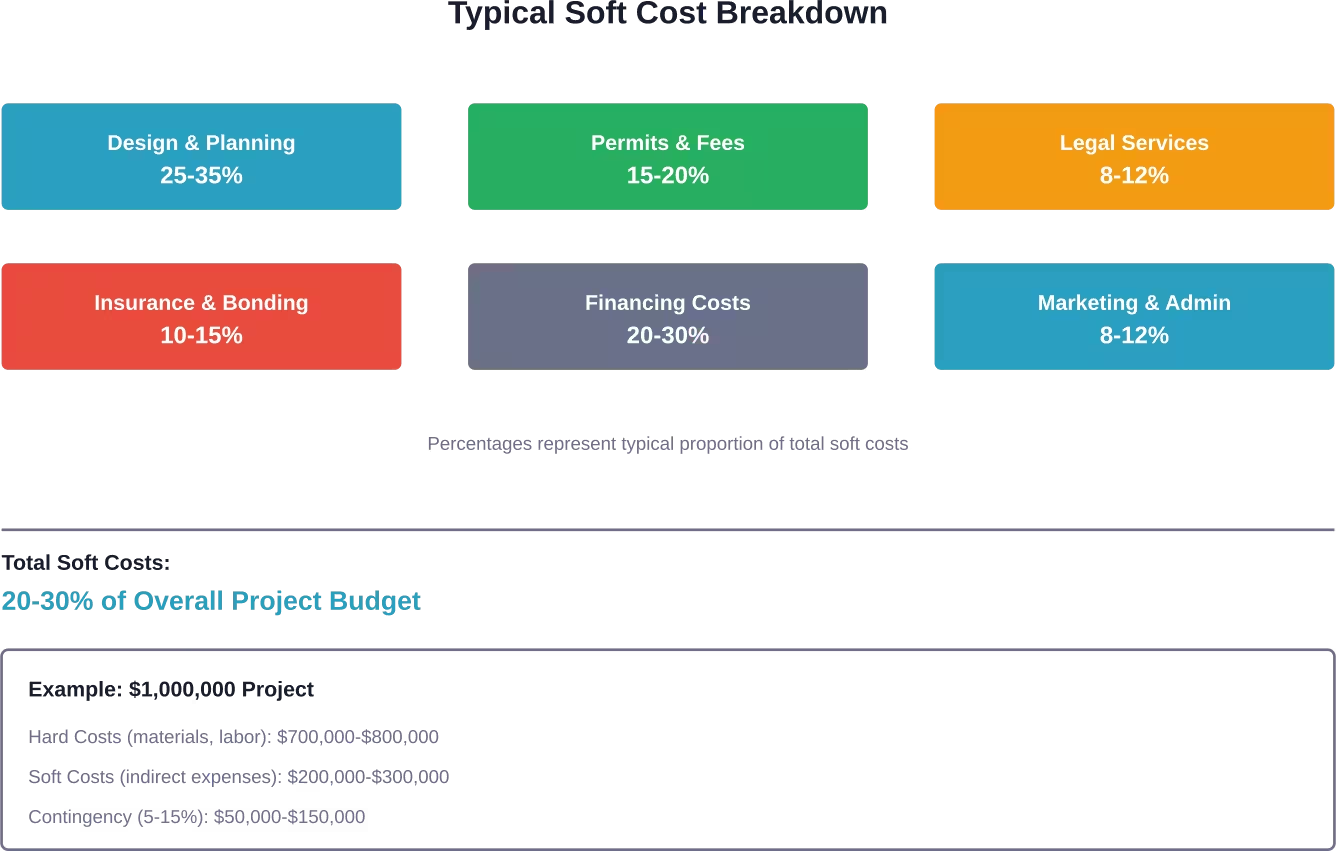
The construction soft costs percentage typically falls between 20-30% of the total project budget. That’s a significant chunk of money. On a $1 million project, soft costs could easily represent $200,000 to $300,000—hardly an amount to ignore or underestimate.
Real talk: Many project owners focus intensely on negotiating material prices and labor rates while giving soft costs minimal attention. This approach creates a blind spot that leads to budget overruns and project delays.
Why Soft Costs Matter for Project Success
Soft costs impact more than just the bottom line. They influence project timelines, quality outcomes, regulatory compliance, and long-term building performance.
According to the AIA’s January 2026 Consensus Construction Forecast, nonresidential construction faces continued economic uncertainty. The forecast panel is projecting just a 1.0% gain in spending on building in 2026, increasing to just 2.2% in 2027. Since these figures are not adjusted for inflation, the modest expectations for growth likely won’t even cover increased construction costs. In this environment, accurate cost forecasting becomes even more critical.
Ignoring soft costs or failing to estimate them accurately creates several problems:
- Budget shortfalls that halt construction mid-project
- Rushed decisions on critical design or engineering elements
- Inadequate insurance coverage that creates liability risks
- Legal complications from incomplete permitting or documentation
- Financing gaps that delay project completion
Managing these expenses properly allows for better resource allocation and helps maintain project momentum from planning through completion.
Common Types of Soft Costs in Construction
Soft costs encompass a wide range of expenses. Understanding the specific categories helps with more accurate budgeting and cost control.
Design and Planning Fees
Before any physical work begins, projects require extensive design and planning work. These professional services represent some of the largest soft cost categories.
Architectural fees cover everything from initial concept designs through construction documents. Engineering services—structural, mechanical, electrical, civil—ensure buildings are safe, functional, and code-compliant.
Design costs typically range from 6-14% of the construction budget, depending on project complexity. A straightforward office tower with repeated floor layouts sits at the lower end, while a custom healthcare facility or complex mixed-use development pushes toward the higher range.
Additional design-related soft costs include:
- Site surveys and geotechnical investigations
- Environmental impact assessments
- Landscape architecture services
- Diseño interior y planificación de espacios
- Acoustic or lighting consultants for specialized spaces
Permits, Fees, and Regulatory Costs
Construction can’t proceed without proper permits and regulatory approvals. These government-mandated expenses vary significantly based on location and project type.
Building permits represent the most obvious cost, but projects often require numerous additional permits for electrical work, plumbing, mechanical systems, demolition, signage, and site access.
Impact fees—charges assessed by municipalities to offset the infrastructure burden of new development—can reach substantial amounts, particularly for large commercial or residential developments.
Other regulatory costs include:
- Plan review fees charged by building departments
- Utility connection and tap fees
- Environmental compliance and mitigation costs
- Historic preservation reviews for protected areas
- Special district assessments
Extended permit reviews can create cascading costs. A delay of even a few weeks adds expenses through extended insurance premiums, loan interest, equipment rentals, and project management time.
Legal and Professional Services
Legal expertise protects projects from disputes and ensures proper contract structures. Construction attorneys review contracts, draft agreements, and provide guidance on liability issues.
Real estate attorneys handle property acquisitions, title work, and easement negotiations. For complex projects, specialized legal counsel might address zoning variances, public-private partnerships, or environmental regulations.
Other professional services include:
- Accounting and bookkeeping for project finances
- Cost estimating services for detailed budget development
- Project management and owner’s representation
- Construction testing and inspection services
- Commissioning agents for building systems
Insurance and Bonding
Construction insurance protects against numerous risks throughout the building process. These policies represent ongoing soft costs that span the project duration.
Builder’s risk insurance covers the structure itself during construction. General liability insurance protects against third-party injuries or property damage. Professional liability insurance covers design professionals against errors and omissions.
Bonding requirements add another layer of cost. Performance bonds guarantee project completion, while payment bonds ensure subcontractors and suppliers get paid. Together, these typically cost 1-3% of the construction value.
Financing Costs
Few projects proceed without financing, and borrowing money comes with substantial costs. Construction loans typically charge higher interest rates than permanent mortgages due to increased risk during the building phase.
Loan origination fees, often 1-2% of the loan amount, represent upfront costs. Interest carries throughout construction—on a two-year project with a $5 million loan at 7% interest, that’s approximately $700,000 in financing costs.
Additional financing-related soft costs include:
- Loan application and processing fees
- Appraisal fees for property valuation
- Lender’s legal fees and document preparation
- Title insurance and escrow services
- Construction draw inspection fees
Marketing and Administrative Expenses
For commercial developments or speculative projects, marketing costs begin well before completion. These include website development, renderings, signage, leasing commissions, and promotional materials.
Administrative expenses cover project management time, office overhead allocated to the project, temporary facilities, utilities for construction trailers, and communication systems.
Move-in costs represent soft expenses at project completion: furniture, equipment, technology infrastructure, signage, and initial occupancy permits all add to the total investment required before a building becomes operational.
Soft Costs vs. Hard Costs: Key Differences
Understanding the distinction between soft and hard costs is fundamental for proper budget development and project planning.
Hard costs represent direct construction expenses—the tangible, physical elements of building. These include materials like concrete, lumber, steel, glass, and mechanical systems, plus the labor to install them. Equipment rentals, site preparation, and utility installations also fall under hard costs.
Hard costs typically comprise 70-80% of the total construction budget. They’re easier to estimate because they’re based on measurable quantities: square footage, cubic yards, linear feet, and labor hours.
Soft costs, by contrast, are indirect expenses that enable construction but don’t result in physical building components. They’re more difficult to estimate accurately because they depend on project complexity, location, regulatory environment, and timeline rather than simple quantity takeoffs.
Tangibility and Measurement
The fundamental difference lies in tangibility. Hard costs produce something physical and permanent. Soft costs produce services, documentation, permissions, or financial arrangements.
Hard costs scale predictably with building size and specifications. Double the square footage, and material and labor costs roughly double. Soft costs don’t scale as predictably—doubling building size might only increase permit fees by 50% or architectural fees by 60%.
Timing and Cash Flow
Hard costs concentrate during active construction. Soft costs spread across the entire project lifecycle, with significant expenses before construction begins and after it ends.
Design fees, permitting costs, and financing origination happen upfront. Insurance and project management span the construction duration. Commissioning, final inspections, and occupancy preparations occur at completion.
This timing difference affects cash flow planning. Projects need substantial funding for soft costs before any physical work begins—a reality that surprises owners expecting expenses to track construction progress.
| Characteristic | Hard Costs | Soft Costs |
|---|---|---|
| Definition | Direct construction expenses for physical building | Indirect expenses that enable construction |
| Typical Budget % | 70-80% of total project cost | 20-30% of total project cost |
| Ejemplos | Materials, labor, equipment, site work | Design fees, permits, insurance, financing |
| Tangibility | Results in physical building components | Results in services, permissions, documentation |
| Timing | Concentrated during active construction | Spread before, during, and after construction |
| Estimación | Based on measurable quantities | Based on complexity and regulations |
| Escalabilidad | Scales predictably with building size | Doesn’t scale proportionally |
How to Control and Manage Soft Costs
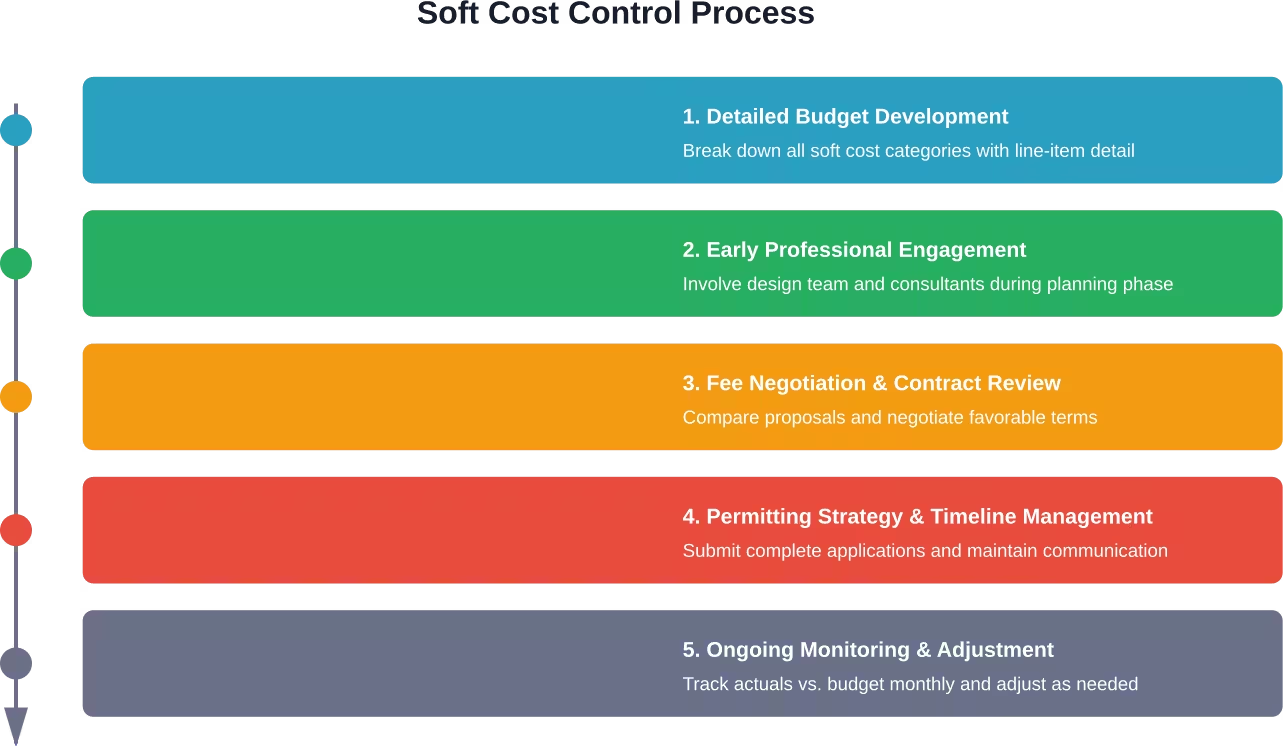
Soft costs can spiral quickly without proper management. But they’re controllable with proactive planning and ongoing monitoring.
Start with Comprehensive Budgeting
Accurate soft cost estimation begins during project conception. Texas A&M University’s construction management research emphasizes that preparing cost estimates is among the primary responsibilities of construction project managers, alongside monitoring project resources and progress.
Create detailed line items for each soft cost category rather than using a single lump sum. Break down design fees by discipline, list specific permit types, and estimate insurance premiums based on actual coverage requirements.
Research local permit fee schedules, impact fees, and regulatory requirements early. Municipal websites typically publish fee schedules, but a call to the building department can clarify complex projects.
Allocate a contingency fund of 5-15% specifically for soft costs. Design changes, permit delays, and extended timelines all increase soft costs, and having dedicated reserves prevents these from derailing the project.
Engage Professionals Early
Bringing architects, engineers, and cost estimators into the project during conceptual planning reduces downstream soft costs. Early involvement allows design professionals to identify potential permitting issues, optimize for constructability, and prevent costly redesigns.
Value engineering sessions during design development can reduce both hard and soft costs. Simplifying structural systems might lower engineering fees and permit review time while also reducing material costs.
Streamline the Permitting Process
Permit delays create a domino effect of increased soft costs. Every week of delay adds insurance premiums, financing interest, project management time, and potentially equipment rental costs.
Submit complete, well-organized permit applications. Incomplete submittals trigger review cycles that extend timelines. Working with experienced permit expediters in complex jurisdictions can be money well spent—their fees are offset by faster approvals and reduced carrying costs.
Maintain regular communication with plan reviewers. Addressing questions quickly keeps reviews moving and demonstrates responsiveness that can facilitate approvals.
Negotiate Professional Fees
Design and consulting fees are negotiable, particularly on larger projects. Request detailed fee breakdowns showing hourly rates, estimated hours by task, and reimbursable expenses.
Consider alternative fee structures. Lump-sum fees provide cost certainty but might include padding for scope uncertainty. Hourly arrangements with not-to-exceed caps balance flexibility with budget protection.
For projects with repeated elements—like multiple identical residential buildings—negotiate reduced rates for repetitive work.
Optimize Financing Strategies
Financing costs represent one of the largest soft cost categories and respond well to strategic management. Shopping multiple lenders creates competition and better terms.
Shorter construction timelines directly reduce interest costs. Accelerating schedules by even a few months can save substantial sums on large projects.
Consider phased funding that matches draw schedules to actual need rather than borrowing the full amount upfront. Some lenders offer interest-only periods during construction with principal payments beginning after completion.
Monitor and Track Throughout the Project
Regular cost tracking prevents soft cost surprises. Maintain a detailed budget spreadsheet with actual costs compared to estimates, updated at least monthly.
Flag variances early. A 10% overrun in architectural fees identified during design development allows for adjustments elsewhere. The same overrun discovered at project completion offers no corrective opportunities.
Document scope changes and their soft cost implications. Design revisions trigger additional engineering work, permit amendments, and extended timelines—capture these costs as they occur rather than absorbing them as general overruns.
Cut Soft Costs Before They Grow

Soft costs rise when design decisions keep shifting, coordination drags on, or issues are discovered too late. Every extra review, redesign, or clarification adds time and fees. Powerkh checks design and coordination early to spot unstable decisions, unresolved interfaces, and gaps that will lead to rework once construction starts. Their focus is on reducing the amount of rework and repeated effort that drives soft costs up. By keeping design intent clear and coordinated early, fewer issues spill into additional design time, extended coordination, or repeated technical work.
Reduce Design Time And Rework
Here’s where Powerkh helps control soft costs:
- Identify design areas that will trigger repeated revisions
- Resolve coordination issues before they extend design timelines
- Check constructability to avoid redesign during delivery
- Flag unclear or incomplete details early
- Reduce the need for ongoing clarifications and technical queries
If soft costs are starting to climb, contact Powerkh and cut off the causes before they turn into more time and fees.
Real-World Impact: When Soft Costs Derail Projects
Underestimating soft costs creates real problems. Consider a commercial tenant improvement project with the following scenario:
Initial budget: $500,000 for interior renovations. The owner allocated $450,000 for hard costs and $50,000 for soft costs—a 10% soft cost assumption.
Actual soft costs emerged quite differently:
- Architectural revisions after initial permit rejection: $25,000
- Extended permit review requiring multiple resubmittals: $8,000 in additional fees
- Environmental compliance for asbestos abatement not identified initially: $15,000
- Additional insurance requirements from the landlord: $12,000
- Legal review of tenant agreements and construction contracts: $18,000
- Three additional months of construction financing interest: $8,750
Total actual soft costs: $86,750—a 73% overrun that consumed the entire contingency and forced value engineering of finishes.
This scenario isn’t unusual. It demonstrates how interconnected soft costs become under project stress. Permit delays trigger extended financing costs. Design issues require additional professional services. Unforeseen conditions demand legal and environmental expertise.
Industry Context and Current Conditions
Understanding soft costs requires awareness of broader construction industry trends. According to the AIA’s February 2026 Architecture Billing Index, the ABI score for the month was 49.4, meaning that the share of firms reporting that billing declined was only slightly greater than the share of firms reporting that billings increased (a score of 50 would mean that those shares were equal).
The January 2026 Consensus Construction Forecast projects that nonresidential building spending will remain sluggish through 2026. Commercial facilities spending is projected to increase just 3.0% in 2026 and 3.5% the following year—modest growth that likely won’t cover increased construction costs when adjusted for inflation.
This challenging environment makes soft cost management even more critical. When overall construction spending faces headwinds and margins tighten, every dollar of efficiency matters.
Nearly half of firm leaders surveyed expect billings to remain flat in coming quarters—a sentiment that reflects ongoing uncertainty. In this context, projects that control soft costs effectively gain competitive advantages through more accurate bids and better financial outcomes.
Tools and Resources for Soft Cost Management
Managing soft costs benefits from proper tools and systematic approaches. Construction management software increasingly includes modules for tracking indirect expenses alongside direct construction costs.
Cost estimating platforms allow detailed soft cost breakdowns with historical data from similar projects. This comparative analysis helps validate assumptions and identify potential gaps.
Spreadsheet templates specifically designed for soft cost tracking provide structure for teams without dedicated software. Templates should include categories for design fees by discipline, individual permit types, insurance policies, financing costs broken down by fee type and interest, and administrative expenses.
Professional organizations provide resources. The AIA publishes compensation and billing data that helps benchmark design fees. The AIA’s 2025 Compensation & Benefits Report is built on data from 13,227 positions across 817 firms, providing the architecture profession’s most comprehensive data for salary and workplace practices decisions.
Local builder associations often maintain databases of typical permit fees, impact charges, and utility connection costs for their regions—valuable benchmarking information for preliminary budgets.
Best Practices for Different Project Types
Soft cost management strategies vary by project type. What works for residential construction doesn’t necessarily translate to commercial or industrial projects.
Proyectos residenciales
Single-family homes and small residential projects typically see lower soft cost percentages—often 15-20% rather than 30%. Design fees are smaller, permitting is more straightforward, and financing structures are simpler.
But residential projects face unique soft costs: homeowner association reviews and fees, soil testing and percolation tests for septic systems, well drilling permits, and landscape requirements.
Production builders developing multiple homes benefit from economies of scale. Design fees spread across multiple units, and permit processes become routine. Custom homes face higher per-unit soft costs.
Edificios comerciales y de oficinas
Commercial projects encounter complex soft costs from multiple stakeholders. Landlord requirements, tenant improvement allowances, zoning compliance, and accessibility regulations all add layers.
Parking requirements can trigger substantial impact fees. Office buildings in urban cores might face transportation demand management fees, transit contributions, or affordable housing linkage fees.
These projects benefit most from experienced project managers familiar with local regulatory environments who can navigate requirements efficiently.
Industria y fabricación
Industrial facilities face specialized soft costs. Environmental permitting for manufacturing processes, air quality reviews, hazardous material handling permits, and industrial wastewater connections add expense and timeline.
Utility infrastructure costs can be substantial—bringing adequate electrical service, gas lines, or water capacity to industrial sites sometimes requires off-site improvements that blur the line between hard and soft costs.
Renovación y reutilización adaptativa
Renovation projects often encounter the highest soft cost percentages. Existing condition assessments, hazardous material testing and abatement, structural evaluations, and code upgrade requirements all add expense.
Historic preservation projects face additional review layers and specialized consulting requirements. Projects in historic districts require design review board approvals that extend timelines and require additional design iterations.
| Project Type | Typical Soft Cost % | Key Soft Cost Drivers | Management Priority |
|---|---|---|---|
| Single-Family Residential | 15-20% | Design fees, permits, financing | Efficient permitting |
| Multi-Family Residential | 20-25% | Design, permits, impact fees, financing | Fee negotiation, timeline |
| Commercial Office | 25-30% | Design, permits, impact fees, tenant coordination | Regulatory navigation |
| Industrial/Manufacturing | 20-28% | Environmental permits, utility infrastructure, specialized engineering | Early agency engagement |
| Renovation/Adaptive Reuse | 30-40% | Existing conditions assessment, code upgrades, hazmat abatement | Thorough due diligence |
Preguntas frecuentes
What percentage of a construction budget should be allocated to soft costs?
Soft costs typically account for 20–30% of the total project budget. Simpler projects may fall closer to 15–20%, while complex or highly regulated projects can reach 35–40%.
Are soft costs tax deductible or must they be capitalized?
Most soft costs are capitalized as part of the total construction cost rather than deducted immediately. Tax treatment depends on project structure, so professional advice is recommended.
How do soft costs differ between new construction and renovation projects?
Renovations usually have higher soft costs due to additional requirements like site assessments, structural analysis, and regulatory compliance. These projects may reach 30–40% compared to 20–25% for new builds.
Can soft costs be included in construction loan financing?
Yes. Most lenders include soft costs in financing, though limits may apply. Some expenses may need to be covered by equity depending on lender requirements.
What happens if soft costs exceed the budget?
Overruns may require adjusting hard costs, securing additional funding, or increasing equity. Contingency reserves help manage these risks without impacting core construction work.
How can technology help manage soft costs more effectively?
Digital tools improve tracking, streamline approvals, and reduce administrative overhead. BIM and project management software help prevent costly design changes and improve efficiency.
Do soft costs vary significantly by geographic location?
Yes. Local regulations, permit fees, environmental requirements, and market conditions all influence soft cost levels. Urban and highly regulated areas typically have higher costs.
Moving Forward with Soft Cost Awareness
Soft costs aren’t optional expenses to minimize or ignore. They’re essential investments that enable successful construction projects and protect long-term interests.
The difference between projects that succeed financially and those that struggle often comes down to how well soft costs were estimated, tracked, and managed. Detailed planning during project conception, engagement of experienced professionals, and ongoing monitoring throughout construction create the foundation for soft cost control.
As the construction industry faces continued economic uncertainty through 2026 and beyond, the ability to accurately forecast and manage all project costs—both hard and soft—becomes increasingly valuable. Projects that treat soft costs with the same rigor as material and labor costs position themselves for better outcomes.
Ready to develop more accurate construction budgets? Start by creating detailed soft cost estimates for each category, building in appropriate contingencies, and establishing tracking systems that flag variances early. The investment in thorough soft cost planning pays dividends throughout the project lifecycle and contributes directly to financial success.

Nuestros casos prácticos
Hemos gestionado más de 200 proyectos BIM y VDC para los sectores comercial, industrial y residencial.
Nuestro trabajo incluye:
Automatización del diseño de encofrados
Our client from
California, USA
Automatización del diseño de falsos techos
Our client from
New York, USA
Automatización del diseño del entramado de muros
Our client from
California, USA