¿Tiene alguna pregunta? Póngase en contacto con nosotros
¡Únete a nuestro equipo!
Solicitar presupuesto o consulta gratuita

Quick Summary: ICF construction uses hollow foam blocks stacked into wall shapes, reinforced with steel rebar, and filled with concrete to create highly insulated, durable structures. This building method combines expanded polystyrene insulation with steel-reinforced concrete, delivering superior energy efficiency, sound resistance, and structural strength compared to traditional wood-frame construction.
Building methods have evolved significantly over the past few decades, and one construction technique has quietly transformed how residential and commercial structures are built. Insulated Concrete Forms — commonly called ICF — represent a departure from traditional wood-frame construction that’s been the standard for generations.
But what exactly is ICF construction? And why are more builders, architects, and homeowners choosing this method over conventional building techniques?
Here’s the thing: ICF isn’t just another construction trend. It’s a proven building system that addresses multiple challenges simultaneously — energy efficiency, structural durability, disaster resistance, and long-term cost savings. Let’s break down what makes this construction method different.
Understanding ICF Construction: The Basics
ICF stands for Insulated Concrete Forms. At its core, this system consists of hollow foam blocks — typically made from Expanded Polystyrene (EPS) — that are stacked into the shape of exterior walls, reinforced with steel rebar, and then filled with concrete.
The foam blocks remain in place permanently after the concrete cures, serving as both formwork during construction and continuous insulation once the building is complete. This creates a wall assembly with three distinct layers: interior insulation, a concrete core, and exterior insulation.
Unlike traditional concrete forms that get removed after pouring, these forms stay put. That’s the key difference. The result? A wall system that combines one of the finest insulating materials with one of the strongest structural building materials available.
How ICF Blocks Are Assembled
The construction process starts with interlocking foam blocks that stack together similar to oversized Lego pieces. These blocks feature a cavity in the center — typically 4 to 12 inches wide — where the concrete will be poured.
Steel reinforcement bars (rebar) are positioned vertically and horizontally within this cavity according to engineering specifications. Once the wall is stacked to the desired height and the rebar is in place, concrete is pumped into the forms from the top.
The foam blocks hold the concrete in place while it cures, creating a monolithic structure that’s exceptionally strong and well-insulated. According to the American Concrete Institute, this stay-in-place form system is increasingly used to achieve more sustainable buildings across both residential and commercial applications.
Add a BIM and VDC Team to Your Project

Powerkh helps companies that need outside support for BIM production work. The company handles modeling, coordination, Scan to BIM, automation, prefabrication support, and structural detailing. For project teams, that means extra capacity for technical work that has to move forward without delays.
Need Extra BIM Delivery Support?
Talk with Powerkh to:
- develop models and drawings for ongoing work
- process point cloud files into BIM outputs
- handle detailing and coordination tasks
👉 Contact Powerkh for a project review and consultation.
Why ICF Construction Differs From Traditional Wood-Frame Building
Traditional wood-frame construction has dominated residential building for decades. It’s familiar, widely understood, and contractors know how to work with it. So what makes ICF different enough to warrant consideration?
The fundamental difference lies in the wall assembly itself. Wood-frame walls consist of dimensional lumber studs with insulation batts stuffed between them. Drywall goes on the interior, sheathing and siding on the exterior.
ICF walls, by contrast, are solid concrete cores with continuous insulation on both sides. There are no studs, no thermal bridges, and no gaps where insulation might compress or settle over time.
The Thermal Bridge Problem
Here’s where things get interesting. Wood studs in traditional framing create thermal bridges — paths where heat escapes more easily because wood conducts heat better than insulation. Even with good insulation between studs, the studs themselves compromise the wall’s overall thermal performance.
ICF eliminates this issue entirely. The insulation is continuous across the entire wall surface with no interruptions. According to the Insulating Concrete Forms Manufacturers Association (ICFMA), ICF walls have two continuous insulation layers with no thermal bridges, significantly reducing heat loss.
The Performance Advantages of ICF Construction
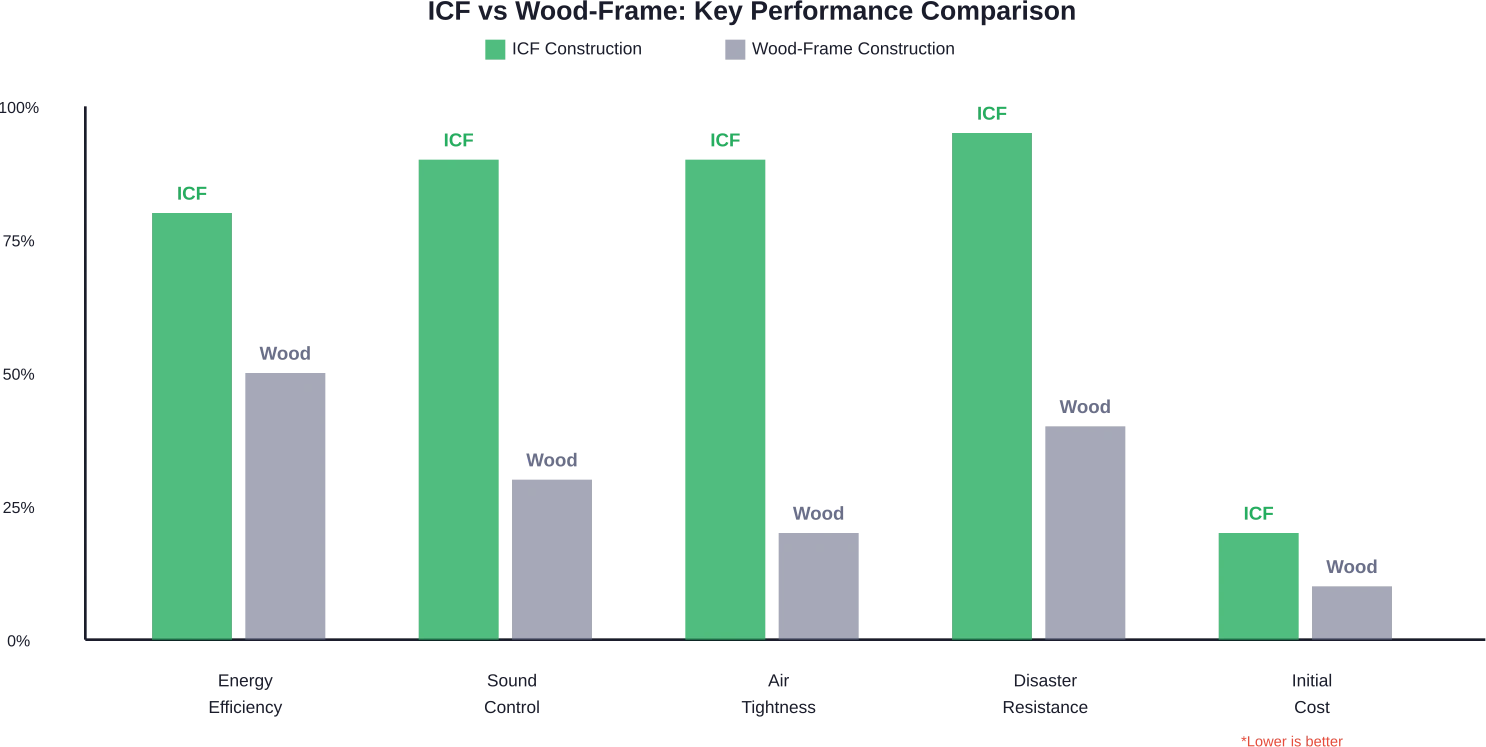
Numbers tell part of the story. ICF walls deliver R-values up to 50, though the real performance comes from the combination of insulation value, thermal mass, and airtight construction.
But performance goes beyond just energy efficiency. Let’s break down the major advantages.
Energy Efficiency That Shows Up in Bills
The efficiency starts in the walls and shows up in monthly utility costs. ICF construction enables HVAC downsizing by up to 60% compared to wood-frame buildings because the heating and cooling loads are dramatically lower.
That’s not just theoretical. The concrete core provides thermal mass that moderates temperature swings, keeping indoor temperatures more stable. The continuous insulation prevents heat transfer, and the airtight construction — with reduced air infiltration compared to wood-frame construction — means conditioned air stays where it belongs.
Sound Control You Can Actually Notice
Sound transmission testing reveals a striking difference. According to data from the Insulating Concrete Forms Manufacturers Association, ICF walls allowed less than one-third as much sound to pass through compared to ordinary frame walls filled with fiberglass insulation.
For homes near busy roads, airports, or in dense neighborhoods, this translates to measurably quieter interior spaces. The mass of the concrete combined with the foam layers creates effective sound damping across a wide frequency range.
Disaster Resistance That Matters
Steel-reinforced concrete walls offer inherent resistance to extreme weather events, fire, and impact damage that wood-frame construction simply can’t match.
Wind resistance is particularly noteworthy. ICF walls can withstand hurricane-force winds and flying debris that would severely damage or destroy wood-frame structures. Fire resistance is exceptional — concrete doesn’t burn, and the foam insulation is treated with fire retardants.
| Performance Factor | ICF Construction | Wood-Frame Construction |
|---|---|---|
| Typical R-Value | Up to R-50 | R-13 to R-21 |
| Air Infiltration | Reduced compared to wood-frame | Standard baseline |
| Sound Transmission | Less than 1/3 of wood-frame | Standard baseline |
| HVAC Sizing | Can reduce by up to 60% | Standard sizing |
| Fire Resistance | Non-combustible concrete core | Combustible wood structure |
| Thermal Bridges | None — continuous insulation | Present at every stud |
ICF Construction Costs: The Real Numbers
Cost is where many builders and homeowners pause. ICF construction does cost more upfront than traditional wood-frame building.
Insulated concrete forms cost between $120 and $230 and per square foot, which is 3% to 10% more than standard wood-frame construction. That’s a real difference, especially on larger projects.
But here’s what that comparison misses: the upfront cost difference doesn’t account for long-term operating costs, HVAC equipment savings, reduced maintenance, or insurance discounts that ICF buildings often qualify for.
Where the Savings Accumulate
Energy savings add up month after month, year after year. According to the American Concrete Institute, ICF construction can deliver 25 to 50% energy savings versus traditional wood or steel-framed homes.
Smaller HVAC systems mean lower equipment costs upfront. Reduced maintenance on exterior walls (concrete doesn’t rot, warp, or attract termites) eliminates costs that wood-frame buildings incur. Some insurance companies offer premium reductions for ICF construction due to superior disaster resistance.
The payback period varies depending on local energy costs, climate, and building size, but many owners report recovering the additional construction cost within 5 to 10 years through accumulated savings.
Design Flexibility and Architectural Possibilities
A common misconception suggests ICF construction limits design options. Not true.
ICF systems accommodate virtually any architectural style. The foam blocks can be cut and shaped to create curves, angles, and custom configurations. Window and door openings are framed during the stacking process using buck frames.
Exterior finishes work the same way they do on any concrete wall — stucco, stone, brick, wood siding, or synthetic materials all attach to the ICF wall using appropriate fastening methods. Interior finishes attach directly to the foam using specialized fasteners or furring strips.
For architects who need to design energy-efficient structures without changing their typical design processes, ICF offers the ideal combination of insulating power, design versatility, and aesthetic flexibility.
The ICF Market and Industry Standards
The ICF industry has matured significantly. More than 80 ICF products are available on the market today, manufactured by companies ranging from large building material corporations to specialized ICF-focused manufacturers.
Quality standards matter when choosing ICF products. ASTM International Committee E06 on Performance of Buildings developed ASTM E2634, the Specification for Flat Wall Insulating Concrete Form Systems, which provides minimum quality standards.
According to Sheldon Warman, senior structural engineer and committee member, this standard ensures that conforming ICF products meet building code requirements. Real talk: checking for ASTM E2634 compliance is a smart first step when evaluating ICF products.
Common Applications for ICF Construction
While ICF started primarily in foundation and basement wall construction, applications have expanded considerably. Today’s projects include:
- Residential homes (single-family and multi-family)
- Commercial buildings and offices
- Schools and educational facilities
- Medical facilities and hospitals
- Agricultural buildings
- Cold storage and warehouse facilities
- Safe rooms and storm shelters
ICF decking is becoming increasingly popular as an addition to ICF wall construction. This system weighs up to 40% less than standard concrete flooring while providing superior insulation. When ICF decking is designed in conjunction with ICF walls, it creates a continuous monolithic structure that maximizes the performance benefits.
Installation Considerations and Contractor Expertise
ICF installation requires specific knowledge and experience. The learning curve isn’t steep, but it’s real. Contractors familiar with wood-frame construction need training on ICF-specific techniques.
Key installation aspects include proper bracing during concrete placement, understanding concrete placement rates and pressures, managing embedments and penetrations, and coordinating mechanical and electrical rough-ins.
The good news? Many ICF manufacturers provide training programs, technical support, and installation guidance. Some offer certification programs for contractors, which helps ensure quality installation.
Construction Timeline Factors
Construction speed varies depending on crew experience and project complexity. Experienced ICF crews can often build walls faster than conventional framing because multiple steps happen simultaneously — the forms provide structure, insulation, and backing for finishes all at once.
Weather impacts ICF construction differently than wood-frame. Cold weather requires concrete curing considerations, but the work can proceed in conditions that would halt wood-frame construction. Rain doesn’t damage ICF materials the way it can affect dimensional lumber and OSB sheathing.
Environmental and Sustainability Aspects
Sustainability metrics increasingly influence building material choices. ICF construction offers several environmental advantages worth considering.
Energy consumption over a building’s lifetime typically dwarfs the embodied energy in construction materials. ICF buildings use significantly less energy for heating and cooling, which reduces their operational carbon footprint year after year.
Durability matters for sustainability. Buildings that last longer without major renovations consume fewer resources over their lifecycle. ICF structures are exceptionally durable — concrete walls don’t rot, aren’t susceptible to termites, and don’t deteriorate the way organic materials can.
The concrete itself can incorporate recycled materials like fly ash or slag cement, further improving sustainability metrics. EPS foam is recyclable, though end-of-life considerations for ICF buildings are still evolving.
Maintenance and Longevity
Long-term maintenance requirements for ICF buildings are notably lower than wood-frame structures. The concrete core doesn’t decay, warp, or require replacement. The foam insulation doesn’t settle, compress, or lose R-value over time the way some batt insulations can.
Exterior finishes require the same maintenance they would on any building — paint needs refreshing, siding needs occasional replacement. But the underlying wall structure remains stable and functional for generations.
Pest resistance is another maintenance advantage. Termites can’t eat concrete or treated EPS foam. Rodents can’t nest in solid concrete walls. This eliminates entire categories of maintenance issues that plague wood-frame buildings in many regions.
Challenges and Limitations to Consider
ICF construction isn’t perfect for every application. Honest assessment requires acknowledging the limitations.
The higher upfront cost remains the primary barrier for many projects, particularly in markets where construction budgets are tight or financing is limited. Not every builder has the budget flexibility to absorb the 2% to 7% cost premium.
Contractor availability varies by region. In areas where ICF construction is common, finding experienced crews is easy. In markets where ICF is rare, identifying qualified contractors can be challenging.
Modifications and renovations require different approaches. Cutting through a concrete wall to add a window isn’t as straightforward as cutting through wood studs. This doesn’t make modifications impossible, just different — and potentially more expensive.
Electrical and plumbing installations require planning. Running wiring and pipes through solid concrete walls means embedding chases during construction or routing services through the foam layer. Again, not impossible, but different from conventional construction.
| Aspect | Ventajas | Considerations |
|---|---|---|
| Coste | Lower operating costs, reduced HVAC, less maintenance | 2-7% higher upfront construction cost |
| Energy | Superior insulation, no thermal bridges, high R-value | Benefits greatest in extreme climates |
| Installation | Faster for experienced crews, all-weather capable | Requires specialized knowledge and training |
| Diseño | Accommodates most architectural styles | Requires planning for utilities and embedments |
| Durability | Exceptional longevity, pest-resistant, disaster-resistant | Future modifications more complex than wood-frame |
| Availability | 80+ products available, growing market | Contractor expertise varies by region |
Is ICF Construction Right for Your Project?
The decision to use ICF construction depends on project priorities, budget flexibility, and long-term goals.
ICF makes particular sense when:
- Energy efficiency is a top priority
- The building site faces extreme weather or disaster risks
- Sound control matters significantly
- Long-term operating costs outweigh upfront construction costs in the decision matrix
- Building codes or project requirements demand high-performance envelopes
- Durability and low maintenance are valued
ICF may not be the best choice when:
- Budget constraints make the upfront cost difference prohibitive
- Experienced ICF contractors aren’t available locally
- The building design requires extensive future modifications
- Project timelines don’t allow for crew training or learning curves
Preguntas frecuentes
Does ICF construction need a vapor barrier?
ICF walls typically do not require a separate vapor barrier because the concrete core is largely vapor-impermeable and the foam layers provide additional vapor control. However, requirements depend on local building codes and climate conditions.
How long do ICF buildings last?
ICF structures can last 100 years or more. The reinforced concrete core provides long-term durability, while the foam insulation maintains its performance over time when properly protected.
Can you build a second story with ICF?
Yes. ICF systems support multi-story construction due to their strong load-bearing concrete walls. They are commonly used for foundations, first floors, and even full multi-story buildings.
What’s the maximum R-value achievable with ICF walls?
ICF walls can achieve R-values up to around R-50 depending on design and insulation thickness. Their real-world performance is often higher due to thermal mass and reduced air leakage.
Is ICF construction more expensive than wood-frame?
ICF construction typically costs 3–10% more upfront than wood-frame. However, long-term savings in energy efficiency, maintenance, and durability often offset the initial investment within several years.
Can you attach finishes to ICF walls like regular walls?
Yes. Interior and exterior finishes can be applied using appropriate fastening systems. Materials such as drywall, siding, brick, and stucco are all compatible with ICF construction.
Are ICF buildings quieter than wood-frame buildings?
Yes. ICF walls significantly reduce sound transmission due to their concrete core and insulation layers. They can block up to two-thirds more sound compared to typical wood-frame walls.
Conclusion: The Future of ICF Construction
ICF construction represents more than just another building method. It’s a comprehensive approach that addresses multiple building performance criteria simultaneously — energy efficiency, structural strength, disaster resistance, sound control, and longevity.
The higher upfront cost remains a real consideration, but the long-term value proposition is compelling. Buildings that cost less to operate, require less maintenance, last longer, and provide superior comfort don’t just save money — they represent a fundamentally different approach to building performance.
As energy codes tighten, climate concerns intensify, and building performance expectations rise, ICF construction is positioned to move from alternative building method to mainstream standard. The growth from foundation-only applications to full-building systems reflects increasing recognition of the benefits.
For builders, architects, and property owners evaluating construction methods in 2026, ICF deserves serious consideration. The technology is proven, the industry is mature, quality standards exist, and the performance advantages are measurable.
Want to explore whether ICF construction makes sense for your next project? Connect with ICF manufacturers, talk to experienced contractors in your area, and run the numbers on operating cost savings. The right building method depends on your specific priorities — but ICF construction offers a compelling combination of benefits that’s hard to match with conventional building systems.

Nuestros casos prácticos
Hemos gestionado más de 200 proyectos BIM y VDC para los sectores comercial, industrial y residencial.
Nuestro trabajo incluye:
Automatización del diseño de encofrados
Our client from
California, USA
Automatización del diseño de falsos techos
Our client from
New York, USA
Automatización del diseño del entramado de muros
Our client from
California, USA