¿Tiene alguna pregunta? Póngase en contacto con nosotros
¡Únete a nuestro equipo!
Solicitar presupuesto o consulta gratuita

OSHA requires fall protection in construction when workers are exposed to falls of 6 feet or more, depending on the specific work environment. Different standards apply to leading edges, scaffolds, roofing work, excavations, and other construction activities. Employers must implement guardrails, safety nets, or personal fall arrest systems to comply with 29 CFR 1926.501.
Falls remain the deadliest hazard in construction. According to the Bureau of Labor Statistics, falls accounted for 351 out of 1,008 total construction fatalities in 2020, representing 34.8% of all construction deaths. That’s more than one death every single day.
OSHA knows this. That’s why fall protection violations consistently top the agency’s citation list. In fiscal year 2025, fall protection for general requirements (29 CFR 1926.501) had 5,914 violations, ranking as the #1 most frequently cited standard. The pattern repeats year after year.
But here’s the thing: knowing fall protection is important doesn’t answer the practical question that safety managers, contractors, and workers face daily. When exactly does OSHA require fall protection systems? At what height? In which situations?
The regulations are more nuanced than a simple height threshold. This guide breaks down the exact requirements under 29 CFR 1926.501, clarifies common confusion points, and provides actionable compliance strategies for construction sites in 2026.
The Six-Foot Rule: OSHA's Core Threshold for Construction
The fundamental rule is straightforward: OSHA requires fall protection in construction when workers are exposed to vertical drops of 6 feet or more to lower levels.
This 6-foot threshold appears throughout OSHA standard 1926.501 and applies to most construction activities. It’s the baseline that determines when employers must implement protective systems—whether guardrails, safety nets, or personal fall arrest systems.
But that’s just the starting point. The specific height trigger varies depending on the type of work being performed and the location of the hazard.
When the Threshold Drops Below Six Feet
Some construction scenarios require protection at lower heights:
- Excavations and trenches: Workers need protection when exposed to falls of 6 feet or more near excavation edges
- Dangerous equipment: Protection is required regardless of height when workers could fall onto dangerous equipment or machinery below
- Impalement hazards: Any exposure to protruding rebar, stakes, or similar hazards triggers protection requirements regardless of distance
These exceptions reflect the severity of potential injuries. A fall onto rebar from 3 feet can be just as fatal as a fall from 10 feet onto a flat surface.
Construction vs. General Industry: A Critical Distinction
Here’s where confusion often creeps in. General industry standards under 1910 Subpart D use a 4-foot threshold, not 6 feet. This creates complications for facilities that perform both construction and maintenance work.
| Factor | General Industry (1910) | Construction (1926)
|
|---|---|---|
| Standard fall protection threshold | 4 feet | 6 feet |
| Covers roofing work | Limited application | Extensive requirements |
| Leading edge provisions | Not addressed | Specific requirements at 6+ feet |
Determining which standard applies depends on the nature of the work, not the industry of the employer. A manufacturing facility performing construction activities must follow the construction standards. HVAC maintenance on a roof may fall under general industry rules depending on the scope and duration of work.
Specific Requirements by Work Location and Activity
OSHA 1926.501 breaks down fall protection requirements by specific work scenarios. Each subsection addresses different exposures and mandates specific protection approaches.
Unprotected Sides and Edges (Leading Edges)
According to OSHA data, edge exposure accounts for a disproportionate share of fatal falls in construction. Workers on walking or working surfaces with unprotected sides or edges must have protection when exposed to falls of 6 feet or more.
Leading edges—the advancing edge of floor, roof, or formwork during construction—present unique challenges. Workers can’t always install guardrails ahead of their work. OSHA recognizes this and allows controlled access zones combined with personal fall arrest systems or safety monitoring systems under specific conditions.
The key is that protection must be in place before exposure occurs. Guardrails are the preferred solution when feasible. When they’re not, employers must document why and implement alternative protective measures.
Scaffolds and Elevated Platforms
Scaffold work falls under both scaffold-specific standards (1926.451) and general fall protection requirements. Workers on scaffolds more than 10 feet above lower levels must have guardrail systems, personal fall arrest systems, or both.
Wait—10 feet, not 6? Correct. Scaffolds have their own threshold, and it’s higher than the general construction standard. But once work reaches that height, protection is non-negotiable.
The type of scaffold matters too. Supported scaffolds require guardrails or fall arrest systems. Suspended scaffolds mandate both guardrails and personal fall arrest systems as backup protection.
Roof Work: Low-Slope vs. Steep-Slope
Roofing triggers fall protection at 6 feet, but the specific requirements split based on roof slope. Low-slope roofs (pitch less than 4:12) and steep-slope roofs (4:12 or greater) have different compliance options.
For low-slope roofs, employers can choose from:
- Guardrail systems at roof perimeters
- Safety net systems positioned to catch falling workers
- Personal fall arrest systems with proper anchorage
- Warning line systems (if work is more than 15 feet from edge)
Steep-slope roofing demands guardrails, safety nets, or personal fall arrest systems—warning lines alone won’t cut it. The steeper pitch increases fall risk substantially, so OSHA eliminates the warning line option.
Flat roof work creates confusion because the surface looks safer. It’s not. Working on a flat roof might look less dangerous than a steep-pitched surface, but OSHA sees things differently. Whether performing HVAC maintenance, installing rooftop equipment, or laying membrane, the fall hazard remains real and the 6-foot rule applies.
Holes and Openings
Floor holes, skylights, and other openings create fall hazards even on otherwise protected surfaces. OSHA requires covers or guardrails around holes through which workers or materials could fall 6 feet or more.
Covers must support twice the weight of workers, equipment, and materials that might cross them. They need to be secured to prevent displacement and clearly marked as “HOLE” or “COVER.”
Skylights deserve special attention. They often can’t support worker weight, creating both fall-through and fall-around hazards. Protection options include screens or guardrails that prevent workers from stepping on or near the skylight.
Excavations and Wall Openings
The CDC notes that workers should never work in an unprotected trench—a trench can collapse or cave-in at any moment. While cave-ins are the primary concern, falls into excavations also pose serious risks.
OSHA requires fall protection for workers on walking or working surfaces exposed to excavation edges of 6 feet or more. The protection must be installed within 6 feet of the edge.
Wall openings—door and window openings in walls under construction—trigger protection when the bottom edge is less than 39 inches above the walking surface and the drop is 6 feet or more. Guardrails or covers prevent falls through these openings.
Acceptable Fall Protection Systems Under OSHA Standards
OSHA doesn’t just tell employers to provide fall protection—it specifies what systems are acceptable and how they must be configured. The standard recognizes three primary approaches: guardrails, safety nets, and personal fall arrest systems.
Guardrail Systems: The Preferred Solution
Guardrails are passive protection. They don’t require workers to take action, wear equipment, or remember procedures. That makes them the preferred option in OSHA’s hierarchy of controls.
Compliant guardrail systems must have:
- Top rail at 42 inches above the walking surface (plus or minus 3 inches)
- Midrail installed midway between the top rail and walking surface, or mesh/screening extending from the top rail to the surface
- Top rail capable of withstanding 200 pounds of force in any outward or downward direction
- Midrail capable of withstanding 150 pounds of force
- Openings small enough to prevent passage of a 19-inch diameter sphere
Standard pipe railings, cable railings, and manufactured guardrail systems can all meet these criteria when properly installed. The key is ensuring structural integrity and maintaining the required dimensions.
Safety Net Systems: Catching Falls Before Impact
Safety nets provide passive protection when guardrails aren’t feasible. Bridge work, structural steel erection, and certain precast concrete operations commonly use net systems.
OSHA mandates that safety nets must:
- Be installed as close as practicable beneath the work surface, never more than 30 feet below
- Extend outward from the edge at least 8 feet for falls up to 5 feet, with greater extensions for higher work surfaces
- Be drop-tested after installation, repair, or relocation, and at 6-month intervals if left in place
- Be inspected weekly for wear, damage, and deterioration
- Be capable of absorbing the impact force of a drop test using a 400-pound bag of sand
Debris and materials must be removed from nets promptly. Objects accumulating in nets reduce their energy absorption capacity and can become projectiles when the net deflects during a fall arrest.
Personal Fall Arrest Systems: Active Protection
Personal fall arrest systems (PFAS) stop falls after they occur but before workers hit lower levels. These systems consist of three essential components working together: anchorage, body support, and connectors.
The body support must be a full-body harness. Body belts are not acceptable for fall arrest—they’ve caused too many internal injuries and spinal damage during arrest events.
Anchorage points must support 5,000 pounds per attached worker, or be designed, installed, and used under the supervision of a qualified person as part of a complete personal fall arrest system maintaining a safety factor of at least two.
Connectors—lanyards, lifelines, and deceleration devices—link the harness to the anchorage. Shock-absorbing lanyards or self-retracting lifelines limit arrest forces to 1,800 pounds or less on the worker’s body.
Here’s the critical part: PFAS must be rigged to prevent free falls of more than 6 feet and to prevent workers from contacting lower levels. That means calculating fall distance carefully, accounting for:
- Lanyard length
- Deceleration distance (the stretch of shock absorbers)
- Worker height and harness stretch
- Any sag in horizontal lifelines
Insufficient fall clearance is one of the most common PFAS errors. Workers can still hit the ground or a lower level even while wearing a harness if the system isn’t calculated correctly.
Alternative Systems for Specific Situations
OSHA recognizes several alternative protection methods for specific work activities:
On low-slope roofs, warning line systems can be used alone if the work is performed at least 15 feet from the edge and is infrequent and temporary. For roofing work specifically, warning lines can be used 6 feet from the edge if combined with a safety monitoring system.
Safety monitoring systems use a designated competent person to monitor workers and warn them when they approach fall hazards. This approach is permitted only for specific activities like leading edge work, precast concrete erection, and some roofing tasks. The monitor can’t have other responsibilities and must be on the same walking surface as workers being monitored.
Covers over holes and openings must support twice the expected load, be secured against displacement, and be marked. A plywood sheet laid over a hole doesn’t count unless it’s fastened down and rated for the load.
The Competent Person Requirement: Non-Negotiable Oversight
OSHA construction standards repeatedly reference the “competent person”—and it’s not just a suggestion. For fall protection, employers must designate a competent person to identify hazards and authorize corrective measures.
A competent person must have the knowledge, training, and authority to:
- Identify existing and predictable fall hazards
- Take prompt corrective action to eliminate hazards
- Recognize when fall protection systems are required
- Ensure systems are properly installed and maintained
This isn’t a self-declared title. The competent person needs documented training and demonstrable expertise. During OSHA inspections, compliance officers will ask who the competent person is and verify their qualifications.
The competent person must inspect fall protection equipment and systems before each work shift and after any occurrence that could affect system integrity. That daily inspection catches damaged components before they fail during a real fall event.
Common OSHA Fall Protection Violations and How to Avoid Them
Fall protection violations dominate OSHA’s citation lists. Understanding the most common failures helps employers avoid penalties and, more importantly, prevent injuries.
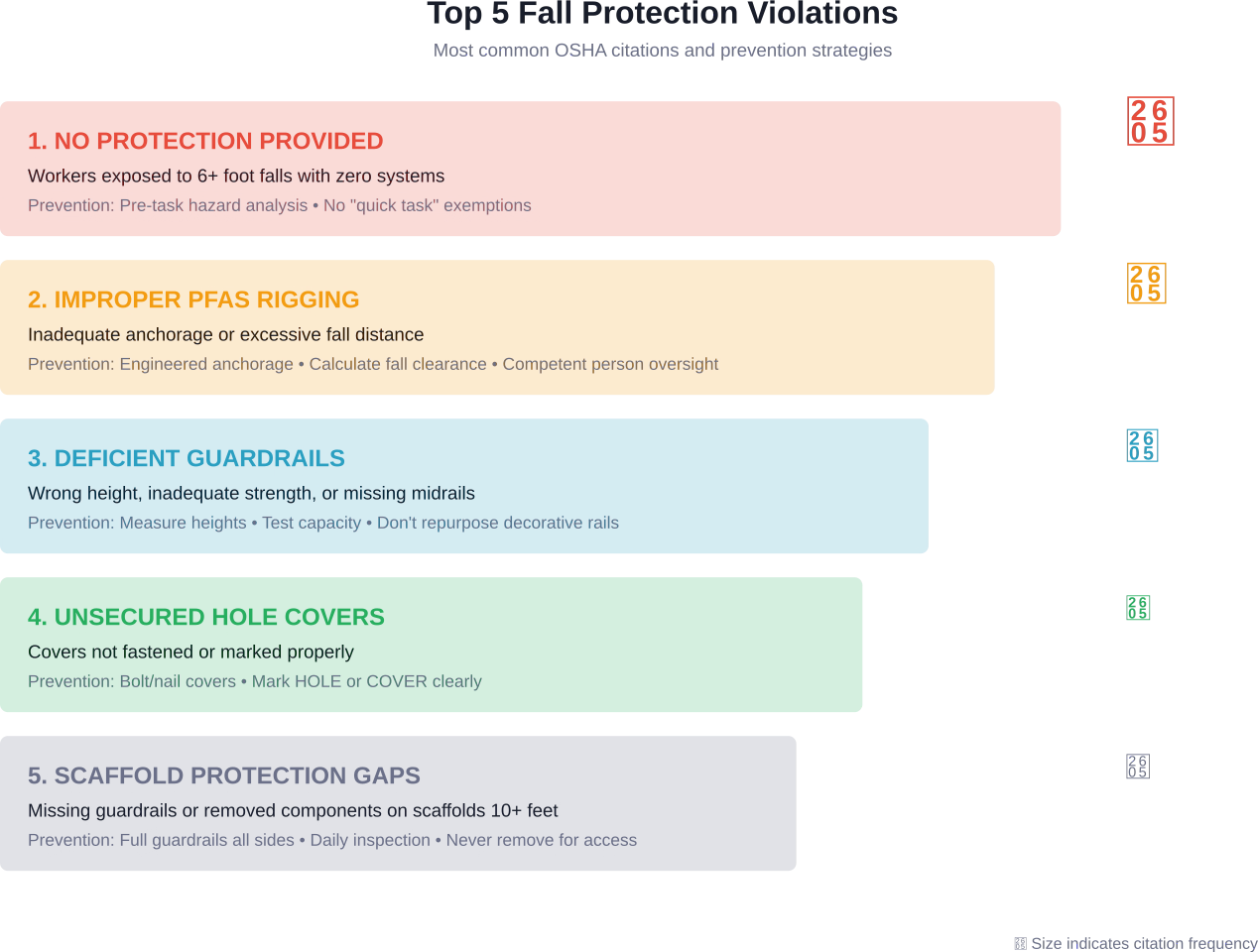
Violation 1: No Fall Protection Provided
The most cited violation is simply failing to provide any fall protection when required. Workers on roofs, scaffolds, or near edges above 6 feet with no guardrails, nets, or personal fall arrest systems create obvious violations.
This often happens during short-duration tasks. Supervisors think “it’ll only take a minute” and allow unprotected work. OSHA doesn’t recognize a time limit. Six feet is six feet, whether the exposure lasts five seconds or five hours.
Prevention: Conduct job hazard analyses before work begins. If fall exposure exists, protection is required. No exceptions for quick tasks.
Violation 2: Improper Personal Fall Arrest Rigging
Providing harnesses doesn’t equal compliance. Workers wearing fall arrest equipment connected to inadequate anchorages, or rigged with excessive slack allowing dangerous free falls, creates violations even though equipment is present.
Tying off to conduit, piping, or structural members not rated for 5,000 pounds is a common mistake. So is attaching to points that allow workers to swing into hazards or contact lower levels.
Prevention: Engineered anchorage points rated for fall arrest loads. Competent person oversight of rigging. Training on calculating fall clearance.
Violation 3: Deficient Guardrail Systems
Guardrails that look adequate but fail to meet OSHA specifications—wrong height, inadequate strength, openings too large, missing midrails—generate citations.
Decorative railings around architectural features sometimes get repurposed as fall protection. But if they’re not 42 inches high and structurally capable of withstanding 200 pounds of outward force, they don’t meet OSHA requirements.
Prevention: Measure rail heights. Verify structural capacity. Don’t assume existing railings are compliant.
Violation 4: Hole Covers Not Secured or Marked
Plywood sheets over floor openings create a false sense of security. If they’re not secured against displacement and clearly marked, they don’t provide protection—workers can step on edges, tipping the cover into the hole and falling through.
Prevention: Bolt, nail, or otherwise fasten covers. Mark them “HOLE” or “COVER” in high-visibility paint or labels.
Violation 5: Scaffold Fall Protection Failures
Scaffolds over 10 feet lacking guardrails or fall arrest create frequent citations. Incomplete guardrails—missing toe boards, gaps at platform ends, removed midrails—also violate standards.
Prevention: Install full guardrails on all open sides and ends of scaffold platforms. Inspect before each shift. Don’t remove components to move materials.
State-Specific Requirements: Exceeding Federal Standards
While federal OSHA standards apply nationwide, state OSHA plans can adopt more stringent requirements. State-specific fall protection rules may exceed federal OSHA requirements. California, Washington, Oregon, Michigan, and several other states maintain their own OSHA programs with variations from federal standards.
Employers operating across multiple states need to track which jurisdictions have state plans and what additional requirements apply. The safest approach: comply with the most stringent applicable standard. If a state requires protection that federal OSHA doesn’t, implementing that higher level of protection everywhere creates consistency and reduces the risk of confusion on multi-state projects.
Building a Comprehensive Fall Protection Program
Compliance isn’t just about equipment. Effective fall protection requires systematic planning, training, and enforcement.
Risk Assessment and Job Hazard Analysis
Every construction project should begin with fall hazard identification. Walk the site. Identify all locations where workers will be exposed to falls of 6 feet or more. Document edge conditions, roof work, scaffold locations, excavations, and other exposures.
For each identified hazard, determine the appropriate protection system based on:
- The type of work activity
- Duration of exposure
- Feasibility of guardrails vs. nets vs. personal fall arrest
- Anchorage availability
- Environmental factors (weather, lighting, surface conditions)
The Prevention through Design approach integrates fall protection into project planning rather than treating it as an afterthought. One project using Prevention through Design methodology prevented over 1.7 million hours of high-risk work, eliminating 700,000 hours of work at heights while saving nine million dollars.
Training Requirements
OSHA requires training for workers exposed to fall hazards. The training must cover:
- Recognition of fall hazards in the work area
- Correct procedures for installing, using, and maintaining fall protection systems
- The role and function of each component of the fall protection system
- Limitations of fall protection systems
- Standards relevant to the employee’s work
Training must occur before workers begin tasks requiring fall protection. Retraining is required when changes in the workplace render previous training obsolete, when employee actions suggest inadequate understanding, or when new fall protection systems are introduced.
Documentation matters. Maintain records showing who received training, when, on what topics, and who provided the instruction. During OSHA inspections, training records demonstrate program implementation.
Equipment Inspection and Maintenance
Fall protection equipment deteriorates. UV exposure degrades synthetic fibers. Corrosion weakens metal components. Normal wear creates hidden damage.
Competent persons must inspect equipment before each use and after any occurrence that could affect integrity—drops, impacts, exposure to chemicals, or suspected overloading.
Personal fall arrest components must be removed from service if they show:
- Cuts, tears, or abrasions in webbing
- Distorted or cracked hardware
- Excessive wear or deterioration
- Evidence of prior fall arrest (shock absorbers deployed, stitching broken)
Equipment that arrests a fall must be removed from service immediately. The forces involved can compromise structural integrity even when damage isn’t visible. Treat arrested equipment as single-use.
Enforcement and Accountability
The best-written fall protection program fails without consistent enforcement. Workers who see others working unprotected without consequences will follow suit.
Establish clear consequences for fall protection violations. Document infractions. Follow progressive discipline consistently. But also create positive incentives—recognize crews that maintain excellent fall protection compliance.
Leadership visibility matters. When site managers and executives wear fall protection and comply with the same rules as field workers, it sends a message. When they don’t, that sends a message too.
Find And Fix Fall Risks Before They Show Up On Site

If fall protection only comes up when work starts, it is already late. The real exposure builds earlier, when layouts shift, access changes, or coordination decisions don’t fully carry through.
Powerkh works alongside that process, following the design into construction and checking how it actually plays out on site. They look at how people will move, where work will happen, and how small changes can create unsafe conditions that are easy to miss in drawings. Instead of reacting to issues, this gives teams a chance to see them forming and deal with them early.
Contact Powerkh to review how your project is really taking shape and catch fall risks before they turn into problems on site.
Emerging Technologies and Fall Protection Innovation
Fall protection technology continues to evolve. Modern solutions address traditional system limitations and create new protection options.
Self-retracting lifelines with integrated rescue capabilities allow workers to extract themselves or be retrieved after a fall arrest. This addresses suspension trauma—the potentially fatal condition that occurs when workers hang motionless in harnesses after falls.
Wearable technology monitors worker location and detects fall events. Sensors can trigger automatic alerts when falls occur, reducing response time for rescue operations. Some systems track proximity to edges and provide warnings before workers enter fall zones.
Modular guardrail systems install without penetrating surfaces, protecting roof membranes and avoiding structural modifications. Counterweighted bases and clamp-on designs provide temporary edge protection without permanent anchorage.
Mobile anchor systems create fall protection opportunities in areas lacking structural anchorage points. Rolling carts and weighted base systems allow workers to maintain protection while moving across surfaces.
But technology doesn’t replace fundamentals. The most advanced equipment still requires proper selection, installation, and use. Competent person oversight remains essential regardless of system sophistication.
Industry Initiatives: National Safety Stand-Down
The National Safety Stand-Down to Prevent Falls encourages employers to pause work and conduct fall hazard discussions with workers. Originally scheduled for early May each year, the initiative has expanded to year-round participation.
Stand-downs can include:
- Toolbox talks on fall hazards and prevention
- Safety equipment demonstrations
- Hazard identification walks
- Training on fall protection system use
- Discussions of recent incidents and lessons learned
Employers of any size can participate. The value lies in focusing attention specifically on fall hazards rather than general safety topics. Dedicated time for fall protection discussion reinforces its priority status.
OSHA, NIOSH, and industry partners including ASSP promote the stand-down as part of broader fall prevention campaigns. Participation is voluntary but demonstrates commitment to worker safety.
Practical Implementation Checklist
For construction employers developing or improving fall protection programs, this implementation checklist provides a practical framework:
| Program Element | Action Items | Responsibility
|
|---|---|---|
| Policy and Planning | Develop written fall protection plan; identify competent person; establish enforcement procedures | Gestión |
| Hazard Assessment | Conduct site-specific fall hazard analysis; document all exposures 6+ feet; determine protection systems | Competent Person |
| Equipment Selection | Select appropriate systems for identified hazards; ensure adequate quantity; verify certifications | Safety Department |
| Formación | Train all exposed workers; train competent persons; document training; schedule refreshers | Safety Department |
| Inspection | Daily equipment checks; weekly system audits; document inspections; remove damaged equipment | Competent Person |
| Enforcement | Monitor compliance; address violations immediately; progressive discipline; recognize compliance | Supervisors |
| Review | Quarterly program evaluation; incident investigation; update based on lessons learned | Gestión |
Moving Forward: Making Fall Protection Standard Practice
Falls remain construction’s leading cause of death, but they’re preventable. Every worker who falls from an unprotected edge represents a failure—not of individual workers, but of systems, planning, and commitment.
The regulations are clear. The technology exists. The training methods work. What’s required is consistent implementation and unwavering enforcement.
Fall protection can’t be treated as optional equipment deployed only when inspectors might be watching. It must become standard operating procedure—as automatic as wearing hard hats or safety glasses.
Start with the fundamentals: identify fall hazards during project planning, select appropriate protection systems, train workers thoroughly, designate competent persons for oversight, inspect equipment consistently, and enforce requirements without exception.
When fall protection becomes ingrained in work culture rather than viewed as a compliance burden, the statistics change. Injury rates drop. Workers go home safely. Projects complete without tragic interruptions.
The question isn’t whether fall protection is required. It’s whether your organization will meet those requirements comprehensively enough to protect the lives depending on it.
Review your current fall protection program today. Conduct a site walk to identify unprotected fall hazards. Verify that competent persons are trained and designated. Check equipment inspection records. Update training for any workers who haven’t received fall protection instruction in the past year. Schedule a stand-down to discuss fall hazards with your entire crew. Small actions implemented consistently create the difference between compliance and catastrophe.
Frequently Asked Questions About Fall Protection in Construction
What is the OSHA fall protection height requirement for construction?
OSHA requires fall protection in construction when workers are exposed to falls of 6 feet or more to lower levels. This threshold applies to most construction activities including unprotected edges, leading edges, and roof work. Specific situations have different thresholds: scaffolds require protection at 10 feet, while work near excavations triggers protection at 6 feet. Any exposure to dangerous equipment or impalement hazards requires protection regardless of height.
Can warning lines be used alone for fall protection?
On low-slope roofs, warning line systems can be used alone if the work is performed at least 15 feet from the edge and is infrequent and temporary. For roofing work specifically, warning lines can be used 6 feet from the edge if combined with a safety monitoring system.
What anchorage strength is required for personal fall arrest systems?
Anchorage points for personal fall arrest systems must be capable of supporting at least 5,000 pounds per attached worker. Alternatively, anchorages can be designed, installed, and used under the supervision of a qualified person as part of a complete system maintaining a safety factor of at least two. Structural members or fixtures not specifically rated for fall arrest loads should not be used without proper engineering verification.
Do contractors need to provide fall protection for short-duration tasks?
Yes. OSHA does not recognize a time-based exemption for fall protection requirements. If workers are exposed to falls of 6 feet or more, protection is required regardless of task duration. Short tasks still present the same risk and must follow safety standards.
What’s the difference between fall protection in construction and general industry?
Construction fall protection follows a 6-foot threshold for most activities, while general industry uses a 4-foot threshold. The applicable standard depends on the type of work being performed rather than the employer’s industry classification. Construction tasks must follow construction safety standards even if performed in non-construction environments.
How often must fall protection equipment be inspected?
Fall protection equipment must be inspected before each work shift and after any event that could affect its integrity. Workers should also inspect their equipment before each use. Damaged or worn equipment must be removed from service immediately, and any equipment that has arrested a fall must not be reused.
What training is required for workers using fall protection?
Workers must receive training before being exposed to fall hazards. Training should cover hazard recognition, proper use of equipment, system limitations, and relevant safety standards. Retraining is required when conditions change, new equipment is introduced, or when workers demonstrate insufficient understanding. Employers must document all training activities.

Nuestros casos prácticos
Hemos gestionado más de 200 proyectos BIM y VDC para los sectores comercial, industrial y residencial.
Nuestro trabajo incluye:
Automatización del diseño de encofrados
Our client from
California, USA
Automatización del diseño de falsos techos
Our client from
New York, USA
Automatización del diseño del entramado de muros
Our client from
California, USA