Haben Sie noch Fragen? Kontaktieren Sie uns!
Kommen Sie in unser Team!
Kostenloses Angebot oder Beratung anfordern

Quick Summary: MEP stands for Mechanical, Electrical, and Plumbing—the three critical engineering disciplines that make buildings functional, comfortable, and safe. These systems provide heating, cooling, ventilation, power, lighting, water supply, waste management, and fire protection. MEP design and coordination are essential for every construction project, accounting for a significant portion of project costs and impacting long-term building performance.
When you walk into any modern building, you probably don’t think twice about flipping a light switch, adjusting the thermostat, or using the restroom. Behind the walls and ceilings, there’s an intricate network of systems working together to deliver these essential services.
That network is MEP—and understanding what it stands for is crucial for anyone involved in construction, design, or building management.
What MEP Stands For: Breaking Down the Acronym
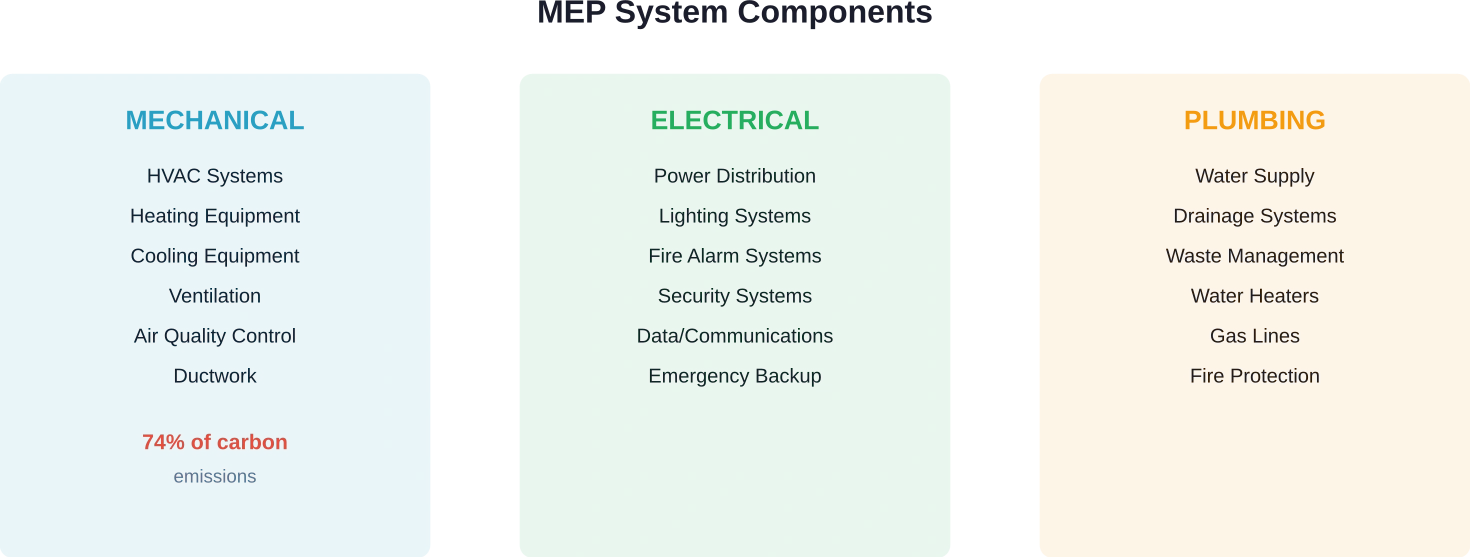
MEP is an abbreviation for Mechanical, Electrical, and Plumbing. These three technical fields cover the systems that make buildings habitable for humans. According to VDCI educational resources, MEP systems are vital for modern building functionality and comfort.
Here’s what each letter represents:
M: Mechanical Systems
Mechanical refers to heating, ventilation, and air conditioning systems—commonly known as HVAC. These systems control indoor climate, air quality, and temperature throughout a building.
According to ASHRAE research on whole life carbon for MEP systems, HVAC systems play a pivotal role in a building’s carbon emissions. Selected examples show that HVAC accounts for 56% of weight and a staggering 74% of carbon emissions in MEP installations.
Mechanical systems include heat exchangers, boilers, chillers, air handlers, ductwork, and ventilation equipment. ASHRAE recommends keeping relative humidity between 30% and 60% to minimize airborne bacteria and viruses while maintaining comfort.
E: Electrical Systems
Electrical covers the building’s power supply, distribution, and all electrical equipment. This includes core operations like lighting and mechanical equipment operation, as well as data and communications systems that support modern connectivity and building use.
Lighting installations are the electrical systems most visible to building occupants. But electrical engineering extends far beyond lights—it encompasses power distribution panels, emergency backup systems, fire alarm systems, security systems, and telecommunications infrastructure.
P: Plumbing Systems
Plumbing handles water supply, drainage, and waste management. The International Plumbing Code (IPC) is the most widely adopted plumbing code across the United States, currently adopted in 37 states. Approximately 257 million people, or 76% of the US population, live in areas that have adopted the IPC.
Plumbing systems include water supply lines, drainage pipes, sewage systems, water heaters, pumps, and fixtures. They also encompass specialized systems like natural gas lines, medical gas systems in healthcare facilities, and grease interceptors in commercial kitchens.
Add Outside BIM Capacity to Your Project Team

Powerkh works with project teams that need extra support for BIM modeling, Scan to BIM, BIM coordination, automation, and detailing. The company helps deliver the technical work behind models, drawings, clash resolution, and fabrication-ready documentation. For construction projects that need reliable BIM production support, Powerkh acts as an external delivery partner.
Need Help With BIM Models, Coordination, or Scan Data?
Talk with Powerkh to:
- develop models and drawings for active projects
- convert point cloud files into structured BIM outputs
- support coordination, automation, and detailing tasks
👉 Contact Powerkh for a project review and consultation.
Why MEP Systems Matter in Construction Projects
MEP systems are far more than just technical details. They’re fundamental to how buildings function and how occupants experience them.
According to VDCI educational materials, MEP is a major cost and coordination driver. These systems are expensive to design, install, and maintain. They’re also complex—requiring careful coordination between multiple disciplines throughout the design and construction phases.
Here’s why MEP engineering is so critical:
Occupant Comfort and Safety
MEP installations directly impact whether a building is comfortable, safe, and functional. Poor mechanical design leads to hot and cold spots, humidity problems, and poor air quality. Inadequate electrical systems create safety hazards and operational disruptions. Faulty plumbing can cause water damage, sanitation issues, and health risks.
Energieeffizienz und Nachhaltigkeit
ASHRAE’s research on whole life carbon shows that MEP systems contribute significantly to a building’s energy consumption and carbon emissions. Proper design reduces operational costs and environmental impact over the building’s lifetime.
These assessments rely on high-quality Embodied Carbon Data Sources, often obtained from Environmental Product Declarations. This data helps engineers make informed decisions about equipment selection and system design.
Building Code Compliance
MEP systems must comply with numerous codes and standards. ASHRAE Standards 62.1 and 62.2 are the recognized standards for ventilation system design and acceptable indoor air quality. These standards specify minimum ventilation rates and other measures to minimize adverse health effects for occupants.
The International Code Council provides comprehensive codes for electrical, mechanical, and plumbing installations that jurisdictions adopt nationwide.
How MEP Engineering Works in Practice
MEP installations are normally designed together due to the high degree of interaction between systems. A mechanical engineer can’t design an HVAC system without knowing where electrical power will be available. An electrical engineer needs to account for the power demands of mechanical equipment. A plumbing engineer must coordinate pipe routing with ductwork and electrical conduits.
This coordination happens throughout the project lifecycle:
| Project Phase | MEP Activities | Key Stakeholders |
|---|---|---|
| Design Development | System sizing, equipment selection, preliminary layouts | Architects, MEP engineers, owners |
| Bauunterlagen | Detailed drawings, specifications, coordination drawings | Design team, code officials |
| Bauwesen | Installation, testing, coordination with trades | Contractors, inspectors, commissioning agents |
| Commissioning | System verification, performance testing, documentation | Commissioning team, facility managers |
According to industry data, Autodesk Revit is used by 75% of architects for their 3D projects, while AutoCAD is used by 85% of engineers and architects. These tools enable Building Information Modeling (BIM), which allows MEP disciplines to design in a coordinated three-dimensional environment.
Common MEP Challenges and Solutions
Real talk: MEP coordination is where many construction projects encounter problems. Space conflicts between ducts, pipes, and conduits are common. Equipment doesn’t fit in the allocated mechanical rooms. Systems don’t perform as designed.
Over-Engineering Problems
One consequence of over-engineering in mechanical systems is poor control of indoor humidity. When HVAC equipment is oversized, it cycles on and off too frequently, failing to remove adequate moisture from the air. This creates comfort problems even though the temperature is controlled.
Coordination Failures
When MEP disciplines work in isolation, conflicts emerge during construction. A plumbing pipe interferes with an electrical panel. Ductwork blocks access to a fire sprinkler valve. These issues cause delays, rework, and cost overruns.
BIM coordination and clash detection help identify these conflicts before construction begins. Regular coordination meetings between disciplines keep everyone aligned.
Value Engineering Impact
Budget pressures often lead to value engineering of MEP systems. But cutting corners on mechanical, electrical, or plumbing installations can backfire. Lower-efficiency equipment costs more to operate. Undersized systems don’t meet building needs. Poor-quality installations require more maintenance and fail prematurely.
Frequently Asked Questions About MEP in Construction
What does MEP stand for in construction?
MEP stands for Mechanical, Electrical, and Plumbing. These engineering disciplines design and implement the systems that make buildings functional, safe, and comfortable for occupants.
Why are MEP systems important?
MEP systems provide essential services such as heating, cooling, electricity, lighting, water supply, and waste removal. They significantly impact building performance, energy efficiency, and overall comfort.
What’s included in mechanical systems?
Mechanical systems primarily include HVAC components such as furnaces, boilers, chillers, air handling units, heat pumps, ductwork, and ventilation systems. These systems regulate temperature, humidity, and air quality.
What do electrical engineers design in buildings?
Electrical engineers design power distribution systems, lighting, fire alarms, security systems, telecommunications infrastructure, and backup power systems. They also coordinate power needs for mechanical equipment.
What’s the difference between plumbing and mechanical?
Plumbing focuses on water supply, drainage, waste systems, and gas piping. Mechanical systems focus on heating, cooling, and ventilation. Some systems, like hydronic heating, involve both disciplines.
How much do MEP systems cost?
MEP systems typically account for 30% to 50% of total construction costs, depending on building complexity. Specialized facilities like hospitals or laboratories may require higher investment.
What software do MEP engineers use?
Common tools include AutoCAD, Revit, Navisworks, and AutoCAD MEP. These platforms support design, 3D modeling, coordination, and clash detection across disciplines.
Conclusion: The Foundation of Modern Buildings
So what does MEP stand for in construction? Mechanical, Electrical, and Plumbing—three disciplines that transform architectural vision into functional reality.
These systems are the lifeblood of buildings. They ensure occupant comfort and operational functionality while accounting for energy efficiency, code compliance, and long-term sustainability.
Understanding MEP is essential whether you’re an architect, contractor, building owner, or facility manager. The coordination and quality of these systems make the difference between a building that performs well and one that struggles with operational problems.
For construction projects of any scale, investing in proper MEP engineering pays dividends through lower operating costs, better occupant satisfaction, and fewer maintenance headaches down the road.

Unsere Fallstudien
Wir haben mehr als 200 BIM- und VDC-Projekte für Gewerbe, Industrie und Wohnungsbau durchgeführt.
Unsere Arbeit umfasst:
Automatisierung der Schalungsplanung
Our client from
California, USA
Automatisierung von abgehängten Decken
Our client from
New York, USA
Automatisierung von Wandkonstruktionen
Our client from
California, USA