Haben Sie noch Fragen? Kontaktieren Sie uns!
Kommen Sie in unser Team!
Kostenloses Angebot oder Beratung anfordern

Quick Summary: Construction engineering is a specialized branch of civil engineering focused on planning, coordinating, and managing construction projects from design through completion. Construction engineers bridge the gap between engineering design and practical execution, handling project scheduling, budget management, site safety, temporary structures, and resource coordination to ensure infrastructure projects are built according to specifications.
When you drive across a newly built highway, walk through a modern office building, or cross a bridge spanning a river, you’re experiencing the work of construction engineers. These professionals transform architectural blueprints and engineering designs into physical reality.
But what exactly does construction engineering involve? And how does it differ from related fields like civil engineering or construction management?
This guide breaks down everything you need to know about this essential engineering discipline.
Defining Construction Engineering
Construction engineering represents a specialized subdiscipline within civil engineering that concentrates on the construction process itself. While civil engineers focus primarily on design, construction engineers take those designs and figure out how to actually build them.
According to the Bureau of Labor Statistics, civil engineers (which includes construction engineering specialists) earned a median annual wage of $99,590 in May 2024. The field combines technical engineering knowledge with practical project management skills.
Construction engineers manage construction projects from start to finish. They ensure projects stay on schedule, remain within budget, and meet all safety requirements and specifications.
Core Responsibilities
The role of construction engineers extends far beyond simple oversight. These professionals handle multiple critical functions:
- Designing and ensuring safety of temporary structures used during construction
- Developing project schedules and coordinating construction activities
- Managing budgets and tracking project costs
- Overseeing quality control and ensuring compliance with plans and specifications
- Coordinating between contractors, subcontractors, and project stakeholders
- Solving on-site problems as they arise during construction
- Ensuring workplace safety and regulatory compliance
A construction engineer might be tasked with building a new highway or tunnel, or with ensuring that new buildings connect properly to main roads for accessibility. The work requires both high-level strategic planning and detailed practical oversight.
Work With a BIM and VDC Support Team

Powerkh provides BIM and VDC services for construction and design projects. The company handles BIM modeling, coordination, Scan to BIM, BIM automation, prefabrication workflows, and structural detailing. Its work is centered on project delivery – helping teams with models, drawings, point cloud processing, and technical documentation.
Need Outside BIM Support for Project Work?
Talk with Powerkh to:
- build BIM models and documentation
- convert scans into usable project outputs
- support coordination, detailing, and automation tasks
👉 Contact Powerkh for a project review and consultation.
Construction Engineering vs. Civil Engineering
Here’s where things get interesting. Construction engineering and civil engineering overlap significantly, but they’re not identical.
Civil engineers primarily focus on design. They create the plans, perform structural calculations, and determine what needs to be built. According to ASCE, civil engineers have a leading role in planning, designing, building, and ensuring a sustainable future by providing the bridge between science and society.
Construction engineers, by contrast, concentrate on execution. They take those civil engineering designs and figure out the practical aspects of building them.
| Aspect | Bauingenieurwesen | Bauingenieurwesen |
|---|---|---|
| Primary Focus | Design and analysis | Execution and management |
| Key Activities | Structural design, calculations, specifications | Scheduling, coordination, site management |
| Project Phase | Pre-construction planning | Construction and implementation |
| Liefergegenstände | Drawings, specifications, reports | Built structures, completed projects |
| Typical Work Location | Office-based design work | Split between office and construction sites |
That said, many professionals work in both areas. Civil engineering programs often include construction engineering as a concentration or specialization, and professionals frequently move between design and construction roles throughout their careers.
Educational Requirements and Career Path
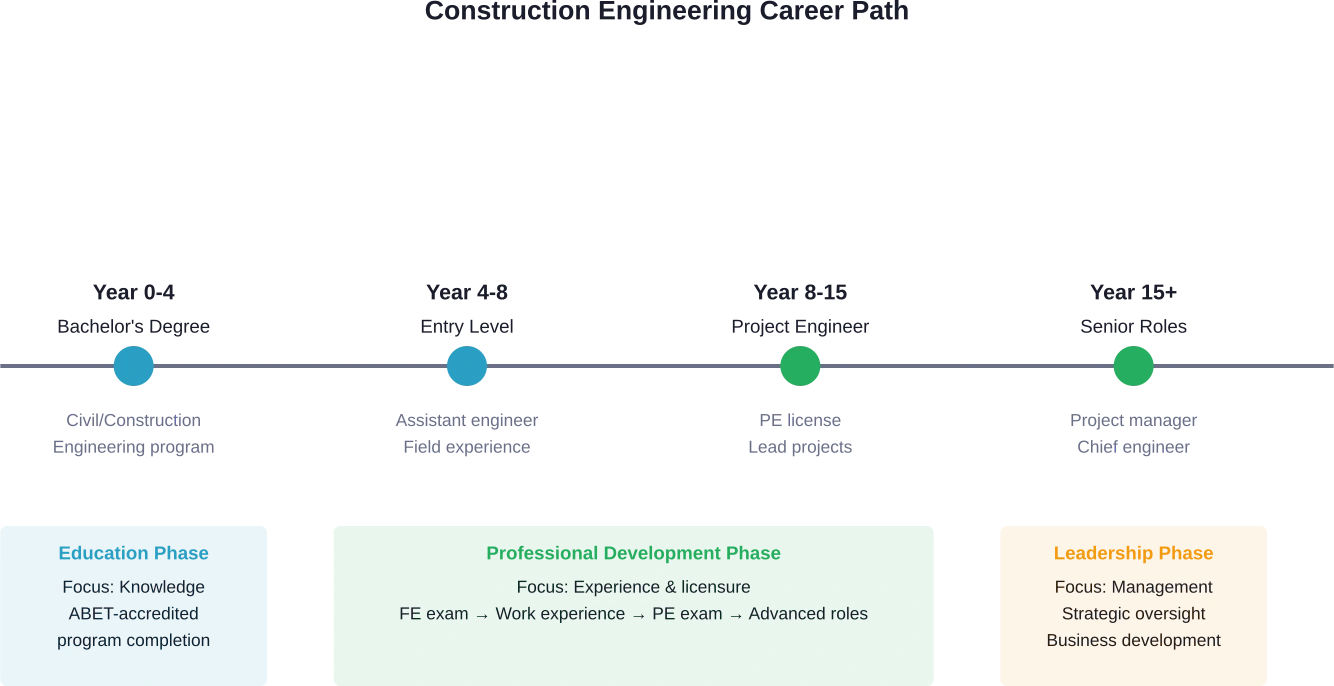
Breaking into construction engineering typically requires a bachelor’s degree. Most professionals earn a degree in civil engineering with a construction engineering concentration, though dedicated construction engineering programs exist at some universities.
According to the Bureau of Labor Statistics, construction managers (a related role) earned a median annual wage of $106,980 in May 2024, while civil engineering technologists and technicians earned $64,200 in the same period. Large construction firms may prefer to hire candidates who have both construction experience and a bachelor’s degree in a construction-related field.
Degree Requirements
ABET accreditation standards outline the curriculum requirements for engineering programs. Construction engineering education typically includes:
- Advanced mathematics (calculus, trigonometry, statistics)
- Physics and engineering mechanics
- Materials science
- Strukturelle Analyse
- Construction methods and equipment
- Project management principles
- Kostenabschätzung und Terminplanung
- Engineering ethics and professional practice
According to MIT’s educational materials, civil engineering skills include math (advanced algebra, calculus, trigonometry, statistics), physics, and understanding of infrastructure systems including buildings, roads, bridges, canals, dams, airports, pipelines, railways, and water supply systems.
Many construction engineers also pursue professional licensure. Civil engineers typically need a state-issued license if they provide services directly to the public, according to BLS data.
Is Construction Engineering a Good Career?
The short answer? Yes, for the right person.
According to Michigan Technological University, there were 341,800 civil engineering jobs in 2023, with positions expected to grow by 6% by 2033, with about 22,100 new annual openings. The Bureau of Labor Statistics projects about 22,100 new annual openings between 2023 and 2033.
Overall employment in architecture and engineering occupations is projected to grow faster than the average for all occupations from 2024 to 2034, with about 186,500 openings expected each year, according to BLS data.
In 2023, the median wage for workers with construction degrees was $90,000, compared to $70,000 across all fields, according to U.S. Census Bureau data (American Community Survey). About 68% of construction degree holders worked in occupations requiring at least a bachelor’s degree.
Career Advantages
Construction engineering offers several compelling benefits:
- Strong salary potential with clear advancement paths
- Tangible results — seeing projects transform from plans to physical structures
- Diverse project types across multiple industries
- Combination of office work and field experience
- Problem-solving opportunities requiring creative solutions
- Growing demand driven by infrastructure needs
The profession provides both stability and variety. Infrastructure always needs maintenance, expansion, and modernization.
Career Challenges
But it’s not without challenges:
- Project deadlines can create high-pressure situations
- Weather-dependent work schedules
- Occasional long hours during critical construction phases
- Responsibility for safety and compliance carries significant weight
- Balancing competing priorities (cost, schedule, quality, safety)
Industry discussions highlight that construction engineers need strong interpersonal skills alongside technical expertise. The role requires coordination with diverse stakeholders, from architects to contractors to regulatory officials.
Key Skills for Success
Technical knowledge forms the foundation, but construction engineers need a broader skill set. According to ASCE guidelines for engineering grades, engineers at various levels require progressively more sophisticated knowledge, skills, and responsibilities.
Critical competencies include:
- Technical proficiency: Understanding of structural principles, construction methods, materials, and equipment
- Project management: Scheduling, resource allocation, budget control, and timeline coordination
- Kommunikation: Clear interaction with diverse stakeholders at all project levels
- Problem-solving: Quick thinking when field conditions don’t match plans
- Leadership: Directing teams and making decisions under pressure
- Regulatory knowledge: Understanding of building codes, safety regulations, and permitting requirements
According to NSPE’s Code of Ethics for Engineers, professionals must hold paramount the safety, health, and welfare of the public. This ethical foundation shapes every decision construction engineers make.
Future Outlook and Opportunities
The construction engineering field continues evolving. Automation has changed some aspects of engineering work, but human expertise remains essential for complex project coordination and problem-solving.
Infrastructure investment remains a priority across the United States. Aging bridges, roads, water systems, and buildings require replacement or renovation. New construction continues in both residential and commercial sectors.
Sustainability presents new challenges and opportunities. ASCE’s policy statement 418 emphasizes that civil engineers have a leading role in ensuring a sustainable future. Construction engineers increasingly must consider environmental impact, energy efficiency, and long-term sustainability in their work.
Technology integration also shapes the field. Building Information Modeling (BIM), drone surveys, and advanced project management software have transformed how construction projects are planned and executed.
Häufig gestellte Fragen
What’s the difference between construction engineering and construction management?
Construction engineering focuses on technical and engineering aspects such as structural systems, materials, and problem-solving. Construction management focuses on business and organizational aspects like contracts, scheduling, and coordination. Engineers handle technical decisions, while managers oversee project execution.
Do construction engineers work mostly in offices or on construction sites?
Construction engineers work both in offices and on-site. They handle planning and documentation in the office, while also conducting inspections, coordinating teams, and solving issues directly on construction sites.
Can I become a construction engineer with a civil engineering degree?
Yes. A civil engineering degree is one of the most common paths into construction engineering. Many professionals specialize in construction through experience or additional training.
What types of projects do construction engineers work on?
They work on a wide range of projects including buildings, roads, bridges, tunnels, railways, airports, water systems, and other infrastructure developments.
Is a Professional Engineer (PE) license required for construction engineers?
It depends on the role. A PE license is often required for engineers providing services to the public and is valuable for career advancement, though not all positions require it.
How long does it take to become a construction engineer?
A bachelor’s degree typically takes four years. Gaining experience and achieving professional licensure can take an additional four years or more.
What’s the job outlook for construction engineers through 2030?
The outlook is positive, with steady demand driven by infrastructure development, urban growth, and the need to replace aging facilities. Employment is expected to grow consistently over the coming years.
Schlussfolgerung
Construction engineering offers a rewarding career path for those who want to blend technical engineering knowledge with practical project execution. These professionals transform designs into reality, ensuring infrastructure projects are built safely, on schedule, and within budget.
The field requires strong technical foundations, project management skills, and the ability to solve problems under pressure. But for those drawn to seeing tangible results from their work, construction engineering provides exactly that — the satisfaction of watching structures rise from empty ground.
Whether working on bridges spanning rivers, highways connecting communities, or buildings housing businesses and families, construction engineers play an essential role in building the infrastructure that shapes modern life.
Ready to explore a career in construction engineering? Research ABET-accredited programs in civil or construction engineering, reach out to professionals in the field, and consider internship opportunities to gain firsthand experience. The built environment needs skilled engineers to bring tomorrow’s infrastructure to life.

Unsere Fallstudien
Wir haben mehr als 200 BIM- und VDC-Projekte für Gewerbe, Industrie und Wohnungsbau durchgeführt.
Unsere Arbeit umfasst:
Automatisierung der Schalungsplanung
Our client from
California, USA
Automatisierung von abgehängten Decken
Our client from
New York, USA
Automatisierung von Wandkonstruktionen
Our client from
California, USA