Haben Sie noch Fragen? Kontaktieren Sie uns!
Kommen Sie in unser Team!
Kostenloses Angebot oder Beratung anfordern

Quick Summary: Modular construction is a process where buildings are constructed off-site in controlled factory environments, then transported and assembled at the final location. Unlike traditional on-site construction, this method produces structures in prefabricated modules using the same codes and materials but in significantly less time—often 30-50% faster—while reducing waste, costs, and environmental impact.
The construction industry faces mounting pressure. Labor shortages plague job sites across the nation. Project timelines stretch longer while costs spiral upward. And traditional building methods struggle to keep pace with demand for affordable housing and commercial spaces.
Enter modular construction—a building approach that’s fundamentally changing how structures come together. But it’s not some experimental technique. According to the National Association of Home Builders (NAHB), modular homes are built to the same standards and codes as site-built homes in a fraction of the time.
In 2024, modular and panelized (offsite) construction accounted for 3% of single-family home completions in the United States (28,000 out of 1,019,000 homes). The market share has been declining since the early 2000s and flattened nationally in recent years.
So what exactly makes modular construction different? And why are architects, developers, and builders increasingly turning to this approach?
Defining Modular Construction: The Basics
Modular construction is a process in which a building is constructed off-site, under controlled plant conditions, using the same materials and designing to the same codes and standards as conventionally built facilities. The key difference? Time and environment.
Buildings are produced in “modules” that when put together on site reflect the identical design intent and specifications of the most sophisticated site-built facility. These aren’t temporary structures or lower-quality alternatives. They’re permanent buildings constructed with precision manufacturing techniques.
Here’s how it works: While site contractors prepare the foundation, factory workers simultaneously build the structure’s components in a climate-controlled facility. Once modules are complete, they’re transported to the site and assembled—often in days rather than months.
The NAHB emphasizes that modular homes shouldn’t be confused with mobile homes. These structures install on permanent foundations and meet all local building codes. The only real difference is where construction happens.
Two Primary Types of Modular Construction
Not all modular construction looks the same. The industry recognizes two main approaches, each with distinct characteristics and applications.
Volumetric Modular Construction
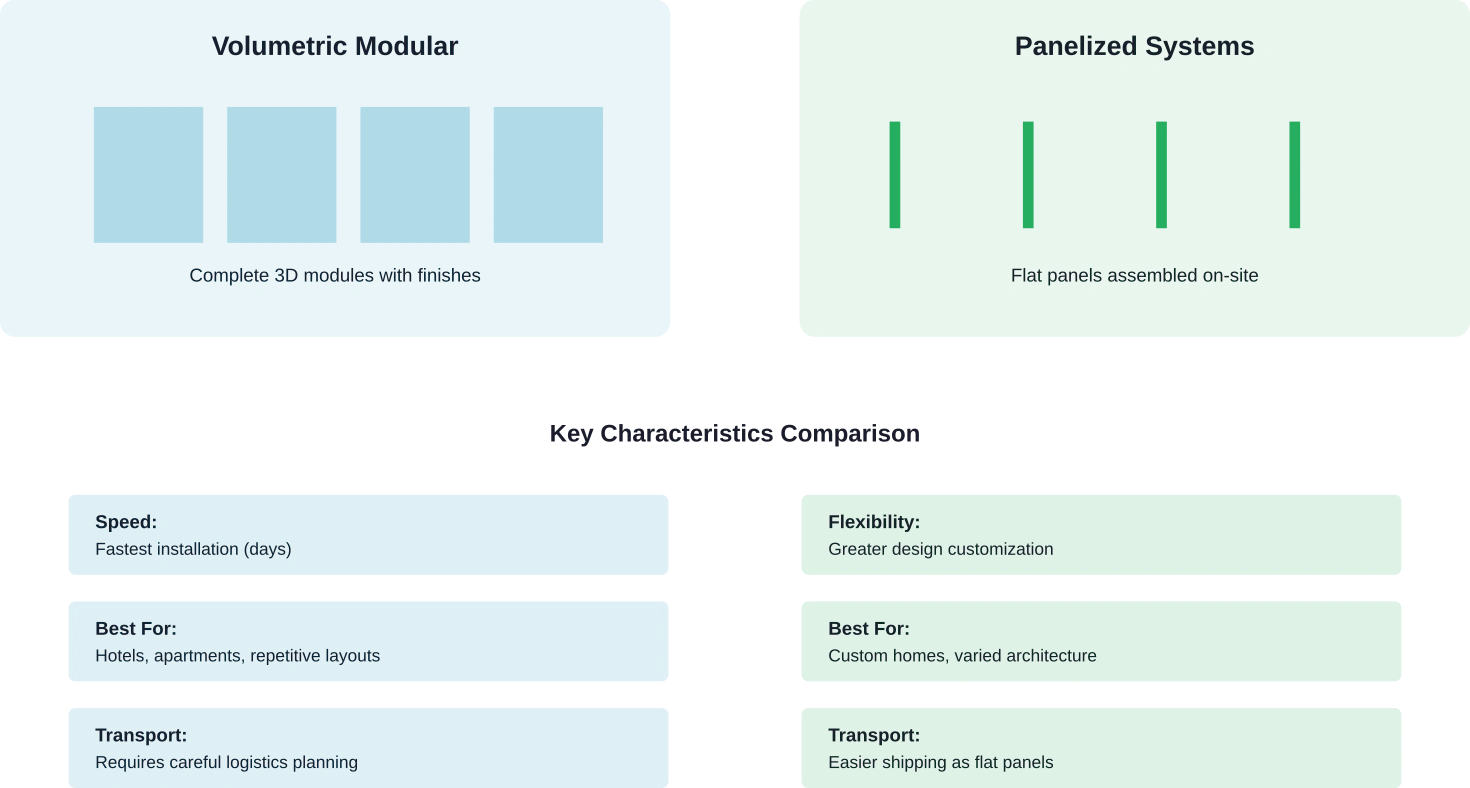
Volumetric construction produces complete three-dimensional modules in the factory. Think of them as finished rooms or sections of a building—walls, floors, ceilings, electrical, plumbing, and even interior finishes all installed before transport.
These modules arrive on-site as self-contained units. Workers crane them into position, connect utilities between modules, and seal the joints. Within days, a fully functional building stands ready.
Volumetric modular works particularly well for repetitive designs like hotels, student housing, and apartment buildings where rooms share similar layouts.
Panelized Building Systems
Panelized construction takes a different approach. Rather than complete volumetric modules, factories produce flat panels—walls, floors, and roof sections. According to the NAHB, a panelized building system incorporates construction techniques that use advanced technology, quality materials, and a controlled work environment to build energy-efficient homes in less time.
These panels arrive at the job site where crews assemble them into the final structure. It offers more flexibility than volumetric construction while still capturing many factory-production benefits.
Panelized systems work well for custom homes and buildings where architectural variety matters more than pure speed.
Use Powerkh for BIM Project Support

Powerkh provides BIM and VDC services for construction and design teams. Its work includes BIM modeling, BIM coordination, Scan to BIM, BIM automation, prefabrication workflows, and structural detailing. The company supports projects with models, drawings, point cloud processing, and coordination work that needs to be done on the delivery side.
Need BIM Help on an Active Project?
Talk with Powerkh to:
- build BIM models and documentation
- convert scan data into usable project outputs
- support coordination, detailing, and automation work
👉 Contact Powerkh for a project review and consultation.
The Modular Construction Process Explained
Understanding how modular construction unfolds helps clarify why it delivers such dramatic time savings. The process runs on parallel timelines rather than sequential steps.
Design and Engineering Phase
Everything starts with detailed design work. Architects and engineers create plans that account for both factory production and final assembly. Unlike traditional construction where some details get resolved on-site, modular projects require complete documentation upfront.
This front-loaded design work pays dividends later. Fewer change orders. Minimal surprises. Better cost control.
Simultaneous Site and Factory Work
Here’s where modular construction separates itself from conventional methods. While excavators prepare the foundation and install utilities at the building site, factory workers simultaneously construct the building modules.
This parallel workflow cuts total project time dramatically. Construction of modular buildings can occur simultaneously with site and foundation work, allowing projects to be completed in about half the time of traditional construction.
Weather doesn’t slow factory production. Rain, snow, or extreme temperatures that would halt conventional construction have zero impact on climate-controlled manufacturing facilities.
Transportation and Assembly
Once modules pass rigorous quality inspections, specialized trucks transport them to the site. Logistics matter here—routes need planning, permits may be required for oversized loads, and delivery timing must align with site readiness.
Cranes lift modules into position, typically completing this work in days. Skilled crews then connect modules, seal joints, complete exterior finishes, and connect utilities. The building takes final form quickly.
Finishing and Inspection
Final touches happen on-site: landscaping, parking areas, external utilities connections. Then come inspections. Because modular buildings meet the same codes as traditional construction, they undergo identical inspection processes.
Once approved, occupancy can begin—often months earlier than conventional construction would allow.
Major Benefits Driving Modular Adoption
Why do developers, architects, and builders increasingly choose modular methods? The advantages extend well beyond simple speed.
Dramatically Reduced Construction Schedules
Time savings represent the most visible benefit. Modular construction has consistently been at least 20 percent faster than traditional on-site builds. Wikipedia notes claimed time savings of between 20 and 50 percent faster than traditional building techniques.
For commercial projects, this means faster revenue generation. For housing developments, it means addressing affordability crises more effectively. Time really is money in construction.
Enhanced Quality Control
Factory environments provide consistent conditions impossible to replicate on outdoor job sites. Workers access proper tools, materials stay dry and organized, and quality control happens at every production stage.
Inspections occur throughout manufacturing rather than waiting for completion. Issues get caught and corrected immediately. The result? Fewer callbacks, reduced warranty claims, and longer-lasting structures.
Labor Efficiency and Safety
The NAHB notes that labor reduction represents one of home builders’ chief concerns nationwide. Systems-built home manufacturing happens at factories where skilled workers complete multiple projects without traveling between job sites.
Factory work also proves safer than traditional construction. Workers operate on stable platforms rather than scaffolding. They aren’t exposed to weather extremes. Fall risks diminish dramatically. These safety improvements reduce injuries and lower insurance costs.
Environmental Advantages
Sustainability matters more every year. Modular construction delivers measurable environmental benefits. Material supplies are easier to control in factory settings, reducing wastage and thereby cost, as well as lowering the environmental impact of a build. The UK group WRAP estimates that this reduces construction waste compared to traditional building methods.
Precision manufacturing also improves energy efficiency. Tighter construction means better insulation performance and lower operational energy consumption throughout the building’s life.
Vorhersagbarkeit der Kosten
Construction budgets often balloon beyond initial estimates. Weather delays, material price fluctuations, labor shortages—traditional projects face numerous cost variables.
Modular construction tames these wildcards. Fixed-price contracts become more feasible. Material costs lock in during bulk purchasing. Labor productivity stays consistent in factory environments. Weather doesn’t derail schedules and budgets.
Common Applications for Modular Construction
Modular construction suits various building types, though some applications prove more common than others.
Residential Housing
Single-family homes, townhouses, and apartments all work well with modular methods. Housing developments benefit particularly from the speed advantage when addressing urgent housing needs or building in remote communities.
Modular homes offer identical aesthetics to traditional homes. Once complete, most people cannot distinguish modular from stick-built construction.
Multifamily and Student Housing
Repetitive room layouts make apartment buildings and student dormitories ideal for volumetric modular construction. Developers appreciate the faster time-to-occupancy, which means revenue generation begins months earlier.
Universities facing enrollment growth turn to modular construction to meet housing demand within tight timelines.
Einrichtungen des Gesundheitswesens
Medical buildings, clinics, and temporary treatment facilities increasingly use modular methods. The controlled factory environment particularly suits healthcare construction where cleanliness and precision matter.
During emergencies, modular construction provides rapid healthcare infrastructure expansion when traditional construction timelines prove too slow.
Geschäfts- und Bürogebäude
Offices, schools, retail spaces, and industrial facilities all benefit from modular approaches. Commercial developers value the cost predictability and reduced financing costs from faster completion.
Temporary and Remote Infrastructure
Construction camps, remote workforce housing, and temporary facilities represent growing modular applications. The ability to relocate and repurpose modular buildings adds long-term value.
ASTM research on moisture management in wood volumetric modular construction specifically addresses challenges in remote or underserved communities where housing providers need quick affordable solutions.
Addressing Common Misconceptions
Despite growing adoption, modular construction faces persistent myths that deserve addressing.
“Modular Buildings Look Cheap or Temporary”
This misconception likely stems from confusion with mobile homes or temporary trailers. Modern modular buildings meet identical aesthetic standards as conventional construction. Architectural firms design sophisticated structures using modular methods that showcase no visual differences from traditional builds.
Exterior finishes, materials, and design complexity match any conventional building. Once complete, modular structures are indistinguishable from site-built counterparts.
“Quality Suffers Compared to Traditional Construction”
Actually, the opposite often proves true. Factory quality control exceeds what’s possible on outdoor job sites. Materials don’t weather-damage before installation. Inspections happen throughout production rather than after completion. Workers have proper tools and stable working platforms.
Building codes apply equally to modular and traditional construction. There’s no separate “lesser” standard for factory-built structures.
“Design Options Are Limited”
Early modular construction focused on repetitive, simple designs. Modern capabilities changed that equation. CAD technology and advanced manufacturing enable complex architectural designs. Custom homes, unique commercial buildings, and sophisticated structures all work with modular methods.
Design limitations exist primarily around transportation—modules must fit on trucks and navigate roads. But creative architects work within these constraints without sacrificing aesthetic vision.
“Financing Is Difficult”
Lenders understand modular construction better now than a decade ago. Once modular buildings attach to permanent foundations and meet local codes, they qualify for traditional mortgages and commercial loans just like site-built structures.
Some lenders actually prefer modular projects because shorter construction periods reduce loan risk and construction financing costs.
Herausforderungen und Überlegungen
Modular construction offers significant advantages, but it’s not universally superior for every project. Understanding limitations helps determine when this approach makes sense.
Transportation and Site Access
Getting completed modules to the job site requires planning. Rural areas with narrow roads or urban sites with overhead obstacles present challenges. Module dimensions face constraints based on highway regulations and delivery routes.
Some locations simply cannot accommodate modular delivery. Site assessment early in planning prevents discovering access problems too late.
Design Coordination Requirements
Front-loaded design work demands more time and precision upfront than traditional construction. Changes mid-production prove expensive or impossible. Teams must finalize details before factory production begins.
This requirement actually improves projects by forcing thorough planning, but it does shift effort to earlier project phases.
Module Size and Configuration Limits
Transportation constraints impact room sizes. Very large open spaces may require creative solutions or hybrid approaches combining modular and conventional construction methods.
These limitations decrease as manufacturers develop innovative approaches, but they remain considerations during design phases.
Coordination Between Factory and Site
Successful modular projects require excellent coordination between factory production schedules and site readiness. If foundations aren’t ready when modules arrive, delays negate time advantages. If modules aren’t ready when sites are prepared, costs increase.
Communication and scheduling coordination prove critical for modular project success.
| Project Factor | Best Fit for Modular | Consider Traditional |
|---|---|---|
| Zeitleiste | Urgent occupancy needs, tight deadlines | Flexible schedules, no rush |
| Gestaltung | Repetitive layouts, defined requirements | Highly custom, evolving design |
| Site Access | Good road access, clear delivery routes | Difficult access, overhead obstacles |
| Haushalt | Fixed costs important, financing sensitive | Flexible budgets, cost adjustments possible |
| Standort | Remote areas, harsh climates | Urban infill with space constraints |
| Skala | Multiple units, larger projects | Single small structures |
Cost Considerations: What to Expect
Cost comparisons between modular and traditional construction defy simple answers. Multiple variables influence final expenses.
Factors Affecting Modular Construction Costs
Module complexity, building size, finish quality, site conditions, and transportation distance all impact costs. Simple structures with repetitive designs deliver maximum savings. Highly customized buildings reduce cost advantages.
Factory efficiency improves with larger orders. A single custom modular home sees less cost benefit than a 100-unit apartment building using identical modules.
Where Savings Emerge
Labor costs typically decrease with modular construction. Factory workers complete multiple projects without travel time. Productivity stays higher in controlled environments.
Reduced construction schedules lower financing costs. Every month saved means reduced interest payments on construction loans. For commercial projects, earlier occupancy generates revenue sooner.
Material waste reduction cuts costs and environmental impact. Bulk purchasing for factory production captures volume discounts impossible on individual job sites.
Potential Premium Costs
Transportation and crane operations add expenses absent from traditional construction. Long-distance module delivery or difficult site access increase these costs significantly.
Design and engineering require more upfront investment. Detailed planning necessary for factory production means higher early-phase professional fees.
Some modular manufacturers charge premiums for customization or small-scale projects where factory efficiency gains don’t materialize.
Total Cost of Ownership
Looking beyond initial construction, modular buildings often deliver lifecycle savings. Better quality control means fewer maintenance issues. Tighter construction improves energy efficiency, lowering operational costs for decades.
Reusability represents another value factor. Modular building components can be disassembled, relocated, and repurposed, allowing flexibility as needs evolve while minimizing waste and extending material lifespan.
The Future of Modular Construction
Industry momentum suggests modular construction’s market share will continue growing. Several trends are accelerating adoption.
Technology Integration
Advanced manufacturing technologies improve factory capabilities. Robotic systems, automated production lines, and precision machinery enable increasingly complex designs with better quality control.
Government research from NIST on assembly performance metrics and test methods explores how new technologies in robotic arms and end-effectors accelerate modular construction capabilities.
Sustainability Pressures
Climate concerns drive construction industry changes. Modular methods align well with sustainability goals through waste reduction, energy efficiency, and potential for material reuse.
Building standards organizations like ASTM continue developing specifications that address environmental performance, including moisture management systems crucial for long-term durability in various climates.
Labor Market Realities
Construction labor shortages show no signs of resolving soon. Modular construction’s factory-based approach provides partial solutions by creating more controlled, appealing work environments that attract and retain skilled workers.
Affordable Housing Demands
Housing affordability crises affect communities nationwide. Modular construction’s speed and cost advantages position it as a key tool for addressing housing shortages, particularly for affordable and workforce housing developments.
Organizations like the NAHB’s Modular Home Building Council actively promote awareness of modular construction’s quality and efficiency advantages as housing demand outpaces traditional construction capacity.
Is Modular Construction Right for Your Project?
Deciding whether modular construction fits a specific project requires honest assessment of priorities and constraints.
Modular construction works best when timeline matters significantly, design requirements are clear upfront, site access allows module delivery, and projects involve multiple similar units or repetitive layouts.
Traditional construction might suit projects better when design flexibility throughout construction is essential, site access presents severe challenges, projects are very small scale, or highly unusual architectural requirements exist that factories cannot easily accommodate.
Many projects benefit from hybrid approaches—combining modular components for repetitive elements with conventional construction for unique features. This strategy captures modular advantages while maintaining design flexibility where it matters most.
Consulting with experienced modular manufacturers early in planning helps determine feasibility and identify potential issues before committing to a construction approach.
Häufig gestellte Fragen
How long does modular construction take compared to traditional building?
Modular construction typically reduces project timelines by 30–50% due to parallel workflows. While modules are built in a factory, site preparation happens simultaneously, significantly shortening overall schedules.
Do modular buildings meet the same building codes as site-built structures?
Yes. Modular buildings must comply with the same building codes, zoning regulations, and safety standards as traditional construction. They undergo inspections during factory production and after on-site assembly.
Can modular buildings be customized or are they all the same?
Modern modular construction allows extensive customization. Architects can design unique residential and commercial buildings within transportation constraints, making modular structures nearly indistinguishable from traditional ones.
Is modular construction more expensive than traditional building?
Costs vary depending on the project. Modular construction often reduces labor, material waste, and financing costs, but transportation and engineering expenses may offset savings. Larger, repetitive projects typically see the greatest cost benefits.
What types of buildings work best with modular construction?
Modular construction works well for housing, apartments, hotels, dormitories, healthcare facilities, schools, offices, and remote workforce housing. Projects with repetitive layouts benefit the most.
Can modular buildings be relocated or expanded later?
Yes. Modular structures can be disassembled, relocated, and expanded by adding new modules. This flexibility makes them ideal for temporary or evolving needs.
How does weather affect modular construction timelines?
Weather has minimal impact because most construction occurs in controlled factory environments. Only site preparation and final assembly are affected by weather conditions, reducing delays compared to traditional building methods.
Conclusion: Building Smarter with Modular Methods
Modular construction represents more than a construction trend—it’s a fundamental evolution in how buildings come together. By moving major construction work into controlled factory environments while site preparation occurs simultaneously, this approach delivers measurable advantages in speed, quality, cost predictability, and sustainability.
The method isn’t universally superior for every project. Transportation logistics, design coordination requirements, and site access considerations mean traditional construction still suits some situations better. But for many residential, commercial, and institutional projects, modular construction offers compelling benefits that traditional methods struggle to match.
As technology advances, labor markets tighten, and sustainability pressures increase, modular construction’s market share will likely continue growing. The National Association of Home Builders and other industry organizations actively support this evolution, recognizing that systems-built construction addresses critical challenges facing the building industry.
Whether building a single-family home, multifamily development, commercial facility, or specialized structure, modular construction deserves serious consideration. The question isn’t whether modular construction works—decades of successful projects prove it does. The question is whether it fits specific project requirements, timelines, and constraints.
For projects where speed matters, budgets need predictability, quality control is paramount, and designs allow factory production, modular construction often delivers superior results. The building industry increasingly recognizes what early adopters learned: sometimes the smartest way to build isn’t on-site at all.

Unsere Fallstudien
Wir haben mehr als 200 BIM- und VDC-Projekte für Gewerbe, Industrie und Wohnungsbau durchgeführt.
Unsere Arbeit umfasst:
Automatisierung der Schalungsplanung
Our client from
California, USA
Automatisierung von abgehängten Decken
Our client from
New York, USA
Automatisierung von Wandkonstruktionen
Our client from
California, USA