Haben Sie noch Fragen? Kontaktieren Sie uns!
Kommen Sie in unser Team!
Kostenloses Angebot oder Beratung anfordern

Modern buildings are packed with systems. Ducts, pipes, cable trays, equipment rooms, risers – all of it competing for space inside tight architectural and structural constraints. When something goes wrong in that web of systems, the impact spreads fast.
MEP BIM support exists to prevent that chaos. It helps teams model, coordinate, review, update, and maintain mechanical, electrical, and plumbing systems using structured BIM workflows.
This article explains what MEP BIM support actually means, what it includes in practice, how it works across design and construction stages, and why it plays a critical role even after handover.
What Does MEP BIM Support Actually Mean?
MEP BIM support refers to ongoing technical assistance and modeling services focused on mechanical, electrical, and plumbing systems within a Building Information Modeling environment.
It is not just 3D modeling. It is structured, process-driven support that keeps MEP models accurate, coordinated, and aligned with real project requirements.
In practical terms, MEP BIM support can include:
- Developing discipline-specific MEP models.
- Updating models after design changes.
- Running clash detection and resolving conflicts.
- Preparing shop drawings and fabrication-ready outputs.
- Managing model versions and coordination files.
- Supporting facility management data integration.
It acts as the backbone behind MEP coordination. Without consistent support, models quickly fall out of sync with design intent or site reality.
How MEP BIM Support Differs From Basic MEP Modeling
Many people confuse modeling with support. They are related, but not the same.
Basic MEP modeling focuses on creating system layouts in 3D. That is only one part of the picture.
MEP BIM support goes further. It maintains, audits, improves, and adapts those models throughout the project lifecycle. It ensures that system routes match structural and architectural updates, clearances are preserved, equipment data stays consistent, fabrication details reflect actual site conditions, and documentation aligns with the model.
In short, modeling creates. Support sustains.
How Powerkh Supports MEP BIM Projects

Unter Powerkh, we position ourselves as an engineering-led digital construction consultancy supporting project teams from design through construction. Our BIM services are built around maintaining clarity, coordination, and workflow consistency across disciplines.
We provide 3D BIM modeling services from LOD 100 to LOD 400 and 500, BIM coordination and consultation, and Revit clash detection and resolution services. Our team works with structured workflows to ensure models are accurate, coordinated, and aligned with project requirements. We also support Scan to BIM services, including point cloud to BIM conversion and as-built drawings based on scan data.
Our process begins with a project audit, where we review drawings and scope to define a clear budget and timeline. During execution, we deliver accurate models and documentation while keeping clients updated. We stay connected throughout the project to provide ongoing support and adjust to requirement changes when needed. Our established workflow and communication tracking help keep coordination on track across complex BIM and VDC projects.
Core Components of MEP BIM Support
MEP BIM support is not one single task. It is a combination of structured activities that keep mechanical, electrical, and plumbing systems aligned with design intent and site reality. When these components work together, coordination becomes predictable instead of chaotic. When they are ignored, small gaps quickly turn into costly problems.
Coordination and Clash Management
Coordination is often the most visible part of MEP BIM support. In real projects, ducts do not float freely in open space. They pass through beams, share ceiling zones with lighting, and compete with plumbing routes. If those interactions are not checked early and consistently, conflicts multiply fast.
Support teams run multi-disciplinary clash detection across architectural, structural, and MEP models. Issues are reviewed, grouped by severity, and assigned to the relevant discipline for resolution. Once changes are made, models are tested again to confirm that the fix has not created a new conflict somewhere else. This repeated cycle might feel methodical, even repetitive, but it keeps systems aligned before anything reaches site. That alone saves time and frustration later.
Model Validation and Quality Control
Even strong models can drift off course without oversight. A ceiling height changes, a piece of equipment moves slightly, or a version gets linked incorrectly. Over time, these small adjustments create inconsistencies that are easy to miss.
MEP BIM support includes regular validation checks. Models are reviewed against architectural backgrounds to confirm alignment. System naming and classification are checked to maintain consistency. Level of detail requirements are verified so elements match the agreed stage of development. Clearances, hosting conditions, and constraints are reviewed carefully. None of this is glamorous work, but it prevents expensive surprises during installation.
Documentation and Shop Drawing Support
A coordinated model does not automatically produce clear construction information. Site teams need shop drawings, schedules, and annotated views that reflect real installation logic.
MEP BIM support bridges that gap. Shop drawings are extracted carefully from the coordinated model. Quantities are reviewed so schedules reflect actual content. Installation views are prepared with the right level of detail, and fabrication information is checked against coordination decisions. When this process is handled properly, documentation supports construction instead of chasing it.
Change Management During Construction
Construction rarely follows drawings exactly. Site conditions shift, equipment substitutions happen, and timelines tighten. These changes ripple through MEP systems quickly.
This is where MEP BIM support becomes critical. Models are updated based on approved RFIs, site measurements, revised layouts, and prefabrication adjustments. The objective is simple but essential – keep the digital model synchronized with what is being built. Without continuous updates, the BIM model stops reflecting reality and loses its value as a coordination and verification tool.
When managed consistently, these core components turn MEP BIM support into more than a modeling service. They create a structured control layer that protects coordination, documentation, and project clarity from design through construction.
MEP BIM Support Across Project Phases
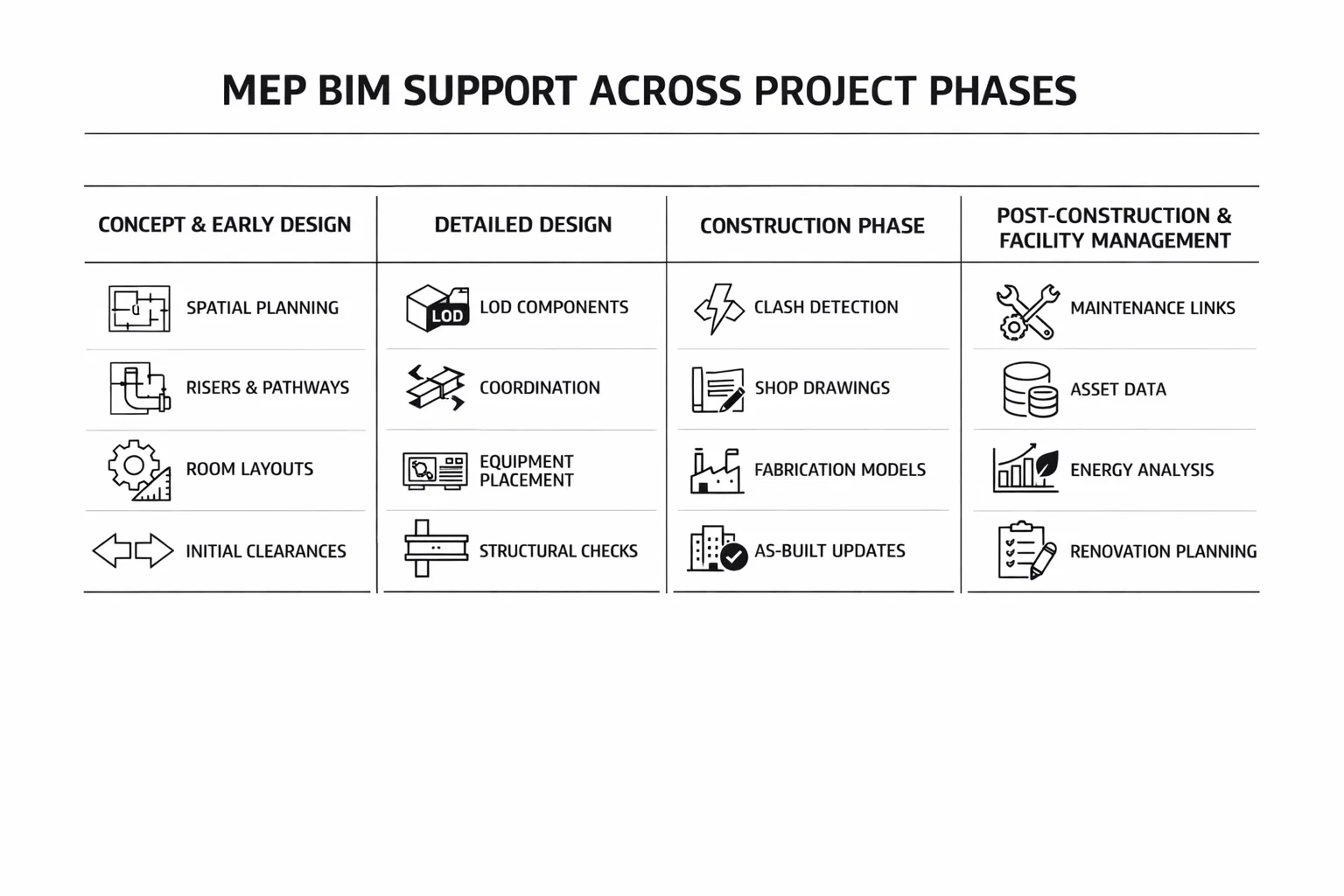
MEP BIM support does not begin and end at a single milestone. It evolves as the project moves forward. What starts as spatial planning during early design gradually shifts into technical coordination, construction control, and eventually operational alignment. The level of detail increases, the pressure rises, and the need for structured support becomes more visible.
Understanding how support changes from one phase to another helps clarify its real value. It is not a static service. It adapts to the maturity of the design and the realities of construction.
Concept and Early Design
At early stages, support focuses on spatial planning.
Teams review plant room sizing, vertical riser allocation, main distribution paths, and clearance allowances.
It is less about fine detail and more about avoiding fundamental spatial conflicts.
Detailed Design
As the model matures, support becomes more technical.
Activities often include:
- Adding system components with defined LOD.
- Running discipline-by-discipline coordination.
- Refining equipment placement.
- Reviewing structural penetrations.
This stage demands tight communication between trades.
Construction Phase
During construction, support shifts toward continuous clash monitoring, shop drawing revisions, fabrication modeling, and as-built updates.
It is a dynamic environment. MEP systems are sensitive to even minor structural adjustments.
Post-Construction and Facility Management
Many teams stop thinking about BIM once construction ends. That is a mistake.
MEP BIM support can extend into facility management by:
- Linking models to maintenance systems.
- Embedding equipment specifications and service intervals.
- Supporting energy analysis.
- Assisting renovation planning.
When properly structured, the model becomes a long-term operational tool.
Why MEP BIM Support Is Critical for Complex Projects
Not every project requires intensive support. A small residential building may manage with minimal coordination.
However, MEP BIM support becomes essential in numerous cases. Here are some of them.
There is dense HVAC routing. Multiple contractors share ceiling space. High LOD models are required. Prefabrication is involved. Deadlines are compressed. Buildings contain complex technical zones like hospitals or data centers.
In these cases, separation between design and construction increases risk. Support bridges that gap.
Common Challenges Without Proper Support
When MEP BIM support is weak or inconsistent, issues tend to surface quickly:
- Repeated clashes between systems.
- Incomplete documentation.
- Fabrication mismatches.
- Version control confusion.
- Misalignment between model and site reality.
None of these problems appear dramatic at first. But over time, they compound.
Structured support minimizes those risks by maintaining clarity and accountability.
Human Side for MEP BIM Support
Technology alone does not solve coordination challenges.
Effective support depends on clear communication between trades, transparent issue tracking, defined responsibility matrices, and structured approval workflows.
A good support team does not simply send reports. It engages, discusses, adjusts, and confirms.
It also understands something simple but often ignored: deadlines shift, and models must adapt without collapsing under revision pressure.
How to Evaluate MEP BIM Support Services
When assessing a BIM support partner, it helps to look beyond modeling portfolios.
Key questions include:
- How are clashes categorized and tracked?
- What quality control steps are documented?
- How are model updates managed during construction?
- Is there experience with fabrication-ready modeling?
- How is facility management data structured for handover?
Strong support is visible in process transparency, not just polished 3D visuals.
Abschließende Überlegungen
MEP BIM support is more than modeling assistance. It is a structured approach to maintaining clarity, coordination, and accuracy across mechanical, electrical, and plumbing systems throughout the building lifecycle.
It protects projects from avoidable conflicts, keeps documentation aligned with reality, and strengthens collaboration between disciplines. Most importantly, it turns BIM from a design tool into a dependable operational asset.
In complex projects, that difference is not subtle. It is what separates reactive coordination from controlled delivery.
FAQ
1. Is MEP BIM support only needed on large projects?
Not always, but it becomes critical as complexity increases. Small buildings with simple layouts may manage with limited coordination. Once projects involve dense ceiling zones, multiple trades, or prefabrication, structured BIM support stops being optional. It becomes risk control.
2. How is MEP BIM support different from hiring a BIM modeler?
A modeler creates geometry. MEP BIM support maintains accuracy, coordination, and consistency throughout the project. It includes clash management, updates after site changes, documentation control, and quality checks. In short, it keeps the model alive instead of static.
3. Does MEP BIM support continue after construction?
It should. When the model is properly maintained, it becomes useful for facility management, renovations, and asset tracking. Without post-construction updates, the model slowly loses value. With support, it stays relevant.
4. What tools are typically used in MEP BIM support?
Most workflows rely on platforms like Revit for modeling and Navisworks for coordination. Some teams integrate automation scripts or link models to maintenance systems. The software matters, but the process behind it matters more.
5. Can MEP BIM support reduce on-site problems?
Yes, and that is usually the point. Early clash detection, coordinated layouts, and structured reviews prevent many conflicts from reaching the site. It does not eliminate every issue, but it reduces surprises and rework significantly.
6. When should MEP BIM support start?
Ideally during developed design, before coordination pressure builds. Starting early helps define clear system routes and identify high-risk zones. Waiting until construction often means reacting instead of controlling.
7. What makes MEP BIM support effective?
Consistency. Clear communication between trades. Regular model validation. And someone who takes ownership of the coordination process instead of assuming it will fix itself. When those pieces are in place, the system holds together.

Unsere Fallstudien
Wir haben mehr als 200 BIM- und VDC-Projekte für Gewerbe, Industrie und Wohnungsbau durchgeführt.
Unsere Arbeit umfasst:
Automatisierung der Schalungsplanung
Our client from
California, USA
Automatisierung von abgehängten Decken
Our client from
New York, USA
Automatisierung von Wandkonstruktionen
Our client from
California, USA