Have any questions? Contact us!
Join our team!
Request a free quote or consultation

Cost plus in construction is a contract model where the owner pays the contractor for all direct project costs (labor, materials, equipment) plus an agreed-upon markup or fee for overhead and profit. Unlike fixed-price contracts, the final price isn’t set upfront, making cost-plus ideal for complex or uncertain projects where scope may evolve during construction.
When planning a construction project, one of the earliest decisions revolves around contract structure. How will the contractor get paid? What happens if material costs spike or the scope changes mid-project?
Enter the cost-plus contract—a pricing model that trades upfront certainty for flexibility and transparency. But what exactly does “cost plus” mean in construction, and when does it make sense to use this approach?
Let’s break down everything owners, contractors, and project stakeholders need to know about cost-plus construction contracts.
Understanding the Cost-Plus Contract Model
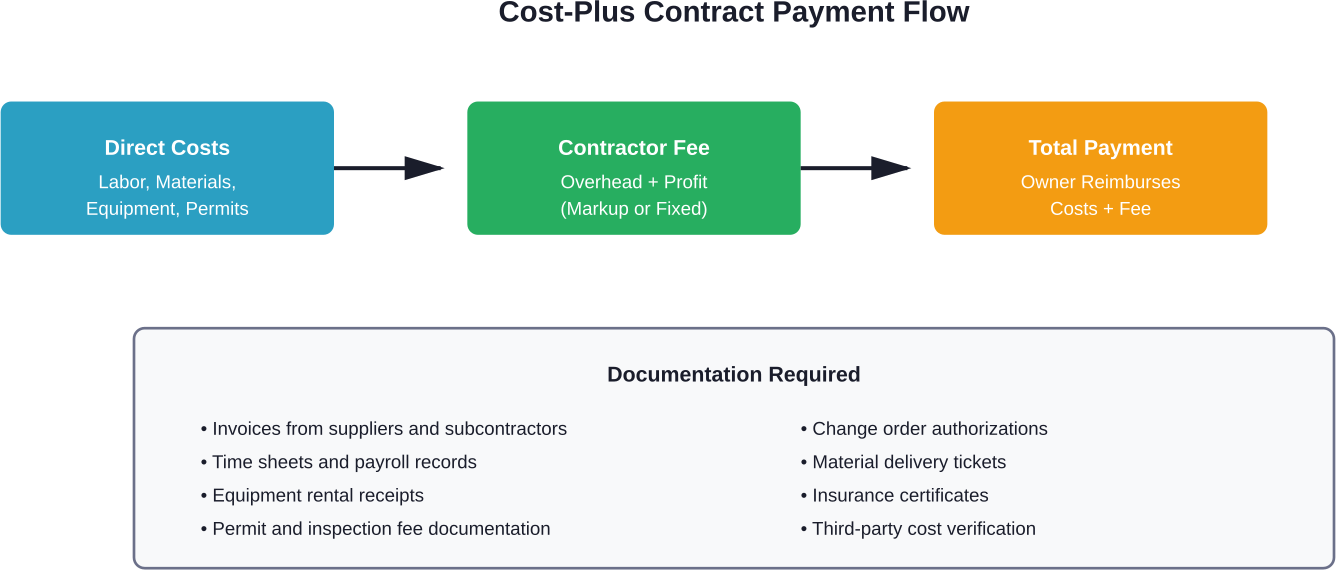
A cost-plus contract (also called a cost-reimbursement contract) is a construction agreement in which the contractor is paid for all legitimate project costs plus an additional fee representing their profit and overhead.
Unlike fixed-price contracts where the total is set before work begins, cost-plus contracts leave the final price open. The owner reimburses actual expenses as they occur, then pays the contractor’s markup on top.
Here’s what typically counts as reimbursable costs:
- Direct labor: Wages for workers, subcontractors, and tradespeople
- Materials: Lumber, concrete, steel, fixtures, finishes—everything purchased for the job
- Equipment: Rental costs for machinery, tools, scaffolding
- Permits and fees: Building permits, inspection fees, utility connections
- Insurance and bonds: Project-specific coverage required by contract
The “plus” portion—the contractor’s fee—covers general overhead (office costs, administrative staff, insurance) and profit. This fee structure varies widely depending on the contract type.
How Cost-Plus Construction Contracts Actually Work
The mechanics are straightforward. Throughout the project, the contractor tracks every expense with detailed documentation—invoices, timesheets, receipts, delivery tickets.
At regular intervals (typically monthly), the contractor submits these records to the owner along with an invoice. The owner reviews the costs, verifies their legitimate project expenses, and reimburses the contractor while also paying the agreed-upon fee or markup.
Transparency matters here. Most cost-plus contracts require open-book accounting, meaning the owner has the right to audit costs and review financial records. This keeps everyone honest and builds trust between parties.
Real talk: this model demands more administrative effort than fixed-price contracts. Contractors need solid cost-tracking systems, and owners need bandwidth to review documentation regularly.
Types of Cost-Plus Construction Contracts
Not all cost-plus contracts work the same way. The “plus” portion varies, creating several distinct contract types recognized by the Federal Acquisition Regulation and used across private construction.
Cost-Plus-Fixed-Fee (CPFF)
The contractor receives reimbursement for costs plus a predetermined fixed fee that doesn’t change regardless of final project cost. If the job costs $500,000 and the fixed fee is $50,000, the contractor gets exactly $50,000 regardless of whether final costs hit $480,000 or $520,000.
According to the Federal Acquisition Regulation, this structure is common in government contracts where cost uncertainty exists but the scope is reasonably defined.
Cost-Plus-Incentive-Fee (CPIF)
This hybrid adjusts the contractor’s fee based on performance against predetermined targets (typically cost, schedule, or quality metrics). Hit the targets and the fee increases. Miss them and it decreases, within agreed-upon minimum and maximum bounds.
The Federal Acquisition Regulation recognizes CPIF contracts as tools to motivate efficiency while maintaining cost-reimbursement flexibility.
Cost-Plus-Award-Fee (CPAF)
Similar to CPIF, but the award portion is subjectively determined by the owner based on contractor performance. The base fee is fixed, but an additional award fee is available if the contractor excels in agreed-upon evaluation criteria.
Federal Acquisition Regulation guidance (effective March 13, 2026) addresses CPAF contracts and requirements for evaluation criteria.
Cost-Plus with Guaranteed Maximum Price (GMP)
This popular variation caps the owner’s financial exposure. The contractor tracks costs as usual, but if expenses exceed the guaranteed maximum, the contractor absorbs the overrun (with limited exceptions for owner-directed changes).
If costs come in under the GMP, savings are typically shared between owner and contractor according to a predetermined formula. This structure balances flexibility with cost protection.
| Contract Type | Fee Structure | Owner Risk | Contractor Incentive
|
|---|---|---|---|
| Cost-Plus-Fixed-Fee | Set dollar amount | High (no cost cap) | Moderate (no gain from overruns) |
| Cost-Plus-Incentive-Fee | Adjusts based on targets | Moderate to High | High (rewarded for efficiency) |
| Cost-Plus with GMP | Fixed or % with ceiling | Low to Moderate | High (shares in savings) |
What Markup Do Contractors Charge?
Community discussions and industry practice suggest most professional residential builders apply markups between 15% and 25% in cost-plus arrangements. Commercial projects might see different ranges depending on complexity and risk.
But wait—markup isn’t pure profit. It covers:
- General overhead (office rent, utilities, administrative salaries)
- Insurance and bonding costs not specific to one project
- Marketing and business development
- Technology and software subscriptions
- Vehicle and equipment ownership costs
- Actual profit margin
Even a 25% markup might translate to just 8-12% net profit after covering these expenses. The markup percentage alone doesn’t tell the whole story.
Some contractors use tiered markups—different percentages for materials versus labor versus subcontractors. Others apply flat percentages across all costs. The key is transparency about what the markup covers and how it’s calculated.
Advantages of Cost-Plus Construction Contracts
Why choose cost-plus over fixed-price? Several scenarios favor this flexible approach.
For Owners
- Faster project starts: Work can begin before every detail is finalized. No need to wait for complete designs and fixed-price bidding when timing matters.
- Design flexibility: Owners can make changes during construction without renegotiating an entire contract. Want to upgrade finishes or adjust layouts? Just document the change and proceed.
- Transparency: Open-book accounting shows exactly where money goes. No hidden markups or unexplained costs buried in lump-sum pricing.
- Quality focus: Contractors aren’t incentivized to cut corners or use cheaper materials to protect their margins. They get paid for actual costs regardless.
For Contractors
- Reduced financial risk: Unforeseen conditions, material price spikes, and scope changes don’t eat into profit margins. Legitimate cost increases get reimbursed.
- Guaranteed compensation: The fee structure ensures payment for overhead and profit, even if estimating is difficult due to project uncertainty.
- Relationship building: The collaborative, transparent nature often creates stronger owner-contractor relationships than adversarial fixed-price negotiations.
Disadvantages and Risks of Cost-Plus Contracts
This model isn’t perfect. Understanding the disadvantages helps both parties manage risk effectively.
For Owners
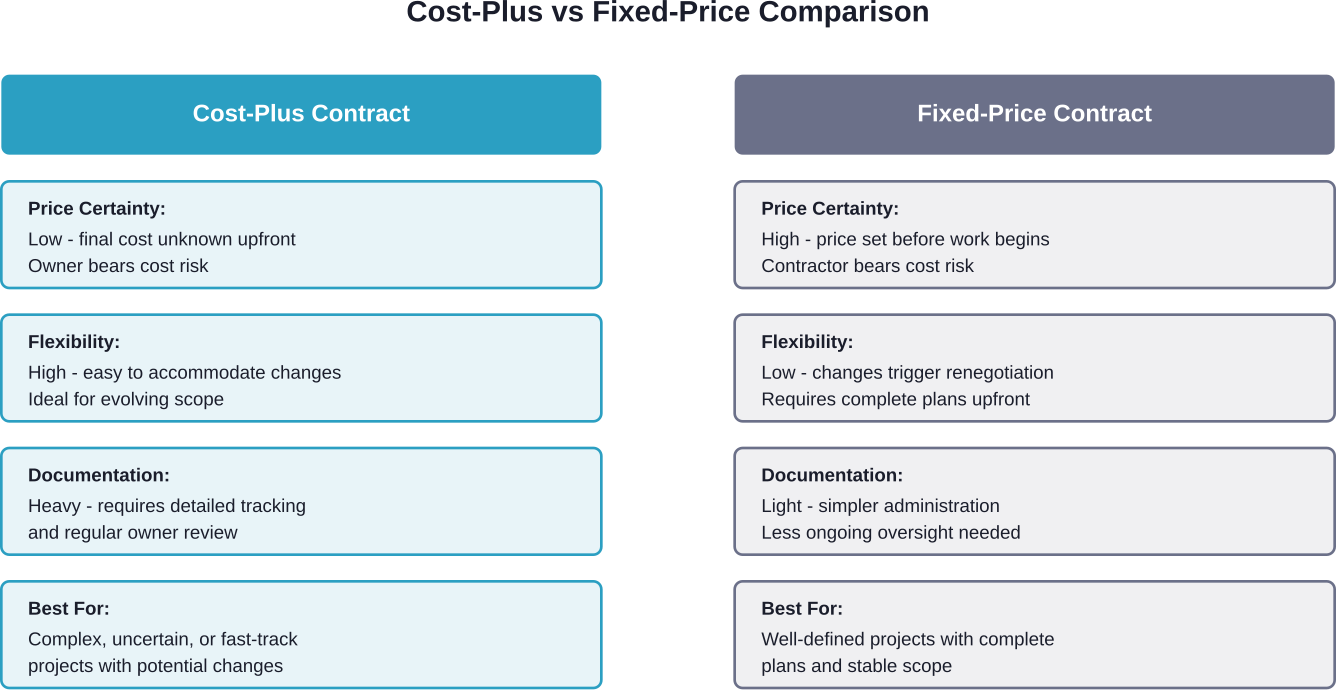
- Cost uncertainty: The final price remains unknown until project completion. Budgeting becomes challenging, especially without a guaranteed maximum price.
- Administrative burden: Reviewing documentation, verifying costs, and monitoring expenses requires significant owner involvement—or hiring a third-party project manager.
- Potential for inefficiency: Without proper oversight, contractors might lack incentive to minimize costs or complete work quickly (though reputation concerns usually prevent egregious behavior).
- Requires trust: The open-book approach only works when both parties operate in good faith. Disputes over what constitutes legitimate project costs can strain relationships.
For Contractors
- Documentation demands: Tracking and proving every expense creates substantial paperwork. Small contractors without robust accounting systems struggle here.
- Payment delays: Owners might delay reimbursement while reviewing documentation, creating cash flow challenges.
- Fee limitations: The agreed-upon fee or percentage might not adequately compensate for extraordinary project challenges if the structure is cost-plus-fixed-fee.
- Scope creep: Flexible contracts sometimes lead to never-ending projects as owners continuously request changes, extending timelines without proportional fee increases.
When Does Cost-Plus Make Strategic Sense?
Certain project characteristics make cost-plus the obvious choice:
- Complex or unique projects: Custom homes, specialized facilities, or technically challenging work where accurate upfront estimating is nearly impossible.
- Fast-track schedules: When construction must start before design is complete, cost-plus allows overlapping design and construction phases.
- Uncertain site conditions: Renovation work, environmental remediation, or building on sites with unknown subsurface conditions.
- Volatile material markets: During periods of rapid price fluctuation, according to February 2026 data from the Associated General Contractors, aluminum mill shapes and steel mill products increased by 33.0 percent and 20.7 percent respectively—cost-plus protects contractors from estimation errors.
- Owner-driven customization: Projects where the owner wants significant input throughout construction, continuously refining selections and specifications.
- Research and development: Experimental construction methods or prototype facilities where the path forward isn’t clear from day one.
That said, cost-plus makes less sense for straightforward projects with complete plans, stable material costs, and well-defined scope. Why pay for administrative complexity when a fixed price provides budget certainty?
Managing Cost-Plus Contracts Effectively
Success requires proactive management from both parties. Here’s what works:
Establish Clear Cost Categories
Define precisely what counts as reimbursable. Are contractor vehicle expenses covered? What about small tools? Home office overhead? Spell it out in the contract to avoid disputes later.
Implement Robust Tracking Systems
Contractors need reliable cost accounting software that categorizes expenses, links them to specific projects, and generates clear reports. Manual spreadsheets don’t scale beyond very small projects.
Set Up Regular Review Cycles
Monthly cost reviews keep everyone aligned. The contractor presents documentation, the owner asks questions, and both parties address discrepancies before they snowball.
Include Budget Targets and Contingencies
Even without fixed prices, establish budget targets and contingency reserves. According to industry practice, contingencies typically run 5–10% of the project cost to cover unforeseen conditions and minor scope changes.
Define Change Order Procedures
How are scope changes authorized? Who can approve them? What documentation is required? Clear procedures prevent confusion and disputes.
Consider Third-Party Cost Verification
For large projects, hiring an independent cost consultant to verify contractor billing protects the owner while removing friction from the owner-contractor relationship.
Take Control Of Cost Plus Spend

Cost Plus gives flexibility, but every unresolved detail turns into more work, more time, and more cost. Powerkh checks where that growth is coming from before it spreads.
They review how design intent is carried through coordination and into construction, highlight where scope is still moving, and compare what’s being built with what was originally defined. Instead of reacting to rising costs, you see what’s causing them while there’s still time to act.
Cut Extra Costs Now
Here’s how Powerkh helps you manage cost-plus projects:
- Identifies areas where design changes are still driving additional work
- Flags coordination gaps that lead to expanding scope
- Highlights repeated tasks and rework increasing overall cost
- Verifies installed work against what was defined
- Shows where decisions are still open and affecting spend
If costs are starting to drift, reach out to Powerkh and take back control before it turns into overrun.
Common Pitfalls to Avoid
Even well-intentioned parties stumble. Watch out for these mistakes:
- Vague contract language: Ambiguity about what’s reimbursable creates conflict. Be specific.
- Inadequate contingency planning: Owners who don’t budget for contingencies face unpleasant surprises when legitimate additional costs arise.
- Poor documentation habits: Contractors who fall behind on record-keeping face payment delays and owner distrust.
- Lack of budget monitoring: Owners who don’t track cumulative costs against targets lose control of their financial exposure.
- Choosing cost-plus-percentage unwisely: This structure creates perverse incentives and is generally discouraged except in limited circumstances with strong oversight.
- Insufficient owner involvement: Cost-plus requires active owner participation. Absentee owners who rubber-stamp invoices without review invite problems.
Real-World Applications Across Industries
Cost-plus contracting appears throughout construction and beyond:
- Government contracts: Federal agencies use various cost-reimbursement formats under Federal Acquisition Regulation guidelines, particularly for research, development, and projects with significant uncertainty.
- Custom residential: High-end home builders often prefer cost-plus for luxury projects where owners want extensive involvement in material selection and design evolution.
- Renovation and restoration: Opening up old buildings reveals surprises. Cost-plus handles the unknown better than fixed-price contracts.
- Infrastructure and civil work: Complex public works projects with subsurface uncertainty often employ cost-plus or cost-plus-with-GMP structures.
- Commercial interiors: Tenant improvements in occupied buildings, where coordination and phasing create scheduling uncertainty, benefit from cost-plus flexibility.
Key Contractual Elements to Include
A solid cost-plus contract addresses these components:
- Scope of work: Detailed description of what’s included, even if details evolve
- Cost definitions: Clear categories of reimbursable versus non-reimbursable expenses
- Fee structure: Specific markup percentage, fixed fee amount, or incentive formula
- Documentation requirements: What records must be kept and how they’ll be submitted
- Payment terms: Billing cycle, review period, payment timeline
- Budget targets: Estimated costs even if not guaranteed
- Contingency provisions: How much, when it’s used, who authorizes it
- Change order procedures: Process for approving scope changes
- Audit rights: Owner’s ability to verify costs and review records
- Guaranteed maximum (if applicable): Cost ceiling and procedures when approached
- Savings sharing (if applicable): How under-budget performance is rewarded
- Dispute resolution: Process for resolving cost disagreements
Organizations like the American Institute of Architects provide standardized contract documents that address these elements, which many parties use as templates.
Conclusion
Cost-plus construction contracts trade upfront price certainty for flexibility, transparency, and shared risk. They work beautifully when uncertainty is high, scope evolves during construction, or projects demand rapid starts before complete design.
But they’re not universally better than fixed-price alternatives—just different. The administrative demands are real, and owners who can’t or won’t engage in regular cost oversight should think twice.
Success with cost-plus requires clear contracts, robust cost tracking, open communication, and good faith from both parties. When these elements align, cost-plus delivers excellent results on complex projects where rigid fixed-price contracts would create conflict and claims.
Whether you’re an owner evaluating contract options or a contractor proposing pricing structures, understanding how cost-plus actually works—the types, the mechanics, the advantages and pitfalls—enables smarter decisions that set projects up for success.
Need help structuring your next construction contract? Consult with construction attorneys and contract specialists who can tailor agreements to your specific project needs and risk tolerance.
Frequently Asked Questions
What’s the typical markup in cost-plus construction contracts?
Professional builders in residential construction commonly apply markups between 15% and 25%, though this varies based on project complexity, risk, and regional market conditions. Commercial projects may see different ranges. Remember that markup covers overhead and profit, not just profit alone.
Can cost-plus contracts include a maximum price?
Yes. Cost-plus with guaranteed maximum price (GMP) contracts cap the owner’s exposure at a predetermined amount. If costs exceed the GMP, the contractor typically absorbs overruns unless they result from owner-directed changes. This hybrid approach balances flexibility with budget protection.
Why is cost-plus-percentage-of-cost problematic?
This structure creates a conflict of interest—the contractor’s fee increases when project costs increase, potentially incentivizing inefficiency or unnecessary expenses. It’s prohibited in federal government contracts and generally discouraged in private construction. Cost-plus-fixed-fee or cost-plus-with-GMP structures align incentives better.
How much documentation does a cost-plus contract require?
Expect substantial record-keeping. Contractors must provide invoices, receipts, timesheets, delivery tickets, subcontractor billings, and other proof of expenses. Owners review these documents regularly—often monthly—before approving reimbursement. The administrative burden exceeds fixed-price contracts significantly.
When should I choose cost-plus instead of fixed-price?
Cost-plus makes sense when project scope is uncertain, design isn’t complete, site conditions are unknown, you need to start quickly, or you want flexibility to make changes during construction. Fixed-price works better when plans are complete, scope is well-defined, and you prioritize budget certainty over flexibility.
What happens if the contractor and owner disagree about whether a cost is legitimate?
The contract should specify dispute resolution procedures. Typically, the owner can withhold payment on disputed items while paying undisputed amounts. Many contracts include mediation or arbitration clauses for resolving disagreements. Clear upfront definitions of reimbursable costs prevent most disputes.
Do cost-plus contracts take longer than fixed-price contracts?
Not necessarily. Cost-plus contracts often enable faster starts since work can begin before complete design and bidding. However, without strong schedule incentives, some projects might extend longer than fixed-price alternatives. Including schedule milestones or time-based incentives helps maintain momentum.

Our Case Studies
We have handled 200+ BIM & VDC projects for commercial, industrial, and residential sectors.
Our work includes:
Formwork design automation
Our client from
California, USA
Suspended ceiling design automation
Our client from
New York, USA
Wall framing design automation
Our client from
California, USA