Have any questions? Contact us!
Join our team!
Request a free quote or consultation

Quick Summary: Becoming a construction inspector typically requires a high school diploma, relevant work experience in construction or a related field, and professional certification from organizations like ICC. Most states require licensing, and candidates must pass certification exams covering building codes and inspection procedures. The median annual wage is $72,120 as of May 2024.
Construction and building inspectors play a critical role in ensuring structures meet safety standards, building codes, and zoning regulations. They examine everything from residential buildings to bridges, highways, and plumbing systems.
But how do you break into this field?
The path isn’t always straightforward. Some inspectors start with hands-on construction experience, while others pursue formal education. Here’s what the profession actually requires.
Education Requirements for Construction Inspectors
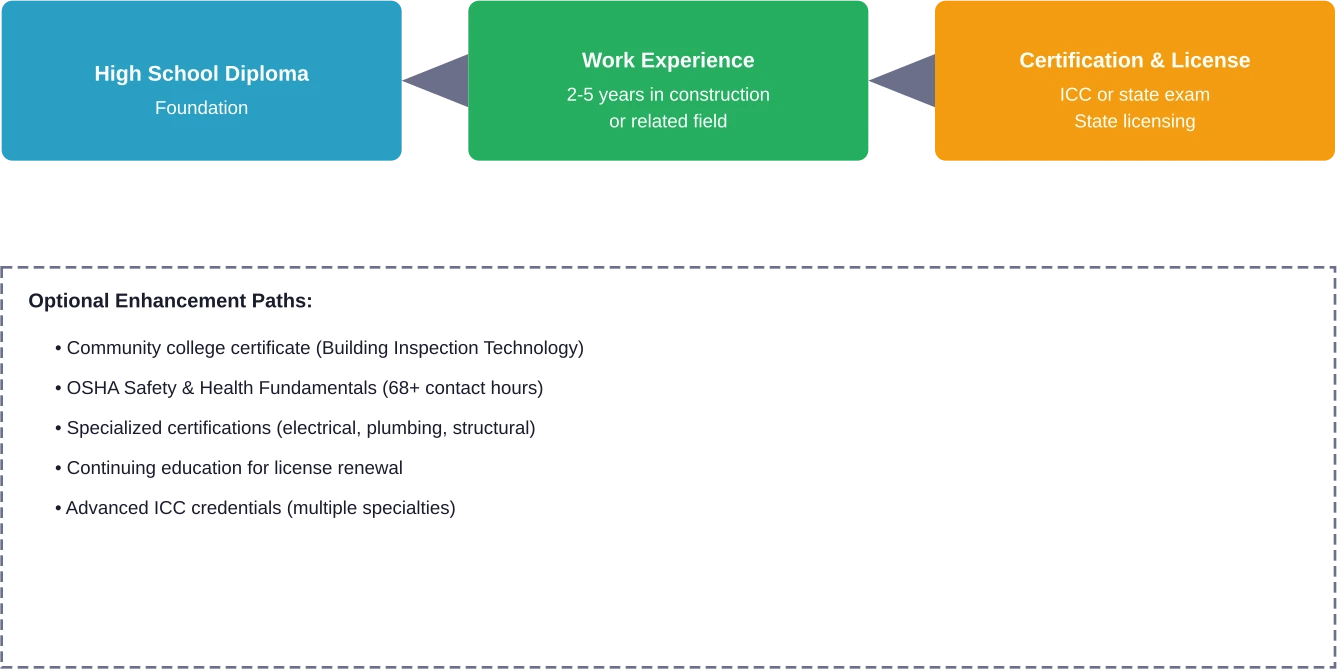
According to the Bureau of Labor Statistics, most construction and building inspectors need at least a high school diploma or equivalent. That’s the baseline.
However, many employers prefer candidates with postsecondary education in construction technology, engineering, or a related field. Community colleges offer specialized programs that can give you an edge.
San Bernardino Valley College and Chemeketa Community College both offer Building Inspection Technology programs that cover building codes, construction materials, and inspection procedures. These programs typically include coursework in permit processing, residential codes, and construction systems.
Here’s the thing though—formal education alone won’t get you hired. Real-world construction knowledge matters just as much.
Gaining Relevant Work Experience
Most successful inspectors have a background in construction or a related trade. Experience as an electrician, plumber, carpenter, or construction worker provides the practical knowledge that classroom training can’t replicate.
Why does this matter? Because inspectors need to understand how buildings are actually constructed, not just how they should be according to code books.
Many states require several years of experience in construction, engineering, or a related field before granting an inspector license. The exact requirements vary by jurisdiction, but expect to need anywhere from two to five years of hands-on experience.
BIM Services for Construction Inspection Work

Construction inspectors rely on clear drawings, existing-condition data, and documentation that matches what is happening on site. Powerkh provides BIM modeling, Scan to BIM, BIM coordination, structural detailing, prefabrication support, and BIM automation. Their work helps turn drawings and point cloud data into coordinated models and documents that can support inspection, review, and verification.
Need BIM support for inspection-related work?
Talk with Powerkh to:
- create BIM models from drawings or scan data
- prepare coordinated documentation for review
- support site verification with clearer project information
👉 Contact Powerkh to review your drawings, scope, and BIM needs.
Certification and Licensing Requirements
Many states and local jurisdictions require construction inspectors to hold specific licenses or certifications. The International Code Council (ICC) offers the most widely recognized certification programs.
ICC certification demonstrates expertise in specific inspection areas like residential building, commercial building, plumbing, electrical systems, or mechanical systems. According to ICC, for Contractor/Trades exams, a candidate must answer at least 70 or 75 percent of the questions correctly in order to pass the exam, depending on the exam title or jurisdiction. ICC offers multiple certification levels, allowing inspectors to specialize in different construction types.
Real talk: certification isn’t just a bureaucratic hurdle. It proves you know the International Building Code and can apply it consistently.
State-Specific Requirements
Requirements vary significantly by state. Some jurisdictions accept ICC certification as meeting their licensing standards, while others have additional state-specific exams or education requirements.
For example, Texas requires completion of specific coursework modules totaling 90-114 hours for real estate inspector licensure, including Property and Building Inspection modules and Business Operations courses.
Check your state’s construction code academy or building department for exact requirements.
Training Programs and Professional Development
OSHA offers a Safety & Health Fundamentals Certificate Program for Construction that requires completion of a minimum of 7 OTI Education courses comprised of required and elective courses that include a minimum of 68 contact hours of training. This training covers construction safety fundamentals and can strengthen your qualifications.
The EPA provides a Construction Inspection Training Course focused on stormwater compliance and construction site inspections. The course consists of five modules and takes approximately seven hours to complete—and it’s free.
But wait. There’s more specialized training available.
NICET offers Highway Construction Inspection certification for those interested in infrastructure projects. InterNACHI provides certification specifically for new construction inspection.
| Certification | Focus Area | Requirements |
|---|---|---|
| ICC Building Inspector | General building codes | Exam (70-75% passing score) |
| ICC Residential Inspector | Residential construction | Exam, code knowledge |
| OSHA Safety Fundamentals | Construction safety | 68+ contact hours, 7 courses |
| EPA Construction Inspector | Stormwater compliance | 5 modules (7 hours total) |
| NICET Highway | Infrastructure projects | Experience, technical exams |
Salary Expectations and Job Outlook
According to the Bureau of Labor Statistics, the median annual wage for construction and building inspectors was $72,120 as of May 2024. That translates to roughly $34.67 per hour.
In New Jersey, the median salary for construction and building inspectors is $67,470 annually.
Employment of construction and building inspectors is projected to decline 1 percent from 2024 to 2034. Demand tends to be strongest in government agencies and firms specializing in architectural and engineering services.
Sound familiar? That’s because building codes keep getting more complex, and communities keep expanding.
Day-to-Day Responsibilities
Construction inspectors examine buildings, highways, sewer systems, dams, bridges, and various structures to ensure compliance with local and national building codes, zoning regulations, and contract specifications.
No two inspections are identical. One day might involve checking electrical systems in a commercial building. The next could mean inspecting foundation work at a residential site or reviewing HVAC installations.
Inspectors spend time both in offices reviewing plans and specifications, and on construction sites conducting physical inspections. The job requires meeting with contractors, clients, and building officials regularly.
Getting Started in Construction Inspection
The construction inspection field offers solid career prospects for those with the right combination of practical experience and technical knowledge. The median salary of over $72,000 provides decent compensation, and the work contributes directly to public safety.
Start by assessing your current experience level. If you’re already working in construction, begin researching certification requirements in your state. If you’re new to the field, consider community college programs that combine education with networking opportunities.
Most importantly, understand that becoming an inspector isn’t just about passing exams. It’s about developing the judgment to identify potential safety issues and the knowledge to apply building codes consistently.
Ready to take the next step? Contact your state’s building code academy or ICC to learn specific certification requirements for your area.
Frequently Asked Questions
Can I become a construction inspector without a degree?
Yes. While many employers prefer postsecondary education, it’s not always required. A high school diploma combined with several years of construction experience and professional certification can qualify you for inspector positions in many jurisdictions.
How long does it take to become a construction inspector?
The timeline varies based on your starting point. If you already have construction experience, obtaining certification and licensing might take six months to two years. Starting from scratch with no experience typically requires three to five years of combined education and work experience.
What’s the difference between ICC and state licensing?
ICC certification is a professional credential offered by a national organization. State licensing is a legal requirement to work as an inspector in specific jurisdictions. Many states accept ICC certification as meeting their licensing standards, but some require additional state-specific exams.
Do construction inspectors need continuing education?
Most states require continuing education for license renewal. ICC certifications typically need renewal every three years, which may involve completing additional training hours or retaking exams.
What construction experience is most valuable?
Experience in trades directly related to inspection specialties is most valuable. Electrical, plumbing, carpentry, and general contracting experience all provide practical knowledge that strengthens inspection skills.
Is there demand for construction inspectors?
Generally speaking, demand remains steady due to ongoing construction activity and increasingly complex building codes. Government positions and specialized inspection firms show the strongest hiring patterns.
Can I specialize in specific types of inspections?
Absolutely. Inspectors often specialize in areas like residential building, commercial construction, electrical systems, plumbing, mechanical systems, or structural inspection. ICC offers separate certifications for each specialty.

Our Case Studies
We have handled 200+ BIM & VDC projects for commercial, industrial, and residential sectors.
Our work includes:
Formwork design automation
Our client from
California, USA
Suspended ceiling design automation
Our client from
New York, USA
Wall framing design automation
Our client from
California, USA