Have any questions? Contact us!
Join our team!
Request a free quote or consultation

Laser Scanning for Refurbishment Projects: How to Avoid Design Errors from Poor Existing Information
Refurbishment design rarely starts with clean information. Most projects inherit drawings that are outdated, partial, or quietly wrong. Walls have moved, services have been added without records, and ceiling voids tell a different story once opened. Yet design decisions are still expected to progress as if the building were predictable.
This is where many projects begin to drift. Without laser scanning, teams rely on assumptions. Dimensions are inferred, levels are averaged, and hidden spaces are guessed. The result is familiar: plant that does not fit, risers that clash, and coordination issues that only surface once the design is already deep into development.
Laser scanning changes that dynamic early, especially when used before Stage 3. Instead of treating existing information as background context, it becomes the foundation. Plant rooms can be checked for real clearances, risers can be traced floor to floor, and uneven slabs or legacy services are visible before coordination begins. It does not remove complexity, but it removes the false certainty that causes design errors to compound later.
Why Existing Information Fails So Often in Refurbishment Projects
Poor existing information is not a minor inconvenience. It is a structural risk.
In new build projects, the design defines reality. In refurbishment, reality already exists and does not care what the drawings say. The problem is that many teams still treat existing information as if it were reliable enough to design around. It rarely is.
Common Issues:
- Legacy drawings that reflect design intent, not what was built
- Partial updates where only certain trades were revised
- Hand sketches that never made it into digital records
- Measurements taken from accessible areas only
- Structural changes made decades later with no documentation
These gaps do not always reveal themselves immediately. Early concept layouts can look fine. Problems surface later, when coordination becomes tighter and tolerances shrink. By then, changes are expensive.
Laser scanning addresses this by capturing the building as it is, not as it was meant to be.
Common Failures When Refurbishment Projects Skip Laser Scanning
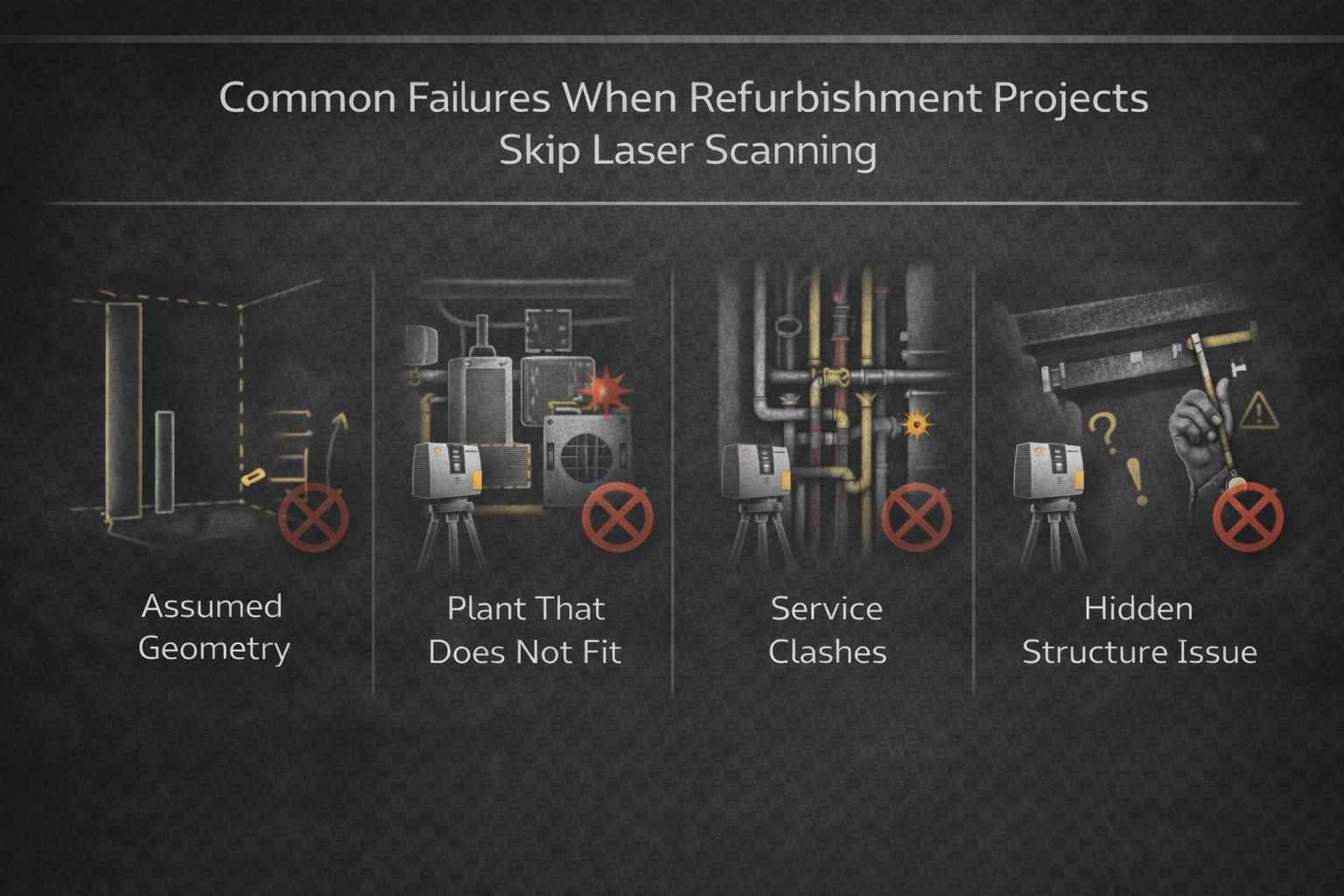
Skipping laser scanning does not guarantee failure, but it significantly increases the odds of predictable problems.
Design Based on Assumed Geometry
Without scans, designers often average dimensions. Walls are assumed straight. Columns are assumed plumb. Floor levels are assumed consistent. In reality, older buildings rarely behave that neatly.
These assumptions usually hold until detailed layouts or fabrication drawings begin. At that point, misalignments appear and force redesign.
Plant That Does Not Fit
Plant rooms are one of the most common failure points. Equipment clearances are tight. Ceiling heights are critical. Door openings and access routes matter.
Without scans, teams rely on tape measurements and partial sections. Once equipment arrives or layouts are coordinated, clashes appear. Units do not fit. Access is compromised. Changes ripple through the design.
Service Clashes in Risers and Shafts
Risers are another repeat offender. Existing risers often contain undocumented services, abandoned runs, or offsets between floors. Drawings rarely reflect this accurately.
Without laser scanning, risers are modeled based on assumptions. During coordination, services clash. Fire stopping zones are compromised. Structural penetrations become an issue. Late-stage redesign becomes unavoidable.
Late Discovery of Structural Constraints
Beams that sit lower than expected. Slabs that vary in thickness. Columns that drift slightly floor to floor. These details matter, especially for MEP coordination and architectural finishes.
Laser scanning exposes these conditions early. Without it, they surface at the worst possible time.
How Powerkh Supports Refurbishment Projects

At Powerkh, we are an international engineering-led digital construction consultancy with 400+ projects across 11 countries, including the UK, US, and Europe. We support design teams by ensuring design continuity through BIM and VDC. We don’t just provide disconnected models; we integrate into your workflow to protect design intent through high-precision coordination and verify it against reality using advanced Scan to BIM processing.
We approach laser scanning and existing-conditions modelling as a decision-making tool, not a standalone survey task. We capture and model buildings so designers can rely on the data, coordinators can protect key interfaces, and site teams can verify what is actually being built. Simply put, we help make sure what is designed is what gets built, even when the building itself does not behave as expected.
Our services are structured around continuity, not disconnected BIM tasks. We establish intent during design, protect it through coordination, and verify it against reality on site. That continuity-led approach is what allows refurbishment teams to reduce coordination risk, avoid late-stage redesign, and move into construction with fewer unknowns.
How This Connects to Refurbishment Projects
- Laser scanning and existing-conditions modelling provide a verified base before Stage 3 decisions are fixed
- Coordination focuses on critical zones such as plant rooms, risers, and constrained interfaces
- Engineering-led reviews test constructability before issues reach site
- Scan-based verification checks design intent against what is actually installed
Across RIBA Stages 1 to 6, we combine engineering judgement, BIM, and reality-based verification to support refurbishment projects where accuracy, clarity, and continuity are non-negotiable.
Why Coordination Risk Is Higher in Refurbishment Than New Build
Coordination is difficult in any project, but refurbishment adds layers of complexity that new build teams do not face.
- Existing services remain live during parts of the work
- Structural elements cannot simply be moved
- Temporary conditions affect access and sequencing
- Tolerances are tighter because space already exists
In this environment, coordination models built on weak existing data are fragile. They may look coordinated on screen but fail the moment they meet reality.
Laser scanning strengthens coordination by anchoring it to verified geometry. It does not remove coordination challenges, but it ensures teams are solving real problems instead of imaginary ones.
Why Surveys Before Stage 3 Matter More Than Many Teams Admit
One of the most common mistakes in refurbishment projects is delaying laser scanning until after Stage 3 or an equivalent design milestone. By that point, many decisions are already locked in. Spatial strategies are defined, plant sizes have been selected, risers allocated, and structural assumptions embedded into the model.
Introducing accurate existing-condition data after this stage often forces uncomfortable choices. Teams either reopen decisions and absorb redesign time, or they quietly compromise quality to protect the programme. Neither option is ideal, and both are avoidable.
When scanning is carried out before Stage 3, concept layouts are developed using real geometry rather than estimates. Tight zones are identified early, disciplines align more naturally around verified constraints, and coordination issues surface while there is still room to respond. In refurbishment work, early accuracy consistently delivers more value than late precision.
Laser Scanning as a Decision-Making Tool, Not Just a Survey
One of the biggest misunderstandings about laser scanning is treating it as a deliverable instead of a process input.
A point cloud on its own does not solve problems. Its value depends on how it is used, interpreted, and translated into models that support design decisions.
Effective scanning workflows focus on:
- What needs to be captured and why
- What level of detail is required
- How the data will be used downstream
- Who is responsible for interpreting it
This shifts scanning from a technical task to a design-enabling activity.
Record Models vs Coordination Models: Why the Distinction Matters
Not every refurbishment project needs the same type of BIM model, yet this distinction is often left vague. Laser scanning can support multiple outcomes, but the value depends on whether the model is intended to record existing conditions or actively support design and coordination. When this is not defined early, expectations drift and the model often fails to serve its real purpose.
The table below outlines the key differences.
| Aspect | Record Model | Coordination Model |
| Primary purpose | Accurate representation of existing conditions | Supporting design coordination and clash resolution |
| Typical use cases | Asset documentation, facility management, legal or contractual records, long-term reference | Design development, MEP coordination, fabrication planning, construction sequencing |
| Level of detail focus | High geometric accuracy and completeness | Targeted detail in high-risk and high-interaction zones |
| Design interaction | Largely passive, used for reference | Actively used to test layouts, routes, and clearances |
| Update frequency | Often static once delivered | Updated iteratively as design develops |
| Risk if misused | Over-modelled but underutilised | Under-modelled where coordination is most critical |
Laser scanning supports both model types, but the modelling strategy must be agreed at the outset. Without that clarity, teams either invest time modelling areas that do not influence design decisions or miss critical zones where coordination accuracy really matters.
Where Laser Scanning Pays Off Most: Plant Rooms and Risers
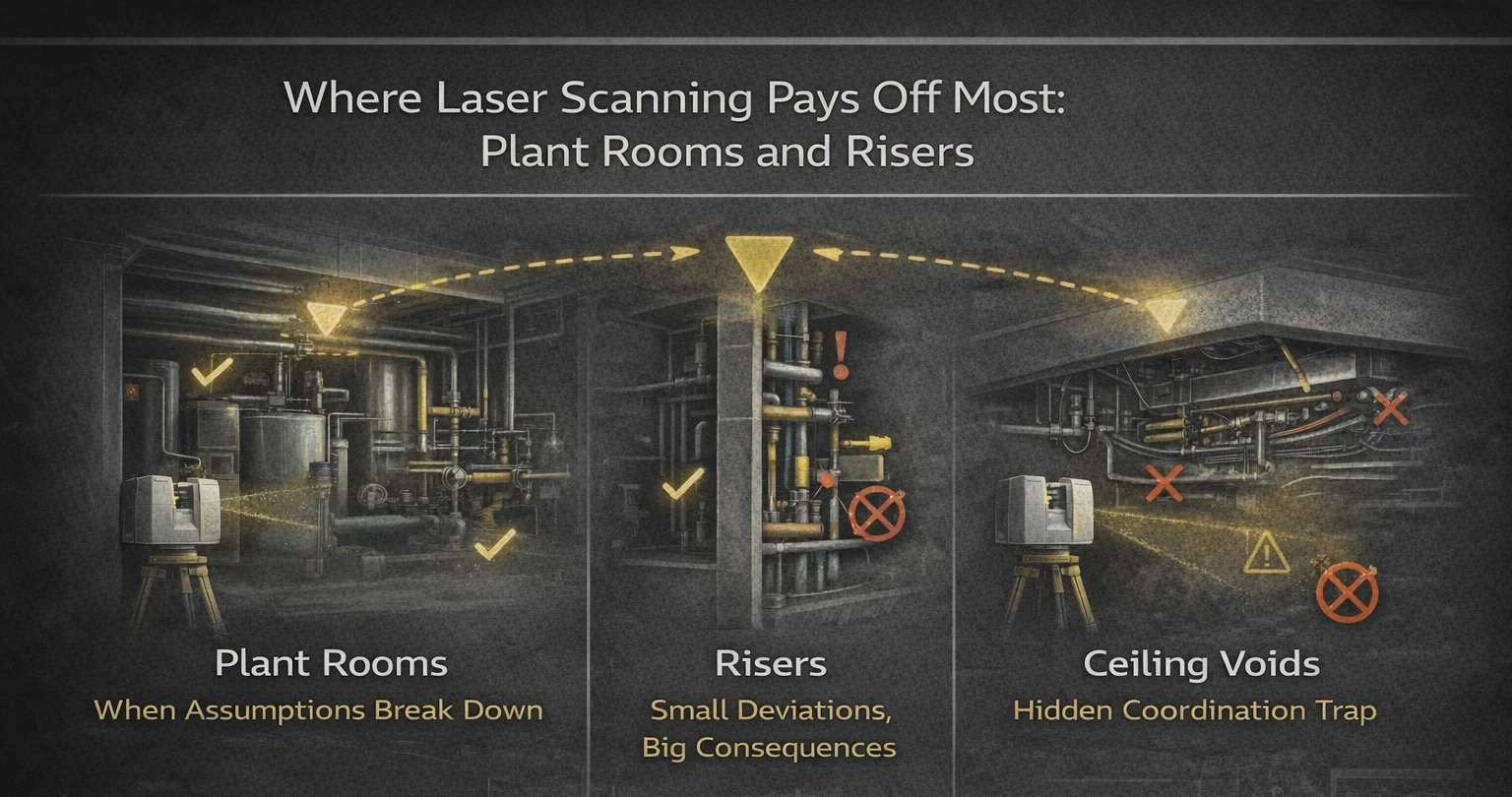
In refurbishment projects, not all spaces carry the same level of risk. Plant rooms and risers consistently sit at the top of the list because they combine tight tolerances, fixed structure, and dense services. These are also the areas where poor existing information causes the most disruption once design moves beyond concept.
Plant Rooms: When Assumptions Break Down
Plant rooms are rarely as straightforward as the drawings suggest. Ceiling heights vary, structural beams sit lower than expected, and legacy services often occupy space that no longer appears in any record. Without laser scanning, layouts are typically developed using nominal dimensions and assumed clearances.
These assumptions tend to hold until equipment sizes are finalised or coordination becomes detailed. At that point, units do not fit, access routes fail compliance checks, or maintenance clearances are compromised. Laser scanning allows teams to work with the true available volume from the outset, testing layouts against real constraints and avoiding redesign later in the process.
Risers: Small Deviations, Big Consequences
Risers present a different kind of challenge. They are rarely consistent from floor to floor, even when drawings suggest they should be. Offsets, undocumented services, and historical alterations are common, particularly in older buildings.
Without accurate scanning, risers are often modelled as clean vertical zones. Problems only surface once services are coordinated across multiple levels. Laser scanning makes these irregularities visible early, allowing risers to be traced accurately and coordinated against structure, fire compartments, and access requirements before conflicts escalate.
Ceiling Voids: The Hidden Coordination Trap
Ceiling voids are another frequent source of refurbishment errors. They often contain a mix of original services, later additions, abandoned runs, and temporary fixes that were never documented. Headroom can vary significantly across short distances, especially where structure, fire protection, and services overlap.
When ceiling voids are not scanned, coordination models tend to assume clear, uniform zones. This breaks down quickly once detailed layouts are introduced. Ducts clash with beams, lighting conflicts with services, and access panels end up in impractical locations. Laser scanning exposes the true depth and congestion of ceiling voids early, allowing services to be routed realistically and reducing the risk of late-stage compromises.
Why These Areas Deserve Priority
In plant rooms, risers, and ceiling voids, the value of laser scanning goes beyond geometric accuracy. These spaces drive coordination effort, installation risk, and programme pressure. Capturing them properly at the outset gives design teams a stable foundation, replacing guesswork with verified constraints and preventing small unknowns from turning into major problems later in the project.
Laser Scanning Does Not Remove Responsibility
It is worth stating clearly that laser scanning does not replace engineering judgement. It improves the quality of the information, but it does not make decisions on its own. Models still need to be interpreted, tolerances still need to be understood, and design choices still depend on experience. Coordination remains a disciplined process, not something that happens automatically because accurate data exists.
What laser scanning does remove is plausible deniability. When existing conditions are measured and visible, problems cannot be ignored or postponed. Constraints appear earlier, while there is still time to respond properly rather than react under pressure. In refurbishment projects, that shift often makes the difference between controlled design development and late-stage compromise.
Final Thoughts
Refurbishment projects succeed when teams respect what already exists.
Laser scanning is one of the most effective ways to build that respect into the design process. Not by adding complexity, but by removing guesswork. It turns unknowns into known constraints and replaces assumptions with evidence.
The real value is not the scan itself. It is the decisions it allows teams to make with confidence, before mistakes become expensive.
In refurbishment, accuracy is not a luxury. It is risk control.
Frequently Asked Questions
Why is poor existing information such a problem in refurbishment projects?
Most refurbishment projects rely on drawings that no longer reflect reality. Buildings change over time, services are altered, and structural elements shift. When design decisions are based on outdated or incomplete information, errors tend to appear later during coordination or construction, when fixes are costly and disruptive.
How does laser scanning reduce design errors in refurbishment?
Laser scanning captures the building as it actually exists, not how it was originally designed. This replaces assumptions with measured data, allowing designers to work with accurate geometry from the start. As a result, clashes, clearance issues, and misaligned layouts are identified earlier rather than discovered on site.
Is laser scanning only useful for complex refurbishments?
It is most valuable where space is tight, coordination is dense, or existing information is unreliable. Even relatively simple refurbishments can benefit if plant rooms, risers, or ceiling voids are involved. The more unknowns a project has, the greater the value of scanning.
When should laser scanning be carried out in the design process?
Scanning is most effective when completed before Stage 3 or equivalent design milestones. At that point, layouts and system strategies are still flexible. Introducing accurate data after this stage often leads to redesign or compromises to protect the programme.
What happens if laser scanning is done too late?
Late scanning can still reveal important constraints, but it often forces difficult decisions. Teams may need to revisit agreed layouts, resize systems, or accept less efficient solutions. Early scanning gives designers more options and reduces pressure later in the project.

Our Case Studies
We have handled 200+ BIM & VDC projects for commercial, industrial, and residential sectors.
Our work includes:
Formwork design automation
Our client from
California, USA
Suspended ceiling design automation
Our client from
New York, USA
Wall framing design automation
Our client from
California, USA


