Have any questions? Contact us!
Join our team!
Request a free quote or consultation

COBie in the UK: When It’s Required, What “COBie or Equivalent” Means, and How to Deliver It Without Pain
COBie has a reputation problem. For some teams, it’s a harmless spreadsheet. For others, it’s a last-minute scramble filled with missing data, unclear requirements, and awkward conversations just before handover. The truth sits somewhere in between.
In the UK, COBie is rarely about the file itself. It’s about what asset information is expected, when it’s needed, and whether anyone agreed on that early enough. Phrases like “COBie or equivalent” sound flexible, but in practice they often cause more confusion than freedom.
This article breaks it down from a delivery perspective. When COBie is actually required, what clients usually mean by “or equivalent”, what inputs you need long before handover, and how to avoid the familiar data panic at the end of a project. No theory, no standards soup, just the practical reality teams deal with on live jobs.
What COBie Actually Is in UK Projects
In the UK context, COBie is best understood as a structured handover of asset information, not a model and not a design deliverable.
It focuses on non-graphical data. Spaces, systems, components, types, attributes, maintenance tasks, warranties, contacts, and relationships between them. The geometry may help populate that data, but the geometry itself is not the output.
One reason COBie has survived so long is its format. A spreadsheet is not glamorous, but it is readable, reviewable, and auditable. A facilities team can open it. A client can ask questions about it. A checker can validate it. That human-readability is intentional.
In UK standards, COBie is referenced as a format for non-geometric information exchange rather than a full representation of the building. It is a filtered view of information that already exists somewhere else. Ideally, in IFC-based models and specifications.
That distinction matters, because many problems start when teams treat COBie as something separate that will be “done later”, instead of as an output of information that is being authored throughout the project.
When COBie Is Actually Required in the UK
COBie is not universally mandatory on every UK project. Despite how it is sometimes discussed, there is no blanket rule that every job must produce a COBie spreadsheet.
Where it is clearly required:
- Central government and public sector projects where the employer’s information requirements explicitly call for COBie
- Projects aligned to ISO 19650 where the UK National Annex references COBie for non-graphical data exchange
- Frameworks or repeat-client environments where COBie has been embedded as the standard handover format
- Jobs where facilities management systems expect COBie as an import or validation step
Where it is often optional, but still appears:
- Private sector projects using “COBie or equivalent” wording
- Design and build projects where the client wants asset data but has not specified the format clearly
- Mixed portfolios where some assets are managed digitally and others are not
The key point is this: COBie is only truly required when it is named in the information requirements. If it is not defined there, teams should not assume the spreadsheet alone is the goal.
That said, ignoring it because the wording feels vague is risky. Which brings us to the most misunderstood phrase in UK BIM documentation.
How We Support COBie Delivery at Powerkh

At Powerkh, our background in engineering-led BIM modeling and automation allows us to align asset data long before handover. With experience across 400+ projects in 11 countries, we treat COBie as a structured engineering output. We ensure that asset data is not just collected, but audited for technical consistency across all disciplines.
We help project teams define what information is actually needed, structure it correctly across models and specifications, and validate it as the project develops. That way, COBie becomes a predictable output of the work already being done, whether it is delivered as a formal COBie file or as an agreed equivalent through FM systems or digital O&M platforms.
With experience across 400+ BIM and VDC projects in the UK, US, and Europe, our focus is always the same: reduce last-minute data panic, protect delivery teams at handover, and make sure the information passed on is clear, usable, and aligned with how buildings are really operated.
What “COBie or Equivalent” Really Means
“COBie or equivalent” sounds flexible. In practice, it often causes more trouble than a firm requirement. Most clients do not care about COBie as a brand name. They care about consistent, structured asset information that can be used after handover. The spreadsheet is just one way to package that.
When clients say “or equivalent”, they are usually leaving the door open to other structured ways of delivering the same information. That might mean asset data handed over through an FM or CAFM system, IFC-based asset information that has been validated against defined attribute sets, or a digital O&M platform that preserves the same relationships COBie would normally enforce between spaces, systems, and components.
What they are not saying is “deliver whatever you like”.
An equivalent needs to answer the same basic questions COBie answers:
- What assets exist?
- Where are they?
- What type are they?
- Who supplied them?
- How are they maintained?
- What documentation is associated with them?
If your alternative cannot do that clearly, it is not equivalent in any meaningful sense.
Commercially, the safest approach is simple. If “COBie or equivalent” appears in the contract, agree early what the equivalent actually is. Do not wait until stage 5. Get it signed off as part of the information delivery plan.
COBie Is Not IFC, and It Should Not Replace It
One of the most common conceptual mistakes is treating COBie as the source of truth.
In reality, COBie is a view of data, not the data model itself. IFC remains the primary open standard for exchanging building information between software platforms. COBie simply flattens part of that model into tables so people can read, review, and manage it without needing to work directly inside a data schema.
Problems usually appear when teams try to work backwards. Manually filling spreadsheets without aligning the underlying models, specifications, and classifications almost always leads to inconsistency and rework. Data ends up duplicated, relationships break, and someone has to fix it late in the process.
A healthier approach starts by defining information requirements first, then authoring that information in models and specifications where it belongs. From there, the data should be validated against agreed rules before being exported or mapped into COBie format at the required stages. Thinking “IFC first” avoids a lot of pain. COBie should be an output, not a parallel universe.
What Inputs You Actually Need to Deliver COBie Smoothly
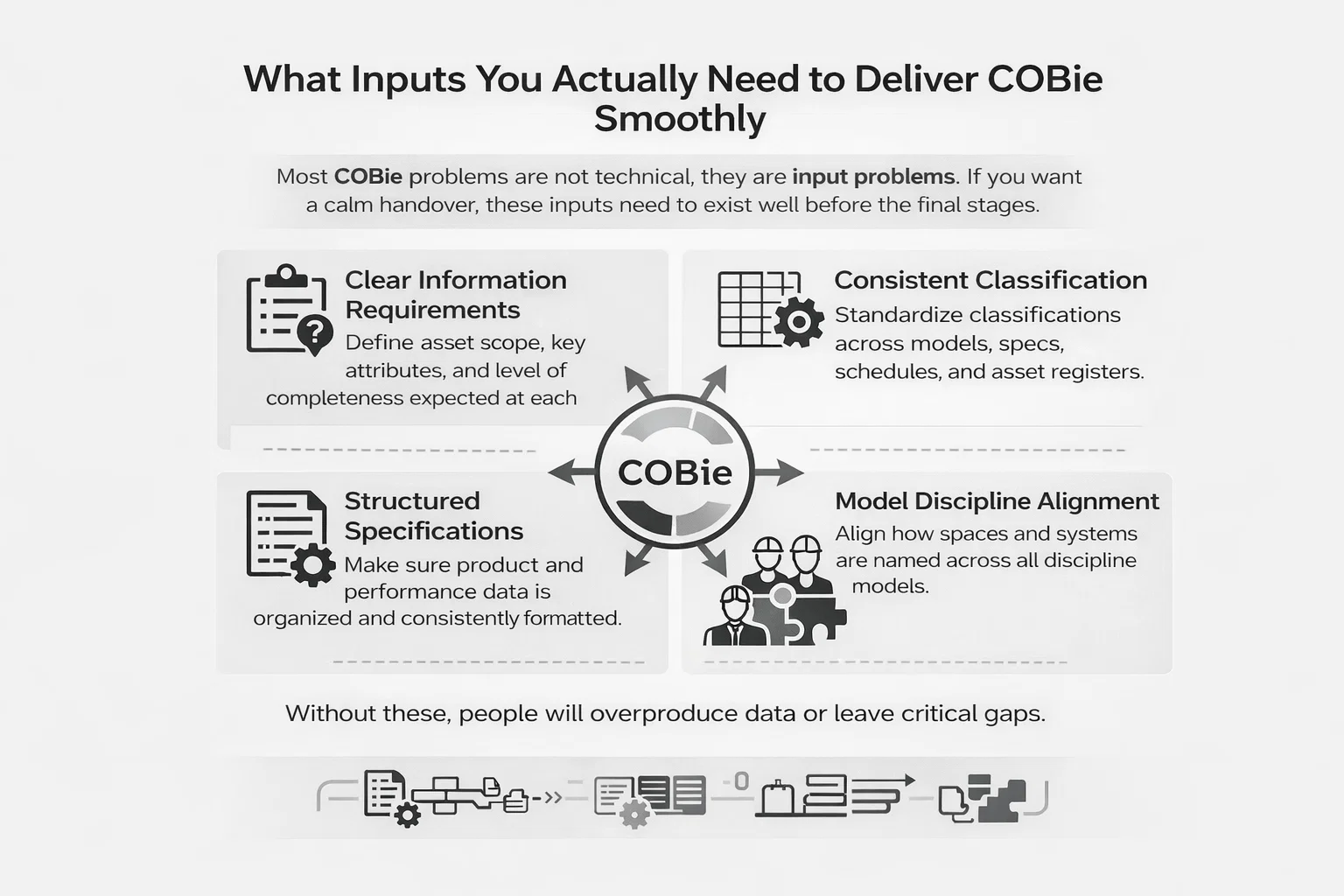
Most COBie problems are not technical. They are input problems.
If you want a calm handover, these inputs need to exist well before the final stages.
Clear Information Requirements
If the employer’s information requirements are vague, COBie will be vague. Teams need to know:
- Which asset types are in scope
- Which attributes matter and which do not
- What level of completeness is expected at each stage
Without this, people either overproduce data or leave critical gaps.
Consistent Classification
Whether you are using Uniclass or another agreed system, classification has to stay consistent across models, specifications, schedules, and asset registers. COBie relies heavily on relationships between objects, spaces, and systems, and those relationships only hold together when naming and classification follow the same logic everywhere.
When classifications drift or are applied differently by each discipline, links break quickly. That is usually when data starts to feel unreliable and teams are forced into manual fixes that should never have been needed.
Structured Specifications
A lot of COBie data comes from specifications, not geometry. Product types, manufacturers, warranties, standards, and performance data live there.
If specifications are written as loose text with no structure, extracting reliable COBie data becomes a manual exercise.
Model Discipline Alignment
Architectural, structural, and MEP models need to agree on how spaces and zones are defined, where system boundaries sit, and which naming conventions are used. COBie does not tolerate ambiguity well, because it depends on clear relationships between elements authored by different disciplines.
If two models describe the same space, system, or component in different ways, that conflict has to be resolved before export. Leaving it unresolved only pushes the problem downstream, where it becomes harder to fix and far more disruptive.
What Actually Gets Handed Over at the End
There is often a mismatch between expectations and reality at handover. COBie is frequently assumed to be a complete digital mirror of the building, but in practice it is a focused asset information deliverable, shaped by what was defined, authored, and agreed during the project.
What a UK COBie Deliverable Typically Includes
A standard UK COBie handover usually covers the core structure of the asset. This includes floors, spaces, and zones that define how the building is organised, along with asset types and individual component instances that are considered maintainable. Attribute sets are provided for those items, capturing the information facilities teams actually need rather than design intent.
Contact information and responsibility roles are also part of the dataset, linking assets back to designers, contractors, manufacturers, and suppliers. Maintenance tasks and schedules are included where they have been defined, alongside references to documents such as manuals, warranties, and certificates that support ongoing operation.
What COBie Usually Does Not Include
What COBie does not normally contain is just as important to understand. It does not attempt to list every minor or non-maintainable component in the building. It also avoids carrying design intent data that has no operational value once the building is in use. In many cases, it will not provide perfect or complete information for assets that were never clearly specified or properly defined during delivery.
This is where early agreement pays off. When all parties understand what “good enough” looks like from the start, the handover becomes a controlled, predictable process rather than a negotiation under pressure in the final weeks of the project.
The Real Reason Last-Minute Data Panic Happens
Almost every project that struggles with COBie struggles for the same reason. Data responsibility is unclear.
People assume:
- The designer will populate it later
- The contractor will fix it at the end
- The BIM coordinator will somehow make it work
In reality, COBie is collaborative by nature. No single party owns all the information. If roles are not defined, gaps appear and no one notices until deadlines loom.
Another trigger for panic is late validation. Checking COBie data after export is too late. Validation needs to happen while data is being authored, not when the spreadsheet already exists.
How to Deliver COBie Without Pain
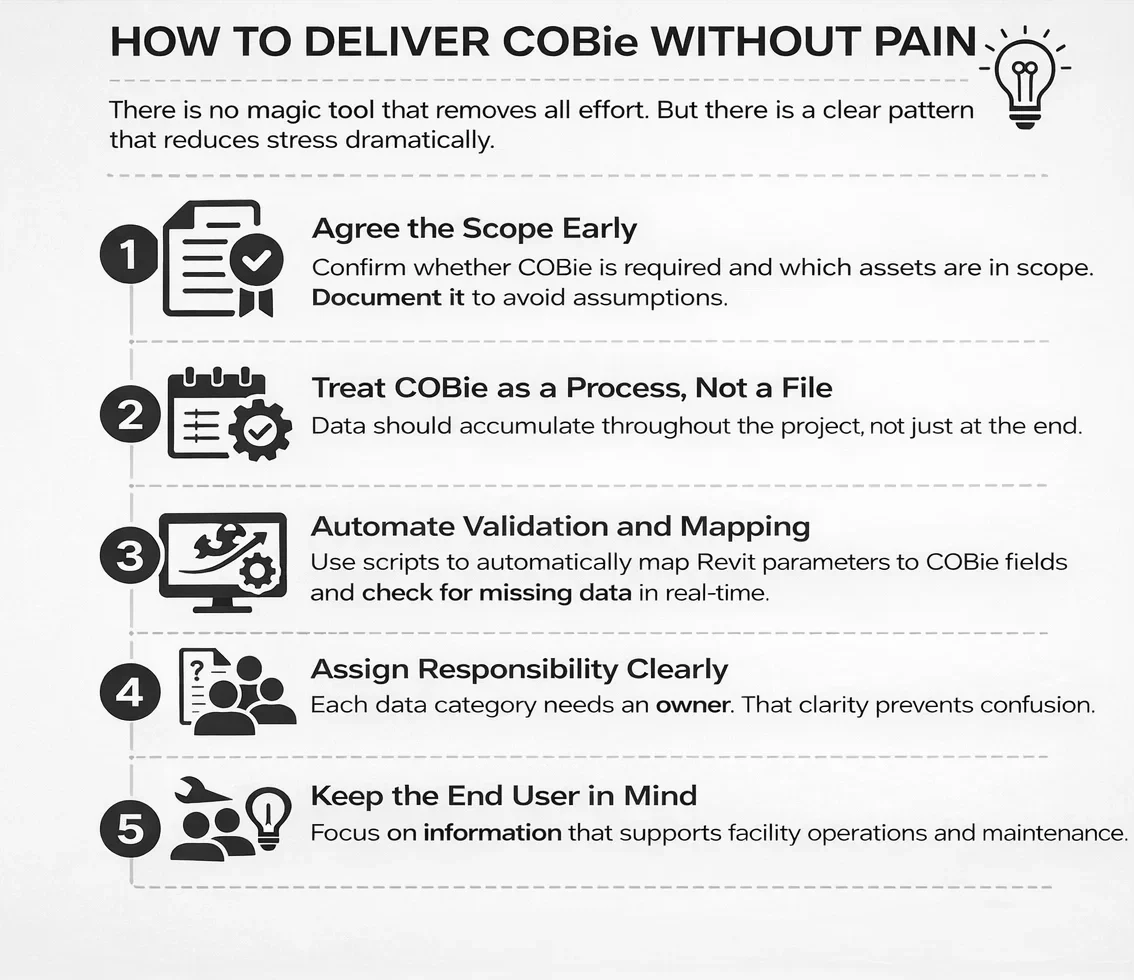
There is no magic tool that removes all effort. But there is a clear pattern that reduces stress dramatically.
1. Agree the Scope Early
Confirm whether COBie is required, what “equivalent” means if applicable, and which assets are in scope. Document it. Do not rely on assumptions.
2. Treat COBie as a Process, Not a File
If COBie only appears in the final month, something has gone wrong. Data should be accumulating throughout the project, even if the spreadsheet itself is not generated yet.
3. Automate Validation and Mapping
At Powerkh, we eliminate ‘data panic’ through BIM Automation. We use custom scripts to automatically map Revit parameters to COBie fields and run algorithmic checks for missing data (Attributes, Type, Warranty) in real-time. This shifts the effort from manual entry to automated quality control.
4. Assign Responsibility Clearly
Each data category should have an owner. Not one person, but one role. That clarity removes a huge amount of friction.
5. Keep the End User in Mind
Facilities teams care about usability, not theoretical completeness. Focus on information that supports operations, maintenance, and decision making.
COBie as a Commercial Deliverable, Not a Compliance Box
From a commercial perspective, COBie should be seen as risk management rather than a box-ticking exercise.
A clean, well-structured asset data handover reduces disputes at practical completion, shortens the handover period, and improves client confidence in the project team. It also protects designers and contractors from ongoing data requests after handover, because expectations have been met in a clear, auditable way.
A rushed or incomplete COBie deliverable does the opposite. It creates open-ended obligations, invites follow-up queries, and erodes trust at exactly the point where projects should be closing cleanly. When approached properly, COBie stops being a headache and becomes a predictable output of good information management.
Final Thoughts
COBie in the UK is not going away, but it is also not something to fear. Most of the pain associated with it comes from late decisions, unclear requirements, and the idea that it can be fixed at the end.
If you understand when it is required, clarify what “COBie or equivalent” actually means on your project, line up the right inputs early, and validate continuously, the spreadsheet itself becomes almost boring.
And in construction, boring handovers are usually a sign that things went right.
Frequently Asked Questions
What is COBie and why is it used in the UK?
COBie, or Construction Operations Building Information Exchange, is a structured way of handing over asset information at the end of a project. In the UK, it is used to ensure that building owners and facilities teams receive usable, consistent data for operations and maintenance, rather than piles of drawings or unstructured documents.
Is COBie mandatory on all UK construction projects?
No. COBie is only mandatory when it is explicitly required in the employer’s information requirements or referenced through ISO 19650 and its UK National Annex. It is most common on public sector and government-aligned projects, but it can also appear on private sector jobs depending on client expectations.
What does “COBie or equivalent” actually mean?
“COBie or equivalent” usually means the client wants structured asset data, not necessarily a specific spreadsheet. An equivalent might be asset information delivered through an FM or CAFM system, a digital O&M platform, or validated IFC-based data, as long as it provides the same clarity, structure, and relationships COBie is designed to enforce.
Is COBie the same thing as IFC?
No. IFC is the underlying data model used to exchange building information between software platforms. COBie is a filtered, tabular view of part of that information, focused on operations and maintenance. In the UK, IFC should be treated as the source, with COBie produced as an output when required.
When should COBie be started on a project?
COBie should be considered from the start, even if the spreadsheet itself is delivered later. Information requirements, asset scope, classification, and responsibilities need to be agreed early. Leaving COBie until the final stages almost always leads to rushed data and avoidable problems.
Who is responsible for delivering COBie?
COBie is a collaborative deliverable. No single party owns all the information. Designers, contractors, and suppliers all contribute different parts of the data. The key is to clearly assign responsibility by role for each data category so gaps are identified early rather than at handover.

Our Case Studies
We have handled 200+ BIM & VDC projects for commercial, industrial, and residential sectors.
Our work includes:
Formwork design automation
Our client from
California, USA
Suspended ceiling design automation
Our client from
New York, USA
Wall framing design automation
Our client from
California, USA