Have any questions? Contact us!
Join our team!
Request a free quote or consultation

When you’re dealing with a construction project,whether it’s a small commercial space or a sprawling residential complex, it’s easy for things to get messy fast. Miscommunications, overlapping systems, missed details. That’s where BIM design support steps in.
It’s not just another layer of drawings or digital polish. BIM design support helps everyone on the team see the same thing, work from the same data, and move forward with fewer surprises. It ties together structural logic, systems coordination, and clear documentation so that design decisions aren’t just good-looking – they actually work on-site.
In this article, we’ll break down what BIM design support really is, where it fits into your process, and why it matters more now than ever.
A Simple Definition: What Is BIM Design Support?
At its core, BIM design support means providing technical assistance throughout the design and construction lifecycle using data-rich digital models. This includes everything from modeling architectural and structural systems to detecting design clashes before they happen, and delivering the documentation that makes site work smoother.
But it’s not a one-size-fits-all process. BIM design support can range from helping draft early concept models to managing the digital side of a renovation, or even guiding how prefabricated parts are prepared and assembled offsite.
The key word here is “support.” It’s about helping teams make sure the design can actually be built the way it was intended.
Where BIM Design Support Fits Into the Workflow
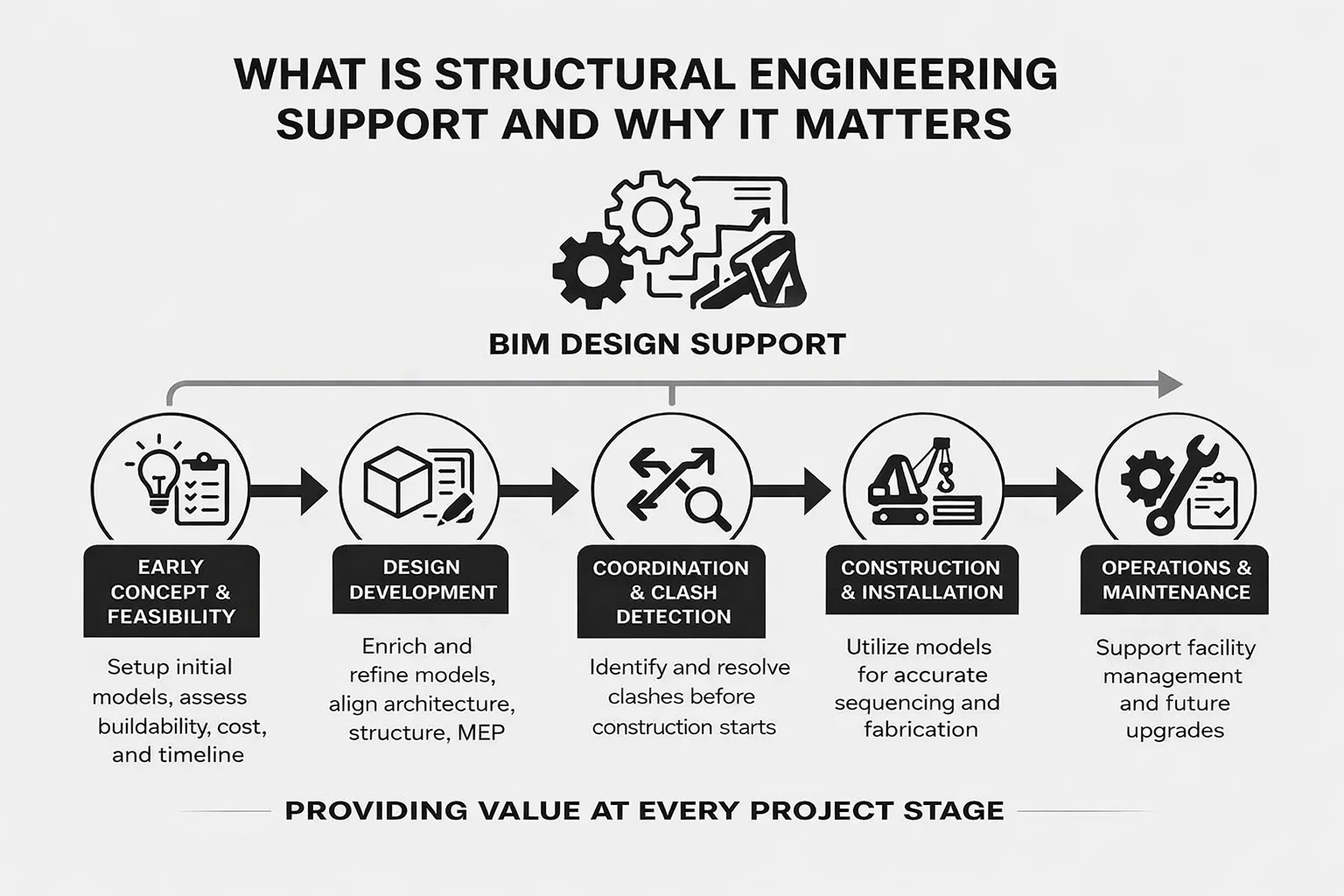
BIM design support is most commonly involved during design and pre-construction phases, but can also extend to construction and post-build stages depending on project needs. Here’s how it typically fits into the broader lifecycle:
- Early concept and feasibility: Support teams help set up initial models that can be tested for buildability, cost, and timeline impact.
- Design development: As plans get more detailed, BIM support ensures that architectural, structural, and MEP elements align properly.
- Coordination and clash detection: The system checks whether systems are interfering with each other before construction begins.
- Construction and installation: Teams use models to plan sequences, guide fabrication, and stay on track with timelines.
- Operations and maintenance: Once built, the BIM model can continue supporting facility management and future upgrades.
It’s a full-cycle involvement that provides value at every stage, especially for complex projects where small errors can cause big delays.
What’s Included in BIM Design Support?
Let’s break it down into the key types of tasks and deliverables that typically fall under BIM design support:
3D Modeling and Visualization
BIM design support starts with creating digital models that include architecture, structure, and MEP systems in one place. This isn’t just about visuals – it helps everyone see how different parts of the project fit together and spot layout issues before construction begins.
Clash Detection and Issue Tracking
One major perk of BIM is catching design conflicts early. When systems overlap or interfere, the model flags those issues so they can be fixed before reaching the site. That saves time, money, and a lot of headaches later on.
Construction Documentation
Once the model is ready, it generates up-to-date drawings and specifications. Because everything is tied to the model, documentation stays consistent and reflects the current design, which helps teams stay aligned on site.
Quantity Takeoffs and Cost Forecasts
The model can support quantity takeoffs and cost estimates when extended into 5D BIM with proper input data. It’s a faster, more reliable way to plan budgets and reduce the chance of unpleasant surprises.
4D and 5D Modeling
Beyond geometry, BIM can connect time and cost to the model. This lets teams simulate construction phases and track budget changes over time, making it easier to plan realistically and avoid overruns.
Scan-to-BIM
When working with existing buildings, laser scans can be turned into accurate digital models. This makes it easier to plan upgrades or renovations using real-world data instead of assumptions.
Prefabrication Support
For projects using offsite manufacturing, BIM design support ensures the model is fabrication-ready. It helps streamline production and reduces the need for rework once materials arrive on site.
Why BIM Design Support Is a Big Deal
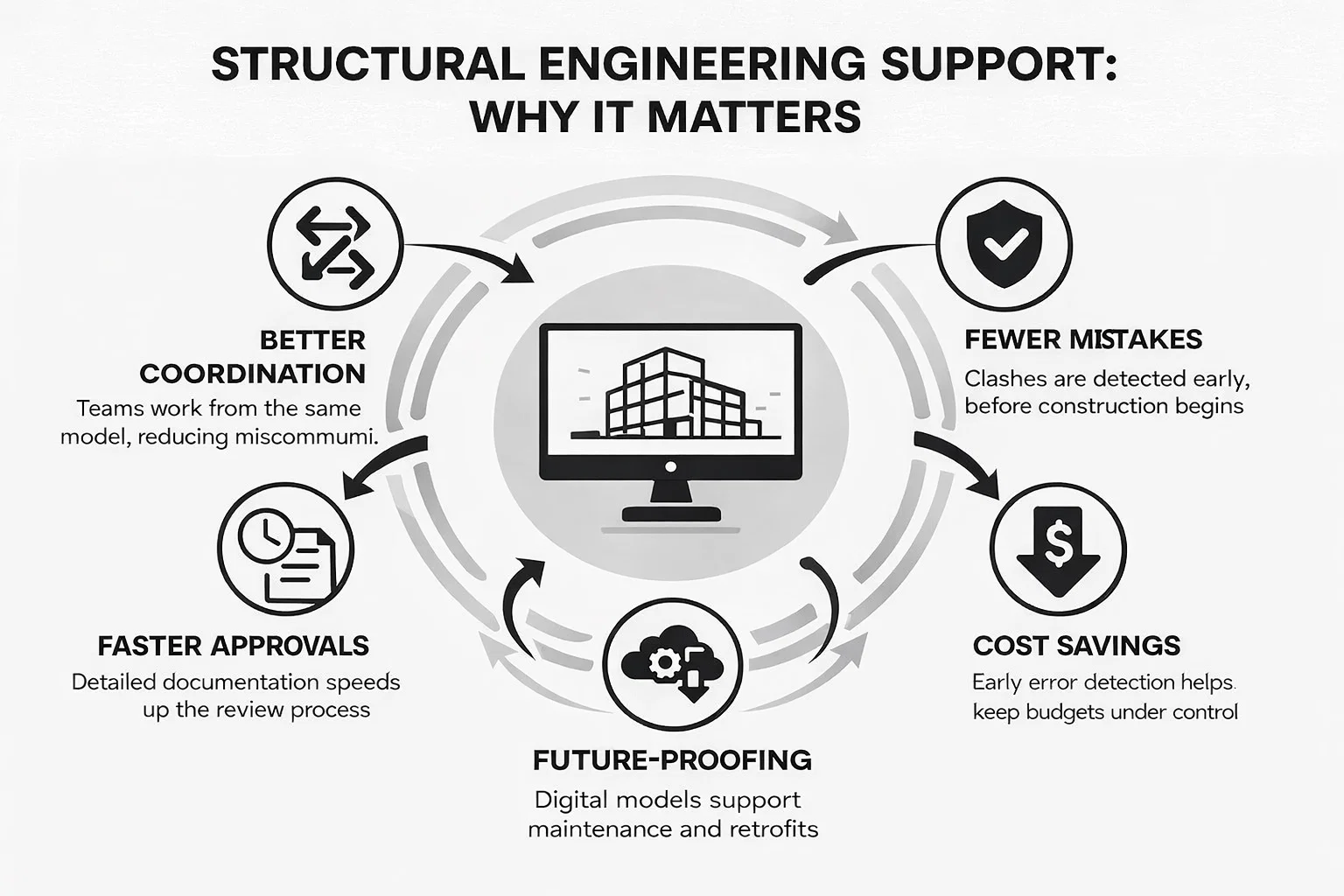
In an ideal world, every project would go smoothly. But most real-world projects involve multiple teams, changing requirements, and tight deadlines. BIM design support helps reduce that chaos.
Here’s what it brings to the table:
- Better coordination across teams: When everyone’s working from the same model, the chance of miscommunication drops significantly.
- Fewer mistakes on-site: Design clashes get caught before they reach the build stage.
- Faster approvals and smoother inspections: With detailed, up-to-date documentation, there’s less confusion when working with local authorities.
- Cost savings: Catching errors early and getting quantities right the first time means fewer budget surprises.
- Future-proofing: When a project is complete, the digital model can live on and support operations, maintenance, or future retrofits.
Who Uses BIM Design Support?
BIM design support isn’t just for massive firms or megaprojects. It’s being used across the board:
- Architects looking to keep designs coordinated without drowning in detail.
- Structural and MEP engineers checking their systems will fit without conflict.
- Contractors planning out sequences, prefabrication, and installations.
- Facility managers managing the building long after it’s complete.
- Developers and owners tracking the full project with fewer surprises.
Whether it’s a small commercial build or a multi-phase urban development, BIM design support brings value by keeping things moving and aligned.
How We Approach BIM Design Support at Powerkh

At Powerkh, we see BIM design support as more than just creating a clean model. For us, it’s about maintaining design continuity from the drawing board all the way to handover. That means we stay close to the intent behind each design decision and help protect it through coordination, construction, and verification on-site.
We support teams across the UK, US, and Europe with a structure-first, engineering-led mindset. Whether we’re modeling complex MEP layouts, reviewing constructability before drawings go out, or scanning built elements to check what’s actually been installed, we’re focused on one thing: making sure what’s designed is what gets built. Our clients rely on us not just for 3D outputs, but for clear feedback, risk visibility, and technical insight at each stage of the process.
BIM design support isn’t about just pushing data around. It’s about catching real problems before they land on site. That’s why our services stretch from early-stage Revit modeling to deviation monitoring and close-out support. We’re not here to flood projects with more layers of complexity. We’re here to keep things moving, keep designs intact, and help teams make decisions based on what’s really happening.
What BIM Design Support Is Not
Let’s clear up a few common misconceptions:
- It’s not a design service. BIM support helps you model, check, and refine designs, but it doesn’t replace architects or engineers.
- It’s not just 3D modeling. While the visual model is important, the real value lies in the data underneath and how it connects schedules, costs, and components.
- It’s not only for new buildings. BIM support can also help map out older structures and support renovation, restoration, or expansion projects.
Practical Use Cases
To see how this works in practice, imagine a team converting an old warehouse into a modern office space. Instead of guessing what’s behind the walls, they use a scan-to-BIM process to model the existing conditions. That gives them a reliable foundation to plan retrofits without running into surprise obstacles mid-build.
In another case, a hospital project presents a challenge with limited ceiling space, where structural and mechanical systems are packed tightly together. Before anyone steps on site, BIM support helps catch those clashes and smooth out the layout so the systems can fit without conflict.
On the construction side, a contractor leans on the 4D model to understand how the build will unfold. With that timeline visualization, they’re able to adjust sequencing early and avoid costly delays caused by equipment or crew overlap.
Meanwhile, in a prefabrication setting, shop teams rely on the BIM model to cut materials to exact dimensions before anything ships out. That kind of precision reduces on-site work, limits waste, and keeps things moving faster.
Each of these examples shows how BIM design support flexes to meet different needs across a project. It’s not tied to one phase or discipline – it’s about keeping the design grounded and the build on track, no matter the context.
Key Benefits Recap
Let’s boil it down to what matters most. BIM design support helps you:
- Catch mistakes early.
- Save time and money.
- Coordinate multiple teams.
- Improve documentation quality.
- Reduce rework and change orders.
- Support long-term facility operations.
If you’ve ever been on a project where something went sideways because a pipe ran through a beam or a contractor got the wrong drawing version, then you already understand the value.
Final Thoughts
BIM design support isn’t a trend or a tech gimmick. It’s become a core part of how buildings get made in today’s industry. It bridges the gap between design vision and construction reality.
And the best part? You don’t need to overhaul your entire process to benefit from it. Even bringing in targeted support for a specific stage can prevent costly mistakes and tighten up the workflow.
The future of building isn’t just digital. It’s coordinated, informed, and built on better support. That’s what BIM design support offers.
FAQ
1. What’s the difference between BIM design support and BIM modeling?
BIM modeling is usually about creating the digital model itself. BIM design support goes a step further. It helps teams use that model properly throughout design, coordination, and construction. The focus isn’t just on geometry, but on keeping decisions aligned, spotting risks early, and making sure the design actually works when it reaches the site.
2. Do small or mid-size projects really need BIM design support?
Not every project needs full-scale BIM involvement, but even smaller builds can benefit from targeted support. A single coordination issue can delay a job or trigger expensive changes. BIM design support is often most valuable where space is tight, systems overlap, or changes are likely later in the process.
3. When should BIM design support start in a project?
Earlier than most people expect. Getting support involved during design development helps prevent problems from becoming locked in. That said, BIM design support can still add value mid-project, especially if coordination issues, site constraints, or scope changes start piling up.
4. Is BIM design support only useful before construction starts?
No. That’s a common misunderstanding. BIM design support often continues into construction, where it helps track deviations, answer technical questions, and confirm that what’s being built matches the design intent. This stage is where support can prevent quiet mistakes from becoming long-term problems.
5. How does BIM design support reduce rework on site?
By resolving conflicts digitally instead of physically. When clashes, access issues, or sequencing problems are handled in the model, crews don’t have to stop work to fix them later. Fewer surprises mean fewer rushed decisions, which usually leads to better outcomes.
6. What should I look for when choosing BIM design support?
Look for teams that understand construction, not just software. Good BIM design support comes from people who can question assumptions, explain trade-offs, and communicate clearly with both designers and site teams. If the support feels disconnected from how buildings are actually built, it probably won’t deliver much value.

Our Case Studies
We have handled 200+ BIM & VDC projects for commercial, industrial, and residential sectors.
Our work includes:
Formwork design automation
Our client from
California, USA
Suspended ceiling design automation
Our client from
New York, USA
Wall framing design automation
Our client from
California, USA