Have any questions? Contact us!
Join our team!
Request a free quote or consultation

If you are scoping a steel frame or concrete package, the next question after design intent is simple: what will the shop drawings cost. In 2026, most structural sets are priced in three common ways. Per sheet is the cleanest to budget for, typically $100-250 per sheet, with a wider market range of $50-250 depending on detail level and provider. Hourly works best for moving targets and deep coordination, usually $40-100 per hour. Many teams also use a rule of thumb at 5-8 percent of the fabrication value to sanity check quotes. For a small scope, totals often land around $500-2,000. For mid sized warehouse or mixed use work, expect several thousand and up, especially with dense connections, rebar schedules, and clash resolution. The real driver is complexity. Clear inputs and a defined scope bring costs down. Constant changes, rush timelines, and custom assemblies push them up.
What Structural Shop Drawings Are and Why They Matter
Before diving into numbers, it’s worth clarifying what these drawings include. Structural shop drawings are detailed technical documents that translate a design concept into buildable instructions. Instead of broad architectural intent, they provide exact dimensions, material specifications, welding symbols, reinforcement details, and connection types.
Their role in construction is hard to overstate. They eliminate ambiguity during fabrication and installation, ensure that everything complies with building codes and engineering standards, and, when paired with BIM tools, allow teams to catch clashes before work begins on-site. These drawings also help fabricators order materials with accuracy and give project managers a clearer view of costs and timelines. Just as importantly, they keep construction teams aligned, reducing the risk of rework and miscommunication.
Without structural shop drawings, projects can slip into costly delays and errors. Treated properly, they are not just an expense but a safeguard for quality and precision.
Powerkh: How We Support Structural Shop Drawings

At Powerkh, we see shop drawings as more than just paperwork – they are the foundation for building with confidence. With over 200 BIM and VDC projects delivered across the UK, USA, and Europe, we know how to take a design from concept to construction with precision and efficiency.
Our advantage comes from blending structural detailing with advanced BIM workflows. Instead of relying only on flat drawings, we build detailed 3D models that detect clashes early and minimize the risk of rework. This approach not only saves time on-site but also cuts unnecessary costs for our clients. Whether it’s steel, rebar, precast, or facade elements, our detailing is backed by a digital model that everyone can rely on.
We also understand that speed matters. By using BIM automation and scripting tools, we can complete repetitive tasks up to three times faster than conventional methods. That means quicker turnaround for shop drawings without sacrificing accuracy. Our established workflow keeps communication clear at every step: from scope definition to final delivery, so clients always know where things stand.
What Sets Us Apart:
- Detailed 3D BIM models that prevent clashes before they reach the site.
- Faster turnaround thanks to BIM automation and workflow optimization.
- Proven experience across 200+ commercial, industrial, and residential projects.
- Full spectrum of services, from scan-to-BIM to fabrication-ready detailing.
- Clear communication and responsive support throughout the project.
- Flexible collaboration with architects, engineers, contractors, and on-site teams.
We don’t just deliver drawings. We deliver certainty, efficiency, and a smoother path from design to construction.
Common Pricing Models in 2026
Structural shop drawings are generally billed in one of three ways: per sheet, hourly, or as a percentage of fabrication costs. Each method suits a different project type and client preference.
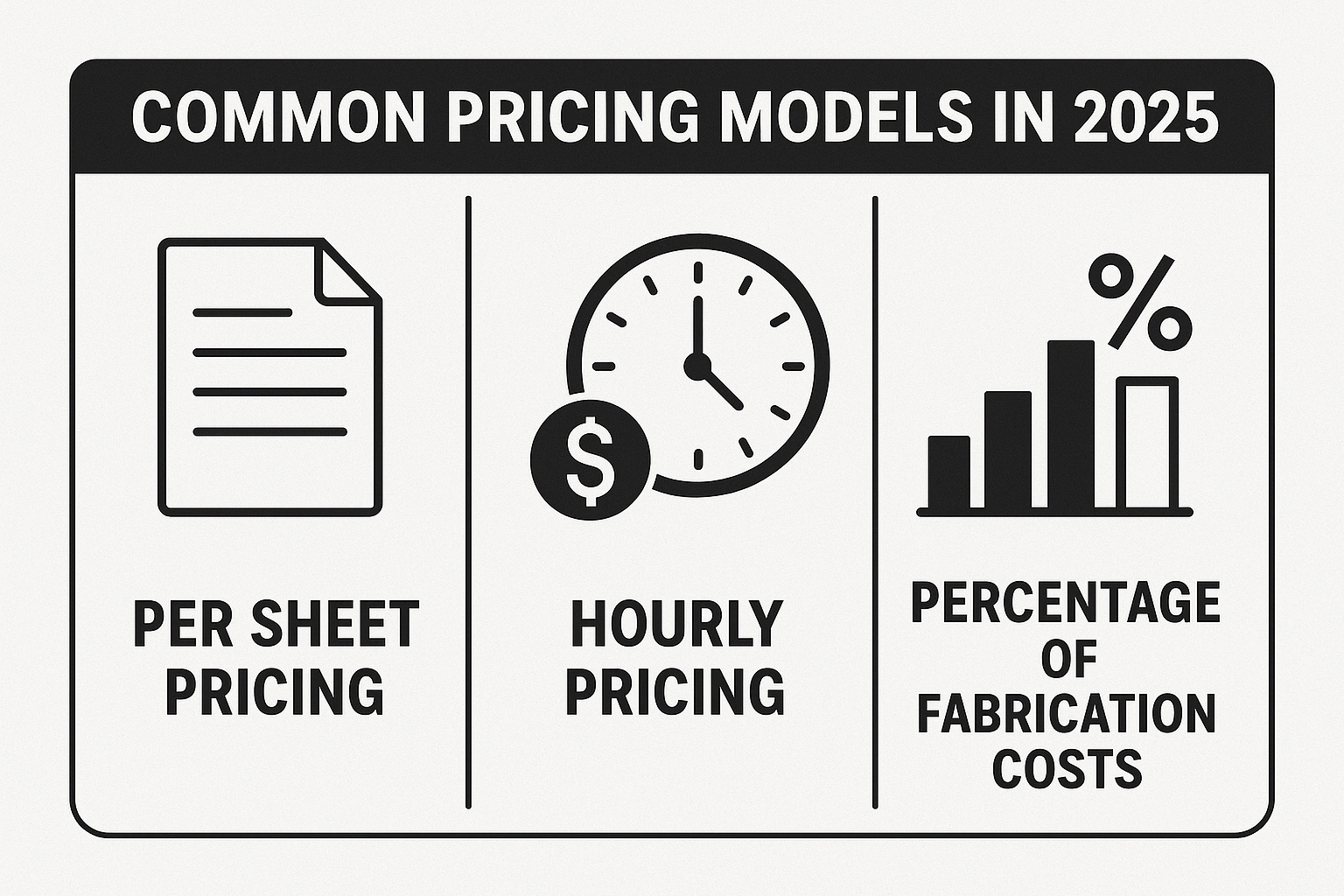
Per Sheet Pricing
This is the most predictable approach and still the most popular in 2026. You pay for each drawing sheet, which may include plans, elevations, sections, and detail views.
- Typical cost range: $100-250 per sheet.
- Lower rates ($50-80) are possible with freelancers, but quality and turnaround can be inconsistent.
- High-end or complex drawings may climb to $250 or more per sheet.
A small project with five sheets could cost $500-1,200. Larger scopes, such as 20-30 sheets for a mid-sized commercial building, can run $3,000-6,000.
Hourly Pricing
Some providers prefer to bill for time spent. This model is common when the scope is fluid, revisions are expected, or coordination is ongoing.
- Average hourly rates: $40-100 depending on expertise and region.
- Simple revisions may take 2-4 hours, adding $100-400 to the bill.
- Complex rework, such as adjusting rebar layouts after site measurements, may take dozens of hours.
Hourly billing offers flexibility, but it requires clear caps and regular communication to avoid surprises.
Percentage of Fabrication Costs
This method ties drawing fees directly to the value of the structural package. It is less common than per-sheet or hourly but still used in specialized or custom-heavy projects.
- Typical range: 5-8 percent of fabrication costs.
- Example: If steel fabrication is $100,000, drawings could run $5,000-8,000.
This approach scales naturally with project size but is harder to pin down early in planning.
Cost Ranges by Drawing Type
Not all structural shop drawings are priced equally. Each discipline has its own demands, level of detail, and drafting challenges, which is why costs vary so much. Below are the average benchmarks for 2026 and what typically influences them.
Steel Shop Drawings
Steel detailing remains one of the most labor-intensive areas. On average, steel shop drawings cost between $150 and $250 per sheet. For a small project, such as a residential frame or a simple warehouse, the total may be as little as $750 to $2,500. But larger commercial or industrial steel packages can easily surpass $10,000, especially when custom joints, welding specifications, and heavy coordination with MEP trades are required. Some firms also offer pricing by weight, averaging $50 to $100 per ton of steel, though per-sheet billing is more common.
Rebar Detailing
Reinforcement drawings are another critical category. These usually run between $100 and $200 per sheet, or $40 to $80 per hour when billed on time spent. Straightforward slab reinforcement can be prepared relatively quickly, but costs rise when multiple bar sizes, bends, and overlapping schedules are involved. A dense high-rise core, for example, will require far more sheets than a single-level foundation, pushing totals well beyond the baseline.
Precast Concrete
Precast concrete elements also demand detailed shop drawings, covering panels, beams, stairs, or slabs. Typical pricing falls between $100 and $200 per sheet. A small set of drawings may cost $500 to $2,000, but for larger projects with dozens of elements, costs multiply quickly. Since precast relies heavily on accurate dimensions for off-site fabrication, errors are costly, making precision here especially valuable.
Miscellaneous Metals
Items like custom stairs, railings, ladders, and architectural metalwork are often priced a bit lower, usually in the $80 to $150 per sheet range. While the cost per sheet is more affordable, these elements can still add up if a project involves multiple stair towers or extensive decorative features. Their value lies in making sure installers have exact guidance on fit, finishes, and safety compliance.
Putting It in Perspective
Across all categories, these numbers align with the common rule of thumb that shop drawings account for about 5 to 8 percent of fabrication costs. That means a $20,000 steel package might carry $1,000 to $1,600 in drawing fees, while a $100,000 precast job could run $5,000 to $8,000. The percentages help keep estimates realistic, but the actual figure always depends on complexity, scope, and how many revisions are required.
Hidden or Overlooked Expenses
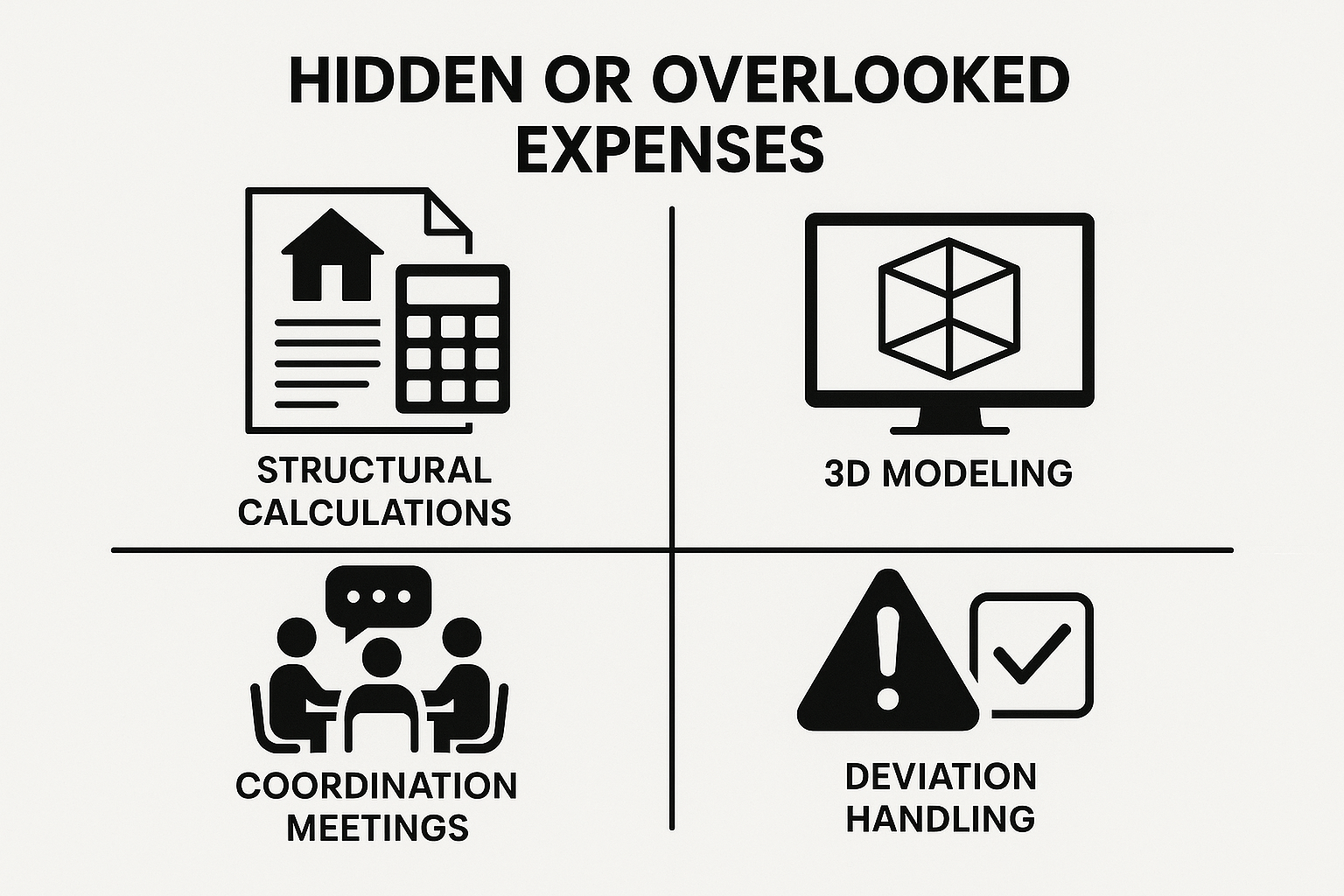
One reason budgets creep upward is the extras that are not always included in the initial quote. These can seem small on their own but add up quickly, especially on larger projects.
- Structural calculations: May be required in addition to drawings, particularly for complex steel connections or reinforced concrete. These can add $500 to $2,000 depending on the level of engineering involved.
- 3D modeling: It’s another expense that sometimes slips under the radar. A simple 3D view might only cost $200, but full parametric models used for clash detection and coordination can reach $500 or more.
- Coordination meetings and reviews: They are often billed separately, usually at $100 to $300 per hour. If the project demands multiple review cycles with architects, engineers, and contractors, those hours accumulate fast.
- Deviation handling: It’s another overlooked line item. Unexpected site changes or adjustments to accommodate field conditions can add $200 to $500 per incident, sometimes more if the change requires a full rework of drawings.
For all these reasons, asking for an itemized proposal at the start is one of the best ways to keep costs transparent and avoid unpleasant surprises halfway through the project.
What Drives the Cost Up or Down
Two projects of similar size can end up with very different shop drawing budgets. In 2026, the final price depends on several key factors that shape both the scope of work and the amount of time required.
Complexity and Level of Detail
The more intricate the design, the more sheets and hours are required. A basic steel frame with standard connections can be documented fairly quickly, while something like a stadium roof with custom joints or a high-rise packed with dense rebar is far more demanding. Features such as curved or angled members, unique connection details, and reinforcement schedules with multiple bar types all increase the workload. If advanced clash detection is added to coordinate steel, concrete, and MEP systems, that too extends the drafting effort and raises the price.
Project Size
Scale matters just as much as complexity. A small residential build may require under ten sheets, which keeps costs on the lower end. A mid-sized warehouse might call for thirty to fifty sheets, while a hospital or airport terminal could require hundreds. The larger the project, the more drawings are needed, and the budget grows in proportion.
Revision Frequency
Revisions are another cost driver. Even well-planned projects tend to evolve, but every change has a price tag. Most providers bill revisions hourly at $65 to $150. A small tweak might add $200 or so, while major rework or ongoing design adjustments can climb into the thousands. The more complete and accurate the initial information, the fewer revisions are needed, which helps keep budgets under control.
Timeline and Urgency
Shop drawings usually take two to four weeks depending on the scope. If you need them faster, costs go up. Rush jobs often add a surcharge of 25 to 50 percent because they require overtime and reshuffling of schedules. Planning ahead is the best way to avoid these premiums.
Provider Expertise and Location
The experience and location of the drafting team also influence pricing. Freelancers working in lower-cost regions may charge $30 to $80 per sheet, but turnaround times and quality control can vary. Established firms based in major cities often bill $150 to $250 per sheet. While that higher rate may sting initially, it often comes with reliable delivery, thorough quality checks, and fewer errors that could otherwise cost far more during construction.
How to Keep Costs Under Control
Smart planning is the best way to keep shop drawing expenses in check. While costs can vary widely, a few consistent strategies help keep budgets predictable and manageable.
- Provide complete information upfront: The more detail you can give at the beginning, the fewer revisions you will need later. Clear specifications, accurate dimensions, and material choices reduce back-and-forth and save both time and money. Even a small omission early on can lead to multiple hours of paid revisions.
- Pick the right pricing model: Not every project benefits from the same billing structure. A fixed per-sheet model is safer when the scope is clearly defined, since you know exactly what you’ll pay. Hourly billing, on the other hand, is often more practical when designs are evolving or when coordination across trades is ongoing. Choosing the right model upfront helps you avoid runaway costs.
- Bundle drawing types: If your project requires steel, rebar, and precast drawings, consider working with a single provider. Many firms offer discounts for bundled services, and using one team also improves coordination, reducing the risk of errors between disciplines.
- Avoid rush orders: Planning ahead is one of the simplest ways to save money. Shop drawings typically take two to four weeks, but requesting a fast turnaround often adds a 25 to 50 percent surcharge. By building in a realistic timeline, you avoid paying for overtime and priority scheduling.
- Use BIM effectively: Leveraging Building Information Modeling helps catch clashes before they reach the site, which significantly reduces costly revisions. A small investment in digital coordination can prevent thousands in rework and schedule delays later on.
- Get multiple quotes: Prices vary not just between regions but also between providers. Gathering a few detailed quotes gives you a sense of the market rate and helps you set realistic expectations. It also provides leverage when negotiating scope, timelines, or added services.
Conclusion
Structural shop drawings in 2026 typically cost $100-250 per sheet, $40-100 per hour, or 5-8 percent of fabrication costs. Small projects might run $500-2,000, while larger ones can easily exceed $10,000. Complexity, revisions, urgency, and provider expertise are the biggest drivers of cost.
For anyone planning a construction project, these drawings should be treated as an essential investment rather than an afterthought. With clear inputs, the right provider, and a realistic budget, structural shop drawings will save time, prevent errors, and ultimately keep your build on track.
FAQs
What is the average cost per sheet for structural shop drawings?
In 2026, most structural shop drawings cost between $150 and $250 per sheet. Smaller projects may total under $2,000, while larger or more complex steel packages can exceed $10,000.
Do revisions cost extra?
Yes. Revisions are usually billed hourly, averaging $65 to $150 per hour. A small adjustment may add a couple hundred dollars, while significant rework can add thousands. Providing complete information upfront helps minimize these costs.
How long does it take to produce shop drawings?
For most projects, shop drawings take 2-4 weeks. The timeline depends on the size of the project, the number of drawings needed, and how much coordination is required. Rush orders are possible but often add a 25-50 percent surcharge.
Which pricing model is best: per sheet or hourly?
Per-sheet pricing works well when the scope is clearly defined and predictable. Hourly billing is better for projects that are evolving or require frequent revisions. Some providers use a hybrid model, combining per-sheet pricing with hourly billing for changes.
Do shop drawings always require 3D modeling?
Not always, but 3D modeling is increasingly common. While 2D sheets are standard, 3D models help detect clashes, coordinate across trades, and reduce rework. Depending on the provider, adding 3D modeling may cost an extra $200-500.
Who usually prepares structural shop drawings?
They are typically prepared by specialized drafting firms, structural detailers, or subcontractors with experience in steel and concrete. Larger firms often combine detailing with BIM coordination to ensure accuracy.
Our Case Studies
We have handled 200+ BIM & VDC projects for commercial, industrial, and residential sectors.
Our work includes:
Formwork design automation
Our client from
California, USA
Suspended ceiling design automation
Our client from
New York, USA
Wall framing design automation
Our client from
California, USA