Have any questions? Contact us!
Join our team!
Request a free quote or consultation

What Determines the Cost of MEP BIM Drafting and Why It Varies
MEP BIM drafting isn’t a one-size-fits-all service. Pricing can shift a lot depending on how complex the project is, what systems are involved, and how detailed the output needs to be. A small residential layout may run on a tight budget, but large-scale commercial projects often require more modeling, coordination, and revisions. This isn’t just about cost per square foot – it’s about scope, accuracy, and how many moving parts your project has.
Behind the Acronyms: What MEP BIM Drafting Actually Covers
You hear a lot about MEP and BIM in construction – usually in the same breath – but it’s easy to gloss over what the actual drafting process involves. Strip away the terminology, and you’re looking at the technical backbone of every modern building: mechanical systems that move air, electrical systems that power everything, and plumbing systems that keep water flowing where it should. Now add a digital layer that maps it all out in 3D, down to the last fitting, before a single pipe or wire goes in.
That’s essentially what MEP BIM drafting does. It’s the process of translating those systems into precise, buildable models using tools like Revit or AutoCAD MEP. These aren’t just diagrams – they’re coordinated models that account for physical space, performance, and code compliance. And because the data is structured, any changes ripple across the model in real time. No more redoing drawings from scratch when the architect shifts a wall or the HVAC spec gets updated.
Done right, MEP BIM drafting helps teams avoid rework, prevent clashes before they hit the site, and keep projects moving without last-minute surprises. It’s not just drawing – it’s design logic, layered in a format that machines and humans can both follow.
Powerkh in Action: MEP BIM Drafting That Fits the Build

Powerkh is a UK-based company with offices in Ukraine and the USA, focused on delivering structured, model-based drafting for complex MEP systems. Our MEP BIM drafting services are built around Autodesk Revit and Navisworks, where we convert traditional 2D plans into coordinated 3D models that reflect how mechanical, electrical, plumbing, and fire protection systems actually work within the structure.
These models aren’t just visual – they’re used to check how MEP systems align with structural and architectural elements, run clash detection, and generate coordination reports with clear resolution paths. Our team handles this process from start to finish, including regular review meetings with architects, consultants, and engineers to catch and resolve issues before construction starts.
As part of the drafting process, we also build custom Revit families for equipment like valves, pumps, fire dampers, and electrical devices. These parametric components are reusable and editable, making future updates easier across multiple projects. For prefabrication workflows, we produce coordinated shop-ready models that support modular assembly and off-site fabrication.
How Much Does MEP BIM Drafting Actually Cost?
The cost of MEP BIM drafting isn’t pulled out of a catalog. It depends on the size of the project, how detailed the models need to be, and what systems are involved. But if you’re trying to build a real estimate – not just guesswork – here’s what you can expect to pay in most situations.
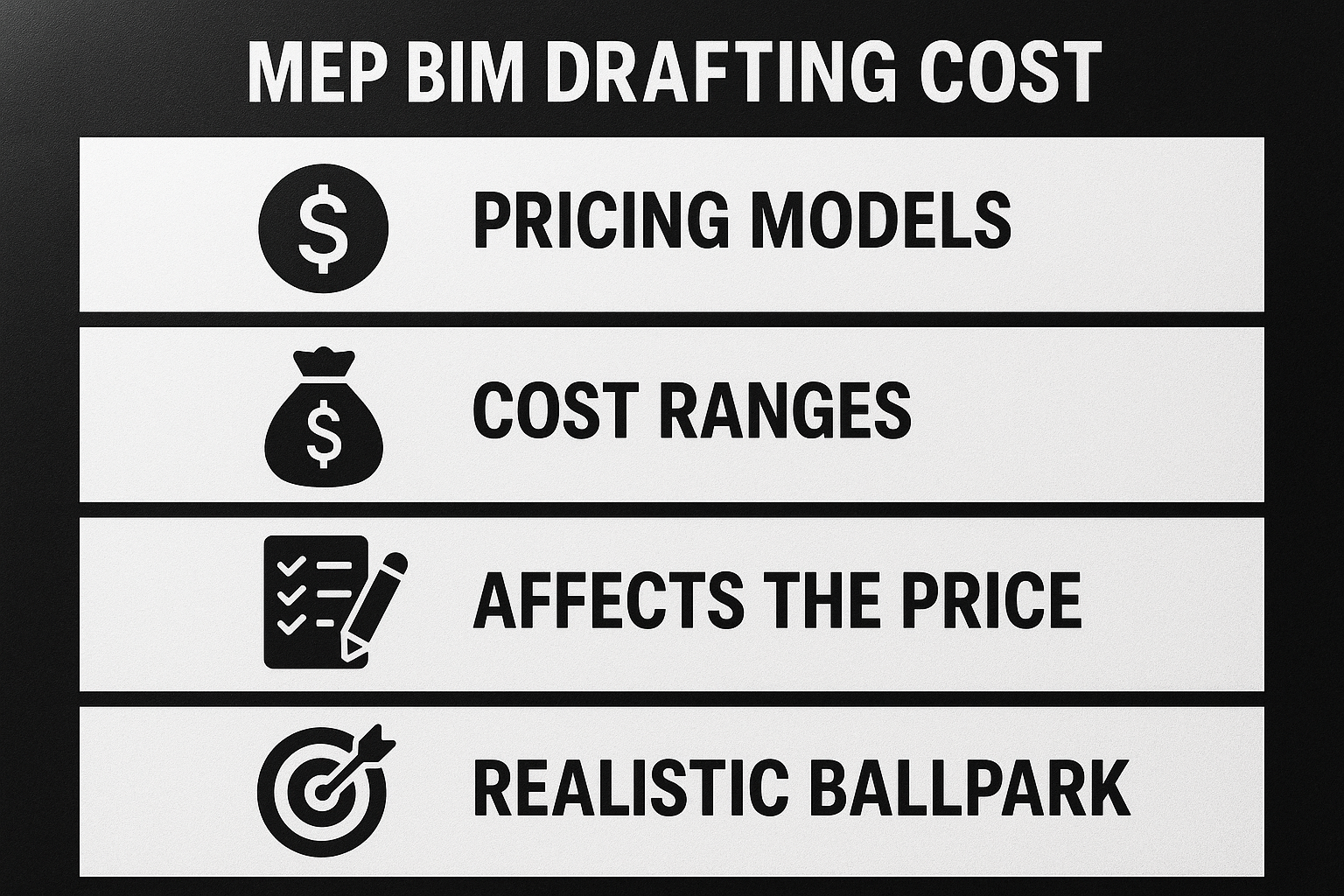
Typical Pricing Models
MEP BIM service providers usually quote projects in one of three ways:
- Per square foot: Common for residential and smaller commercial jobs. Works best when the scope is clearly defined.
- Fixed project fee: Used for mid-size to large projects with known deliverables and deadlines.
- Hourly rate: Often applies to support tasks, design iterations, or on-demand coordination help.
Estimated Cost Ranges by Project Type
Here’s what MEP BIM drafting usually costs, based on real project data and current rates across the U.S. and global outsourcing hubs:
- Basic residential project (LOD 200-300): $0.50 – $1.50 per sq ft. This usually includes HVAC, plumbing, and electrical layouts with limited coordination between systems.
- Mid-size commercial building (LOD 300-400): $1.50 – $3.50 per sq ft. Involves more detailed modeling, coordination between disciplines, and often includes shop-drawing-ready outputs.
- Industrial or healthcare facility (LOD 350-400+): $3 – $6+ per sq ft. These projects require complex modeling of specialized systems like medical gas, lab exhaust, or high-capacity electrical infrastructure, along with strict code adherence.
- Shop drawings (HVAC, electrical, plumbing): $2,500 – $15,000 per discipline. Pricing varies based on project complexity and the level of documentation required.
- MEP Revit family creation (custom components): $200 – $1,000 per family. Depends on how detailed the geometry is and whether the component includes advanced parametric behavior.
- Clash detection and coordination modeling: $50 – $150 per hour. Some firms roll this into their overall BIM service package for large projects; others bill it separately.
What Affects the Price the Most
Some variables can push your MEP BIM costs up or down, even within the same square footage:
- Level of Detail (LOD): LOD 100 is a concept sketch. LOD 400+ gets into fabrication-ready territory. Higher LOD = more hours.
- Scope per discipline: Are you modeling HVAC only, or full MEP + fire protection + specialty systems?
- Number of revisions: More change orders = more time, especially if they come late in the process.
- Timeline pressure: Faster delivery means more people on the job. That impacts the quote.
- Coordination load: Projects with heavy architectural or structural overlaps usually cost more to model properly.
A Realistic Ballpark
If you’re budgeting from scratch:
- A basic 5,000 sq ft residential build might cost $2,500-$5,000 for MEP drafting alone.
- A 30,000 sq ft office building with full MEP BIM + coordination could land in the $45,000-$90,000 range.
- A specialized industrial facility with high-detail requirements can easily pass $120,000+ for MEP BIM deliverables.
The takeaway? Don’t rely on square-foot rates alone. The fastest way to overpay is to underestimate scope, especially when coordination isn’t baked in from the start. Talk through the deliverables, get clear on the LOD, and ask where the revision buffer is. That’s where a lot of the hidden cost lives.
Key Factors That Influence MEP BIM Drafting Costs
The pricing behind MEP BIM work isn’t random. Most quotes are built around a handful of core variables that stack up fast if you’re not paying attention. Below are the main drivers that tend to shift the numbers – sometimes by thousands of dollars – depending on how your project is scoped and managed.
Level of Detail (LOD)
The more detail you want, the more time it takes to build. A conceptual LOD 200 model might give you general layout and spatial coordination. But once you move toward LOD 350 or LOD 400, you’re asking for fabrication-ready geometry, full annotation sets, and tighter tolerances. That added accuracy comes with higher modeling time – and cost.
System Complexity
Modeling HVAC for a single-family home isn’t in the same ballpark as coordinating multiple air handling units, backup generators, sprinkler zoning, and medical gas systems. The more systems involved – and the more interdependent they are – the more expensive it gets to model them properly.
Project Size
Cost per square foot can look low on paper, but scale matters. A 5,000 sq ft residential layout might take a few days of drafting work. A 150,000 sq ft mixed-use facility will likely involve weeks of modeling, review cycles, and coordination rounds. Larger projects also tend to require more consultants, which adds to communication overhead.
Change Frequency
Revisions are one of the quiet cost escalators. If architectural or structural plans keep changing mid-process, expect the MEP model to chase those updates. Even small design tweaks – moving a shaft, changing ceiling heights – can ripple through all three systems (mechanical, electrical, plumbing) and force a round of rework.
Coordination and Clash Resolution
BIM is most valuable when teams use it to prevent issues before they show up on site. That requires coordination – not just within MEP but across architectural and structural models. If you’re working in isolation, costs stay lower. If your MEP consultant is handling clash detection, RFI tracking, and weekly model reviews, that labor is factored in.
Local Code and Compliance Requirements
Some jurisdictions are stricter than others. Designing for New York City or London will usually require more effort (and documentation) than modeling for a rural project in a less regulated zone. Energy codes, fire ratings, duct sizing rules – these all need to be built into the model, and that adds hours.
Deadlines and Delivery Pressure
Rush jobs are expensive. If your timeline is compressed, the BIM team may need to run overnight shifts or add staff to hit the mark. That kind of resource loading gets passed into the quote. Slower schedules give more breathing room – and a lower rate per hour.
If you’re planning a project and want to keep BIM costs manageable, clarity up front makes a difference. Lock in the scope, agree on the level of detail, and avoid late-stage changes where possible. Most of the cost creep happens when those pieces are loose.
Why Costs May Increase Mid-Project
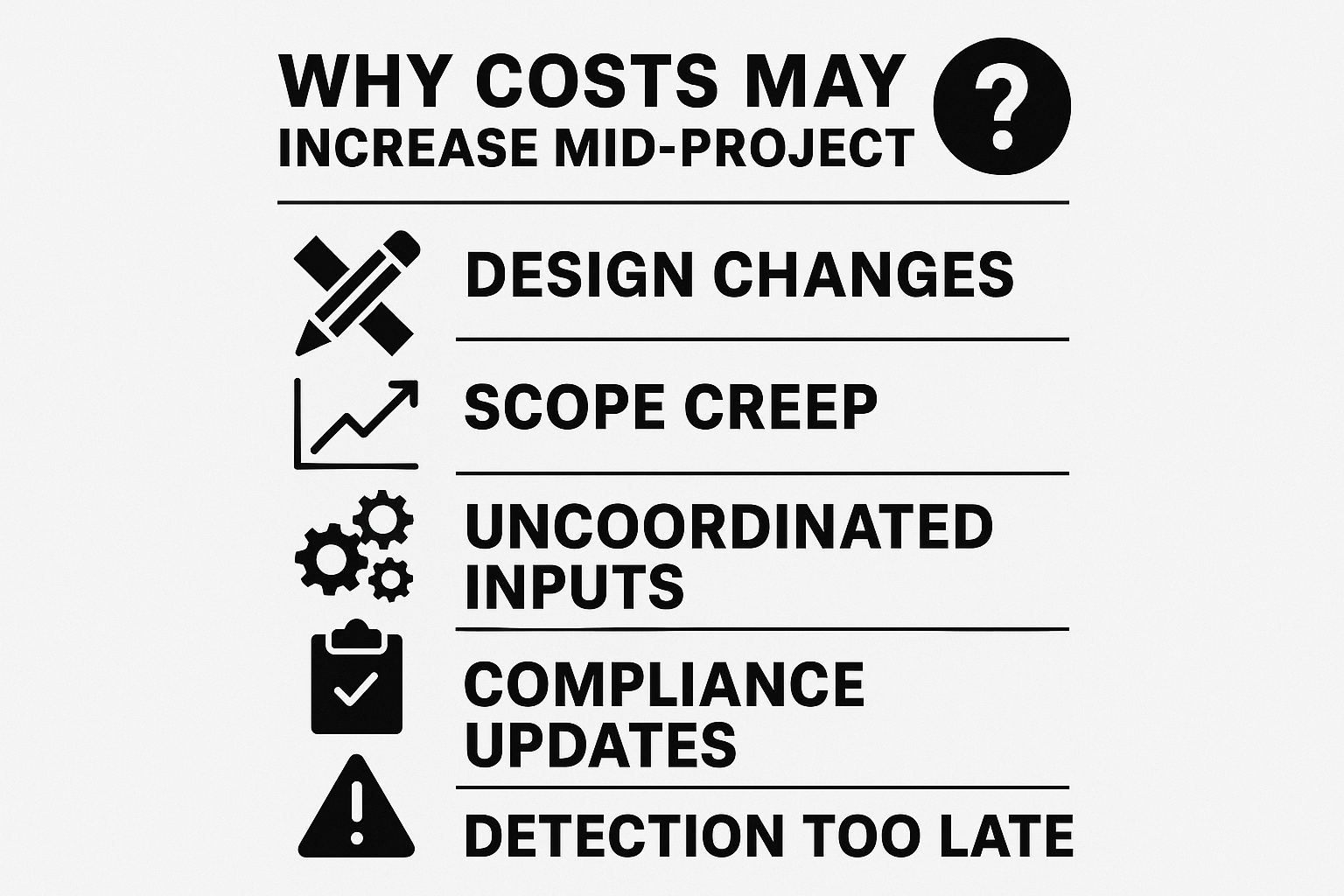
Even with a well-scoped BIM job, numbers can drift. Sometimes it’s inevitable, sometimes it’s preventable – but in either case, it’s better to know what tends to trigger price jumps so you’re not caught off guard.
- Late design changes from architects or clients: Moving a shaft or reworking room layouts mid-stream means redrawing ducts, shifting cable runs, and rerouting pipes. Every change has a downstream cost.
- Scope creep without a change order: Adding new systems (e.g., fire suppression, solar panels) after modeling has started means more hours – even if it sounds “minor.”
- Uncoordinated inputs from other consultants: If structural or architectural teams are running behind or working off outdated models, the MEP team ends up compensating. That slows progress and adds billable time.
- Compliance updates or overlooked code requirements: Realizing mid-way that your HVAC design doesn’t meet local code? That fix often means model revisions and possible equipment changes.
- Clash detection too late in the game: If coordination isn’t done early, resolving conflicts between systems after LOD 300+ modeling has started can turn into a rework loop.
- Compressed delivery schedules: If the timeline gets cut halfway through the job, the team may need to work overtime or split tasks between more people – both of which cost more.
- Missing or unclear initial inputs: Incomplete drawings, missing equipment specs, or vague design intent always result in back-and-forth later – and that burns time fast.
Most overruns aren’t caused by bad work – they’re caused by shifting targets. The more solid the inputs and timeline are at kickoff, the better the chance the budget stays where you expect it.
What to Share If You Want a Realistic BIM Quote
If you’re reaching out for pricing on MEP BIM drafting, the quote will only be as accurate as the information you provide. A vague “how much for modeling?” won’t cut it. What most teams need is a clear scope. That means square footage, system breakdowns (mechanical, electrical, plumbing – and whether they include things like fire protection or med gas), the level of detail expected, and any deadlines that are already locked in. If you know the LOD target, that helps. If not, say how the model will be used – for coordination only, for shop drawings, or for fabrication.
It also helps to flag any special conditions. Are you working with point cloud scans? Is there a structural model already in place? Will the MEP work need to be clash-free with architectural geometry? These details aren’t nice-to-haves – they directly affect the workload, the tools involved, and the number of hours needed. The more upfront clarity you can provide, the less room there is for price creep later on.
Conclusion
There’s no fixed price tag when it comes to MEP BIM drafting – and that’s a good thing. Every project comes with its own shape, scope, and surprises. What matters more than finding the cheapest rate is getting a quote that actually reflects your needs. If your systems are coordinated early, your inputs are clean, and your expectations are aligned with the deliverables, the price tends to stay stable. It’s when scope drifts or decisions get made late that things go sideways.
So before you ask, “What’s the cost per square foot?”, think bigger. What do you need that model to do – and who’s going to be relying on it? If it’s just for layout, that’s one thing. If it’s feeding prefab or guiding install teams, that’s another level entirely. The more you clarify that up front, the easier it’ll be to land on a number that makes sense – and stick to it.
FAQ
1. Is MEP BIM always more expensive than traditional drafting?
Not always. Upfront, it can look that way, especially when you factor in coordination and model development. But when you consider the downstream impact – fewer clashes, fewer RFIs, smoother installs – BIM often ends up saving money overall.
2. What does LOD mean, and why does it affect the cost so much?
LOD stands for Level of Development. It defines how detailed and accurate your model needs to be. The higher the LOD, the more time it takes to model each component. LOD 200 might be enough for early planning. LOD 400 means you’re ready to fabricate or install – and that takes more work.
3. Can I reduce the price by handling part of the modeling in-house?
Yes, but only if your team has the right tools and workflows in place. In some cases, hybrid setups work well – internal teams handle basic layout, and external BIM partners take over coordination and detailing. Just be sure handoffs are clean, or you’ll pay for rework.
4. Why do some quotes include clash detection and others don’t?
Because not all MEP modeling is created equal. Some providers just deliver standalone models – no integration with structural or architectural files. Others fold coordination into the process. Always check what’s actually included in the price.
5. How do I avoid surprise charges mid-project?
Get specific during scoping. Ask what happens if designs change, how many revisions are included, and whether the quote covers coordination or just drafting. Surprises usually happen when those terms aren’t locked in early.
Our Case Studies
We have handled 200+ BIM & VDC projects for commercial, industrial, and residential sectors.
Our work includes:
Formwork design automation
Our client from
California, USA
Suspended ceiling design automation
Our client from
New York, USA
Wall framing design automation
Our client from
California, USA